Buyer Fit Snapshot
| Best fit | Poly Mailers for Fashion Brands projects where brand print, material claims, artwork control, MOQ, and repeat-order consistency need to be specified before quoting. |
|---|---|
| Quote inputs | Share finished size, material target, print colors, finish, packing count, annual reorder estimate, ship-to region, and any compliance wording. |
| Proofing check | Approve dieline scale, logo placement, barcode or warning zones, color tolerance, closure strength, and carton packing before bulk production. |
| Main risk | Vague material claims, crowded artwork, missing packing details, or unclear freight terms can make a low unit price expensive after revisions. |
Fast answer: Poly Mailers for Fashion Brands: Film, Print, MOQ, and Carton Packing should be specified like a repeatable production item. The safest quote records material, print method, finish, artwork proof, packing count, and reorder notes in one written spec.
Production checks before approval
Compare the actual filled-product size with the drawing, then confirm tolerance on folds, seals, hang holes, label areas, and retail display edges. Reserve space for logos, QR codes, warning copy, and material claims before decorative graphics fill the panel.
Quote comparison points
Review material grade, print process, finish, sampling route, tooling charges, carton quantity, and freight assumptions side by side. A quote is only useful when the supplier can repeat the same color, closure quality, and packing count on the next order.
Poly mailers for fashion brands do a very specific job well: they protect soft goods, keep parcel weight down, and still leave room for a polished brand moment at the doorstep. That mix matters. A package can be cheap, or it can look good, or it can move fast through fulfillment. Good poly mailers for fashion brands do all three without turning every order into a carton-and-tape wrestling match.
Not every apparel item belongs in the same shipper. A lightweight tee, a structured jacket, a stack of socks, and a swim set all behave differently once they are folded, stacked, and sent through a warehouse. Packaging should follow the product, not the other way around. Start with the garment, then work outward from fold size, finish, print needs, and the way your team actually packs orders. If you want to compare formats, the Custom Packaging Products page shows how mailers fit into a broader packaging lineup, while the Custom Poly Mailers page gives a closer look at custom runs in real use.
From a buyer's point of view, the appeal is practical. Poly mailers for fashion brands can speed up pack-out, shrink wasted space, and make the opening experience feel tidy instead of oversized. That matters in DTC apparel, where the customer sees the packaging before they touch the product. A mailer that lands flat, clean, and consistent quietly does more brand work than most teams like to admit.
I have watched brands go from oversized cartons to mailers and immediately shave time off every pack station. Not because the staff got magically faster. Because the process stopped fighting them.
Poly Mailers for Fashion Brands: What They Are and Why They Matter
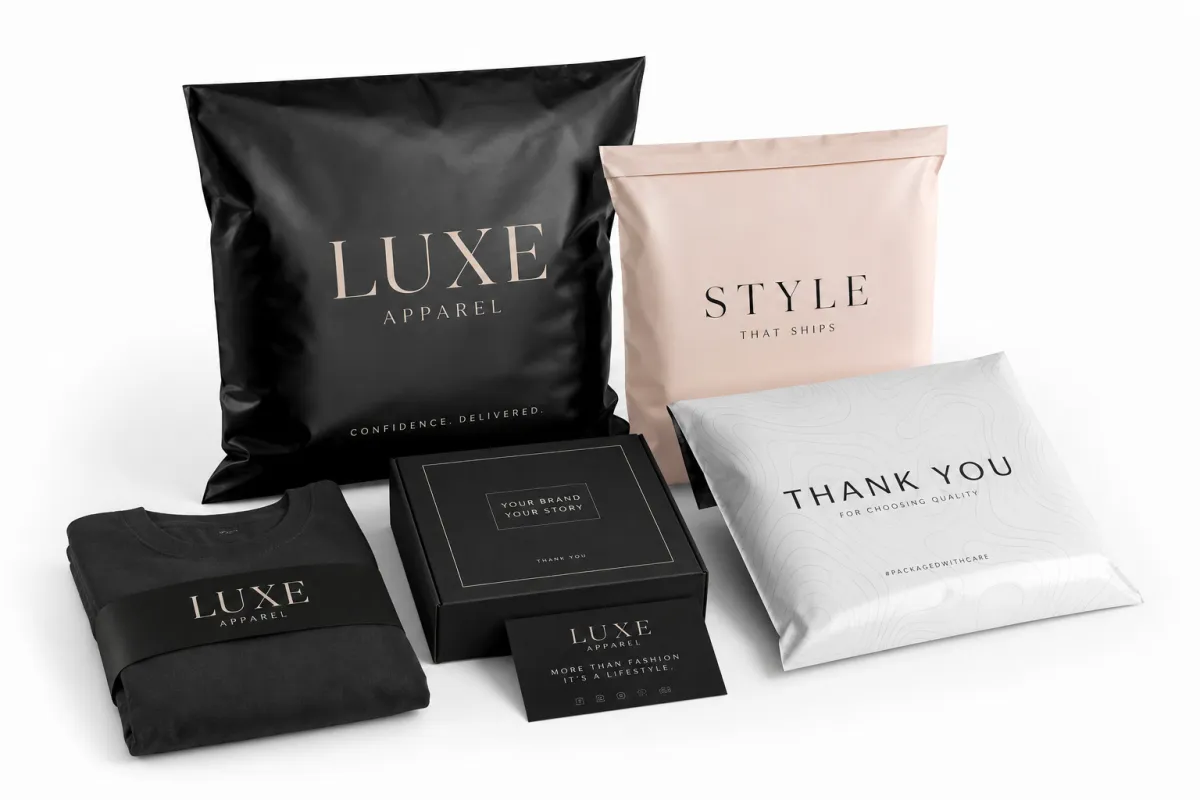
At the most basic level, poly mailers for fashion brands are lightweight shipping envelopes made from polyethylene film, usually with a peel-and-seal adhesive closure and a release liner you remove before sealing. They are built for folded garments, soft accessories, and other items that do not need corrugated walls. Nothing glamorous here. Just a sensible shipping format that keeps products clean, keeps pack-out moving, and keeps the parcel compact.
The money side is where the choice gets real. Package size affects dimensional weight, and dimensional weight is one of those hidden shipping costs that quietly punishes sloppy packaging. A box that is larger than the contents forces you to pay for empty space. Poly mailers for fashion brands cut that waste because the package flexes around the product instead of demanding air around it.
That is why they show up constantly in DTC apparel, athleisure, basics, socks, leggings, tees, knitwear, and swimwear. Those products fold flat. They do not need crush protection. They do need to arrive looking clean, and that is where poly mailers for fashion brands earn their keep. They keep the exterior consistent while reducing the number of materials a packer has to juggle.
Operationally, the logic is plain. Fewer steps at the station usually means more orders out the door without adding labor. No carton assembly. No void fill. No wrestling with box flaps. Poly mailers for fashion brands simplify the line, and that simplicity is part of why they are so common. They also store well, which matters if your back room is already crowded with cartons, inserts, labels, and seasonal inventory.
Best fit examples usually include:
- Light tees and tanks folded to a repeatable footprint.
- Socks, hats, scarves, and other soft accessories.
- Leggings, joggers, and similar knit apparel.
- Swimwear, intimates, and other small soft goods.
- Flat multi-item orders that do not need structural support.
They are not the answer for everything. Structured blazers, shoes, gift sets with rigid inserts, and products with hard edges usually deserve a box or a stronger hybrid format. Still, for a large share of apparel shipping, poly mailers for fashion brands hit the sweet spot between cost, speed, and presentation.
A simple test helps. Ask whether the item needs shape protection or mostly needs enclosure and cleanliness. If shape protection is not the main issue, poly mailers for fashion brands are usually the efficient choice.
How Poly Mailers for Fashion Brands Work in Fulfillment
The normal pack flow is straightforward, and that is a big reason these mailers work. The garment gets folded to a repeatable size, wrapped or bagged if needed, dropped into the mailer, sealed, labeled, and routed into shipping. No extra walls to assemble. No void fill to guess at. No carton tape ritual. In most operations, the process is easy to train and easy to repeat.
Poly mailers for fashion brands hold up because the film bends with the contents without feeling flimsy. That balance matters in sortation and last-mile delivery, where the package gets handled, stacked, nudged, and carried around by people and machines that do not care about your brand guidelines. A film that resists light rain, warehouse dust, and everyday scuffing is usually enough for apparel. The package does not need to survive a car crash. It needs to arrive intact, clean, and presentable.
Branding also matters more than some teams want to admit. A plain mailer does the job, but a custom-printed exterior starts the brand experience before the customer opens the package. Matte finishes read modern and premium. Glossy finishes feel louder and more promotional. Poly mailers for fashion brands can carry a full-color print, a simple logo, or a stripped-down mark that keeps the design understated. The right choice depends on the product and the customer, not whatever looked trendy in a deck last quarter.
Common fulfillment benefits include:
- Faster pack-out because there is less assembly work.
- Lower storage burden compared with bulky carton inventory.
- Less void fill and fewer accessory materials to manage.
- Cleaner shelves and simpler pack station organization.
- Better alignment with high-volume apparel workflows.
Fit changes the whole feel of the package. Sized well, poly mailers for fashion brands make the order look intentional. The garment sits flat instead of drifting around in extra space, and the customer gets a parcel that feels thought through. That does not require expensive packaging. It requires the right dimensions, a clean fold, and a seal that stays put.
For brands that want more examples of packaging decisions in actual operations, the Case Studies section is useful because packaging gets easier to evaluate once it is tied to throughput, damage rates, and order mix.
“The quickest packaging win is usually the one that removes friction from the pack team and still looks sharp at the doorstep. Good mailers do that.”
Poly mailers for fashion brands often win because they calm the process down. That sounds small. It is not. Calmer workflows tend to be more accurate, and accuracy is what keeps rework and customer complaints from piling up.
Key Factors to Compare Before Choosing a Mailer
Choosing poly mailers for fashion brands is less about grabbing the cheapest bag and more about matching the package to the product, the shipping lane, and the brand promise. A mailer can look fine in a sample photo and still fail once it meets real folding variation, a heavier insert, or a rougher shipping network. Comparison needs to start with practical specs, not artwork alone.
Size and fit
Size comes first. The bag should match the folded dimensions of your average order, not the biggest item you ever ship. Too large, and the garment slides around while the package starts to look underfilled. Too small, and packers spend extra time forcing product into place, which slows the line and can create wrinkles or seam stress. Poly mailers for fashion brands work best with a snug fit and a little room, not a lot of room.
Film thickness and durability
Thickness is usually measured in mils, and the right range depends on the weight and profile of the contents. Apparel mailers often land somewhere around 2.5 mil to 4 mil, though the right choice should reflect edge profile and transit conditions. Thicker film usually improves puncture resistance, but it can also raise cost and change the hand feel of the package. Soft basics may be fine with a lighter gauge. Hoodies, denim, or items with zippers and hardware often deserve a stronger film.
Closure performance
The adhesive strip matters more than many teams expect. A weak seal can pop in transit or leave the package easier to tamper with. A good pressure-sensitive closure should grip cleanly, seal quickly, and hold through handling without tape reinforcement. Poly mailers for fashion brands should also let the packer close the bag in one motion, because any extra step becomes expensive when repeated thousands of times a week.
Print quality and finish
Branded printing turns the mailer into a customer-facing surface, so the finish belongs in the decision. Ink density, registration, color consistency, and film finish all shape the final look. A crisp one-color logo on a matte white mailer can feel more polished than a busy multicolor design on a flimsy bag. Poly mailers for fashion brands do not need to shout. They need to look deliberate.
Sustainability claims
Accuracy matters here. Recycled content, recyclability, and compostability are not the same thing, and the claim has to match the material structure and the local disposal path. If you are using recycled-content claims, spell out the percentage and confirm the supplier can document it. If you say the mailer is recyclable, check local acceptance rules. The EPA recycling guidance is a useful starting point for understanding how packaging is handled in wider waste systems.
Testing should not stop at the sample table. Many teams use standards from organizations such as ISTA along with internal drop and compression tests to see how packaging behaves in motion, not just under fluorescent lights. That becomes especially useful when poly mailers for fashion brands are being introduced for a new garment type or a different shipping lane.
From a buyer's point of view, the practical checklist is short:
- Does the size fit the actual folded order?
- Does the film protect against puncture and scuffing?
- Does the closure hold without extra tape?
- Does the print match the brand standard?
- Does the sustainability claim stand up to scrutiny?
That list looks basic because it is. Basic is usually the winning strategy here. The Best Poly Mailers for fashion brands are the ones that work in production and still arrive looking intentional.
Poly Mailers for Fashion Brands: Cost and Pricing Basics
Pricing is where packaging decisions stop being abstract. Poly mailers for fashion brands can look cheap on the quote sheet, then turn expensive once freight, storage, minimum order quantities, artwork complexity, and postage effects show up. Unit price is only part of the story. Sometimes the more expensive mailer lowers total cost once shipping savings and labor savings are included.
The main drivers are easy to name: size, thickness, print coverage, material quality, and order volume. Plain stock mailers usually cost less per unit than custom printed versions, but the printed version can pay back through stronger brand recognition and fewer inserts. For a lot of smaller brands, the real choice is not whether branding matters. It is whether the branding belongs on the mailer, on an insert, or across both.
Here is a practical comparison that helps teams think through poly mailers for fashion brands:
| Option | Typical Unit Price | Strengths | Trade-Offs |
|---|---|---|---|
| Plain stock mailer | $0.08-$0.16 | Lowest entry cost, quick availability, simple replenishment | Limited branding, less distinction at delivery |
| Single-color custom printed mailer | $0.12-$0.24 | Better brand recognition, still efficient for volume runs | Requires artwork approval and setup time |
| Full-color custom printed mailer | $0.18-$0.38 | High visual impact, strong customer-facing presentation | Higher minimums, more proofing, more print control needed |
| Recycled-content branded mailer | $0.15-$0.32 | Supports sustainability positioning, good for current brand narratives | Must confirm actual content, sourcing, and claim language |
These ranges move around based on order size, film gauge, and print layout, but they are still useful for planning. Poly mailers for fashion brands become more economical at higher volumes because setup charges and freight get spread over more units. A 5,000-piece run may sit in one price band, while a 25,000-piece run can drop the per-unit cost enough to change the whole packaging decision.
Hidden costs are where brands get blindsided:
- Freight: bulky shipments can erase savings if the supplier is far away.
- Storage: large print runs need dry, organized space.
- MOQ pressure: the wrong minimum order can force excess inventory.
- Rework: wrong sizing creates waste and packing delays.
- Rush fees: late orders usually cost more than planned replenishment.
Postage matters too. A smaller, lighter mailer can lower shipping costs enough to offset a slightly higher packaging price. That is why poly mailers for fashion brands should be judged on landed cost, not just the line item on a quote. If the package trims enough weight or size to avoid a higher dimensional bracket, the savings can add up fast across a season.
Plainly put, the cheapest bag is not always the cheapest choice if it slows the line, causes damage, or makes the package look forgettable. The real question is whether poly mailers for fashion brands improve total shipment economics while still matching the brand standard.
Step-by-Step Process and Timeline for Ordering
Ordering poly mailers for fashion brands works best when the brand treats it like a small production project instead of a panic buy. A good sequence avoids surprises, and surprises are where waste, delays, and costly reorders start. The spec should come from your actual order profile, not from a guess that feels convenient.
Start with an order audit
Before you ask for quotes, review top SKUs, folded measurements, average parcel weights, insert usage, and return patterns. A brand that ships mostly tees has a very different packaging need than one shipping outerwear or multi-piece sets. Poly mailers for fashion brands become easier to spec once you know the real garment footprint. A few real folds in the warehouse will teach you more than a spreadsheet full of assumptions.
Request samples and test them with real product
Never approve a mailer from a flat sample alone. Put the actual folded garment inside, add tissue or a thank-you card if those are part of the pack, and see how the seal behaves after a few minutes of pressure. Check print clarity, opacity, puncture resistance, and label adhesion. If the package will go through thermal printing or a label applicator, make sure the surface accepts the label cleanly. Poly mailers for fashion brands can look perfect in isolation and still fail at speed, where the small flaws show up fast.
Build in proofing time
Custom packaging needs time because artwork, dielines, and color expectations all need to line up. Proofing can add days, and revisions can add more. If you want a sharp logo edge or a specific brand color, build that into the timeline early. Stock orders can move quickly, but poly mailers for fashion brands with custom print usually need room for artwork review, setup, production, and freight transit.
Typical timing often looks like this:
- Sampling: 3-7 business days if stock samples are ready.
- Artwork proofing: 2-5 business days, sometimes longer if revisions are needed.
- Production: roughly 10-20 business days for custom runs, depending on volume.
- Freight: a few days to a couple of weeks based on origin and mode.
Those are ranges, not hard rules. They are still useful when you are planning a launch or a replenishment cycle and do not want to get stuck waiting on packaging. Poly mailers for fashion brands usually move through the schedule more smoothly when approvals are quick and artwork is already clean.
One useful move is to launch in phases. Start with a core SKU group, maybe your best-selling tee or leggings line, and watch how the packaging behaves in packing, transit, and customer feedback. If the mailer is doing its job, expand from there. If something feels off, adjust before you commit to a larger volume. That is a lot better than discovering a fit issue after thousands of units are already packed.
For a packaging order tied to a brand refresh, line up packaging, labels, inserts, and outer presentation together. The more coordinated those elements are, the more naturally poly mailers for fashion brands support the overall experience.
Common Mistakes Fashion Brands Make with Poly Mailers
Most packaging mistakes are not dramatic. They are small decisions that stack up. A mailer may seem fine on its own, then the flaws show up at volume in labor, damage, or presentation. Poly mailers for fashion brands are especially sensitive to this because they rely on fit and consistency more than rigid packaging does.
Picking the wrong size
The most common error is choosing a bag that is too large. It feels safer during sourcing, but in production it leads to loose packages, higher dimensional weight, and a weaker unboxing impression. The order can also shift enough in transit to show corner wear or a wrinkled exterior. Poly mailers for fashion brands should be sized against real folded dimensions, not a rough estimate of what might fit.
Under-specifying the film
Another mistake is using film that is too thin for the item profile. Zippers, rivets, buttons, and sharp trim can punch through a light bag during sorting, especially if the order gets tossed around or dropped on an edge. The material should match the product, not just the budget. A slightly stronger film can save more than it costs if it reduces damage claims.
Treating branding as decoration only
Some brands treat the print like a bonus and end up with a design that feels disconnected from the product inside. A low-resolution logo, weak contrast, or awkward placement can make the package feel cheaper than the apparel. Poly mailers for fashion brands should support the brand story, not fight it. If the clothing line is minimal and modern, the mailer should probably feel minimal and modern too.
Ignoring the warehouse workflow
A mailer can be attractive and still be wrong for the line. If it jams on a sealing station, sticks together in humid storage, or creates label adhesion problems, labor cost goes up immediately. Teams sometimes focus on the customer-facing side and forget the packing station reality. In practice, poly mailers for fashion brands have to work for the pack team before they can work for the customer.
Overstating sustainability or protection
This one matters because customers and regulators both notice. If a mailer is recyclable only in limited streams, say that clearly. If it contains recycled content, state the percentage and make sure your supplier can document it. If the packaging protects against light moisture but not full submersion, do not imply otherwise. Honest claims build trust, and trust matters more than polished wording. Poly mailers for fashion brands should never be positioned as something they are not.
Brands that avoid these mistakes usually see better results fast: fewer packing headaches, more consistent presentation, and less friction after delivery. That is the practical payoff of getting poly mailers for fashion brands right the first time.
Expert Tips and Next Steps for Better Packaging
The best place to start is your most common shipment, not your weirdest one. If 70% of your orders are tees or leggings, spec the mailer around that case first. Then expand only when actual data says you need another size. Poly mailers for fashion brands get much easier to manage when the SKU range stays disciplined instead of sprawling in every direction.
Consistency helps more than most people think. Use one fold method, one insert placement, one seal motion, and one inspection point at the end of the pack. That kind of standard work reduces variation, and variation is what makes parcels look sloppy. A tight process also makes training easier when seasonal staff or temporary help comes in. I have seen a shop cut their pack errors almost immediately just by making the folding rule non-negotiable. Pretty boring. Pretty effective.
A practical packaging checklist for apparel teams usually includes:
- Mailer size matched to the average folded SKU.
- Film thickness matched to product edges and parcel conditions.
- Closure tested for hold strength and tamper resistance.
- Print finish reviewed under warehouse lighting, not just on screen.
- Label placement checked for adhesion and scanability.
- Transit performance reviewed against damage claims and returns.
Track the results after launch. Do you see fewer crushed corners, lower postage, faster pack times, or fewer customer complaints? Those signals tell you whether the packaging is actually doing its job. Poly mailers for fashion brands should be measured like any other production tool. If the numbers improve, keep the spec. If they do not, adjust it.
It also helps to think beyond the first purchase. A good supplier relationship should leave room for new sizes, updated artwork, seasonal runs, and different film structures if your product mix changes. Fashion brands move fast. Packaging has to keep up. A clear spec, a documented sample approval, and a repeatable replenishment plan save time later.
If your team wants to compare other formats too, the same planning logic applies across boxes, mailers, inserts, and branded wrapping. The goal is not to make every package look busy. The goal is to make the packaging support the product with as little waste as possible. Poly mailers for fashion brands do that well when the spec comes from real order data.
Good packaging usually is not the loudest thing in the room. It is the package that fits, protects, speeds up the line, and still makes the customer feel that someone paid attention. That is why poly mailers for fashion brands stay such a practical choice for apparel sellers who care about cost and presentation.
Frequently Asked Questions
What size poly mailers are best for fashion brands shipping tees and light apparel?
Choose a mailer that fits the folded garment with only a small amount of extra space, so the item stays flat and looks intentional on arrival. For tees and light basics, test the bag with the actual folded stack, any tissue, and any insert you plan to use in production. Oversizing is a common mistake because it makes the package look sloppy and can increase postage.
Are poly mailers for fashion brands better than boxes for clothing?
For soft goods that do not need rigid protection, poly mailers for fashion brands are usually lighter, cheaper, and faster to pack than boxes. Boxes still make sense for premium bundles, structured garments, gift sets, or items that need crush resistance. The best choice depends on the product shape, shipping method, and the customer experience you want to create.
How thick should poly mailers be for apparel shipments?
The right thickness depends on the garment type, the presence of sharp trims or hardware, and how rough your parcel network tends to be. Heavier or sharper items usually need a stronger film to reduce punctures and tearing in transit. Ask for sample specs and test them with real products instead of choosing by thickness alone.
Can small fashion brands afford custom printed poly mailers?
Yes, but the economics depend on order quantity, print coverage, and whether the branding is simple or full-color. Small brands often start with a modest printed design or a stock mailer plus a branded insert to keep cost under control. Compare the unit price against the marketing value of a package that reinforces brand recognition at delivery.
How long does it take to order custom poly mailers for a fashion brand?
Stock mailers can move quickly, while Custom Printed Mailers take longer because of artwork approval, production, and freight. Build time into your launch calendar for sampling, proofing, and any revisions before the final run. If you need a seasonal rollout, plan the packaging order early so it does not become the bottleneck.
If you are tightening your packaging program, poly mailers for fashion brands are a strong place to start because they can improve cost, speed, and presentation without making fulfillment more complicated. The best results come from matching the mailer to the actual garment, testing it with real orders, and choosing a spec your team can repeat reliably at scale. Do that, and the packaging stops being a headache. It just works.


