Buyer Fit Snapshot
| Best fit | Poly Mailers for Small Brands projects where brand print, material claims, artwork control, MOQ, and repeat-order consistency need to be specified before quoting. |
|---|---|
| Quote inputs | Share finished size, material target, print colors, finish, packing count, annual reorder estimate, ship-to region, and any compliance wording. |
| Proofing check | Approve dieline scale, logo placement, barcode or warning zones, color tolerance, closure strength, and carton packing before bulk production. |
| Main risk | Vague material claims, crowded artwork, missing packing details, or unclear freight terms can make a low unit price expensive after revisions. |
Fast answer: Poly Mailers for Small Brands: Film, Print, MOQ, and Carton Packing should be specified like a repeatable production item. The safest quote records material, print method, finish, artwork proof, packing count, and reorder notes in one written spec.
Production checks before approval
Compare the actual filled-product size with the drawing, then confirm tolerance on folds, seals, hang holes, label areas, and retail display edges. Reserve space for logos, QR codes, warning copy, and material claims before decorative graphics fill the panel.
Quote comparison points
Review material grade, print process, finish, sampling route, tooling charges, carton quantity, and freight assumptions side by side. A quote is only useful when the supplier can repeat the same color, closure quality, and packing count on the next order.
Poly Mailers for Small Brands: Practical Buying Guide
Poly mailers for small brands sound boring until a dented box, a postage jump, or a messy unboxing starts cutting into margin. Then they stop being boring real fast. A good mailer trims shipping weight, speeds up packing, and makes a lean brand look like somebody paid attention.
That is the actual appeal. For a lot of shops, poly mailers for small brands solve three headaches at once: lower shipping weight, less packing labor, and a cleaner first impression. If you are sorting out broader packaging pieces too, see our Custom Packaging Products and our Case Studies for examples of how different formats support different product lines.
Still, I would not treat poly mailers for small brands like magic. They work well for soft goods, flat items, and products that do not need hard crush protection. They are a poor fit for sharp corners, breakables, or anything that punishes a thin outer shell. The point is simple: pick a mailer that protects the order, keeps packing efficient, and fits the budget without pretending the cheapest option always wins.
Poly Mailers for Small Brands: What They Solve Fast
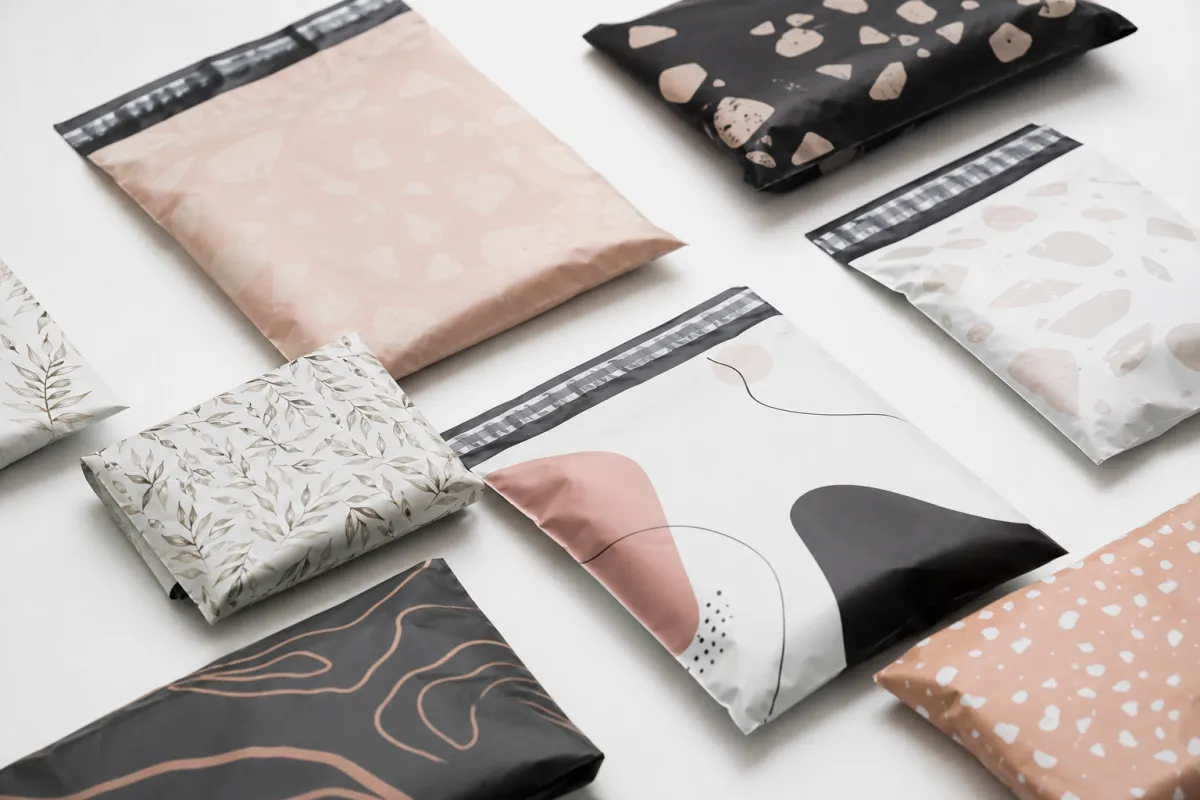
For many shops, poly mailers for small brands do more than move a product from one address to another. They shape shipping cost, pack-out speed, and presentation in one shot. That is why apparel brands, accessory labels, sticker sellers, beauty sample programs, and folded textile brands keep coming back to them.
In plain terms, a poly mailer is a lightweight plastic shipping bag built for items that do not need a box. Most are made from polyethylene film, which gives you a flexible outer layer, a self-seal adhesive strip, and enough toughness to handle normal parcel abuse. The format works best for folded garments, soft accessories, magazines, prints, and compact orders that stay flat. If you are shipping a sweatshirt in a rigid carton, ask yourself why you are paying to move air.
The business case is straightforward. Poly mailers for small brands usually reduce dimensional weight, which matters because carriers charge on size as well as actual weight. They also lower material cost and save packing time. A box may look more premium in some categories, but boxes take more storage space, more assembly time, and often more postage. For a small team, those minutes pile up fast.
"The cheapest mailer is usually the one that does not trigger a replacement shipment."
That line sounds blunt because it is. I have watched brands chase a penny-level savings on packaging and then spend far more on reships, customer service, and damaged goods. Poly mailers for small brands make sense when they protect the product, keep the workflow tidy, and still leave room for brand presentation. They are not right for every item, and that is fine. Good packaging is about fit, not ego.
There is also a familiar setup for newer sellers. The order starts with a T-shirt, an accessory, a sample pack, or a folded textile. It does not justify a box every time, but it still needs to arrive clean and intact. That is why poly mailers for small brands are so hard to beat. Add tissue, a label, or a simple printed insert if you want the unboxing to feel intentional without piling on cost.
For brands still figuring out their packaging stack, I usually start with the product and the shipping path, not the decoration. Ask what gets scuffed, what gets crushed, what gets returned, and what customers actually photograph. That gives you a better answer than "what looks fancy on a supplier page."
How Poly Mailers for Small Brands Work in Shipping
Most poly mailers for small brands use a simple structure: a film body, a sealed edge, and an adhesive strip. Better versions add tear strips, gussets, dual adhesive closures, or bubble lining. The format is basic, but the details matter. A mailer that loads quickly and seals cleanly is worth more than a prettier one that fights your packing team all day.
Here is the shipping workflow in real terms. The product goes into the mailer, excess air gets pushed out, the adhesive strip closes, and the parcel moves through sorting with less bulk than a box. Less bulk often means a better shot at staying under the next dimensional weight tier. That is where poly mailers for small brands quietly save money. The package is still a parcel, but it behaves more like a flexible shipment than a rigid one.
There is a difference between a standard poly mailer and a padded mailer. A standard mailer is usually best for soft, light, or flat goods that do not need cushioning. A padded version adds a layer of bubble or paper-based padding for extra protection. If your item has edges, pressure points, or a tendency to crease, a padded option may be the smarter call even if it costs more per unit. Cheap and wrong is not a bargain.
Branding matters too. Poly mailers for small brands can be plain, stock-colored, or custom printed. A small brand does not need full-coverage graphics to look intentional. Sometimes a strong color, a clean logo placement, and a solid label system are enough. If the package shows up on social media often, pay more attention to the front panel people actually see. There is no prize for printing the side gusset beautifully.
For standards-minded buyers, package testing is worth the time. The ISTA test family is a useful reference if you want to compare how packaging holds up under drop and vibration conditions. You do not need a full lab program to think this way. Even a simple "real pack, real ship, real damage check" routine beats guessing.
Moisture deserves a mention too. Poly film handles light rain, sorting-room grime, and the usual transit scuffs better than most people expect. That does not make the mailer waterproof, and it does not replace inner protection for delicate items. Poly mailers for small brands are good at defending the outside of the order. They are not a force field.
Key Factors When Choosing Poly Mailers for Small Brands
The first decision is size. Poly mailers for small brands should be chosen around the finished packed order, not the raw product dimensions. A folded hoodie, for example, may look manageable on paper and still pack badly if you ignore hang tags, tissue, inserts, or the way the seams sit. Too small, and the mailer bulges or splits. Too large, and the order shifts around and looks sloppy.
Thickness matters too. Most everyday mailers for apparel land somewhere around 2.5 to 3 mil for standard use, while heavier or more handling-sensitive orders may benefit from 3.5 to 4 mil or more. Thicker film usually resists tears better, but there is no medal for going overboard. Poly mailers for small brands should be thick enough to survive sorting and delivery, not so thick that you pay extra for strength you do not use.
Then there is the branding choice. Plain stock mailers are inexpensive and quick. Colored stock mailers feel more intentional. Custom Printed Mailers can turn a bland shipment into a stronger brand touchpoint. The catch is that the custom route usually needs more cash tied up in inventory and more confidence in your visual identity. If your packaging changes every few months, full custom print may be premature. I have seen too many brands lock themselves into a giant run before they even know which products actually sell.
Fit to product matters more than style. Poly mailers for small brands work well for folded garments, books, soft accessories, prints, and sampler kits. Hard items with corners can punch through thin film unless you add inner wrap or choose a cushioned format. A rigid object in a soft sleeve is asking for trouble unless the sleeve is reinforced and the item is protected inside.
Security is another practical detail that gets treated like a sales bullet point when it should be treated like a packing issue. Strong adhesive, clear tamper evidence, and decent tear resistance reduce failed seals and customer complaints. If a bag opens halfway through transit, the branding on the front is irrelevant. So is the pretty color.
Operational fit matters more than most founders expect. Poly mailers for small brands should load quickly, seal consistently, and store efficiently. If the bag is awkward to open, hard to flatten, or sticky in the wrong places, your packout slows down. That becomes labor cost, and labor cost is where a "cheap" mailer starts to look expensive.
- Size: Test the packed product, not just the item alone.
- Film: Match thickness to handling risk and product shape.
- Branding: Choose the lightest branding level that still feels intentional.
- Workflow: Make sure the mailer is easy to load, seal, and stack.
- Protection: Add inner wrapping if the product has sharp edges or scuffs easily.
If you want a broader view of the formats around this choice, our Custom Poly Mailers page is a useful reference point for the options brands usually compare. The point is not to pick the fanciest version. The point is to choose the one that does the job without pretending every shipment needs a parade.
Poly Mailers for Small Brands: Cost, Pricing, and Order Math
Poly mailers for small brands are usually bought on a simple equation: unit price, minimum order quantity, and the cost impact of shipping performance. That sounds dry, but the math protects your margin. A mailer that costs a little more but reduces damage and postage can be the better buy. A cheap mailer that forces you into a box, adds packing time, or causes re-shipments is not cheap at all.
The main pricing drivers are size, thickness, print complexity, material type, and quantity. Stock plain mailers often sit in the lowest range, especially at 1,000 to 5,000 pieces. In bulk, a plain mailer might land around $0.05 to $0.14 per unit, while stock-colored versions can run a bit higher. Custom printed poly mailers for small brands often move into the $0.15 to $0.45 range depending on coverage, ink count, and order size. Bubble-lined options usually cost more because the material stack is heavier and more labor-intensive.
Here is the part many founders miss: the cheapest mailer quote does not automatically create the cheapest shipment. If your orders are often borderline on size, a flimsy mailer can force you into a more expensive packaging format or trigger replacement shipments from damage. That means the real cost is not the unit price on the invoice. The real cost is the unit price plus the postage effect plus the damage rate. Poly mailers for small brands should be judged on total landed packaging cost, not just the bag itself.
| Option | Typical bulk price | Best for | Main tradeoff |
|---|---|---|---|
| Plain stock poly mailer | $0.05-$0.14 each | Early-stage apparel, low-branding needs, fast packing | Least distinctive on arrival |
| Colored stock poly mailer | $0.08-$0.18 each | Brands that want a cleaner look without custom print | Color choices may be limited |
| Custom printed poly mailer | $0.15-$0.45 each | Established brands, social-first packaging, repeat buyers | Higher MOQ and more cash tied up |
| Bubble-lined mailer | $0.20-$0.60 each | Items needing cushioning or added surface protection | Higher material cost and more bulk |
Short-run buying and bulk buying each have a place. Smaller runs reduce inventory risk, which matters if your design is still changing or you are testing a new product. Larger runs reduce unit cost, which matters if you already know the item sells steadily. Poly mailers for small brands usually make sense as a staged purchase: test in a smaller volume, then move up once the packout, damage rate, and repeat order pattern are clear.
There are hidden overspend traps too. Oversized mailers are common because they feel safer. They are not always safer. Extra room can make the order shift, wrinkle, or arrive looking careless. Fancy full-color print can be overkill before the brand has settled on a stable identity. Premium finishes can look good, but if customers never notice them and the product ships quietly, the money may be better spent on sturdier construction. Poly mailers for small brands should earn their keep.
Rule of thumb: spend more when the package is handled often, photographed often, or likely to cause complaints if it looks cheap. Save money when the order is simple, light, and unlikely to be scrutinized beyond the front door. That is not a glamorous answer. It is the answer that protects margin.
For brands balancing packaging types, a useful check is to compare the mailer quote against the shipped order weight, the dimensional size, and the expected return risk. Basic buying discipline. Nothing flashy. Just the kind of thinking that keeps packaging from eating the profit on a healthy product.
Step-by-Step Timeline for Ordering Poly Mailers
Good ordering starts with measurement. Poly mailers for small brands should not be ordered from guesswork or from product photos on a supplier page. Measure the packed product. That means folded size, insert thickness, closure depth, and any labels or cards that live inside the shipment. Then test a few samples in the real packing workflow, because hand-holding a mailer is not the same thing as sealing thirty of them in a row.
The next step is supplier data. Ask for dimensions, film thickness, adhesive type, print area, minimum order quantity, and whether the price changes at 1,000, 3,000, or 5,000 pieces. If you need custom artwork, ask what file format they want and whether the art needs a bleed. This is where poly mailers for small brands either stay simple or turn into a revision cycle. A clear spec sheet saves time and avoids mistakes.
Sampling matters more than people think. Request samples and use them as working units. Load the product. Seal the bag. Shake it a little. Stack it with other outbound orders. If the bag scuffs easily or the adhesive struggles after one close, that is useful information. poly mailers for small brands are packaging, not decoration, so they need a real-world test. The EPA has general guidance on recycling categories and local program variation at EPA recycling guidance, which is a decent reminder that disposal and local acceptance are not always the same thing.
Artwork approval should happen after the practical details are locked down, not before. Check logo placement, margins, bleed, and whether the front panel or back panel gets the stronger branding. If you need secondary packaging support, make sure the graphics do not fight the rest of the system. A bag that looks elegant on a screen can still print badly if the contrast is weak or the logo sits too close to a seal line. That is the kind of mistake that makes reprints expensive and annoying.
Here is a realistic timeline for poly mailers for small brands:
- Measure packed product and gather specs: 1-2 days.
- Request samples and pricing: 2-5 days.
- Review samples in real packout: 2-4 days.
- Approve artwork and production proof: 1-3 days, longer if revisions are needed.
- Manufacture and finish the order: often 12-18 business days for custom work, sometimes faster for stock.
- Ship and receive the order: depends on lane and destination.
That timeline is not guaranteed, because production queues and shipping distance change. Still, it is a useful planning baseline. If your launch date is fixed, build buffer into the schedule. Poly mailers for small brands are easy to underestimate because they seem simple. Simple does not mean instant.
"Test the packout first, then approve the artwork. Reversing that order is how people pay twice."
One more practical step: run a small ship test before committing to the full order. Send five to ten units through the normal carrier route, then inspect them on arrival. Check the seal, scuffing, corner integrity, and the way the package lands with your customer. That tiny test can save a lot of embarrassment later.
Common Mistakes Small Brands Make With Poly Mailers
The first mistake is buying the wrong size and hoping the product compresses into submission. Poly mailers for small brands need a clean fit. If the bag is too tight, the closure fails or the package looks overstuffed. If it is too loose, the order shifts and arrives looking careless. Neither result helps the brand.
The second mistake is picking the thinnest film because the quote looks nice. Thin material can be fine for light, soft shipments, but it has less forgiveness under rough handling. Corners split. Seals fail. Edges poke through. That is why poly mailers for small brands should be tested with a real packed unit before any bulk buy. A quote sheet does not tell you how a driver's day will treat your shipment.
A third mistake is using a mailer for the wrong product class. Fragile goods, hard items, or anything that needs crush resistance usually belong in a cushioned format or a box. If you pack a rigid item in a plain bag without inner protection, damage becomes a matter of time. poly mailers for small brands are efficient, but they are not universal.
Another common error is overbranding too early. A founder gets excited, commits to a huge custom run, and then changes the logo, product line, or marketing direction three months later. Now there is a warehouse full of packaging that no longer matches the brand direction. That is not strategy. That is expensive storage.
Carrier and postage effects get ignored too often. A mailer can look cheap on paper and still push the shipment into a worse postage band if the packed size is awkward. Sometimes a slightly better-designed mailer saves more money than a cheaper one. poly mailers for small brands need to be evaluated like shipping tools, not just shopping items.
And yes, people skip test packs all the time. They assume the seal will hold, the bag will survive, and the customer will never notice a wrinkled shipment. Then the complaints start. If you are running a tight operation, avoid that nonsense by shipping samples to yourself or to a friendly test address before going live at scale.
The cleanest way to avoid these errors is to think in steps: measure, sample, test ship, and then order. That is not sexy. It is effective.
Expert Tips and Next Steps for Poly Mailers for Small Brands
If I had to reduce the decision to one principle, it would be this: choose the mailer around the real shipment, not around the brochure. poly mailers for small brands work best when the spec matches the product, the handling pattern, and the customer experience you actually want. Pick one hero product or one major order type first. Build from that. That is smarter than trying to guess for the entire catalog on day one.
For early-stage brands, a clean stock mailer plus a strong label or insert system is often the best starting point. You do not need custom print just to prove you are serious. You need clean packing, clear branding, and a package that survives transit. poly mailers for small brands can look polished without becoming expensive. A tidy stock-colored mailer and a crisp label can do more than a mediocre full-print design.
Keep a simple spec sheet for every approved version. Write down the dimensions, thickness, seal type, color code, and artwork version. Otherwise, reorders drift. Someone on the team buys the nearest-looking bag, the closure changes, or the color shifts slightly, and now the packaging no longer matches the original standard. poly mailers for small brands only stay consistent if somebody documents the actual decision.
Sample packs are worth the hassle. Compare three things side by side: pack speed, seal confidence, and shipping appearance. Those three measures tell you far more than a glossy mockup ever will. If you want a sense of how different packaging choices affect presentation and operations, our Case Studies are useful because they show the practical side, not just the polished front-end version.
Ask suppliers for quotes at two or three volume levels. That reveals where the price break actually begins. Sometimes the jump from 1,000 to 3,000 pieces is tiny. Sometimes it is meaningful. You should Know Before You place the order. poly mailers for small brands should be bought with eyes open, not by chasing the lowest single quote.
One useful sourcing habit is to compare a plain version, a lightly branded version, and a fully custom version before deciding. You may find that the middle option gives you the best mix of control and cost. That is common, and frankly, it is usually the grown-up answer. The most expensive packaging is not automatically the best packaging. The most visible packaging is not automatically the best packaging either.
If you are unsure about material choice, ask for samples made in more than one thickness and compare them with the actual packed product. A 2.5 mil bag may be enough for one line, while a 3.5 mil or bubble-lined option is the better fit for another. Brands often make the mistake of standardizing everything too early. Real product ranges usually deserve different specs.
Here is the short version: measure, test, quote, and then order the version that fits your product, budget, and timeline. That boring sequence is usually the smartest move. poly mailers for small brands are one of those purchases where discipline beats drama every time.
Frequently Asked Questions
What size poly mailer do small brands need for apparel?
Measure the folded garment after packing, not just the raw item size. Leave enough room for a clean seal without forcing the contents flat. If the item includes boxes, hang tags, or inserts, test one size up before ordering in bulk. That keeps poly mailers for small brands from arriving either too tight or awkwardly loose.
Are poly mailers cheaper than boxes for small brands?
Usually yes for soft goods, because they use less material and often reduce postage. They can become more expensive if the item needs extra protection or if damage rates rise. The cheapest packaging is the one that protects the product and still ships efficiently, which is why poly mailers for small brands often beat boxes on total cost for the right product type.
Can small brands use custom printed poly mailers without huge minimums?
Yes, but the per-unit price is usually higher at low quantities. Many suppliers offer short runs, stock-color options, or limited print customization. A smart first step is to compare stock mailers, printed labels, and full custom runs before locking in a big order of poly mailers for small brands.
How long does it take to get custom poly mailers?
Timeline depends on sample approval, artwork changes, production queue, and shipping distance. Stock mailers move faster than fully custom printed mailers. Build extra time if you need design revisions or want to test a sample before production, because poly mailers for small brands usually take longer once artwork and proofing are part of the job.
What thickness should poly mailers for small brands use?
Use enough thickness to resist tears, punctures, and sloppy handling during shipping. Lightweight apparel may not need the thickest option, but fragile edges or heavier items usually do. Test the mailer with a real packed order before committing to a bulk purchase, because poly mailers for small brands only make sense when they hold up in the real route.
For most brands, poly mailers for small brands should be judged by fit, seal strength, and postage impact first, then by print and color. Start with the product, not the pretty mockup. Test one or two sample options in real shipping, document the winner, and place the order only after the package survives the route you actually use. That is the cleanest way to keep packaging from quietly eating your margin.


