Buyer Fit Snapshot
| Best fit | Poly Mailers Manufacturer Direct projects where brand print, material claims, artwork control, MOQ, and repeat-order consistency need to be specified before quoting. |
|---|---|
| Quote inputs | Share finished size, material target, print colors, finish, packing count, annual reorder estimate, ship-to region, and any compliance wording. |
| Proofing check | Approve dieline scale, logo placement, barcode or warning zones, color tolerance, closure strength, and carton packing before bulk production. |
| Main risk | Vague material claims, crowded artwork, missing packing details, or unclear freight terms can make a low unit price expensive after revisions. |
Fast answer: Poly Mailers Manufacturer Direct: Costs, Timing, and Fit should be specified like a repeatable production item. The safest quote records material, print method, finish, artwork proof, packing count, and reorder notes in one written spec.
Production checks before approval
Compare the actual filled-product size with the drawing, then confirm tolerance on folds, seals, hang holes, label areas, and retail display edges. Reserve space for logos, QR codes, warning copy, and material claims before decorative graphics fill the panel.
Quote comparison points
Review material grade, print process, finish, sampling route, tooling charges, carton quantity, and freight assumptions side by side. A quote is only useful when the supplier can repeat the same color, closure quality, and packing count on the next order.
Poly Mailers Manufacturer Direct: Costs, Timing, and Fit
Working with a Poly Mailers Manufacturer direct supplier looks simple right up until the quote lands and the details start multiplying. Unit price matters. So do film build, seal strength, adhesive performance, print setup, freight, and the dozen small choices that decide whether the mailer behaves in a warehouse or falls apart in front of customers. A direct factory relationship can lower cost, but the real payoff is control. For brands that need packaging to stay consistent across repeat orders, Custom Poly Mailers bought through a direct factory setup can change the buying process in a good way.
That matters for e-commerce teams, subscription brands, and anyone who treats packaging failure as a support ticket waiting to happen. A poly mailers manufacturer direct arrangement gives you a clearer view into resin choice, thickness, adhesive strength, print quality, and schedule risk. It also strips away the fluff. Questions have to get sharper earlier. Annoying? Sure. Useful? Absolutely.
For procurement teams, the upside is plain: fewer middle layers, better spec discipline, and clearer responsibility when something goes wrong. A poly mailers manufacturer direct relationship exposes the tradeoffs instead of hiding them inside a reseller margin. If you want a broader look at packaging programs, the resources at Custom Packaging Products are a solid starting point, and the company background on About Custom Logo Things gives useful context on how those decisions get handled.
What poly mailers manufacturer direct really means
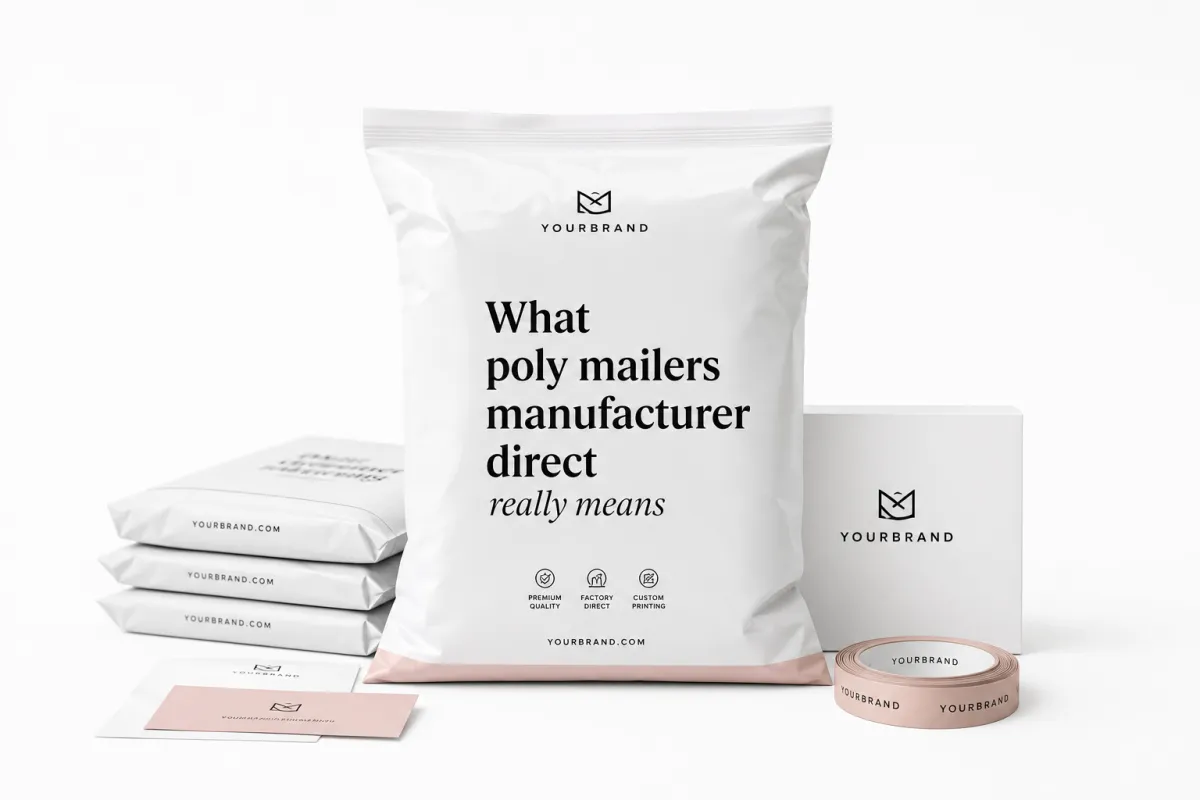
Poly mailers manufacturer direct means you are talking to the factory, or to the operation that actually controls production, not to a reseller passing along your request. That changes the conversation fast. Resellers can move quickly because they work from a simplified catalog. A direct manufacturer needs detail because the order is being built around your spec, not around a generic stock item. More detail in. More control out.
The practical difference shows up in the options available. A poly mailers manufacturer direct buyer can usually choose film gauge, seal style, print method, color structure, and finish with far more precision than a stock-only seller will tolerate. If you need a 2.5 mil co-extruded mailer with a matte outside, strong adhesive, and tight Pantone matching, direct sourcing is usually the cleaner path. If you just need plain shipping bags, the advantage shrinks.
Visibility may be the biggest win. A poly mailers manufacturer direct quote often shows what is actually driving cost: resin prices, volume, print coverage, or a custom dimension that forces a separate production setup. That makes internal approvals easier because finance, operations, and marketing can all see the same logic instead of arguing over a single line item they barely understand.
People sometimes assume direct sourcing is just a bargain hunt with extra steps. It is not. The supply chain still exists. It is just shorter. A poly mailers manufacturer direct setup does not automatically mean cheapest, fastest, or easiest. It means better control over the spec sheet and more responsibility to manage the details that follow. For brands shipping 500, 5,000, or 50,000 parcels a month, repeatability is worth real money.
- What changes: deeper customization, clearer defect responsibility, and tighter alignment between quote and production spec.
- What stays the same: raw material swings, freight costs, and the need for sample approval.
- What improves: accountability, consistency, and access to technical answers before production starts.
A better way to frame it: poly mailers manufacturer direct is not about buying cheap. It is about buying with fewer blind spots. That alone saves brands from a lot of expensive nonsense.
How a poly mailers manufacturer direct order actually works
The first step in a poly mailers manufacturer direct order is specification, not price hunting. Size, material, thickness, closure style, print coverage, color, and volume should be locked before anyone quotes meaningfully. Leave those details vague and the factory fills in the blanks. The quote might look attractive, but only because you have not actually defined what you are buying. That is how people end up paying twice.
After the spec comes proofing. For a poly mailers manufacturer direct run, that usually starts with a digital proof showing artwork placement, bleed, and panel orientation. Serious buyers then ask for a physical sample or a pre-production sample. That is where the real test happens: seal strength, print registration, opacity, hand feel, and fit with the actual products being shipped. A mailer can look clean on screen and still fail the moment a boxed accessory or oversized hoodie hits the line.
Approval is the part that saves money later. In a poly mailers manufacturer direct workflow, the buyer signs off on dimensions, branding, and function before full production starts. Skip that step too fast and the problem shows up in the dullest possible way: the logo is centered perfectly but the mailer is 10 mm short, or the adhesive weakens in cold storage. Those failures rarely show up in a sales pitch. They show up in returns.
Ask for the sample that matches the final build as closely as possible. A glossy proof has its place, but a real poly mailers manufacturer direct test should answer one question: will this mailer survive your packing flow without slowing the line or annoying the customer?
Production location matters too. A poly mailers manufacturer direct order can be built domestically or offshore, and the logistics path changes the result. Domestic production usually shortens transit and makes communication easier. Overseas production can lower the unit price at scale, but it adds freight planning, customs timing, and a lot more inventory discipline. Neither route is magical. The right one depends on demand pattern, cash flow, and how much chaos your team can tolerate.
Quality control should never be an afterthought. In a strong poly mailers manufacturer direct relationship, someone should be able to explain how incoming film is inspected, how print consistency is checked, what defect tolerance applies, and what happens if the run misses spec. If the answer is vague, that is not harmless. It tells you exactly what kind of support you will get if the dock team finds a problem after the truck unloads.
It helps to think in stages, not in one big purchase event. A well-run poly mailers manufacturer direct order usually moves through a few predictable steps:
- Specification intake and quote comparison.
- Artwork proofing and dimension confirmation.
- Sample review or pre-production approval.
- Production scheduling and quality inspection.
- Transit, receiving, and fit testing in the fulfillment workflow.
That sequence looks clean on paper. In practice, the weakest point is usually the handoff between steps. The more a poly mailers manufacturer direct supplier documents each stage, the fewer expensive assumptions slip through. A factory setup is gonna ask for the boring details anyway, so it is better to provide them before the first proof goes out.
Poly mailers manufacturer direct pricing: what drives cost
Pricing is where a poly mailers manufacturer direct conversation becomes genuinely useful, because the factory can show what is costing money instead of stuffing everything into one bland number. The main drivers are familiar, but easy to underestimate: resin prices, film gauge, bag size, print colors, and whether the order uses stock dimensions or a fully custom build. Even a small spec change can swing the quote more than buyers expect.
For example, a 10,000-piece order of simple unprinted mailers might land around $0.10-$0.18 per unit depending on thickness and size, while a branded two-color run may move into the $0.18-$0.32 range. Heavier film, more complex artwork, or special finishes can push it higher. These are ballpark figures, not a promise. Resin swings, currency, and freight can move the number around. A poly mailers manufacturer direct buyer who compares only the lowest unit price usually misses the real difference between a basic shipping bag and a brand-forward mailer That Holds Up better in transit.
Minimum order quantity matters just as much. A lower MOQ usually means a higher unit price because the factory spreads setup across fewer bags. A larger run lowers per-bag cost but ties up more cash and storage space. That is the classic tradeoff in poly mailers manufacturer direct sourcing. You can buy cheaper per unit, or you can buy in a way that protects inventory flexibility. Those goals do not always line up.
Print charges can be the quiet troublemaker. Plates, setup fees, color matching, and multi-panel artwork often move pricing more than the bag itself. A buyer may think the quote is high because of the film when the real cost driver is the artwork. In a poly mailers manufacturer direct order, print coverage is not just a branding decision. It is a production decision.
| Order type | Typical MOQ | Typical unit price | Lead time | Best fit |
|---|---|---|---|---|
| Stock-size, unprinted mailer | 1,000-5,000 | $0.10-$0.18 | Often 7-12 business days | Fast replenishment and basic shipping use |
| Semi-custom printed mailer | 5,000-10,000 | $0.18-$0.32 | Often 12-20 business days | Branded e-commerce programs with repeat demand |
| Fully custom direct build | 10,000+ | $0.24-$0.42+ | Often 15-30 business days | High-volume brands that need exact fit and branding |
The table only helps if the quotes are compared on the same basis. A poly mailers manufacturer direct quote can look cheaper until freight, duties, samples, storage, and rush charges are added. That is landed cost, not unit cost, and the difference is often enough to flip the decision. I have seen buyers celebrate a low quote and then discover the "cheap" option was missing half the actual cost. No one enjoys that conversation.
Compliance and material upgrades matter too. Recycled content, tamper-evident features, stronger adhesives, and more durable co-extruded structures all add cost. They can also reduce failure rates, which is where the return starts to show up. If a poly mailers manufacturer direct supplier can document recycled content claims or performance data, that is worth more than a glossy promise. For broader packaging performance and sustainability context, resources like EPA recycling guidance and the industry education available at Packaging.org are useful references.
Freight mode is the other big swing factor. A poly mailers manufacturer direct order moved by air can seem efficient in a rush, but the premium often wipes out the savings from direct sourcing. Ocean freight is far cheaper per unit, but only if your inventory plan can handle longer transit and variability. The smart buyer compares the full picture, not just the factory price.
Step-by-step timeline for a manufacturer-direct order
The planning window starts before the quote. A disciplined poly mailers manufacturer direct buyer gathers dimensions, artwork, material preferences, and a demand forecast first. That gives the supplier something real to price and keeps the project from turning into a moving target. If the order needs a sample run, decide that up front. If the spec is already validated, the path can be shorter. If not, build in time for revisions. Rushing never makes a sloppy spec better.
A realistic poly mailers manufacturer direct timeline usually follows the same rhythm: quote, proof, sample, production, transit, receiving, inspection. The exact number of days depends on location, customization level, and how quickly the buyer responds. Domestic programs tend to move faster because there is less freight time and fewer coordination layers. Overseas orders can take longer, but at scale they still may make financial sense. The timeline is not just a schedule. It is part of the business case.
Delays usually come from the same handful of problems: artwork approvals, unclear specs, unavailable materials, and late changes after sample approval. Those four issues account for a ridiculous share of schedule slips in poly mailers manufacturer direct buying. The factory can only build what has been approved. If the marketing team keeps changing the logo after signoff, the calendar slips. That is not a manufacturing issue. That is a process issue dressed up as urgency.
For shipments that cannot afford sloppy validation, quality checks need to live inside the schedule. Many packaging teams use poly mailers manufacturer direct samples to check seal strength, fit, and rough handling resistance before placing the full order. If the mailer carries garments, books, or boxed accessories, test it under real conditions. For some programs, asking how supplier testing relates to ISTA transit test protocols is a smart move. The goal is not to over-engineer the bag. The goal is to make sure the bag survives the lane it actually travels.
Inventory planning is where the timeline becomes cash flow. A poly mailers manufacturer direct order that lands late can stop fulfillment. One that lands too early can clog the warehouse and tie up capital. The middle ground is a safety buffer sized to actual demand. If promotions create spikes, keep enough extra stock to absorb transit variability and reprint delays. That buffer is not waste. It is insurance against a packaging bottleneck.
Most teams benefit from one more step: a live receiving check. When the poly mailers manufacturer direct shipment arrives, inspect random units for seal integrity, print alignment, thickness consistency, and bag dimensions. Catch the first problem on the dock, not in the returns inbox. That tiny habit saves a lot of cleanup.
Common mistakes buyers make with manufacturer-direct poly mailers
The biggest mistake is shopping on price alone. A low poly mailers manufacturer direct quote can hide weak film, poor seals, or print quality that makes the brand look cheap. The customer never sees the quote sheet. The customer sees the bag. If the bag tears, the savings story dies fast, usually in a pile of complaints and replacements.
Vague specs are the next problem. If the buyer does not define dimensions, thickness, seal type, and finish clearly, the supplier has to guess. Guessing may be fine for a commodity stock bag. It is a mess for a branded poly mailers manufacturer direct order that needs to fit a specific product line. Exact specs reduce drama later. Funny how that works.
Sample testing is not optional. A mailer can look perfect on a table and still fail with bulky apparel, sharp corners, or cold-weather handling. I have seen poly mailers manufacturer direct buyers approve a sample because it looked good, then discover the adhesive strip loses grip after a warehouse temperature shift. That kind of failure is frustrating because it was preventable from the start. It also shows up after the budget is already spent, which is even better. Sarcasm intended.
- Hidden cost: plate charges, setup, freight, storage, and rush fees.
- Hidden risk: poor adhesion, weak seams, or inaccurate print placement.
- Hidden delay: revised artwork after proof approval.
- Hidden credibility hit: recycled or compostable claims that are not backed by documentation.
Verification is another weak spot. Recycled content, water resistance, and compostable language should be backed by documents, not marketing copy. A responsible poly mailers manufacturer direct supplier should be able to explain testing, material composition, and any limits on performance. If the answer gets vague, treat that as the warning it is. Packaging is physical. Claims should be physical too.
Fit gets underestimated all the time. Some products slide into a standard mailer without drama. Others need enough extra space that the bag scuffs, bulges, or seals poorly. A smart poly mailers manufacturer direct test includes the actual packing workflow, not just a single product dropped into a sample bag. That is where the real ergonomics show up.
Expert tips for choosing the right manufacturer-direct partner
Start with production capacity and repeat-order speed. A good poly mailers manufacturer direct partner should explain what happens when your volume spikes, whether they can hold your artwork for quick reorders, and how they handle seasonal congestion. Capacity matters more than people admit. A supplier that can make a nice sample but cannot repeat it at scale is not much help.
Ask for the documents that show process discipline. That means a sample policy, a QC checklist, and a tolerance range for dimensions and print placement. When a poly mailers manufacturer direct supplier has those controls written down, you can compare vendors on more than the quote sheet. You are comparing operating standards, which is where the real difference usually lives.
Ask for landed cost, not just factory cost. The most useful poly mailers manufacturer direct comparison includes freight, duties, setup, samples, and the likely cost of defects or returns. Tedious? Sure. Necessary? Also yes. A cheaper per-unit bag is not cheaper if it arrives late or fails on the packing line.
Look for packaging knowledge, not just equipment. A supplier that understands fulfillment workflows will ask better questions about pack speed, product shape, storage space, and branding goals. That matters in a poly mailers manufacturer direct relationship because the factory is not just making a bag. It is helping fit that bag into a live shipping system.
Testing language also matters. Puncture resistance, drop survivability, and material consistency are not just industry jargon. They are the difference between a mailer that survives the route and a mailer that looks impressive for a day. The standards ecosystem, including groups like ISTA, keeps the discussion grounded in measurable performance instead of vague claims. That is useful when a poly mailers manufacturer direct supplier says a material is "strong" but cannot explain what that means.
Negotiation still counts. Lock in pricing windows when possible, ask whether shipments can be staggered, and build a backup plan for urgent reorder cycles. A poly mailers manufacturer direct partner that can quote a production slot, not just a price, is usually more valuable than one that is cheap on paper and flimsy everywhere else.
What to do next after you shortlist a supplier
Once you have two or three contenders, build a one-page spec sheet. Include dimensions, thickness, closure style, print requirements, monthly volume, target ship date, and any special handling notes. That turns a poly mailers manufacturer direct conversation from a casual sales exchange into a clean procurement process. It also makes the quotes easier to compare because everyone is being asked to solve the same problem.
Then ask each supplier for the same comparison package: sample, proof, lead time, MOQ, freight assumptions, and defect policy. A poly mailers manufacturer direct quote without those details is incomplete. Buyers love speed, but speed without structure creates false confidence. A complete package may take longer to assemble. That extra time usually pays back in fewer surprises.
Run a small live test through your fulfillment process. Watch seal performance, packing speed, print accuracy, and the finished look from the customer side. A poly mailers manufacturer direct supplier may look great in a presentation and still be awkward in the warehouse if the bag sticks too aggressively or the film feels slippery in the hand. Real use reveals the truth faster than any slide deck.
Score each option on four axes: price, communication, consistency, and timeline reliability. That keeps the conversation practical. If a poly mailers manufacturer direct supplier is a little more expensive but far better on response time and problem-solving, that may be the smarter choice. Packaging does not need to be flashy. It needs to work every time.
My blunt take: a poly mailers manufacturer direct partner should save more than money. It should save friction. If you are getting clear answers, realistic samples, and honest lead times, you are on the right track. If the quoting process feels slippery, that feeling usually gets worse after the purchase order goes out.
The practical takeaway is simple: build the spec first, test the sample in the real packing flow, and compare quotes on landed cost instead of the headline number. Do those three things before you place an order, and the "manufacturer direct" part actually means something.
FAQ
Is a poly mailers manufacturer direct supplier always cheaper?
Not always, because unit price is only one piece of the total landed cost. A poly mailers manufacturer direct quote can still end up higher once freight, duties, plates, samples, and storage are added. The cleanest comparison uses the same bag spec, the same shipping method, and the same service level.
What should I ask a poly mailers manufacturer direct supplier before ordering?
Ask for exact specs: size, thickness, material, seal type, print colors, and finish. Then confirm lead time, sample timing, MOQ, and whether artwork setup or plates are extra. A good poly mailers manufacturer direct supplier should also explain QC standards and how defects are handled if the run misses spec.
How long does a manufacturer-direct poly mailer order usually take?
The path usually includes quoting, proofing, sampling, production, transit, and receiving. Timing depends on whether the order is domestic or overseas and whether the artwork is already approved. For a poly mailers manufacturer direct project, the safest plan is to build in buffer time for revisions and freight variability.
What MOQ is normal for manufacturer-direct poly mailers?
MOQs vary by customization level, print complexity, and factory location. Fully custom printed runs usually require more volume than stock-size or lightly branded orders. If demand is still uncertain, ask whether a poly mailers manufacturer direct partner can support mixed-SKU programs or staged shipments.
How do I compare two poly mailers manufacturer direct quotes fairly?
Compare the same bag size, thickness, print specs, and shipping method across both quotes. Include freight, duties, setup charges, and sample costs so the numbers reflect landed cost. Then request a sample or proof and review the supplier's defect policy before deciding. That is the practical way to judge a poly mailers manufacturer direct offer.
If you want the short version, a poly mailers manufacturer direct purchase works best when the spec is exact, the sample is tested in real use, and the quote is judged on landed cost rather than headline price. That is the difference between a mailer that merely ships products and a mailer that quietly supports the brand every single day.