Buyer Fit Snapshot
| Best fit | Poly Mailers With Logo Price projects where brand print, material claims, artwork control, MOQ, and repeat-order consistency need to be specified before quoting. |
|---|---|
| Quote inputs | Share finished size, material target, print colors, finish, packing count, annual reorder estimate, ship-to region, and any compliance wording. |
| Proofing check | Approve dieline scale, logo placement, barcode or warning zones, color tolerance, closure strength, and carton packing before bulk production. |
| Main risk | Vague material claims, crowded artwork, missing packing details, or unclear freight terms can make a low unit price expensive after revisions. |
Fast answer: Poly Mailers With Logo Price: What Drives the Quote should be specified like a repeatable production item. The safest quote records material, print method, finish, artwork proof, packing count, and reorder notes in one written spec.
Production checks before approval
Compare the actual filled-product size with the drawing, then confirm tolerance on folds, seals, hang holes, label areas, and retail display edges. Reserve space for logos, QR codes, warning copy, and material claims before decorative graphics fill the panel.
Quote comparison points
Review material grade, print process, finish, sampling route, tooling charges, carton quantity, and freight assumptions side by side. A quote is only useful when the supplier can repeat the same color, closure quality, and packing count on the next order.
Poly Mailers with Logo Price: What Actually Drives the Quote
Brands usually look at the mailer quote first and the freight bill second. That order is backwards. A decent printed mailer can cut weight, packing time, and all the little extras that creep into a box system. Once you put those pieces together, poly mailers with logo price starts to look less like a decoration cost and more like a packaging system decision.
I’ve sat through enough packaging reviews to know the trap. Someone sees a per-unit number, compares it to a carton, and calls it expensive. Fine. But that ignores tape, void fill, insert labor, and the fact that a box can push a shipment into a higher carrier band. The real comparison is landed cost, not the sticker on the quote.
That landed-cost view matters most for soft goods, flat apparel, socks, accessories, and ecommerce orders that do not need crush protection. If the product can travel safely in a flexible pouch, poly mailers with logo price may end up beating boxes by a wider margin than the first quote suggests. The savings do not always show up in one place. Sometimes they show up in five small places at once.
Why Poly Mailers With Logo Price Can Beat Box Costs
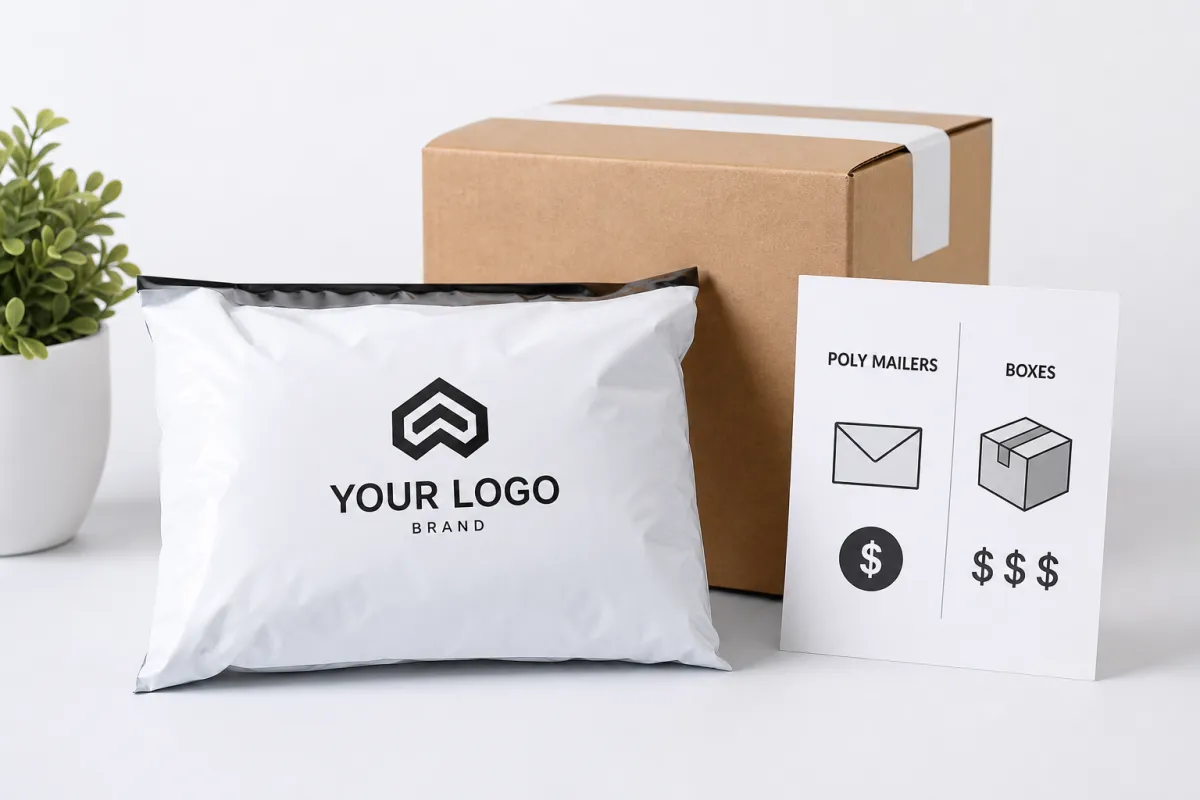
Lightweight shipments are where boxes start to get pricey in sneaky ways. A corrugated carton brings its own weight, then you add tape, label placement, dunnage, and usually a few extra seconds of labor per order. A Printed Poly Mailer can remove most of that clutter. That is why poly mailers with logo price often wins on total shipment cost even if the unit print number looks higher at first glance.
Dimensional weight is the quiet villain here. Carriers price by the larger of actual weight or dimensional weight, so a box that is physically light can still cost more than it should if it takes up too much space. A mailer stays flatter. It rides lower in the parcel math. I’ve seen brands save more on shipping than they expected simply because the package profile changed, not because the ink quote got better.
There is also the labor side, and that one gets ignored way too often. A box workflow usually means more touchpoints: build the carton, tape it, insert filler, place the product, close it, label it, maybe add a card or sticker. A mailer can collapse several of those steps. If your team packs orders all day, a few seconds saved per order becomes real money. That is why poly mailers with logo price should always be read alongside pack-out time.
One more thing. A flexible mailer can reduce storage headaches. Boxes come in multiple sizes, and those SKUs eat shelf space. A custom mailer program can simplify the line and keep the packing station cleaner. Not glamorous, but very real. The cheapest packaging is often the one that causes the fewest downstream problems.
“The unit price looked worse. The landed cost came in better. That was the whole story.”
I hear that line a lot after the math gets rebuilt correctly. A brand thinks it is paying more for print and then realizes it is buying less freight, less labor, and less filler. That is the part that changes the decision. Poly mailers with logo price makes sense when the full shipment cost drops, not when the mailer itself is the cheapest item on the page.
Product Details That Shape Poly Mailers With Logo Price
Not all mailers behave the same, and that is where poly mailers with logo price starts moving around. Material choice, thickness, size, print coverage, and finish all matter. Color matters too, but less than buyers think. A black mailer with a simple one-color logo can cost less than a white mailer with full-coverage artwork if the production setup is easier.
The first question is not “What looks good?” It is “What does the package need to do?” White gives a clean, neutral look. Black feels more premium and hides contents better. Clear mailers work for some retail programs where visibility matters. Tamper-evident options help where security or return integrity matters. Recycled-content film may support sustainability goals, but the claim has to be backed by actual documentation, not a shrug and a nice label.
Print coverage is a big driver, and buyers underestimate it all the time. A small logo in one position is one thing. Full-bleed art that wraps the bag is another. More ink, more setup, more registration sensitivity, more chances for the quote to climb. If someone asks why poly mailers with logo price went up, print area is usually one of the first places to check.
For startups or seasonal launches, stock mailers plus labels can be the smarter first move. That keeps the cash tied up in inventory lower while demand is still shaky. It is not as polished as direct print, though. Labels can work fine, but they rarely feel as integrated as a custom bag. If the unboxing matters to the brand, the printed route usually earns its keep faster than people expect.
If you are comparing packaging families, the broader catalog on Custom Packaging Products is useful because it shows where mailers sit beside cartons, inserts, and label systems. That context matters. Poly mailers with logo price is easier to judge when you can see the full pack-out structure instead of one lonely SKU floating by itself.
Poly Mailer Specifications Buyers Should Confirm
Size is the first spec to lock down, and it is the easiest way to avoid wasting money. A mailer that is too small risks seal failure or product stress. One that is too large wastes film and can make the shipment look sloppy. I’ve watched teams order oversized bags “just to be safe,” and that safety margin ends up costing more than it protects. Poly mailers with logo price improves when the fit is right from the start.
Thickness comes next. Some suppliers describe it as mil, others as gauge, but the idea is the same: how much film is in the bag. Thin film can be perfectly fine for lightweight, non-sharp products. Thicker film resists puncture better and feels sturdier in hand, but the cost climbs with it. A 2.5 mil mailer and a 4 mil mailer are not interchangeable. They are different products with different price behavior and different failure risks.
Seal style matters more than it gets credit for. A strong adhesive flap keeps the package closed in transit. A tear strip can make the opening experience cleaner for the customer. Some programs need extra tamper evidence. Others need a seal that behaves well during returns processing. If the packaging team treats closure style like a tiny detail, the quote can shift later and nobody enjoys that conversation. Better to decide now than renegotiate after proofs are already approved.
Print specs deserve the same discipline. Confirm the number of colors, the print sides, the bleed area, and whether Pantone matching is required. A simple one-color logo on one side is easier to control than art that wraps around the bag or crosses a seal area. Small typography and tight registration make the job trickier too. The more precise the print requirement, the more poly mailers with logo price tends to move upward.
For environmental claims, ask for paperwork. Recycled-content film should come with a clear content statement. Recyclable claims should be grounded in actual collection and processing reality, not just a supplier’s optimistic phrasing. The U.S. EPA has useful packaging and waste guidance at epa.gov/recycle, which is handy if your internal team needs a neutral source to sanity-check a claim before it goes to market.
If parcel performance testing is part of procurement, the standards group to know is the International Safe Transit Association. ISTA publishes widely used shipment testing methods at ista.org. That matters because poly mailers with logo price should not be judged by appearance alone. If the package fails in transit, replacement cost and customer complaints wipe out the savings pretty quickly.
Poly Mailers With Logo Price Breakdown: MOQ, Setup, and Unit Cost
This is where the quote stops being theoretical. Setup charges, print plates or digital setup, proofing, freight, and rush fees all sit outside the clean unit number you see first. Poly mailers with logo price often looks attractive until the rest of the order is fully exposed. That is how buyers end up approving the wrong volume and paying more than they planned.
Setup costs are usually spread across the order, which is why low minimums can look expensive. A small run may carry a setup fee that barely matters at 10,000 pieces but hurts at 1,000. Depending on print method and color count, setup can add roughly $75 to $300 before production even begins. That is not a universal rule, but it is enough to change poly mailers with logo price by several cents a bag.
Minimum order quantity is the next lever. Lower MOQ gives more flexibility, but flexibility has a price. Larger runs usually reduce the unit number because fixed setup costs get diluted and production runs more efficiently. If a supplier only gives you one volume band, ask for two more. You want to see how poly mailers with logo price behaves at 1,000, 5,000, and 10,000 units, not just one neatly rounded middle number.
| Option | Typical MOQ | Indicative Unit Price at 1,000 | Indicative Unit Price at 5,000 | Main Cost Driver |
|---|---|---|---|---|
| Stock mailer + printed label | 100-500 | $0.16-$0.32 | $0.12-$0.24 | Label cost, labor, and stock availability |
| One-color custom printed mailer | 1,000-3,000 | $0.20-$0.42 | $0.11-$0.26 | Setup spread, film thickness, and print area |
| Full-bleed custom mailer | 3,000-5,000 | $0.30-$0.60 | $0.16-$0.34 | Ink coverage, color count, and registration |
| Recycled-content custom mailer | 3,000-5,000 | $0.24-$0.48 | $0.14-$0.30 | Material sourcing and documentation |
Those numbers are directional, not universal, but they show the pattern clearly. The lowest unit cost usually appears at the highest quantity. That does not automatically mean the biggest order is the best order. If freight is long-haul, if storage space is tight, or if the artwork may change soon, a lower MOQ can be smarter even with a slightly higher unit number. Poly mailers with logo price has to be read inside your actual operating reality.
Freight can quietly wreck the math if nobody watches it. A shipment that looks compact on paper can still get expensive if it crosses regions or needs a rushed delivery window. Split-ship charges, reproof fees, and rush production should also be on the table. The honest budget is the full landed cost: product, setup, proofing, freight, and any special handling. That is the only way poly mailers with logo price stays comparable across suppliers.
My rule is simple: if the quote only shows unit price and quantity, it is incomplete. If it also shows setup, freight, and lead time, it is usable. If it includes print method and material spec, it is ready for approval. That level of detail keeps poly mailers with logo price from turning into a surprise two weeks later, which is how bad sourcing stories usually start.
From Proof to Delivery: Process and Timeline
The quote is only the first checkpoint. After that comes artwork review, proofing, sampling, production, quality control, and shipping. Buyers who understand the sequence usually get a better result and fewer delays. Poly mailers with logo price stays predictable only when the artwork is final and the order details are complete. Missing information is what stretches timelines, not the actual printing.
A normal schedule often starts with one to three business days for quote and feasibility review, then another one to three days for digital proofing if the files are ready. Production commonly takes around 12 to 18 business days after proof approval, though that changes with order size and print complexity. Add more colors, more print sides, or a special finish, and the clock moves. Add revisions, and it moves again. Simple math, annoying reality.
Most delays are avoidable. The usual culprits are low-resolution files, missing vector logos, unclear dielines, last-minute color changes, and shipping addresses that were never fully verified. If the buyer can deliver final quantity, approved artwork, and a clean ship-to address on the first pass, poly mailers with logo price usually turns into a much smoother order. That is time well spent. Chasing corrections is not.
Sampling deserves a short pause. A stock sample confirms size and feel. A printed proof confirms color balance, logo placement, and seal behavior. If brand color is sensitive, ask for a proof that reflects production intent rather than a random blank bag with a hopeful note attached. That extra step protects the final result, especially when the order is large enough that a mistake would hurt.
Reorder timing matters too. Inventory should be checked before the last carton is opened, not after. A reprint can take longer than planned if the supplier’s schedule fills up or freight gets messy. The best buyers treat poly mailers with logo price as part of a rolling supply plan, not a one-off order they will remember next quarter when the warehouse is empty.
If you want a broader sense of what can be ordered alongside mailers, the Custom Poly Mailers page is a practical place to compare sizes, print styles, and use cases before requesting a final quote.
Why Buyers Choose Us for Custom Poly Mailers
Buyers stick with suppliers that remove friction. Material options, stable print quality, and clear proof support matter more than shiny promises. Packaging teams need someone who can explain what changes the quote, what can be adjusted, and what should stay fixed. A guided quoting process beats a transactional one because it helps the buyer make a better decision before production starts. Poly mailers with logo price gets easier to control when the spec gets narrowed early.
Category experience matters too. Apparel brands care about finish and pack-out speed. Subscription brands care about repeatability. Ecommerce teams care about freight and reorder timing. A supplier that understands those differences can catch problems before they show up in a warehouse: a bag that is too large, a film that is too thin, a logo too close to the seal edge, or a reorder that is about to miss a launch date. That kind of review improves poly mailers with logo price by preventing waste before it happens.
Quality control and freight coordination matter as much as the print itself. A good order is not just one that looks right in proof. It is one that arrives on schedule, in usable cartons, with the artwork in register and the seal holding the way it should. When procurement teams compare suppliers, they should ask who checks dimensions, who confirms print placement, and who follows the shipment through transit. Those details are what turn poly mailers with logo price into a repeatable sourcing decision instead of a guessing game.
“A quote is only useful if it helps you place the order correctly.”
That sounds obvious because it is. But obvious does not mean common. The best suppliers help buyers understand setup fees, MOQ bands, and transit risk before the PO is cut. If a team needs to compare packaging formats before locking in one spec, the broader catalog on Custom Packaging Products makes that easier. It gives procurement a cleaner way to compare mailers against cartons, labels, and other pieces of the pack-out system without winging it.
Consistency is the other reason buyers come back. Procurement teams do not want a different shade, a different flap, or a different print placement every time they reorder. They want the same mailer, the same approval path, and the same delivery expectation. That is a real reason suppliers keep the account. Poly mailers with logo price matters, sure. Consistency is what protects the brand over time.
Next Steps to Lock In Your Poly Mailers With Logo Price
If you want a quote that actually means something, send complete specs the first time. The essentials are size, quantity, thickness, print colors, print sides, delivery ZIP, and target ship date. Add recycled content, tamper evidence, tear strips, or color matching if you need them. The cleaner the input, the cleaner the quote. That is the fastest path to a dependable poly mailers with logo price.
Do not stop at the first unit number. Ask for at least two volume tiers so you can see how the quantity break changes the pricing. A smaller test order can be smart if design or demand is uncertain, but a second tier tells you what happens when the program scales. That comparison is usually more useful than any single number because poly mailers with logo price changes as fixed costs spread across more units.
Before approval, confirm the landed cost. Freight, proofing, rush charges, and split shipments can shift the final number enough to change the decision. If the order is time-sensitive, compare the cost of holding a few extra cases against the cost of rushing a second production run. The cheapest path on paper is not always the cheapest path in practice. Packaging has a way of teaching that lesson the hard way if nobody checks the details.
Use this checklist before you place the order:
- Confirm exact mailer dimensions and thickness.
- Approve artwork in vector format with the correct color callouts.
- Ask for setup, freight, and proofing in writing.
- Check whether the film includes recycled content or other compliance claims.
- Request two quantity tiers so you can compare poly mailers with logo price across volume levels.
That checklist keeps the process grounded. It also strips out the ambiguity that causes rework, delays, and cost overruns. For a packaging buyer, the best quote is the one that reflects the actual order, not the fantasy version where everything ships perfectly, the art is flawless, and the warehouse has infinite space. Nice idea. Usually not reality.
How does poly mailers with logo price change with order quantity?
Per-piece price usually drops as quantity rises because setup costs are spread across more units. Ask for at least two volume breaks so you can compare the real savings at each MOQ. Watch freight and setup fees, since they can make a small order look cheaper than it is.
What makes custom poly mailer pricing higher or lower?
Price moves with size, thickness, print colors, coverage, and whether the design prints on one side or both. Special features like tamper-evident seals or recycled-content film can also raise the quote. Artwork complexity matters because more colors and larger print areas usually require more production steps.
What is the typical MOQ for poly mailers with logo?
MOQ varies by supplier and print method, but custom runs often start higher than stock mailers with labels. Smaller MOQs can work for launches, but the unit price is usually less favorable. If volume is uncertain, ask for a starter order and a reprice at the next tier.
How long does it take to produce printed poly mailers?
Production timing depends on proof approval, artwork readiness, and the supplier's current schedule. Delays usually come from revisions, missing files, or freight timing rather than the printing itself. A clean dieline and final specs can shorten the process significantly.
Can I get a sample before ordering poly mailers with logo?
Yes, many suppliers can provide stock samples or printed proofs before full production. Samples are useful for testing size, seal strength, and print appearance before you commit. If color matching matters, request a proof or production-style sample rather than a generic blank sample.
Poly mailers with logo price is easiest to control when the specs are complete, the artwork is final, and the quantity plan is honest about how much you really need now versus later. If you do that, the number on the quote stops being a guessing game and starts behaving like a procurement decision. That is the point. Not fancy. Just correct.


