Buyer Fit Snapshot
| Best fit | Premium Poly Mailers Pricing projects where brand print, material claims, artwork control, MOQ, and repeat-order consistency need to be specified before quoting. |
|---|---|
| Quote inputs | Share finished size, material target, print colors, finish, packing count, annual reorder estimate, ship-to region, and any compliance wording. |
| Proofing check | Approve dieline scale, logo placement, barcode or warning zones, color tolerance, closure strength, and carton packing before bulk production. |
| Main risk | Vague material claims, crowded artwork, missing packing details, or unclear freight terms can make a low unit price expensive after revisions. |
Fast answer: Premium Poly Mailers Pricing: What Really Drives Cost should be specified like a repeatable production item. The safest quote records material, print method, finish, artwork proof, packing count, and reorder notes in one written spec.
Production checks before approval
Compare the actual filled-product size with the drawing, then confirm tolerance on folds, seals, hang holes, label areas, and retail display edges. Reserve space for logos, QR codes, warning copy, and material claims before decorative graphics fill the panel.
Quote comparison points
Review material grade, print process, finish, sampling route, tooling charges, carton quantity, and freight assumptions side by side. A quote is only useful when the supplier can repeat the same color, closure quality, and packing count on the next order.
Premium Poly Mailers pricing only starts to make sense once the quote is matched to the job the mailer actually has to survive. Two bags can look almost identical in a photo and still perform very differently once they move through a rough parcel network, get stacked in a warehouse, or ride around in a delivery truck on a hot afternoon. That hidden performance gap explains a lot of the spread in premium poly mailers pricing.
A packaging buyer is not just asking, "Why is this quote higher?" The more useful question is what the added cost buys and whether it protects the brand, the margin, or the customer experience. Premium Poly Mailers pricing is shaped by material choices, print quality, defect control, and the supplier's production discipline, not by markup alone.
Custom Logo Things works with brands that need packaging to do more than move a product from one place to another. A mailer can support presentation, reduce damage claims, and keep replenishment predictable, which is a pretty practical list if you ask me. The useful part is learning which pieces of premium poly mailers pricing are justified, which parts can be negotiated, and which quotes rest on assumptions that do not match real shipping conditions.
Premium poly mailers pricing: why two quotes can look wildly different
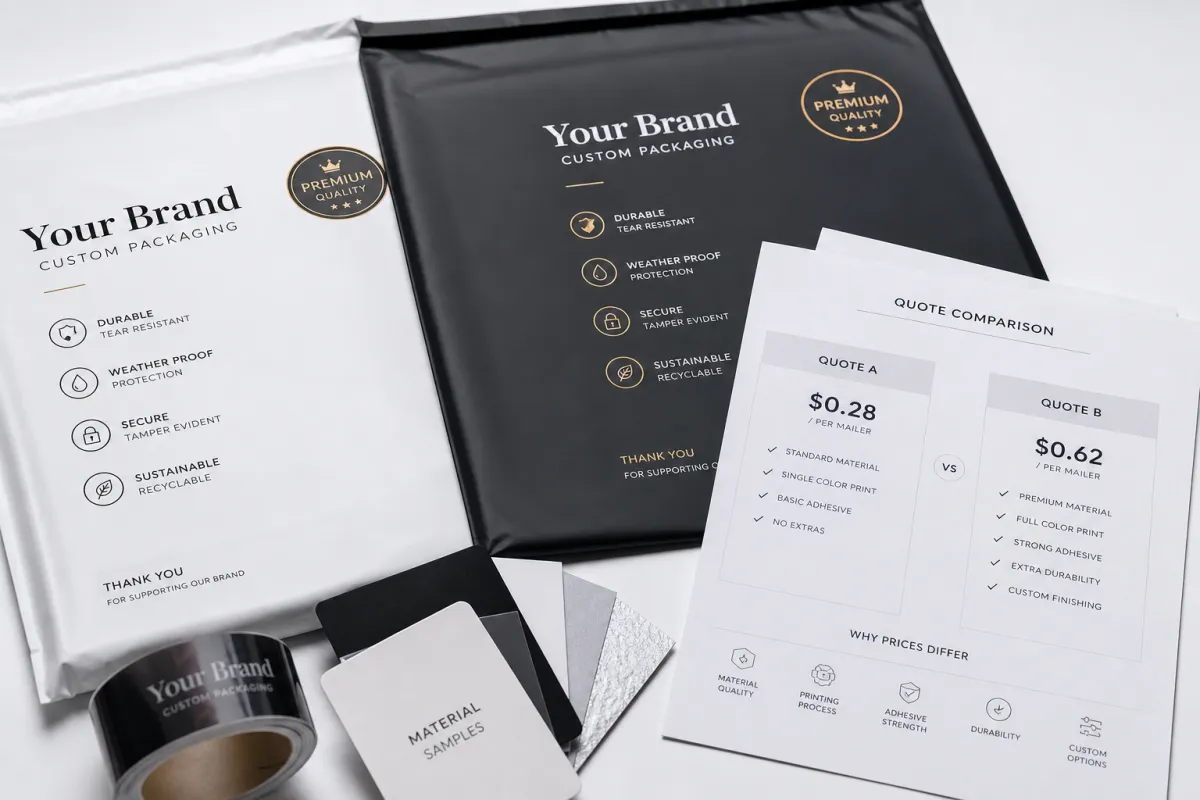
A simple shipping example explains most of the spread. Picture two 10 x 13 inch mailers, both white, both printed with a logo, both quoted at the same quantity. On paper, they appear close. In practice, one may use a more consistent co-extruded film, a stronger closure adhesive, and cleaner print registration. The other may be thinner, easier to puncture, and less consistent from batch to batch. That gap shows up in premium poly mailers pricing because the supplier is not selling a shape; the supplier is selling a performance result.
Premium usually means a thicker or better-built film, stronger puncture resistance, a cleaner finish, and print quality that stays sharp instead of smearing, wrinkling, or drifting out of alignment. Buyers often notice the branding first because a premium mailer looks good at the doorstep. Damage prevention is the quieter value. A few cents more per unit can cost less than reships, refunds, and support tickets.
From a packaging buyer's perspective, the quote should reflect four things: material consistency, defect control, print accuracy, and lower risk across the shipping lane. If a supplier can hold film gauge within tight tolerances and keep the seal stable, premium poly mailers pricing often earns its keep. If the supplier cannot explain what changed from one sample to the next, the quote deserves a second look.
Order volume matters as well. A run of 5,000 pieces has a different cost structure than 100,000 pieces. Setup, color matching, proofing, and machine changeover get spread across more units at higher volumes, which usually lowers premium poly mailers pricing on a per-piece basis. Smaller runs can still make sense, but the buyer should expect a higher unit cost and more visible setup charges.
The buyer's real test is simple: is the higher quote padded, or does it reflect measurable value? If the answer includes stronger film, tighter print consistency, lower spoilage, and better transit performance, premium poly mailers pricing is probably doing honest work. If the quote climbs for vague reasons like "better quality" with no spec sheet behind it, the number needs scrutiny.
How premium poly mailers work from film roll to shipment
Most buyers only see the finished mailer. The price is built long before the final stack gets packed for shipment. The process usually begins with polyethylene film selection, either from stock material or from extrusion. From there, the film is folded or gusseted, sealed on the sides, trimmed, and finished with a closure flap. If the design includes tear strips, dual seals, or perforation, each feature adds steps and control points.
Film structure matters a great deal. A single-layer mailer can be economical, but a co-extruded structure often performs better because the layers can be tuned for opacity, tear resistance, and printability at the same time. That engineering is one reason premium poly mailers pricing can rise. Buyers are not only paying for thickness; they are paying for how the layers behave together under stress. ASTM testing, including tensile and impact-related methods, is often used to compare material behavior, and that conversation is more useful than looking at mils alone.
The adhesive strip and closure flap are small details with outsized consequences. If the adhesive is weak, inconsistent, or badly placed, the bag can open in transit or during packing. If it is too aggressive, the first closure may be fine but repeat use becomes messy. Better adhesive control can raise premium poly mailers pricing, yet it can also reduce the much more expensive problem of package failure. For many brands, that trade makes sense.
Printing adds another layer of economics. Ink coverage, registration, and curing affect appearance, abrasion resistance, and color consistency from run to run. A full-bleed design with multiple spot colors costs more than a simple one-color logo. That is not arbitrary. More coverage means more setup, more material usage, and more quality checks. Premium poly mailers pricing often reflects that reality more clearly than buyers expect.
There is also a waste story hidden in the process. Better machine control can lower reject rates, cut spoilage, and make reorders more predictable. A supplier with tight process control may charge more per unit, but if fewer bags are rejected or remade, the real cost per usable mailer can be lower. Premium poly mailers pricing should be judged against usable output, not only the number printed on the quote.
For brands comparing packaging categories, the same thinking applies across formats. A well-made mailer is part of a broader packaging system, not an isolated purchase. Many buyers also review Custom Packaging Products alongside mailers because the best packaging decisions usually come from matching the right material to the actual fulfillment flow.
Premium poly mailers pricing: the cost, MOQ, and quote drivers
The biggest drivers behind premium poly mailers pricing are usually easy to name once you know where to look. Size, thickness, print coverage, color count, finish, and special features all move the number. A 6 x 9 inch unprinted mailer at 2.5 mil is a very different product from a 14 x 19 inch printed mailer at 3.5 mil with a matte finish and tear strip. Even if both are called "poly mailers," they are not competing on the same cost base.
Thickness is often described in mils, and that single number can fool buyers into thinking it tells the whole story. It does not. A 3 mil film made with poor consistency can perform worse than a carefully engineered 2.75 mil film. This is where premium poly mailers pricing gets misunderstood. Better film can cost more because the supplier is controlling the material more closely, not because the quote has extra padding.
Minimum order quantity, or MOQ, is another major factor. Smaller runs can cost more per unit because setup time gets spread over fewer bags. Larger runs usually improve unit economics, but they also require more cash upfront and more storage space. I have seen buyers celebrate a lower unit price, then discover they bought six months of inventory they did not need. That is not savings. That is a different cost bucket.
Setup charges can catch first-time buyers off guard. Custom artwork may require plates, proofing, color matching, and prepress work. Some suppliers bundle those costs into the unit price. Others break them out. Either structure can be fair, but only if the buyer knows what is included. If premium poly mailers pricing looks unusually low, ask whether the supplier has moved costs elsewhere or stripped out service that will matter later.
Freight is another quiet mover. A quote that looks competitive at the factory gate may become less attractive once pallet configuration, carton count, and shipping distance are added. A compact carton size, efficient pallet stack, and lower damage risk in transit can improve landed cost. Oversized cartons, split shipments, or rushed freight can add more than buyers expect.
The table below gives a rough sense of how pricing can shift for a 5,000-piece order. These are working ranges, not universal numbers, because print coverage, film structure, and freight lanes change the final result.
| Mailer Type | Typical Specs | Approx. Unit Range | What Drives the Price |
|---|---|---|---|
| Stock poly mailer | Plain, 2.5-3 mil, no custom print | $0.10-$0.18 | Basic material, limited setup, lower decoration cost |
| Premium unprinted mailer | Thicker film, better seal, stronger finish | $0.14-$0.26 | Higher-gauge film, more consistent quality control |
| Printed premium mailer | Custom logo, 1-3 colors, 3 mil or more | $0.18-$0.40+ | Artwork setup, print coverage, color matching, MOQ |
| Specialty premium mailer | Tear strip, dual seal, matte finish, custom size | $0.24-$0.55+ | Extra conversion steps, more material usage, tighter specs |
That table makes one thing plain: premium poly mailers pricing is not a single market rate. It is a stack of decisions. A buyer who knows which features truly matter can trim waste without cutting the protection the parcel actually needs.
If you are narrowing down a style, browsing Custom Poly Mailers can help clarify what changes with size, finish, and print style before you request formal quotes.
Premium poly mailers pricing process and timeline: quote to delivery
Buying mailers moves faster when the specification is clean. The usual sequence starts with a request for quote, then artwork submission, proof review, quantity confirmation, and production scheduling. If samples are needed, that adds another decision point. Each step can influence premium poly mailers pricing because each step uses time, staff attention, or both.
The easiest delays are usually avoidable. Unclear dimensions cause back-and-forth. Low-resolution artwork slows prepress. Late color changes force proof revisions. A last-minute request to change size or thickness can push the job into a different production window entirely. In practical terms, a "simple" mailer order may take longer to finalize than a more complex order if the simple one is poorly specified.
Typical checkpoints often look like this: quote within a few business days, proof turnaround after artwork is approved, production after final sign-off, quality inspection near the end of the run, and packing before freight booking. A buyer should ask whether the timeline is production time only or whether it includes transit. That distinction matters. A supplier can quote a short factory lead time while the actual delivery date lands much later.
Fast timelines often cost more. That is normal. Rush scheduling can mean higher production priority, tighter machine windows, or fewer opportunities to batch the job efficiently with other orders. Premium poly mailers pricing may rise when a buyer wants a quick turnaround, especially if the artwork is complex or the order requires special material sourcing. The trade-off is not wrong, but it should be explicit.
Some suppliers keep inventory domestically. Others produce to order and ship from overseas. The commercial result can be very different even when the bag looks the same. Domestic inventory can shorten transit and simplify replenishment. Custom production can offer more control over print and specs, but it usually extends lead time. Those trade-offs should be visible in premium poly mailers pricing instead of being buried in a vague promise of "fast service."
A quote is only cheap if it arrives on time, matches the proof, and survives the shipping lane without extra claims.
It is also smart to ask whether the supplier tests or references standards like ISTA parcel testing guidance. A mailer that has been evaluated against realistic handling conditions gives a buyer more confidence than one selected only because it was the lowest quote on a spreadsheet.
Step-by-step guide to comparing quotes without overpaying
The cleanest way to compare premium poly mailers pricing is to start with a shared spec sheet. If one supplier is quoting a 2.5 mil bag and another is quoting 3 mil, the comparison is already broken. Put size, thickness, material structure, adhesive type, print method, finish, and quantity in writing. Then ask every supplier to quote the same assumptions. It sounds basic, but this one step removes a surprising amount of noise.
Next, compare landed cost rather than unit price alone. That means freight, setup fees, proof charges, cartonization, and any extra fees for split shipments. The lowest unit quote can turn into the highest delivered cost once those charges are added. Premium poly mailers pricing should be judged on the invoice that actually arrives, not on the headline number in the email thread.
Ask suppliers to separate one-time charges from recurring charges. A plate fee or proof fee may be reasonable if it disappears on reorders. A higher recurring print charge is a different story. Over a year, a difference of two or three cents per bag can outweigh a one-time setup fee very quickly. That is why premium poly mailers pricing should always be viewed through volume and reorder frequency, not only through the first purchase.
If possible, request samples or sample images. A quote can hide visual and tactile differences that only show up in hand. Print sharpness, opacity, film stiffness, flap adhesion, and closure feel are difficult to judge from a spreadsheet. I would rather see one good physical sample than five polished sentences from a sales reply.
Here is a simple side-by-side scorecard you can use internally:
- Durability: film thickness, puncture resistance, seal strength, and likely transit performance
- Print quality: color match, registration, coverage, and finish consistency
- Commercial fit: MOQ, lead time, reorder stability, and freight terms
- Total value: unit cost, setup cost, defect risk, and customer experience
That mix is a better decision tool than the lowest price alone. Packaging buyers are usually not trying to win a trophy for the cheapest bag. They are trying to buy the best cost-to-performance ratio they can defend internally. Premium poly mailers pricing should support that decision, not hide it.
A final sanity check helps: ask whether the quote reflects a real production run or an idealized sample run. Some pricing looks good because it was built around a perfect scenario. Real orders have tolerances, freight realities, and occasional rework. A supplier who explains those conditions clearly is usually safer than one who promises more than the process can keep.
Common mistakes buyers make with premium poly mailers
The most expensive mistake is over-specifying the bag. A brand may order a heavyweight mailer with extra features because it sounds premium, even though the shipping lane is gentle and the product is light. In that case, premium poly mailers pricing rises without delivering meaningful benefit. A smarter move is to match the bag to the product, the route, and the customer expectation.
The opposite mistake happens just as often: choosing the cheapest mailer and paying for it later in returns, damage, and service time. I have seen this happen with brittle closures, flimsy seams, and thin film that looks fine in a calm warehouse but fails under pressure. Saving a few cents per unit is not a real win if complaints rise and replacement shipments follow.
Incomplete artwork creates another headache. If the logo file is low resolution or the dimensions are vague, the quote may need to be revised and the proof schedule may slip. That delay can be more expensive than it looks because it can push the order into a different production slot. Premium poly mailers pricing gets harder to control when the input data is messy.
Buyers also forget to ask about reorders. A mailer that looks great once is not enough. The next run should match the first run closely in color, film feel, and closure behavior. If a supplier cannot keep that consistency, brand presentation starts to drift. That kind of drift is subtle, but customers notice it more than most teams expect.
Another common blind spot is sustainability claims. If a supplier says the mailer is recyclable, compostable, or made with recycled content, ask for documentation and clarify what those claims actually mean in the target market. Certifications such as FSC matter for paper-based packaging, while plastic film claims need careful review. The FSC site is a useful reference point for understanding how certification language works in packaging materials generally, even if your mailer itself is polymer-based.
Expert tips and next steps for smarter ordering
Think of a premium mailer as part of the logistics system, not just a packaging SKU. If the right bag reduces labor, lowers damage, and keeps customers happier at the doorstep, the higher quote may be the better commercial decision. That is why premium poly mailers pricing should be measured against what the mailer prevents, not only against what it costs.
A pilot order is often the smartest first move. Test seal strength, print clarity, fit, and handling in a real fulfillment flow before locking a larger volume. A sample that looks clean on a desk may behave differently once it has been packed, stacked, and shipped. One hundred units of field testing can tell you more than a long email exchange ever will.
Ask suppliers for a quote sheet that separates material grade, setup fees, production time, and freight. The clearer the breakdown, the easier it is to challenge assumptions. If a number seems high, you can ask whether it is driven by film choice, decoration method, or packaging format. That is the conversation that moves premium poly mailers pricing from guesswork to negotiation.
Create an internal checklist before approval. It should cover dimensions, thickness, adhesive type, print proof, freight terms, sustainability language, and reorder assumptions. That checklist saves time later, especially when a new team member inherits the ordering job. Good packaging programs run on repeatable rules, not on memory alone.
Brands that sell through e-commerce, subscription boxes, and direct-to-consumer channels tend to feel the impact of packaging decisions quickly. A bag that looks slightly more polished can improve the unboxing moment. A bag that fails can trigger a visible complaint trail. That is why premium poly mailers pricing should sit in the same conversation as product protection, customer perception, and operational consistency.
For teams expanding their packaging lineup, it can help to review Custom Packaging Products at the same time as poly mailers. A broader view often exposes where you can standardize dimensions, simplify artwork, or reduce extra handling steps across different packaging formats.
If you want a practical purchasing rule, keep it simple: gather the specs, request three apples-to-apples quotes, inspect samples, and compare landed cost against the performance you actually need. That is the fastest path to making premium poly mailers pricing work in your favor instead of against it.
My final advice is straightforward: pick the mailer that holds up in your real shipping lane, not the one that only looks impressive in a quote. If a supplier can show you what is driving premium poly mailers pricing, you can decide whether the added cost belongs in the order or should be trimmed back. That is the decision that keeps packaging honest and keeps the operation from paying for pretty specs it does not need.
What affects premium poly mailers pricing the most?
The biggest drivers are size, film thickness, print complexity, order volume, and special features such as tear strips or dual adhesive seals. Freight, setup charges, and proofing can also move premium poly mailers pricing more than many buyers expect, especially on smaller runs.
Do larger orders always lower premium poly mailers pricing?
Usually yes, because setup costs get spread across more units and production runs are easier to plan. Still, the savings can flatten if the order is larger than your actual usage window, since storage, cash flow, and reorder timing matter too.
How do I compare premium poly mailers pricing from different suppliers?
Use the same spec sheet with every supplier, then compare unit price, setup fees, freight, lead time, and sample quality. The fairest comparison is landed cost plus performance, not the lowest quote alone. That approach gives premium poly mailers pricing a real business context.
Does custom printing raise premium poly mailers pricing a lot?
It can, especially when the design uses multiple colors, full coverage, or special finishing that needs extra setup. Even so, printed mailers often pay for themselves by improving brand recognition and reducing the need for separate inserts or labels.
What should I ask before approving a premium poly mailers order?
Confirm dimensions, thickness, adhesive strength, print proof, production timeline, freight terms, and reorder pricing. Also ask whether the sample reflects the final production run, because a prototype can be more forgiving than the bulk order and may not represent true premium poly mailers pricing value.


