Buyer Fit Snapshot
| Best fit | Premium Poly Mailers with Logo projects where brand print, material claims, artwork control, MOQ, and repeat-order consistency need to be specified before quoting. |
|---|---|
| Quote inputs | Share finished size, material target, print colors, finish, packing count, annual reorder estimate, ship-to region, and any compliance wording. |
| Proofing check | Approve dieline scale, logo placement, barcode or warning zones, color tolerance, closure strength, and carton packing before bulk production. |
| Main risk | Vague material claims, crowded artwork, missing packing details, or unclear freight terms can make a low unit price expensive after revisions. |
Fast answer: Premium Poly Mailers with Logo: What Actually Matters should be specified like a repeatable production item. The safest quote records material, print method, finish, artwork proof, packing count, and reorder notes in one written spec.
Production checks before approval
Compare the actual filled-product size with the drawing, then confirm tolerance on folds, seals, hang holes, label areas, and retail display edges. Reserve space for logos, QR codes, warning copy, and material claims before decorative graphics fill the panel.
Quote comparison points
Review material grade, print process, finish, sampling route, tooling charges, carton quantity, and freight assumptions side by side. A quote is only useful when the supplier can repeat the same color, closure quality, and packing count on the next order.
Premium Poly Mailers With Logo look simple from a distance. Flat bag. Plastic. Done. That reading is lazy, and it gets expensive fast. Buyers see a mailer and assume the choices are mostly cosmetic, then they get surprised when one shipment looks polished and another feels like it came out of a back room with bad lighting. The reality is that Premium Poly Mailers with logo are doing three jobs at once: protecting the order, carrying the brand, and setting the tone before the customer even touches the product.
That first contact matters more than a lot of packaging teams want to admit. A flimsy mailer can make a $60 item look like a clearance mistake. A better one does the opposite. It gives the customer a cleaner opening experience, stronger privacy, less wrinkling, and a brand signal that looks deliberate instead of improvised. Premium Poly Mailers With Logo are not about stuffing the thickest film into a quote and calling it strategy. They are about dialing in film structure, seal strength, print quality, and shipping efficiency without paying for nonsense you never needed.
If you are comparing formats across your shipping program, it helps to see where branded mailers sit beside other options in the broader Custom Packaging Products lineup. Apparel, accessories, beauty items, and lightweight soft goods usually get the most value out of premium poly mailers with logo. The math is decent. The presentation is better. The warehouse does not have to wrestle with packaging that behaves like a prop from a science fair.
Premium poly mailers with logo: why they feel expensive before they are
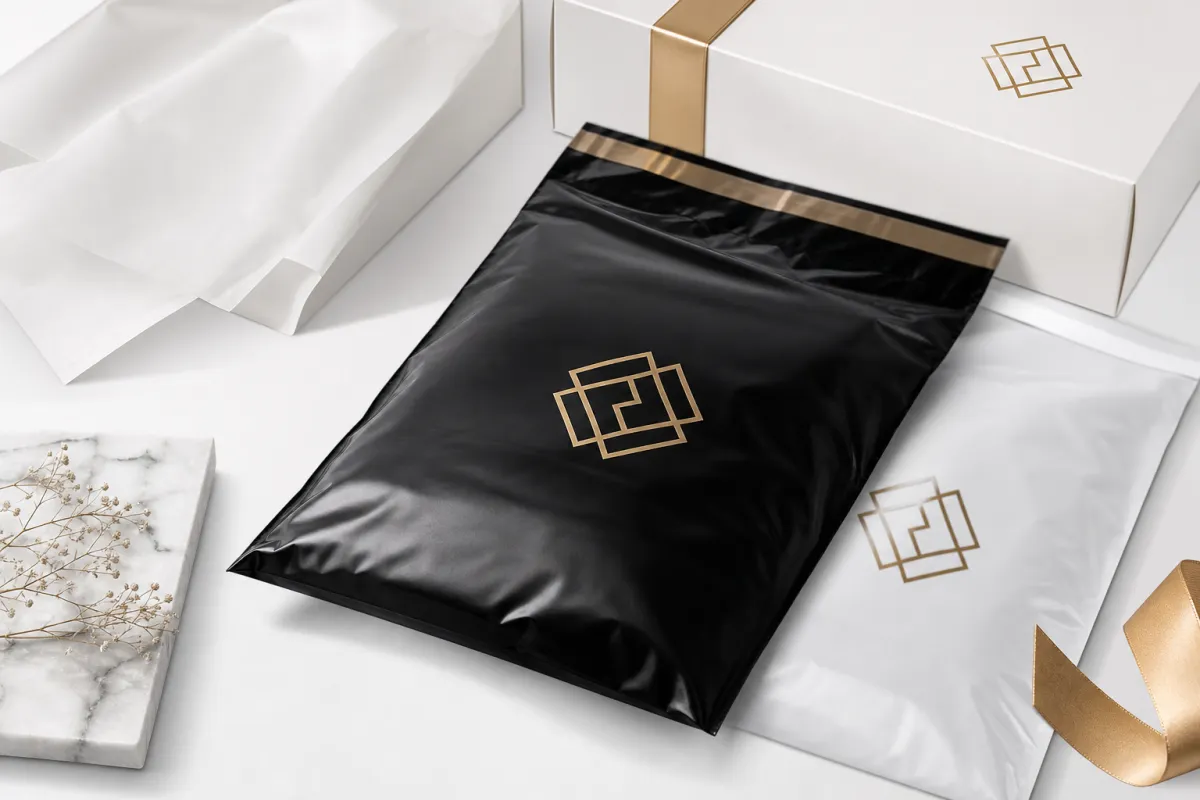
Customers judge the shipment before they touch the product. Packaging buyers know this and still act surprised when the mailer influences the whole experience. It is not just a transport layer. It is visible brand real estate, and premium poly mailers with logo make that presence feel intentional from the mailbox to the unboxing table. A plain gray bag says “we shipped this.” A better bag says “we paid attention.” Those are not the same thing.
What makes a mailer feel premium usually is not one dramatic feature. It is the mix of stronger film, cleaner seals, better print, a smoother finish, and more consistent opening performance. The bag should hold its shape without feeling stiff. It should resist scuffs and punctures without turning into a brick. The logo should land cleanly, with sharp edges and believable color, not fuzzy artwork that looks like it went through a bargain-bin printer.
Premium poly mailers with logo also support brand perception in quieter ways. Better opacity protects privacy. Better adhesive makes the closure feel reliable. Better sizing keeps the product from swimming in empty space or bulging like the bag was chosen by guesswork. People do share packaging when it looks considered. They also complain about packaging when it looks careless. Nobody budgets for the second kind of attention, but it shows up anyway.
A mailer is the first product page your customer can physically touch. If it feels cheap, the brand feels cheaper than the item inside.
Premium does not mean thickest, brightest, or most expensive. A 3.5 mil mailer is not automatically better than a 2.75 mil one if the heavier bag adds bulk, wastes material, or slows fulfillment. Premium poly mailers with logo should fit the product, the parcel network, and the brand position. A fashion label shipping folded tees does not need the same spec as a beauty brand shipping glass bottles. Same category. Different risk.
From a packaging buyer’s point of view, the real test stays simple. Does the mailer protect the order? Does it look aligned with the product price? Does it close cleanly, print cleanly, and survive actual handling? If the answer is yes, you have premium. If the answer is only “the logo is on there,” you have decoration, not brand value.
Brands moving from generic shipping bags to premium poly mailers with logo usually want to remove the little moments that make customers hesitate. Less wrinkling. Better opacity. Cleaner branding. Fewer complaints about torn seams or sloppy presentation. Those details do not sound glamorous, but they are often what separates a package people forget from one they remember for the right reason.
I still remember a batch of mailers I reviewed early in my packaging career that looked fine in the mockup and weirdly cheap in hand. The logo was correct. The color was correct. The film, though? Kinda limp. It shipped fine, but it telegraphed the wrong message. That was the moment I stopped treating packaging like a print job and started treating it like part of the product.
How premium poly mailers with logo are made and printed
Most premium poly mailers with logo start with LDPE film, often in a co-extruded structure instead of a single-layer bag. That matters because each layer can do a different job. One layer can add strength. Another can carry print more cleanly. Another can improve feel or opacity. Co-extrusion gives converters more control over the tradeoffs, which is why the bag can feel stronger without becoming overly stiff.
Recycled content is common now, but the claim only matters if the mailer still performs. A mailer with 30% to 50% post-consumer recycled content can be perfectly workable for many apparel and accessory orders, as long as the film still seals well, resists tearing, and prints evenly. Eco language is cheap. A bag that survives transit is not. If a supplier cannot explain how recycled content affects opacity, stretch, or seal performance, keep your wallet closed.
The printing method changes both the look and the economics. Flexographic printing is the workhorse for larger runs with cleaner, simpler artwork. It is efficient, consistent, and usually the best fit when the logo is bold, the colors are limited, and the order quantity makes setup worth it. Rotogravure can deliver excellent quality for high volumes and rich coverage, but the tooling cost makes it a tougher sell unless the run is large enough to justify it. Digital printing is often the better choice for shorter runs, test launches, or artwork with more color variation and frequent updates.
Premium poly mailers with logo can be printed in several ways:
- Single-color branding: usually the cleanest and most cost-efficient option when the logo stands on its own.
- Two- or three-color artwork: useful when the identity depends on a specific color relationship or a more detailed mark.
- Full-bleed coverage: creates a stronger shelf and mailbox presence, but it adds print cost and requires tighter control over registration.
- Spot or reverse print: can help the logo stand out on dark films without flooding the entire bag with ink.
Every extra print color adds complexity. Every inch of extra coverage adds setup and production attention. That is why premium poly mailers with logo can look expensive even before the bag feels premium. The logo is one part of the build. Film weight, print coverage, ink laydown, and seal design all show up in the final result.
Functional details matter more than most people expect. A self-seal adhesive strip should close firmly without turning into a wrestling match. Tamper-evident closures can help if the contents are sensitive or return rates are high. Gussets can add capacity, but they also change how the bag folds and how much shelf space it eats. Surface finish affects the entire vibe: gloss tends to read brighter and cleaner, while matte hides scuffs better and feels calmer. None of that is cosmetic noise. It changes how premium poly mailers with logo behave at the packing table and in transit.
A clean starting point is simple: compare the mailer spec with the product, not with a random competitor’s bag. A lightweight top on a beauty sample needs a different structure than a folded sweater. That is why premium poly mailers with logo should be chosen with dimensions, product weight, and handling risk in mind instead of habit. A good logo on a weak bag still looks weak.
For buyers who want to see how mailers fit into a broader packaging system, the dedicated Custom Poly Mailers page is a useful place to compare formats before you lock in a spec. That helps a lot if you are deciding between standard mailers, branded mailers, and premium poly mailers with logo that need a more polished finish.
Cost and pricing for premium poly mailers with logo
Pricing starts with quantity. Not glamorous. Still true. Small orders carry heavier setup and proofing costs per unit, while larger orders spread those costs across more bags and usually drive the per-piece price down fast. For premium poly mailers with logo, the gap between a small run and a mid-volume run can be large enough to change the whole packaging plan.
The other major drivers are size, film thickness, print coverage, number of colors, and extras like tamper evidence, matte finish, or recycled content. A 10 x 13 inch mailer with a one-color logo is a very different animal from a 14 x 19 inch full-bleed bag with two custom ink passes and a matte exterior. Same product family. Very different quote.
| Order profile | Typical unit price range | What usually drives the cost | Best use case |
|---|---|---|---|
| 500 to 1,000 units | $0.45 to $0.95 each | Setup, proofing, short-run printing, lower volume spread | Launches, tests, seasonal promos, small DTC brands |
| 3,000 to 5,000 units | $0.22 to $0.45 each | Better production efficiency, more stable print setup | Regular replenishment, growing ecommerce brands |
| 10,000+ units | $0.15 to $0.32 each | Volume buying, lower per-unit setup burden, smoother runs | Established programs, subscription shipments, higher turnover |
Those ranges are not a promise. They are a realistic starting frame. A premium poly mailers with logo quote can move up if the artwork is complex, the print registration needs tight control, or the size is unusual. It can move down if the design is simple and the order volume is strong. Buying packaging is annoyingly similar to buying anything else made in quantity: the boring details do the heavy lifting.
Setup costs are where many buyers get surprised. Plates for flexographic printing, artwork cleanup, proofing, and freight can all sit outside the unit price if the quote is not written carefully. Some suppliers fold those charges into the piece price. Others list them separately. Ask for both views. A quote that hides setup in the unit number may look cheap until you compare it properly.
Here is a practical way to budget premium Poly Mailers With Logo:
- Budget for presentation: choose a cleaner finish, sharper print, and a size that flatters the product.
- Budget for durability: choose the film thickness and seal quality that survive your worst shipping path, not your best one.
- Budget for balance: spend where the customer sees and feels the difference, and skip the vanity extras that do not change the experience.
That middle path usually carries the smartest money. If your product is light and low-risk, you may not need the thickest film in the catalog. If your product is delicate or returns are expensive, the cheapest bag will cost more in replacements and complaints than it saves up front. Premium poly mailers with logo should protect margin, not attack it.
It also helps to separate the quote into film, print, setup, and freight. Once those numbers are visible, it becomes easier to decide whether you want to spend more on a better exterior, a stronger film, or a cleaner logo application. That is the difference between making a packaging decision and approving a number because the email thread is already too long.
One caution here: if a quote feels suspiciously low, ask what was trimmed. Sometimes the answer is obvious, like thinner film or simpler print. Other times the supplier quietly swapped in a spec that only looks close on paper. That is the kind of surprise nobody wants after the first pallet lands.
Key factors that separate premium from plain mailers
Thickness gets too much attention. People love a bigger number because it feels safe. Thicker is not automatically better. A bag can be thick and still feel awkward, bulky, or wasteful if the film construction is wrong or the size is off. For premium poly mailers with logo, thickness should support the package, not turn it into a crinkly brick that wastes shipping space.
Seal strength matters more than the sales pitch. A clean closure that stays shut through sorting, stacking, and drops is what keeps customer service from getting buried in complaints. Puncture resistance matters too, especially if the contents have corners, metal parts, or anything that likes to work its way through plastic during rough handling. Stretch behavior matters because a mailer that tears instead of flexing is not a premium product, no matter how pretty the logo looks.
Opacity is another quiet premium signal. If a bag is supposed to protect privacy, it needs to stay opaque under real light conditions, not just under a showroom bulb. Color consistency matters just as much. One batch should not look noticeably greener, duller, or more transparent than the sample you approved. Buyers often underestimate how much color drift changes the feel of premium poly mailers with logo. A slightly off black can look cheap. A slightly dull white can look tired. Packaging people notice this immediately.
For buyers who care about shipping standards, the right question is not “Is this bag fancy?” It is “Does this spec survive handling?” A supplier should be able to discuss testing aligned with common parcel abuse, including drop and vibration checks associated with ISTA methods. If your mailers are part of a broader sustainability story, you should also ask where recycled content sits in the structure and whether the claim is backed by traceable sourcing. The EPA has useful guidance on materials and waste reduction that is worth reading before you build a packaging story around a claim you cannot support.
Size selection is one of the most overlooked premium factors. Oversized mailers waste film and make the shipment look lazy. Undersized mailers create bulging seams, stressed adhesive, and a rushed appearance. Premium poly mailers with logo should fit the product with just enough breathing room for packing speed and transit movement. Not too roomy. Not squeezed to death. Packaging, like tailoring, punishes guesswork.
Sustainability can be part of premium, but only if it survives reality. Recycled content, source transparency, and reduced material use can all matter, yet a greener spec that tears in transit is not a win. A premium mailer should still deliver the same basics: protection, clean appearance, and predictable performance. Otherwise the eco story turns into an expensive excuse.
There is also the human factor at the packing table. A mailer can be technically strong and still feel annoying if the adhesive grabs too early, the opening edge is hard to find, or the size takes two extra motions to fill. That sounds minor until you multiply it by thousands of units. Then it is labor, not theory.
Ordering process and timeline for premium poly mailers with logo
The ordering process is straightforward if the brief is clear and a mess if it is not. Start with product dimensions, target quantity, artwork files, and the shipping reality. That means weight, fragility, fulfillment method, and whether the order is for retail launch, replenishment, or seasonal demand. Premium poly mailers with logo get much easier to spec when the buyer stops describing the brand and starts describing the package.
A normal workflow usually looks like this:
- Choose size, film structure, and finish.
- Submit artwork in a clean vector format if possible.
- Review the proof for size, placement, color notes, and closure position.
- Approve the proof before production starts.
- Run the order through production and quality control.
- Pack, ship, and inspect the first delivery before the full program rolls out.
Skipping proof approval is one of the fastest ways to create an expensive mistake. The proof is where you catch the logo placement that sits too close to the seam, the color that looks too flat, the address panel that is off by a few millimeters, or the closure strip that clashes with the design. Once the run is printed, your options get smaller and your mood gets worse. That is not drama. That is custom production.
Timeline depends on the print method and order complexity. For simpler flexographic runs, 12 to 15 business days after proof approval is a reasonable planning number. Digital projects can move faster, often around 7 to 12 business days once the artwork is final. Custom sizing, specialty finishes, large color changes, or heavier quality review can stretch the timeline toward 20 business days or more. Freight adds another variable, because the truck does not care how excited you are about launch day.
Plan backward from the date you actually need inventory in hand, not the date you hope everything goes perfectly. If the launch is tied to a promotion, a retail event, or a subscription cycle, leave room for artwork changes and transit delays. Premium poly mailers with logo are not hard to order, but they do require the same discipline as any custom packaging item. Late decisions are where budgets start leaking.
When you are comparing options, use a product page like Custom Poly Mailers to narrow size and finish first, then ask for a quote that separates production from freight. That keeps the conversation honest. It also keeps you from approving the wrong spec because the fastest email won the day.
If you are dealing with a launch date that absolutely cannot slip, build in a buffer. I have seen one missing artwork file add five days to a schedule and one bad proof add another three. Nobody remembers the original promise once the cartons are late.
Common mistakes buyers make with branded poly mailers
The cheapest film is rarely the cheapest outcome. Yet people keep buying the lowest line item and then acting shocked when seams split, corners scuff through, or the bag wrinkles badly in transit. Cheap premium poly mailers with logo are not premium. They are just decorated problems. If the bag fails, the brand pays for the replacement and the apology.
Artwork mistakes are just as common. Low-resolution logos, tiny copy, thin gradients, and overly detailed artwork can look fine on a screen and terrible on plastic. The material surface, print method, and color count all influence how much detail survives. A crisp, simple mark often beats a crowded design by a mile. Especially on smaller mailers, where the print area is limited and every extra element competes for attention.
Overbranding can backfire too. If the bag is screaming, the design feels crowded, or the color system clashes with the product, the result looks forced. Premium poly mailers with logo should support the product category, not fight it. A minimalist apparel line usually reads better with a restrained, high-contrast design. A bold streetwear label can handle more aggression. Context matters. Shocking news, I know.
Size errors are another expensive nuisance. Buyers often pick a mailer based on the product’s flat dimensions and forget about folds, inner packaging, inserts, and sealing tolerance. That leads to bags that are too tight, too loose, or just awkward. Inventory misfires are worse. Ordering 50,000 units in the wrong spec is a long, slow punishment. The warehouse may forgive you. The finance team will not.
Then there is the proof approval mistake. People scan the proof, see their logo, and assume the job is fine. Not even close. Check spelling. Check placement. Check seam margins. Check closure behavior. Check whether the print area overlaps a functional fold or adhesive zone. This is where premium poly mailers with logo either become a tidy asset or an avoidable headache.
Other mistakes worth avoiding:
- Choosing a color that clashes with the brand palette instead of supporting it.
- Ignoring seal width and assuming every adhesive strip performs the same way.
- Buying oversized inventory because the price per unit looked tempting.
- Using one sample as if it represents every production run forever.
Premium poly mailers with logo reward careful buyers and punish lazy ones. That is not a flaw. That is just packaging. The bag is cheap enough that people assume it is simple, and important enough that mistakes show up immediately. Strange little category, really.
Expert tips and next steps for choosing the right spec
Start with shipping reality, not brand fantasy. If the product weighs 6 ounces, ships folded, and rarely comes back, you do not need a tank. If the product has sharp corners, multiple inserts, or a higher return rate, the spec needs to account for that before you obsess over the exact shade of black. Premium poly mailers with logo should be selected from the inside out: product first, mailer second, artwork third.
Compare two or three samples side by side if you can. One mockup on a screen hides a lot. In hand, the differences become obvious fast. One bag feels thinner. One seal is cleaner. One print is sharper. One finish hides scuffs better. This is where premium poly mailers with logo stop being a quote and become a physical decision. Anyone who has opened ten packaging samples in a row knows the winning bag usually announces itself before the spreadsheet does.
Ask for quotes that separate the moving parts. Film, print, setup, proofing, and freight should be visible. If everything is stuffed into one mysterious number, you cannot tell whether you are paying for quality or just paying for convenience. Good suppliers are usually fine breaking it out. If they are not, that tells you something useful.
A practical decision path looks like this:
- Choose the smallest durable size that fits the product plus any inserts.
- Choose the lightest film that survives your shipping path without splits or wrinkling.
- Choose the cleanest print that supports the brand without making the bag busy.
- Choose the finish that fits your category, handling, and aesthetic.
That approach usually gets you to the right spec faster than asking for “the best” bag. Best for what? Presentation? Durability? Margin? Speed? Premium poly mailers with logo are a compromise product in the good sense: they balance a few competing priorities and still make the brand look sharper than plain packaging ever will.
Before you place the full order, gather four things: product dimensions, logo files, target quantity, and budget range. Then request a proof and, if possible, a sample pack. That one step saves a lot of drama. It also gives you a real sense of how premium poly mailers with logo will behave once the packing line starts moving and the customer actually sees the result.
If you want the honest version, the right mailer is not the flashiest one. It is the one that protects margin, survives shipping, and makes the customer feel like the brand paid attention. That is the job. Premium poly mailers with logo do it best when the spec is grounded, the artwork is clean, and the order is placed before the warehouse starts sweating.
My blunt takeaway: pick the smallest size that fits cleanly, the lightest film that passes real transit abuse, and the simplest print that still reads like your brand. That combination is usually where premium poly mailers with logo earn their keep instead of just adding another logo to the pile.
What makes premium poly mailers with logo different from standard poly mailers?
Premium versions usually use better film, stronger seals, cleaner print, and more consistent sizing. They are built to improve both shipping protection and brand presentation, not just carry a logo. In practice, that means premium poly mailers with logo feel more deliberate at the mailbox and hold up better under normal parcel handling.
How much do premium poly mailers with logo usually cost?
Pricing depends on quantity, size, thickness, number of print colors, and finish. Small runs usually cost more per unit because setup and proofing are spread across fewer bags. As volume rises, the unit price typically drops. For premium poly mailers with logo, a simple order can land in the low cents at scale, while small custom runs may be several times higher per piece.
What print method is best for premium poly mailers with logo?
Flexographic printing works well for high-volume orders with simpler designs. Digital printing is often better for shorter runs or artwork with more color variation. Rotogravure can be a strong choice for large, high-coverage programs, but tooling costs make it less attractive for smaller orders. The best method depends on order size, color count, and how much detail the design really needs.
How long do custom premium poly mailers with logo take to produce?
Lead time depends on artwork readiness, proof approval, order size, and print method. Simple flexographic orders may ship in about 12 to 15 business days after approval, while digital runs can be faster. Custom sizing, specialty finishes, or revisions can extend the timeline. Rush jobs are possible in some cases, but they usually cost more and leave less room for corrections.
What artwork files do I need for premium poly mailers with logo?
Vector files are usually the safest starting point because they scale cleanly for print. A clean logo, clear color references, and exact placement notes help avoid proof mistakes. If the artwork is complex, make sure you know which details are essential and which can be simplified. Premium poly mailers with logo reward clean, readable artwork far more than crowded decoration.


