Buyer Fit Snapshot
| Best fit | Price Breakdown for Seasonal Packaging Kits projects where brand print, material claims, artwork control, MOQ, and repeat-order consistency need to be specified before quoting. |
|---|---|
| Quote inputs | Share finished size, material target, print colors, finish, packing count, annual reorder estimate, ship-to region, and any compliance wording. |
| Proofing check | Approve dieline scale, logo placement, barcode or warning zones, color tolerance, closure strength, and carton packing before bulk production. |
| Main risk | Vague material claims, crowded artwork, missing packing details, or unclear freight terms can make a low unit price expensive after revisions. |
Fast answer: Price Breakdown for Seasonal Packaging Kits: Quote Scope, Sample Proof, MOQ, and Lead Time should be specified like a repeatable production item. The safest quote records material, print method, finish, artwork proof, packing count, and reorder notes in one written spec.
Production checks before approval
Compare the actual filled-product size with the drawing, then confirm tolerance on folds, seals, hang holes, label areas, and retail display edges. Reserve space for logos, QR codes, warning copy, and material claims before decorative graphics fill the panel.
Quote comparison points
Review material grade, print process, finish, sampling route, tooling charges, carton quantity, and freight assumptions side by side. A quote is only useful when the supplier can repeat the same color, closure quality, and packing count on the next order.
What goes into a price breakdown for seasonal packaging kits?
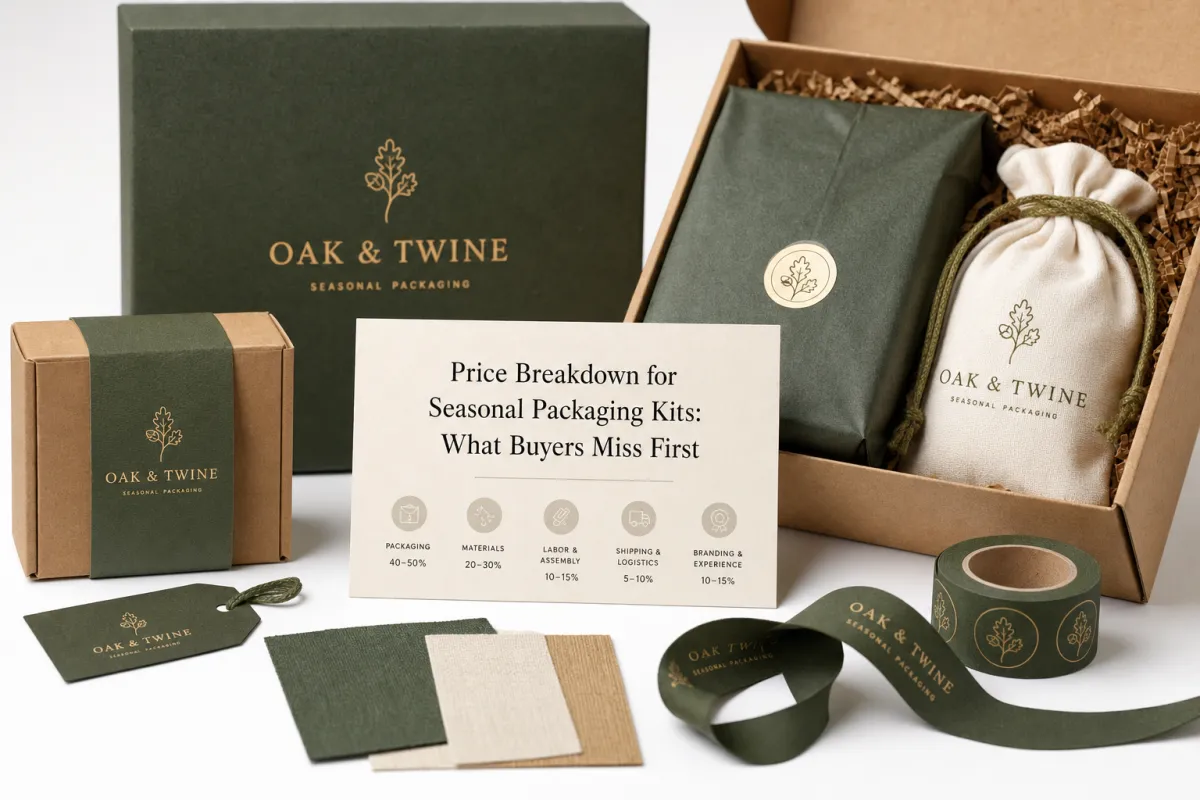
A price breakdown for seasonal packaging kits gets decided long before the first press run, because the real cost usually hides in the little decisions people rush past. Materials, print timing, insert design, freight, and assembly all move the number around. Buyers love to stare at the box line and call it the main expense. Cute. It usually is not. The bigger swings come from setup work, the number of components, and how much handling the kit needs before it is ready to ship. If you need a budget that can survive a meeting, the price breakdown for seasonal packaging kits has to split one-time charges from recurring unit cost and show where the actual savings live.
I have watched more than one seasonal program go off the rails because someone priced the pretty part and forgot the boring part. The boring part is where the money lives. Holiday gift sets, limited-edition launches, and retail packaging refreshes often need Custom Printed Boxes, labels, tissue, inserts, and outer shippers all at once. The build has to protect the product, carry the brand, and keep fulfillment from turning into a slow-motion mess. A smart structure helps all three. A sloppy one creates labor waste and freight pain before the product even lands on a shelf.
For buyers comparing quotes from a packaging supplier, the cleanest move is to define the kit like a bill of materials. Once the spec is locked, the price breakdown for seasonal packaging kits becomes easier to compare across vendors and easier to explain to purchasing, marketing, and operations without everyone squinting at the spreadsheet like it owes them money.
Price Breakdown for Seasonal Packaging Kits: What Buyers Miss First
The first mistake is treating a price breakdown for seasonal packaging kits like a single number. It is never just one number. It is a pile of decisions dressed up as a quote. One vendor leaves out assembly. Another assumes a stock dieline. Another ignores freight until the end and then acts surprised when the budget cracks. That is how a project drifts out of range before the first carton is packed.
The biggest misses usually show up in three places. Buyers underestimate setup, especially when artwork is not print-ready or the dieline still needs work. Buyers focus on the printed box and ignore inserts, sleeves, labels, and sealing parts. Buyers wait too long, then ask for a rush turn, which pushes the order into overtime, expedited freight, or both. That last one can move the cost more than the printed component itself.
Internal reporting makes the problem messier. Purchasing wants a clean number. Marketing wants the package to look right. Operations wants it to pack fast and ship without damage. A useful price breakdown for seasonal packaging kits should give all three groups what they need by showing which costs are fixed, which rise with volume, and which design choices actually change the quote.
Honestly, that is where the business case starts. Seasonal packaging is not decoration for its own sake. A well-built kit can cut damage, lower fulfillment time, and keep a launch on schedule. A vague kit can force hand assembly, rework, and random freight charges that appear out of nowhere and somehow become everybody's problem. From a packaging buyer's point of view, the best price breakdown for seasonal packaging kits is the one that exposes those tradeoffs before the PO gets signed.
A quote that separates tooling, print, kitting labor, and freight is far more useful than a flat number, because it shows where the money is going and where it can still be controlled.
For teams sourcing Custom Packaging Products, the real question is not whether the first quote looks low. The real question is whether the quote reflects the actual build, the actual quantity, and the actual delivery window. If those three pieces line up, the price breakdown for seasonal packaging kits becomes a planning tool instead of a guessing game.
What Seasonal Packaging Kits Include and How They Are Built
Seasonal kits can be basic or packed with components. A simple kit might include a folding carton, a product insert, and a label. A more premium presentation might use a rigid box, printed sleeve, die-cut foam or corrugated inserts, tissue, a thank-you card, and an outer shipper for distribution. Every added piece touches the price breakdown for seasonal packaging kits because every piece adds material, converting, and usually some kind of manual handling.
The common structures are familiar to anyone buying retail packaging or Custom Printed Boxes: mailer boxes, folding cartons, rigid set-up boxes, sleeves, inserts, labels, cartons with partitions, and outer corrugated shippers. A kit can be component-only, meaning the supplier ships each part flat for your team to pack, or fully kitted, meaning the supplier prints, die-cuts, assembles, inserts, and ships the finished set. That difference hits the pricing structure directly.
Seasonal use cases usually fall into a few buckets. Holiday gift sets want a stronger presentation layer because the package is part of the sale. Limited-edition launches need sharper print quality and a tighter clock. Event-ready bundles care more about fast pack-out and shipping efficiency. The structure should fit the product, not the mood board. A heavy glass item needs more protection than a lightweight candle tin, and a display box for retail merchandising should not be built like a plain shipper if the presentation is part of the offer. That is why the price breakdown for seasonal packaging kits starts with product weight, fragility, and display goals.
There is also a difference between a kit built for fulfillment and a kit built for shelf appeal. In a warehouse, labor often matters as much as the printed surface. If the team has to fold four parts, place two inserts, sleeve the product, and add a sticker seal, the labor line becomes real money. If the same kit can be flat-packed, nested efficiently, or pre-assembled in a cleaner sequence, the overall quote can drop without hurting the presentation.
For reference, organizations like ISTA are useful touchpoints for transit testing, while FSC matters when fiber sourcing and chain-of-custody are part of the buying spec. Those standards do not price the job by themselves, but they help define the build so the price breakdown for seasonal packaging kits rests on actual requirements instead of guesswork.
Packaging Specifications That Change Cost and Fit
If the spec sheet is vague, the quote will be vague. Simple rule. Still ignored all the time. That is one of the most common reasons a price breakdown for seasonal packaging kits falls apart when people try to compare vendor quotes. Dimensions, material grade, print coverage, finish, insert style, and assembly sequence all affect the final number. A buyer who standardizes those pieces first usually gets tighter pricing and fewer revisions.
Internal dimensions come first. A box that is even a little oversized may need filler, while a box that is too tight can slow pack-out and raise the risk of damage. Standard sizes and existing dielines often reduce cost because the supplier can use known tooling and predictable material usage. Custom dimensions can add die-cut charges and more waste during converting. That is why a cost comparison should always show whether the structure uses an existing format or a fully custom build.
Material choice changes cost in a very plain way. Lightweight folding cartons, often printed on 300gsm to 400gsm SBS or C1S board, usually sit below rigid boxes or heavy corrugated presentation pieces. If the kit needs a premium feel, thicker board, soft-touch lamination, or specialty wrap will raise the number. A holiday mailer can price very differently from a luxury gift set because the substrate itself changes machine time and labor.
Decoration is another obvious cost lever. One-color printing is usually the most efficient. Full-color process printing adds press time, plate or setup work, and tighter color control. Then come finish choices such as matte varnish, gloss coating, foil stamping, embossing, debossing, spot UV, and specialty inks. Those touches can help retail packaging and package branding, but they should earn their place. If the structure already carries the presentation, stacking three premium finishes can push the budget up without adding much shelf value.
Insert design deserves its own attention. A simple paperboard insert is usually less expensive than molded pulp, EVA foam, or multi-layer corrugated trays. Cheap is not always cheap, though. If the insert helps the packer move faster and cuts breakage, it can pay for itself in labor savings and fewer claims. The most useful cost analysis includes that operational detail, not just a raw material line.
Before asking for prices, lock the following into a spec sheet:
- Exact internal dimensions and product weight
- Board grade or substrate type
- Print method and number of colors
- Coating or finishing requirements
- Insert style and number of cavities
- Flat-packed, pre-assembled, or fully kitted
- Destination, ship window, and delivery terms
That list does more than keep the paperwork tidy. It gives the quoting team enough structure to build a price breakdown for seasonal packaging kits that can actually be compared across vendors and turned into an internal budget without a lot of hand waving.
For buyers who want to see current packaging categories and production options, our custom printed boxes and branded packaging options are a useful starting point for narrowing the spec before requesting a quote.
Price Breakdown for Seasonal Packaging Kits: MOQ, Setup, and Unit Cost
This is the point where the budget stops being theoretical. A price breakdown for seasonal packaging kits should be split into line items because MOQ, setup, and unit cost behave differently. Small run, bigger setup burden per kit. Larger run, setup spread thinner. Nothing mysterious there, just arithmetic people keep trying to ignore until the invoice shows up.
Typical quote lines include prepress or artwork preparation, tooling or cutting dies, print setup, raw material, converting, assembly, kitting labor, packaging for shipment, and freight. Depending on the build, there may also be sample charges, storage fees, and split-shipment fees. A clear price breakdown for seasonal packaging kits should show each one separately so you can see what is fixed and what scales with volume.
Here are realistic ranges many buyers use as a planning tool, though every project depends on structure and finish:
| Kit Style | Typical Components | Common Volume Range | Indicative Cost Impact |
|---|---|---|---|
| Basic folding carton kit | Carton, insert, label | 2,500 to 10,000 kits | Often the lowest entry point for seasonal kit pricing; simple print and standard dielines may keep unit cost around $0.35 to $0.95 per kit depending on size and coverage. |
| Retail gift set kit | Mailer or rigid box, sleeve, insert, card | 1,000 to 5,000 kits | More labor and more finishing; a detailed quote in this range often lands around $1.20 to $3.50 per kit, especially with premium coatings or foil. |
| Fulfillment-ready seasonal bundle | Outer shipper, product tray, tissue, labels, packing | 500 to 3,000 kits | Assembly and freight matter more here; pricing may range from $1.50 to $4.80 per kit depending on product complexity and kitting labor. |
Those ranges are not promises. They are a planning frame. A small box with heavy ink coverage and foil can cost more than a larger plain carton. A rigid box with minimal decoration may price better than a folded structure that needs several manual steps. The point of a price breakdown for seasonal packaging kits is not to chase the cheapest unit price in isolation. The point is to understand what the project is asking the line to do.
MOQ can be especially misleading. A supplier may quote 1,000 kits and 5,000 kits on the same structure, and the bigger order will not be five times the price. Setup costs are mostly fixed. A cutting die, press setup, and sample approval process cost about the same whether the run is tiny or large. As volume rises, unit cost falls. That is exactly why a quote should show multiple quantity bands.
It also helps to ask whether the quote is ex-works, delivered, or fully landed. Ex-works means the price covers production at the supplier's facility. Delivered means freight is added. Fully landed means the quote includes assembly, packing, shipping, and sometimes staging. Without that distinction, two quotes can look close on paper and still land in very different places. A credible estimate should never hide the freight assumptions.
Common cost controls are pretty straightforward. Reduce the number of components. Use a standard size if the product allows it. Simplify the insert layout. Choose a board grade that protects the product without overbuilding the structure. Keep print coverage efficient. Consolidate shipments so you are not paying for a string of partial loads. Each choice can improve the price breakdown for seasonal packaging kits without wrecking the presentation.
If the package has to include the nice touches, compare scenarios side by side: standard versus premium finish, flat-packed versus pre-assembled, and component-only versus fully kitted. That is usually the quickest path to a pricing decision that fits both the marketing brief and the operations budget.
Production Process and Timeline From Quote to Delivery
A price breakdown for seasonal packaging kits only helps if the schedule is believable. The production flow usually moves through intake, quotation, dieline confirmation, proofing, sample approval, production, quality checks, packing, and shipment. If any of those steps gets rushed or muddled, the timing slips and the buyer pays for it later, usually through expedited freight or overtime assembly.
The most common delay is unfinished artwork. The second is a spec that changes after the quote goes out. The third is an insert fit that was never tested against the actual product. None of that is rare. All of it affects the budget because revisions eat time, materials, and machine capacity. Change the insert cavity by a few millimeters after proof stage and the run may need rework. Great way to make a cheap project expensive.
Seasonal work moves fastest when the buyer does three things early: locks the quantity band, sends print-ready files, and approves the sample without delay. Obvious? Sure. Still where people trip. For that reason, a good quote should be read alongside the lead time estimate, not treated like a separate document. A low price that arrives after the season is already over is just a bad joke in a spreadsheet.
Typical lead times vary by structure and complexity. A simple folding carton program may run in 10 to 15 business days after proof approval. A more detailed rigid box or multi-component kitting program can take 20 business days or more, especially if the order includes special finishes, custom inserts, or staged freight. Add proofing and sample review, and the calendar stretches. A buyer who leaves room in the schedule usually gets a better price breakdown for seasonal packaging kits because the order stays in standard production instead of getting shoved into rush status.
The best schedule is not the fastest one on paper. It is the one that leaves room for correction. Samples should be checked for fit, print density, fold accuracy, and label placement. If the project includes display packaging or retail packaging, the buyer should also confirm presentation details under real light, not just on a screen. That extra check protects the final quote from last-minute surprises.
For product teams that want a practical control point, transit testing can help. Industry references such as packaging.org, ISTA, and ASTM testing practices can help teams understand packaging terminology and performance expectations for fragile items. You do not need to overbuild every seasonal package, but if the product is fragile or expensive, testing can save money by preventing claims and replacement shipments.
From a buyer's point of view, the sequence matters as much as the structure. Quote first. Spec confirmation second. Sample approval third. Production fourth. That order keeps the price picture aligned with the real timeline instead of a rushed calendar that quietly adds cost.
Why Choose Us for Seasonal Packaging Kits
Buyers do not need sales fluff. They need a supplier who can read a spec, explain the cost drivers, and produce a clean price breakdown for seasonal packaging kits without hiding the details in fine print. That is where a packaging partner earns trust. Clear quoting saves time, and clear production expectations save money.
At Custom Logo Things, the value is practical support. That includes helping define the kit structure, reviewing whether the dieline is efficient, and pointing out where a finish or insert choice adds cost without improving the package. A useful quote should show those tradeoffs before production starts, not after the PO is already signed and everyone is pretending nobody saw the issue coming.
Technical consistency matters too. Good print registration, accurate die-cutting, consistent board sourcing, and careful kitting labor all lower the odds of rework. If the project needs tighter tolerance or a presentation build that must align with branded packaging standards, the production team should say so early. Honest feedback is often more valuable than a low headline number. That is especially true for custom printed boxes that have to look sharp in retail packaging environments.
Here is what buyers usually want from a supplier, and what a dependable team should be ready to provide:
- A quote that breaks out fixed and variable costs clearly
- Material guidance based on product weight and display goals
- Sample and proof support before full production
- Assembly or kitting options that match the fulfillment plan
- Freight visibility so the landed cost is easy to understand
- Practical advice on simplifying the build without weakening the presentation
That kind of support matters because packaging design is never only visual. It is mechanical, logistical, and commercial. A good design can lower labor, protect the product, and present well on the shelf. A weak design does the opposite, even if the artwork looks polished. The right price breakdown for seasonal packaging kits reflects the real job the packaging has to do.
Most buyers are not chasing the cheapest possible box. They are trying to avoid a mistake that creates reorders or delays. That is why a practical partner matters. If a structure can be simplified without hurting the presentation, say so. If a premium finish is worth the extra spend because it supports the brand story, say that too. That kind of guidance keeps the pricing honest and useful.
Seasonal programs are usually tied to a fixed selling window, so schedule discipline matters just as much as print quality. A supplier that protects proof timing, keeps communication clear, and ships on the promised date is doing real work for the buyer's margin. That is the standard we try to hold on every request for seasonal packaging kits.
Next Steps to Get an Accurate Quote Fast
The fastest way to get a reliable price breakdown for seasonal packaging kits is to send a complete spec package. If the dimensions, product samples, quantity bands, artwork files, and delivery address are already assembled, quoting can move faster and with fewer assumptions. If the project is still changing, say which parts are flexible and which parts are locked. Nobody likes guessing games disguised as procurement.
Use a quantity ladder instead of a single number. Ask for pricing at 1,000, 2,500, and 5,000 units. That shows how setup costs spread across the run and whether the unit price improves enough to justify the extra volume. It also helps buyers decide whether to hold inventory or keep the order lean. A strong quote should make that tradeoff obvious.
It helps to request two or three build scenarios. One can be standard. One can be premium. One can be the lowest-risk production route. A side-by-side quote often shows that the biggest savings come from small structure changes, not dramatic compromises. Maybe the insert can be simplified. Maybe the finish can shift from soft-touch to matte varnish. Maybe the outer shipper can carry the branding instead of decorating every inner part. Those are the decisions that improve the budget without weakening the message.
Before approving any quote, check these items:
- Are the kit components listed clearly?
- Is the quote based on the right quantity band?
- Does the price include assembly and packing?
- Is freight included, separate, or excluded?
- Are samples, proofs, and revisions covered?
- Does the schedule leave time for approval and correction?
If the answer to those questions is yes, the price breakdown for seasonal packaging kits is probably useful enough to guide a purchase decision. If several answers are unclear, the quote needs another pass before anyone trusts it for budgeting.
My practical advice is simple: define the must-have features first, then the nice-to-have details, then the delivery window. That order protects the budget and keeps the project moving. It also makes the quote easier to optimize without weakening the presentation or the product protection.
The quickest path to a clean price breakdown for seasonal packaging kits is a complete spec, a realistic quantity target, and a clear date for when the kits must be in hand. That combination gives the manufacturer enough information to quote accurately and gives the buyer enough detail to compare options with confidence.
What should I prepare for a price breakdown for seasonal packaging kits?
Have the exact kit components, product dimensions, insert or divider needs, quantity targets, artwork files, destination, and the date the kits must arrive. The more complete that package is, the more accurate the price breakdown for seasonal packaging kits will be. If you are comparing options, include tiered quantity bands so the quote shows how pricing changes with volume.
Why does MOQ affect the price breakdown for seasonal packaging kits?
Setup costs are spread across the run, so smaller orders carry more overhead per kit. Material purchasing and production efficiency also improve as the order size stabilizes. A higher MOQ can improve the economics, but only if storage space and cash flow still make sense for the program.
Which changes lower the cost of seasonal packaging kits without hurting quality?
Standard sizes, existing dielines, fewer components, simpler insert layouts, and a print-and-finish combination matched to the product usually lower the total cost. The best savings come from removing unnecessary steps, not from weakening the package. That is the cleanest way to improve the overall quote while keeping the presentation intact.
How far in advance should I order seasonal packaging kits?
Order as soon as quantities and artwork are close to final, because proofing and sample review take time. Build in room for revisions and production scheduling before the seasonal rush starts. The safest timeline is the one that avoids rush freight and late substitutions, which can distort pricing quickly.
Can the quote include assembly and shipping for seasonal packaging kits?
Yes, but ask whether the quote is ex-works, delivered, or fully landed before comparing prices. Assembly, packing, and freight should be shown separately so you can see where the cost sits. A fully loaded quote is often the most useful version because it reflects the true budget number.


