Buyer Fit Snapshot
| Best fit | Cost Breakdown Biodegradable Poly Mailers projects where brand print, material claims, artwork control, MOQ, and repeat-order consistency need to be specified before quoting. |
|---|---|
| Quote inputs | Share finished size, material target, print colors, finish, packing count, annual reorder estimate, ship-to region, and any compliance wording. |
| Proofing check | Approve dieline scale, logo placement, barcode or warning zones, color tolerance, closure strength, and carton packing before bulk production. |
| Main risk | Vague material claims, crowded artwork, missing packing details, or unclear freight terms can make a low unit price expensive after revisions. |
Fast answer: Cost Breakdown Biodegradable Poly Mailers: Real Costs should be specified like a repeatable production item. The safest quote records material, print method, finish, artwork proof, packing count, and reorder notes in one written spec.
Production checks before approval
Compare the actual filled-product size with the drawing, then confirm tolerance on folds, seals, hang holes, label areas, and retail display edges. Reserve space for logos, QR codes, warning copy, and material claims before decorative graphics fill the panel.
Quote comparison points
Review material grade, print process, finish, sampling route, tooling charges, carton quantity, and freight assumptions side by side. A quote is only useful when the supplier can repeat the same color, closure quality, and packing count on the next order.
Cost Breakdown Biodegradable Poly Mailers: Real Costs
The cost breakdown Biodegradable Poly Mailers people see in a first quote almost never equals the final invoice, and I did not learn that from a conference panel—I learned it standing in a Longgang District packing hall in Shenzhen with two white 10 x 13 samples in my hands. They looked like twins until one had a PBAT-heavy blend and better tear resistance, while the other used a cheaper starch-heavy composition that sealed nicely in lab conditions but started showing weakness after a few weeks in real handling. The quote difference was only
The bargain sample is usually a trap. A meaningful cost breakdown Biodegradable Poly Mailers quote has to include material, size, thickness, MOQ, print method, tooling, setup, certification, freight mode, and destination, because any one of those can move the final cost more than the one printed in big type. A supplier can polish the first line; the final line still has to stand up to customs, shipping, and actual use. I have seen two otherwise clean quotes in Dongguan and Suzhou differ by
One buyer once gave me a $0.14 unit estimate and came back with $0.21 landed after freight, paperwork, and a last-minute revision to the artwork window. On 20,000 pieces, that is
What drives the cost breakdown biodegradable poly mailers?
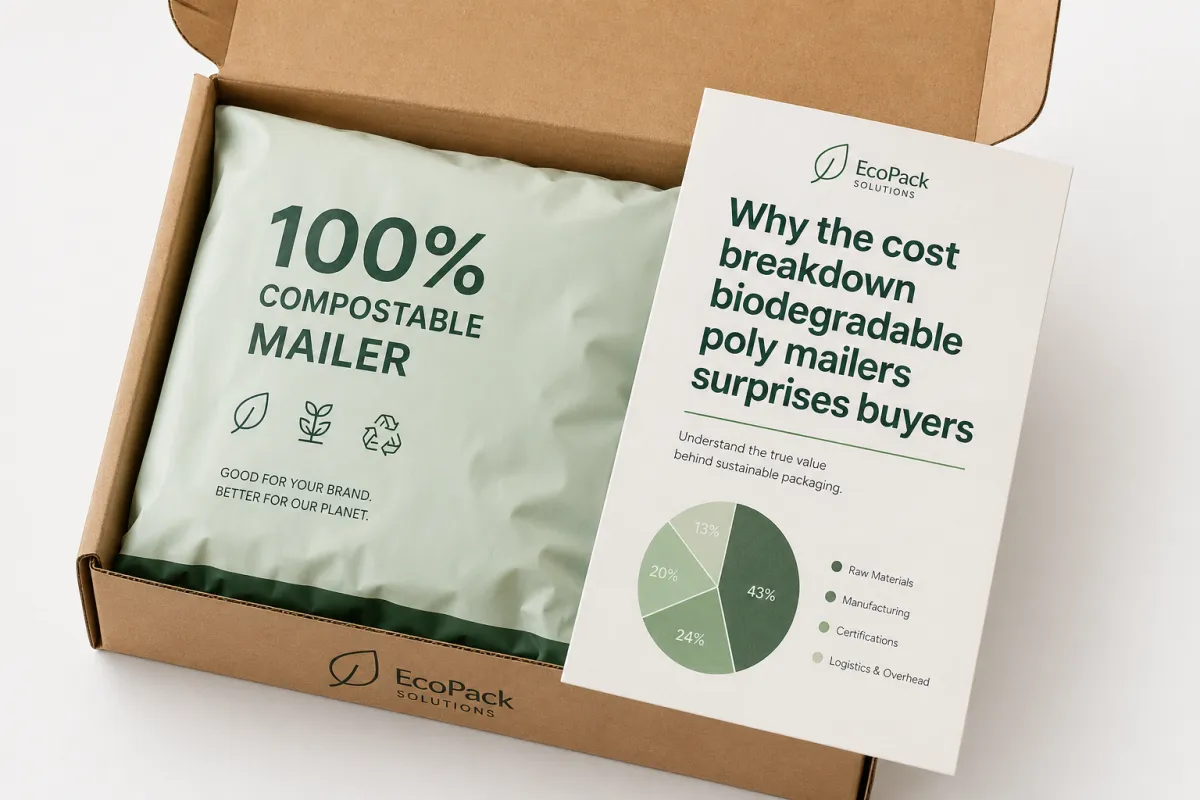
Short version: material, print, and freight drive most of the movement, and they do not arrive in a neat order. Buyers often approve samples, like the baseline price, and then discover final invoices drift upward because carton efficiency, documentation, or incoterms were never clarified. The cost dialogue has to start at grade one: from compound procurement to receiving dock. The dull details are the expensive details.
In Foshan, I watched a buyer compare two seemingly identical 9 x 12 one-color white bags. One came in at $0.16, the other $0.19. Same width, same height, same print count—and still different. The variance came from film blend behavior, strip adhesive quality, and freight bracketing. No dramatic packaging feature changed. Just production reality. That’s where people get burned: by assuming “same look” means “same economics.”
A proper cost breakdown biodegradable poly mailers starts with polymer behavior. PLA, PBAT, and starch blends do not cost the same or respond the same to extrusion, sealing, and humidity. A high PBAT ratio usually improves flexibility and tear handling, but it increases resin exposure to global commodity volatility. A cheaper formulation might pass initial inspection and still fail puncture checks in distribution if the additive profile is wrong. I have seen a 12-micron formulation difference move factory costs by around $180-$260 per metric ton at current supplier quotes—small on paper, huge at 10,000-plus volumes. And yes, that “saving” often gets eaten by returns once customer service starts fielding complaints.
Printing is usually the second silent multiplier. One-color logo placement sounds straightforward, but full flood coverage is a different animal, especially when an opaque background needs consistency across roll-to-roll output. Pantone matching means more than choosing a color value; it means tighter registration control, more ink waste potential, and slower line throughput during setup. A design that looks crisp on a monitor can become a production rework item once the press sees substrate variation and density drift. I have seen this in Guangzhou with a 2-day delay for proof revisions on a medium-volume order.
"The sample looked the same. The invoice did not." A buyer from a beauty DTC brand said that after seeing adhesive choice, setup charges, and freight class push his landed cost up by $0.04 per unit. He laughed at first, then frowned, then asked for a second quote. On 15,000 units that delta became $600 before duty treatment.
Certification has a real footprint in cost. If your packaging claims compostability, you are probably dealing with ASTM D6400, EN 13432, or equivalent testing streams—not every document is equal, and not every supplier interprets claims consistently. Documentation itself costs money: pre-audits, test retention, and traceability records. The packaging coalition page at packaging.org is useful for terminology grounding, and I use it as a first sanity check. I get wary when I see decorative green iconography with no clear chain-of-custody details, especially from brokers who are unwilling to name the manufacturing line.
Freight can be more surprising than resin cost. Low-weight mailers still can become expensive if carton count, cube, and routing push them into a higher dimensional weight class. I saw one lot double from an estimated $180 to $412 because cartons were overvolumed. Any cost breakdown biodegradable poly mailers that omits shipping assumptions is effectively a scenario, not a quotation. There is no romance in that kind of spreadsheet gap.
Cost Breakdown Biodegradable Poly Mailers: what you are paying for
Line items are simple, impact is not. In most orders, the core drivers are base film, size, thickness, print coverage, and MOQ. After that come conversion labor, seal performance, certification, and final freight treatment. If you bury costs into “miscellaneous,” you lose the thing that matters most: comparability across bids. I have seen “miscellaneous” hide
Base film is usually the first honest indicator. PLA and PBAT blends typically cost more than standard PE, and procurement teams should expect regional and channel differences depending on source reliability and lead sourcing. A starch-heavy blend can look cheap on a paper quote, but if it needs stronger stabilizers to pass transit stress, total cost rises with each corrective additive. In practice, factories pulling from stable resin channels in Guangdong or Jiangsu often look expensive upfront and cheaper after the first distribution cycle because reject rates are lower and run stability is higher. I have had to learn that the boring bid with fewer surprises is often the one worth approving.
Conversion labor is where many teams underestimate true cost. The process touches laminating, cutting, heat sealing, printing, and inspection, and any feature like tear strips, pressure-sensitive adhesives, or perforations affects machine time. In Huizhou, a perforation line pushed a small run’s processing down enough to raise unit cost by almost 7% at 5,000 units. I remember the conversation afterwards—same buyer, same product category, same month, same factory, different tolerance for complexity. Machines only care about cycle time, not sentiment.
Tooling and setup are not optional details; they are structural costs. Plate sets, cylinder adjustments, and die calibration can range from
Here is a practical comparison of materials and performance notes I commonly audit when benchmarking factories in Shenzhen, Dongguan, and Jiaxing:
| Material / spec | Typical factory price impact | Performance notes | Best use case |
|---|---|---|---|
| PLA + PBAT blend | Higher by $0.02-$0.05 per piece vs. basic PE at mid volumes | Good balance of flexibility and compostable positioning | Brands that need strong sustainability language and a cleaner finish |
| Starch-based blend | Lower resin cost, but more risk of seal or moisture issues | Can become less stable in humid storage environments | Shorter transit lanes and lower-duty applications |
| Recycled-content film with biodegradable additive | Often competitive, but claims need controlled documentation | Performance depends heavily on additive loading and process control | Buyers balancing cost sensitivity with recycled content targets |
| Custom-printed flood color | Adds measurable setup charges and ink waste in multi-pass runs | High visual impact but higher color consistency risk | E-commerce brands requiring strong on-shelf branding |
Other cost drivers include custom sizes, tear strips, perforation patterns, and closure systems. A 12 x 16.5 with a 50 mm flap may sound like a minor tweak, but one machine setting change cascades into film usage, scrap ratio, and labor steps. I have seen a 2 mm seal-width adjustment add 3% trim waste on an active line in Dongguan. In these cases, the same printed artwork is not the same product economically.
When teams ask for bid comparison, I ask for exact same-spec conditions: same destination, same artwork file, same carton configuration, and same handling profile. A $0.17 quote against a $0.19 one tells you nothing if one excludes freight or bills plates later. A fair cost breakdown biodegradable poly mailers comparison requires parity. I also ask for the final shipping city, because Portland, Toronto, or Hamburg each changes the carrier equation in a way nobody wants to discover after the freight invoice lands.
For transport stress, I reference ISTA methods at ISTA. It sounds bureaucratic, but it is exactly what protects budgets from wishful thinking. If mailers must survive drops, stacking, and conveyor vibration, handling assumptions should match tested scenarios, not a stylized sales image. A 1.2-meter drop sequence and a humidity profile at 85% RH will expose weak seals faster than a week of supplier promises.
Biodegradable poly mailers specifications that move the price
Dimensions are not an administrative footnote. A small width increase can push raw film usage up enough to move landed cost without any change in printing. I saw a 9 x 12 sample line move from $0.15 to $0.18 once the customer demanded extra room for folded knitwear and refused a layout change that improved nesting efficiency. That is plain film math. I remember that exact client saying, “It’s only a little bigger,” and I had to nod and explain that in film terms, a little can be expensive. On a 1,000-meter run, that change can remove 60-90 usable pieces from yield.
Thickness is the next lever. The 30-micron and 50-micron versions are different products in cost and behavior. The thicker option improves puncture resistance and gives more confidence in seal strength, but it also increases material load and can reduce speed if the line needs lower tension. I have watched procurement teams select the cheapest option and then face returns because edges cracked in parcel sorting. Thin film is the classic false economy; if you want, you can still test it, but do it before shipment, not after 20,000 returns.
Load capacity, opacity, seal type, and moisture resistance are line items that should always be explicit in any quote. A stable opaque white film is usually pricier than a translucent grade, and stronger adhesive strips usually cost more upfront but reduce labor and repackaging later. That is the real logic: spend a cent where loss would have been many cents. I once had to approve emergency rebagging because a 1-color adhesive flap delaminated in one fulfillment zone, and no one liked that lesson.
What saves money without undermining performance:
- Stick to standard sizes like 9 x 12 or 10 x 13 wherever operations allow, because custom die dimensions increase setup and conversion waste.
- Limit print to one or two spot colors unless the brand story truly needs more; each extra color increases setup and approval burden.
- Choose standard closure styles if a single shipping cycle is the real use case.
- Match thickness to actual payload category, not to a supplier’s “safe” stock default.
Where teams usually step wrong:
- Trying to shave cost by thinning the film to a cosmetic number and forgetting abrasion and edge stress.
- Ignoring seal strength while expecting zero returns.
- Upgrading a logo from spot print to flood print for no commercial reason.
- Changing size or thickness after quote approval and calling it “small” later.
A clean spec sheet should include five hard lines: finished size, thickness, blend, colors, and carton count, plus destination and delivery date. That is enough for factories to quote cleanly and for you to compare apples-to-apples across teams. Without it, the cost breakdown biodegradable poly mailers becomes guesswork with branding. I have seen teams chase a too-good price only to find it was missing half the operational requirements. If secondary packaging appears in the plan, include it there too: artboard inserts, hang-tag films, or rigid pack protection change the cost equation immediately.
My rule: if the mailer hits rain, humidity, stacking, or abrasion, do not approve by touch-feel alone. I have seen a sample pass manual inspection and fail a real drop test. The dock can be rude, but it is honest, whether it is in Seattle, Rotterdam, or another port city with difficult weather.
Pricing, MOQ, and lead times for biodegradable poly mailers
MOQ is never random. It reflects minimums for resin procurement, extrusion set-up, printer setup, and production stability. For custom runs, a realistic range is usually 5,000–10,000 pieces, but only after all spec variables are accounted for. That is why a good cost breakdown biodegradable poly mailers must show a tiered unit-cost curve, not a single static number. If the supplier refuses to show how quantity changes price, you should assume there are hidden assumptions.
Sampling usually leads, then approvals, then production. A physical sample can take 5–7 business days if stock film and simple artwork are available. Digital proof approval can add 1–3 days, especially with Pantone accuracy. Mass production commonly starts around 12–18 business days after approval; shipping is a separate timeline that often gets underestimated. I have seen teams confuse production time with ocean transit and then question the “delay” when Yantian to Long Beach takes 18–28 more days.
Reference framework for a first-pass comparison:
| Order size | Typical unit price | Setup / tooling | Lead time to ship | Notes |
|---|---|---|---|---|
| Sample run: 200-500 pcs | $0.55-$1.10 each | $0-$120 | 7-10 business days | Good for approval, not for unit-cost efficiency |
| Low MOQ: 5,000 pcs | $0.18-$0.32 each | $80-$250 | 12-15 business days | Common for branded e-commerce launches |
| Mid volume: 10,000 pcs | $0.12-$0.24 each | $80-$250 | 14-18 business days | Usually the cost-sweet spot |
| Production lot: 50,000 pcs | $0.08-$0.16 each | Often absorbed at volume | 18-25 business days | Best chance at lowest landed cost if freight is planned |
These figures are market-dependent and shift with resin cycles, seasonality, and print complexity. A rush request can add 8%–15%, especially when priority freight and overtime are needed. During peak shipping seasons, I have seen per-piece increases of $0.02–$0.05 due to capacity pressure alone. A cost breakdown biodegradable poly mailers is incomplete if timing is not treated as a cost line item.
Airfreight can break even cautious plans. One Austin project used air to rescue an event deadline on a low-value trial: $680 in air vs about $210 by sea on the same quantity. The shipment arrived on time; the campaign budget did not. A lot of people remember the success and forget the ledger, so I keep a separate line for mode-of-transport risk. Not dramatic, just expensive.
If you need the lowest cost per piece, you prioritize volume and standard specification. If speed matters, you price that in early. If you demand both at the same time, your supplier is managing your physics request. In my experience, physics allows a premium, not a free pass. A 30-day plan with 10 days approval plus 18 days sea freight is realistic for Southern China exports to West Coast U.S. receiving points when documentation is clean.
How we build the quote and lock the cost breakdown
We do not begin with a headline price. We begin with a complete build sheet: exact dimensions, blend, microns, print colors, destination, and target date. Without that, we are solving a moving puzzle. A rough description like “green 10 x 13 with logo” is not enough to protect your budget. A complete spec reduces the chance that price changes start after approval.
Artwork quality can make or break timeline and cost. A vector file with clean logos is efficient. A low-resolution JPEG and vague “make it pop” notes are expensive in hidden labor. Every extra color introduces plate load, inspection risk, and likely reproofs. I have had clients share the same file twice before saying “this is good enough” and still losing two days because press calibration needed corrections. Clean files save money; clean files also save stress.
Sample approval is the checkpoint where quotes either become trustworthy or stay theoretical. We validate size, seal strength, print location, and packing count. If revisions are needed, we rerun the impacted cost lines rather than force a hidden late adjustment. That keeps the final figure defensible. I have seen too many teams ignore this and then complain the PO was “not as quoted,” when the real issue was an unconfirmed revision cycle.
Payment terms also influence production certainty. Standard structures are 30/70 or 50/50 on larger, stable runs, but the booking logic is similar: slot protection is time-based. If a firm launch date matters, make that explicit early so converters can secure material and line windows in sequence. Missing approvals are the classic Friday trap, especially before short factory holidays, and they always arrive disguised as “minor follow-ups.”
A practical quote process usually goes like this:
- Submit finished dimensions, thickness, print colors, and target quantity.
- Confirm sustainability claims, compostability pathway, or biodegradable film specification scope.
- Approve a physical sample or final digital proof.
- Receive an explicit cost breakdown with setup, tooling, certification, and freight terms separated.
- Confirm production lock and freight booking if lead time is tight.
That may look boring, and honestly that is the point. Clean procurement language is what prevents late changes and budget fights. I have not seen fancy wording lower a freight invoice yet.
Why choose us for biodegradable poly mailers
What I value most are direct buyers who want the real numbers, and what we deliver is built around that. At Custom Logo Things, the quote format starts with transparency on material choice, production variables, and cost exposure so there are fewer surprises between PO and arrival. I am not interested in a cleaner quote if it falls apart in freight handling or post-shipment inspection.
My advantage is not magic. It is time spent near machines in Dongguan, Ningbo, and surrounding production zones, plus enough rounds of sample review to know where the cost actually hides. I have seen resin substitutions that looked harmless and then failed in distribution. I have also seen high-resin batches treated unfairly as “costly for no reason” because no one translated their benefits back into return-rate reduction. A real cost breakdown biodegradable poly mailers should help you make those calls with evidence, not faith.
For teams that compare multiple categories, our Custom Poly Mailers structure and the broader Custom Packaging Products catalog let you compare dimensions, films, print complexity, and logistics assumptions in one workflow. That reduces the risk of “we chose a mailer” while another component in the pack-out doubles packaging spend. In a mixed packaging setup, the mailer is rarely the only cost center, and matching specs in one source can avoid a lot of double counting.
Quality control is not an optional note item. It is the only thing standing between a good plan and an expensive return cycle. We evaluate seal uniformity, registration, corner strength, and carton efficiency before shipment. If adjustments are needed, we make them before dispatch, not after your warehouse gets hit with damage claims. I am not trying to be difficult when I push back on a “looks fine” sample; I am trying to prevent a costly failure chain.
Industry standards keep this grounded. ISTA methods provide a common language for handling assumptions, whether you are shipping to Barcelona, Atlanta, or a domestic route with heavy sorter exposure. Using test language does not sound glamorous, but it produces fewer surprises and steadier landed cost outcomes.
Next steps: get an exact cost breakdown biodegradable poly mailers quote
If you want a usable quote, you need five things from day one: finished size, film thickness, print colors, annual destination plan, and delivery window. Leave any one out and the result becomes an estimate that can swing with each follow-up. Omit the port-city detail, and freight terms turn into guessing. Omit file format standards, and setup charges can pop up after proofing. A Brooklyn shipment and a Munich shipment are not the same even with identical bags.
As a practical decision method, ask for three tiers: economy, standard, and reinforced build. You can quickly compare lowest-cost film, balanced performance, and upgraded durability without mixing assumptions. I use this method in cross-functional meetings where finance, brand, and operations are pulling in different directions. One aligned spec sheet usually resolves the argument fast. Keep carton count consistent across all scenarios—say 250 per carton—so freight math can be compared fairly.
Before production approval, request either high-resolution sample photos with scale references or a physical sample if timing and volume justify it. That visual check catches obvious seal placement issues, adhesive weakness, and registration drift before large lots start moving. I am not a fan of delayed discovery, and I have seen sample-level fixes save weeks of rework on runs too big to recover cheaply.
Always compare landed cost first. A $0.14 unit price can be a losing proposition if freight class, carton design, or correction cycles are hidden, while a $0.16 unit can win the actual budget if logistics stay clean. On 30,000 pieces, a
Actionable takeaway: send one clean spec sheet with exact dimensions, blend, print scope, and city-level shipping terms; insist on a quote that splits setup, tooling, freight, certification, and inspection; then choose the option with the best total landed outcome, not the smallest first-line unit price. If the quote looks too good to be true, it probably has an unstated condition somewhere. The goal is simple: a cost breakdown biodegradable poly mailers proposal that still makes sense when shipment is on the water and the freight invoice lands at month end.
What drives the cost breakdown of biodegradable poly mailers the most?
Material blend is usually the first driver, followed by size, thickness, print coverage, and volume discount impact. MOQ determines how setup and tooling are allocated, and freight can change landed cost more than a small unit-price delta. In one case, a 10,000-piece quote shifted by $0.04 per unit just from freight planning, turning an apparent $1,200 gap into a near $1,600 landed difference. That is the kind of variation teams should include in every approval discussion.
Are biodegradable poly mailers more expensive than regular poly mailers?
In most cases, yes, because polymer sourcing and sustainability-focused specs add to resin and conversion cost. The gap narrows at higher volumes when tooling and setup are diluted. Compare only equivalent products: the same size, thickness, print method, and destination. A 10 x 13 at 35 microns and a 9 x 12 at 50 microns cannot be treated as a clean substitution in any honest cost review.
What is a realistic MOQ for biodegradable poly mailers?
Most custom runs start around 5,000–10,000 pieces. Smaller batches can happen, but the per-unit cost usually rises because equipment setup is spread over fewer units. Standard dimensions and simple printing keep low MOQs more practical. If you need very small runs to cost like scale production, I have bad news for you and for the machine schedule.
How long does production take for custom biodegradable poly mailers?
Sampling and proof approval are usually the first time sinks; production begins only after signoff. Simple designs run faster than heavy print, custom dimensions, or certification-heavy workflows. Shipping is a separate phase and should be included in your project calendar from day one. I generally recommend adding buffer for Q4 logistics behavior and holiday closeouts because planning optimism rarely survives real throughput.
What should I ask for in a biodegradable poly mailers quote?
Ask for material definition, thickness, dimensions, print colors, MOQ, lead-time assumptions, and shipping terms. Confirm landed cost, not just factory-side pricing, and confirm whether sample, plates, and certification documents are included. This checklist catches most weak quotes early. If a supplier cannot explain the cost breakdown biodegradable poly mailers in those terms, request a revised proposal before committing.

