Buyer Fit Snapshot
| Best fit | printed box inserts for products for packaging buyers comparing material specs, print proof, MOQ, unit cost, freight, and repeat-order risk where brand print, material, artwork control, and repeat-order consistency matter. |
|---|---|
| Quote inputs | Share finished size, material target, print colors, finish, packing count, annual reorder estimate, and delivery region. |
| Proofing check | Approve dieline scale, logo placement, barcode or warning zones, color tolerance, and any recyclable or compostable wording before bulk production. |
| Main risk | Vague material claims, crowded artwork, or missing packing details can create delays even when the unit price looks attractive. |
Fast answer: Printed Box Inserts for Products: Design, Cost, Timing should be specified like a repeatable production item. The safest quote includes material, print method, finish, artwork proof, carton packing, and reorder notes in one written spec.
What to confirm before approving the packaging proof
Check the product dimensions against the actual filled item, not only the sales mockup. Ask for tolerance on folds, seals, hang holes, label areas, and retail display edges. If the package carries a logo, QR code, warning copy, or legal claim, reserve that space before decorative graphics fill the panel.
How to compare quotes without losing quality
Compare board or film grade, print process, finish, sampling route, tooling charges, carton quantity, and freight assumptions side by side. A lower quote is only useful if the supplier can repeat the same color, closure quality, and packing count on the next order.
Printed Box Inserts for Products: Design, Cost, Timing
A product can arrive safely and still feel cheap. That usually happens when Printed Box Inserts for products do the structural job but ignore the brand experience, or when the artwork looks polished and the insert itself folds, bows, or shifts inside the carton. Pretty outside, messy inside. Not a great look.
That is the real value of printed box inserts for products. They are not filler. They are custom internal components that hold items in place, reduce movement, and turn the inside of a box into part of the customer experience. For brands shipping cosmetics, electronics, gift sets, and subscription boxes, the insert often decides whether the packout feels intentional or kinda thrown together.
From a packaging buyer’s point of view, the promise is straightforward: better fit, better presentation, fewer returns, and more predictable packing performance. The tricky part is getting those benefits without making the insert expensive, slow to assemble, or annoying to recycle. That tradeoff is where a lot of projects wobble.
What Are Printed Box Inserts for Products?
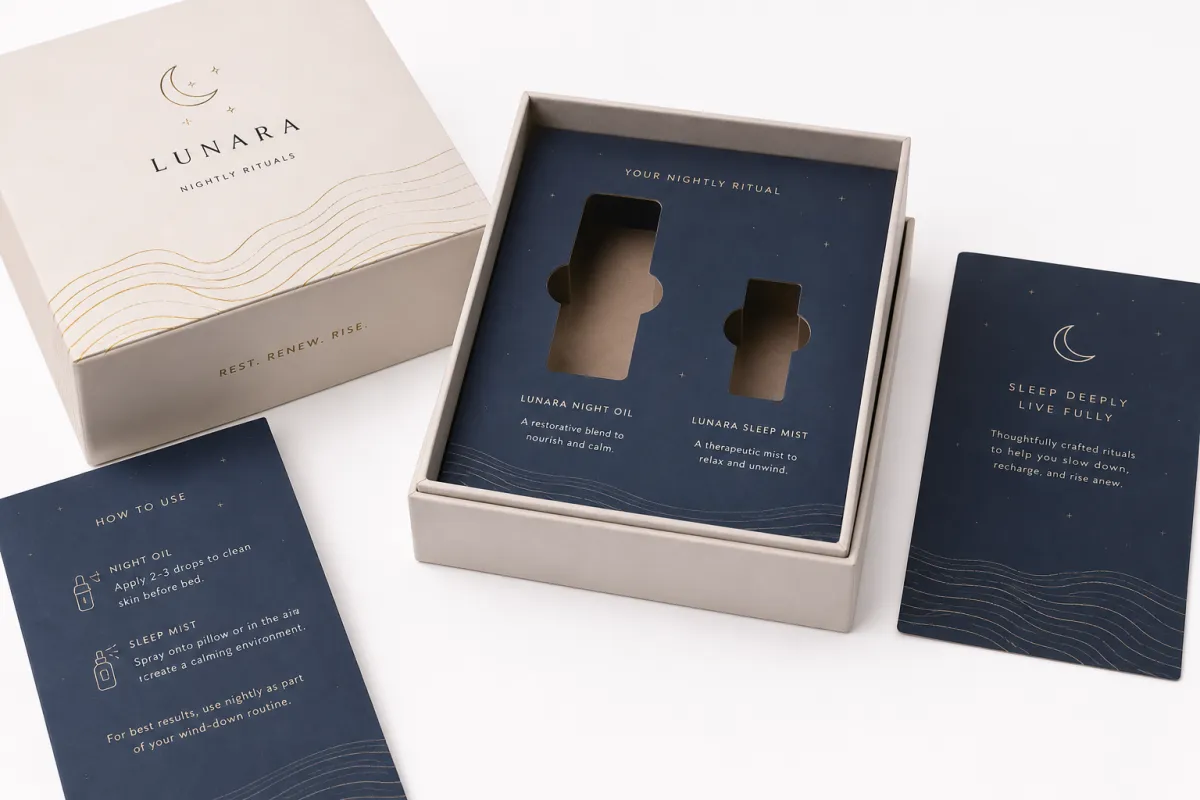
Printed box inserts for products are internal packaging components designed to secure one or more items inside a shipper or retail carton. Most are die-cut from paperboard, corrugated board, molded fiber, or another substrate, then scored, folded, or formed to match the product footprint. The insert may include cutouts, tabs, pockets, walls, or cradles that keep the item from shifting in transit.
The problem is easy to see. A bottle, device, candle, or sample kit may survive the delivery route, but if it rattles inside the box, scuffs at the corners, or lands off-center, the brand experience drops fast. Printed box inserts for products reduce that movement, which helps protect surfaces and keeps the unboxing sequence consistent from order to order.
Two jobs are happening at once: structure and communication. Structural inserts focus on retention, separation, and cushioning. Printed inserts can add brand cues, instructions, recycling guidance, or a visual hit that makes the opening feel more deliberate. Many brands want both in one piece, which is why printed box inserts for products are usually treated as a hybrid packaging element instead of a pure support component.
They show up most often in e-commerce kits, cosmetics, electronics, food gifts, medical sampling programs, and retail shipments where the outer box is part of the sale. In those cases, the insert is not hidden waste. It is visible packaging real estate, and buyers increasingly expect it to say something useful. That might be a QR code, a care reminder, a setup step, or a short brand message that reinforces the purchase.
There is a quieter benefit that procurement teams notice quickly: a well-designed insert makes the packout repeatable. The warehouse does not need to interpret the fit every time. The item lands in the same place, with the same pressure points, and the same closure behavior. I have seen that consistency save more money than the prettier print ever did. It is one reason printed box inserts for products can be the difference between a box that looks good on a sample table and one that holds up across a real shipping run.
How Printed Box Inserts for Products Work
The mechanics are simple. The details are not. An insert is cut or formed to match the dimensions of the product and the carton, then placed inside the box before or during fulfillment. A phone accessory kit might use a flat die-cut insert with pockets. A premium candle set might use a layered board tray. A heavier item may need corrugated walls or a molded fiber cradle. Printed box inserts for products work because geometry does the heavy lifting.
Once the product sits in the cavity, the insert controls movement in three directions. It limits lateral slide, resists vertical bounce, and reduces corner abrasion. If there are multiple components, the insert can separate them so they do not strike each other during transit. That matters with glass, polished metal, painted finishes, and products with fragile appendages. If a brand has ever opened a return and found a scratch across a glossy cap, this is the part that stings.
Printing adds another layer of function. Some brands use direct print on the board. Others choose one-color utility markings, labels, or full-surface graphics. The right option depends on budget, opacity needs, and how much of the insert remains visible after loading. A bright illustration hidden under the product is not doing much, no matter how strong it looked in the mockup.
The relationship between the insert and the outer box is where projects usually succeed or fall apart. A beautifully printed insert that fights the carton closure is a problem. So is a tray that requires too much hand adjustment on the line. Printed box inserts for products need to fit the carton dimensions, closure style, and packing speed, not just the product itself. In practice, a good insert is easy for warehouse staff to load consistently without slowing pick-and-pack flow.
That is also why testing should reflect the actual process. If the packer has to insert the item upside down, rotate a cable, or clip in a leaflet after the product is seated, the design should be judged on that real sequence, not on a tidy CAD render. For transit testing methods, many teams reference the guidance and standards library at ISTA, because a controlled lab test is far more useful than a visual assumption. A supplier can promise the moon. The drop test usually tells the truth.
Key Factors That Shape Printed Box Inserts for Products
Material choice comes first. Paperboard works well for lighter items and premium presentation. Corrugated adds stiffness and better crush resistance. Molded fiber is attractive where recycled content and a more natural look matter. Foam alternatives still exist in some categories, but many brands are moving away from them because of sustainability pressure and recycling concerns. The substrate you choose changes the feel, the print finish, and the cost profile of printed box inserts for products.
Product weight and fragility drive the structure. A 120-gram cosmetic compact does not need the same retention as a 900-gram glass bottle or a small electronic device with accessories. Surface finish matters too. Gloss-coated items, anodized metal, and soft-touch coatings can scuff easily, so the insert may need wider contact points, smoother folds, or a liner that reduces abrasion. If the product shifts even a few millimeters, the customer sees it.
Branding needs are often more ambitious than buyers expect. The insert may carry a setup note, a recycling cue, a quality-control code, a QR link, or a short message that explains what the customer is holding. That is useful, but it should not bury the structure. Printed box inserts for products perform best when the graphics support the packing logic instead of fighting it.
Printing itself has constraints. Heavy ink coverage can affect drying, scuff resistance, and color consistency. Small text needs enough contrast to stay legible once the box is opened under shop lighting or on a doorstep. Some areas of the insert may be hidden by the product, so the visible canvas is often smaller than buyers imagine. A good supplier will map the print zones against the loaded state, not just the flat dieline.
Method matters too. Digital print can be useful for short runs or faster artwork changes. Offset can deliver sharper detail at scale. Flexographic print is often practical for utility-heavy work or larger volumes. None of those choices is magically best; they each solve a different production problem. If someone says one process wins every time, they are selling something.
Sustainability and compliance are part of the conversation too. If a brand wants recyclability claims, the material and inks need to match that claim. If the product touches food, there may be regional requirements around migration, odor, or food-safe construction. If the brand uses forest-based materials, FSC chain-of-custody documentation may be relevant, which is why many teams check resources at FSC before locking in a substrate. None of this is automatic. It depends on channel, geography, and claim language.
Visibility matters more than many teams expect. An insert can be highly printed and still not influence the customer if the box opens in a way that hides most of the artwork. That is why the brief should define the opening moment, the camera angle for social content, and the exact sequence a customer will see. For printed box inserts for products, visibility is a design parameter, not an afterthought.
Printed Box Inserts for Products: Process and Timeline
The process usually starts with measurements, not graphics. The supplier needs product dimensions, weight, accessory count, carton size, and the desired packout sequence. From there, the structural concept is drafted, the dieline is created, and the artwork is placed only after the fit makes sense. For printed box inserts for products, skipping that order of operations is one of the fastest ways to create a costly revision loop.
A realistic timeline depends on complexity. Simple flat inserts can move from brief to production fairly quickly if dimensions and artwork are final. Multi-part structures, premium finishes, and inserts that must hold several objects usually need prototype review, fit checks, and another approval cycle. In many programs, the time sink is not manufacturing; it is decision-making.
Delays usually come from incomplete information. A product measured without a cable, cap, or insert card can be a few millimeters off. That sounds tiny until the cavity is cut too tight. Late artwork changes create another bottleneck because print plates, cutting forms, and sample approvals all depend on a stable file. The cleanest way to keep printed box inserts for products on schedule is to freeze the structural facts before the graphic polish begins.
Here is the sequence that tends to work best:
- Send a physical sample, if possible.
- Share finished dimensions and actual product weight.
- Confirm carton size, closure style, and shipping method.
- Approve a structural prototype before final print sign-off.
- Test the packout with the people who will use it.
That last step is easy to skip and hard to fix later. The warehouse team will reveal whether the insert is too fiddly, whether the product drops into place cleanly, and whether the loading direction makes sense. If the insert takes too long to assemble, the design may be technically correct but operationally weak. That is why printed box inserts for products should be judged by packout speed as much as by appearance.
Typical timing guide: many straightforward projects land in the 12 to 15 business day range from proof approval to production completion, while more complex builds often need 3 to 5 weeks once sampling, revision, and testing are included. Freight, seasonal congestion, and artwork churn can extend that. The safest launch plan is to build the insert schedule around inventory arrival, not after it.
Printed Box Inserts for Products: Cost and Pricing Factors
Pricing is easier to understand when it is broken into parts. Buyers are paying for material, cutting tooling, printing, labor, finishing, and freight. Sometimes they are also paying for setup time, especially on short runs. With printed box inserts for products, the line item that looks expensive on paper can still be cheaper than the hidden cost of damage, rework, or hand-packed void fill.
Volume changes everything. A small run has to absorb design setup and tooling over fewer units, so unit cost looks high at first glance. Once quantity rises, the per-piece price usually drops, but not always in a straight line. A premium insert with several folds, internal partitions, or heavy ink coverage may cost more than a plain structural insert, yet it can replace a separate leaflet, tissue wrap, or top card. That tradeoff matters.
Materials drive a bigger portion of cost than many teams expect. A thicker board or higher ECT corrugated sheet raises the price, but it may also reduce transit damage. Coatings, special finishes, and multi-part assemblies add labor and scrap risk. That is why two inserts that look similar on a render can price very differently. Printed box inserts for products are a design problem before they are a purchasing problem.
Below is a useful directional comparison for common options at mid-volume. These are not universal quotes; they are the kinds of ranges packaging buyers often see when print coverage, setup, and geometry are in the normal range.
| Insert Type | Typical Best Use | Approx. Unit Cost | Strength / Presentation |
|---|---|---|---|
| Paperboard die-cut insert | Light products, cosmetics, gift kits | $0.18-$0.32 | Clean look, moderate protection |
| Corrugated insert | Heavier items, shipping-focused packs | $0.22-$0.40 | Better crush resistance, less premium feel |
| Molded fiber insert | Sustainable retail and e-commerce programs | $0.24-$0.45 | Good protection, natural texture, less print detail |
| Foam alternative insert | Legacy protective packs, fragile hardware | $0.30-$0.60 | High retention, weaker sustainability story |
Freight can be the silent budget problem. A lightweight insert that ships flat may look economical until the lane, pallet count, or packaging format changes. The cheapest option is not always the least expensive choice if it causes damage claims, slows the packing line, or forces a second packing material into the box. With printed box inserts for products, the real question is not unit price alone. It is total cost per successful shipment.
Here is the practical buyer test: if the insert replaces a separate marketing card, reduces fill material, and cuts return rates, it may justify a higher price. If it saves half a cent and adds twelve seconds to assembly, the math gets worse quickly. That is the kind of comparison a procurement team should make before approving artwork and tooling. I am not trying to be dramatic here; the math is just unkind.
Common Mistakes With Printed Box Inserts for Products
The first mistake is designing for the render instead of the real product. CAD files are useful, but actual items come with tolerances, caps, cords, closures, labels, and tiny inconsistencies that show up as soon as a pilot run begins. A beautiful concept can fail because the cavity is a millimeter too tight or the carton flexes more than expected. Printed box inserts for products have to fit reality, not just the approval deck.
The second mistake is over-printing. If every inch is covered with messaging, QR codes, care instructions, and graphic flourishes, the structure becomes harder to read and the insert can look busy. Buyers sometimes forget that an insert is still a packaging component. Too much ink can obscure fold lines, weaken visual hierarchy, or create drying issues that affect scuff resistance. The best printed box inserts for products usually have a clear job and a clear visual order.
A third problem is choosing a material that looks premium but behaves badly under compression, humidity, or repeated handling. A board that looks elegant on the sample table may bow in a hot truck or soften in a damp warehouse. That is not theoretical. It shows up as corner lift, loose fit, and shifted product. For a protective pack, that is a cost center dressed up as design.
If the insert is hard to pack, the problem will show up in labor minutes before it shows up in damage claims.
Another common oversight is assembly time. If the insert has too many folds, too many orientations, or unclear placement steps, the line slows down. A design that looks simple on a drawing can become awkward in a real fulfillment environment. Good printed box inserts for products are designed for repeatable human motion, not just for idealized geometry.
Finally, some brands skip transit testing. That is risky. A packout can look perfect in the office and still fail when vibration, drop height, compression, or temperature changes enter the picture. When testing is relevant, standards such as ASTM D4169 or channel-specific ISTA methods help teams compare apples to apples. The point is not paperwork. It is reducing avoidable returns before they hit the customer.
There is a simple pattern behind most failures: the team optimized one thing and ignored the rest. Protection without speed. Beauty without fit. Sustainability without structure. Cost without risk. Printed box inserts for products perform best when those tradeoffs are named early instead of discovered after launch.
Expert Tips and Next Steps for Printed Box Inserts for Products
Start by deciding what matters most. Not all inserts need to optimize the same thing. Some programs care most about protection. Others care about shelf impact or e-commerce unboxing. A few are mainly cost control exercises. If the team never chooses a primary goal, printed box inserts for products end up trying to do everything and doing none of it especially well.
Then test the insert with the actual product, actual carton, and actual people who will pack it. That means more than sending a PDF to production. It means loading the insert with the accessories, closing the box, shaking it, opening it, and checking whether the product moved, rubbed, or popped out of position. If the insert is part of a premium reveal, confirm that the opening angle creates the effect you expect. Small details create the impression.
A prototype is worth the time. Ask for one, then inspect edge abrasion, print legibility, closure fit, and loading speed. A small pilot run can expose issues that no drawing will reveal. That is especially true for printed box inserts for products used in subscription boxes or assembled kits, where even a small delay per unit scales into a labor problem fast.
When you request quotes, send a clean bundle of information:
- Finished product dimensions and weight.
- Photos of the item from multiple angles.
- Carton size and closure type.
- Target order quantity and replenishment rhythm.
- Brand guidelines, print expectations, and recycling requirements.
The more complete the brief, the more accurate the structural proposal will be. That also shortens the back-and-forth that slows sampling. If the product has multiple components, say so. If a leaflet, cable, or spare part has to fit in the same insert, say that too. The supplier cannot price what it cannot see. Printed box inserts for products are easiest to quote when the use case is specific and the launch date is real.
My final advice is simple: audit your current damage rate, pull together a sample kit, and compare the current packout against a purpose-built insert. If the insert reduces movement, speeds packing, and improves the opening moment, it earns its place. If it only looks nicer in a mockup, it is probably not ready yet. The best printed box inserts for products protect the item first, then make the inside of the box feel worth opening.
Frequently Asked Questions
How do printed box inserts for products improve shipping protection?
They keep the product from shifting inside the box, which reduces impact and abrasion. They also separate multiple components so items do not strike each other during transit. When the packout stays consistent, damage rates are easier to monitor and control.
What materials are best for printed box inserts for products?
Paperboard works well for lighter items and premium presentation. Corrugated and molded fiber are stronger choices for heavier or more protective applications. The best material depends on weight, fragility, sustainability goals, and how quickly the line needs to pack the order.
How long does it take to produce printed box inserts for products?
Simple inserts can move from brief to production quickly if dimensions and artwork are final. Custom structures or multi-part designs usually need prototype review and approval time. Delays usually come from incomplete measurements, late artwork changes, or extra testing rounds.
Are printed box inserts for products expensive for small runs?
Small runs often cost more per unit because tooling and setup are spread over fewer pieces. A simple insert can still be cost-effective if it replaces separate packing materials or reduces damage. A sample or pilot run helps confirm whether the design is worth scaling.
What should I send to get an accurate quote for printed box inserts for products?
Send product dimensions, weight, photos, and any accessories that must fit inside the insert. Include carton size, shipping method, target quantities, and any branding or sustainability requirements. If possible, provide a physical sample so the manufacturer can verify fit and assembly.