Buyer Fit Snapshot
| Best fit | Printed Box Inserts Supplier projects where brand print, material claims, artwork control, MOQ, and repeat-order consistency need to be specified before quoting. |
|---|---|
| Quote inputs | Share finished size, material target, print colors, finish, packing count, annual reorder estimate, ship-to region, and any compliance wording. |
| Proofing check | Approve dieline scale, logo placement, barcode or warning zones, color tolerance, closure strength, and carton packing before bulk production. |
| Main risk | Vague material claims, crowded artwork, missing packing details, or unclear freight terms can make a low unit price expensive after revisions. |
Fast answer: Printed Box Inserts Supplier: Board, Finish, Dieline, and Unit Cost should be specified like a repeatable production item. The safest quote records material, print method, finish, artwork proof, packing count, and reorder notes in one written spec.
Production checks before approval
Compare the actual filled-product size with the drawing, then confirm tolerance on folds, seals, hang holes, label areas, and retail display edges. Reserve space for logos, QR codes, warning copy, and material claims before decorative graphics fill the panel.
Quote comparison points
Review material grade, print process, finish, sampling route, tooling charges, carton quantity, and freight assumptions side by side. A quote is only useful when the supplier can repeat the same color, closure quality, and packing count on the next order.
The first thing customers touch after opening a box is often the insert, not the product. That makes the choice of a Printed Box Inserts supplier a bigger decision than a line item on a quote. It affects brand perception, product protection, and the odds of seeing returns that start with "arrived damaged." A flimsy insert that shifts in transit can make a premium item feel cheap before anyone even gets to the good part.
From a packaging buyer's point of view, the best printed insert does three jobs at once: it holds the product, it supports the brand, and it survives the trip. If a supplier talks only about print and never asks about fit, structure, weight, or shipping abuse, that is not a packaging partner. That is a printer wearing a packaging costume and hoping nobody notices.
I have seen teams approve beautiful inserts that failed in the first real shipment because the cavity was off by a few millimeters. That tiny miss can turn into scuffed finishes, cracked corners, or a pack-out process that slows to a crawl. Packaging is weird like that. Small errors get expensive fast.
What a Printed Box Inserts Supplier Actually Does
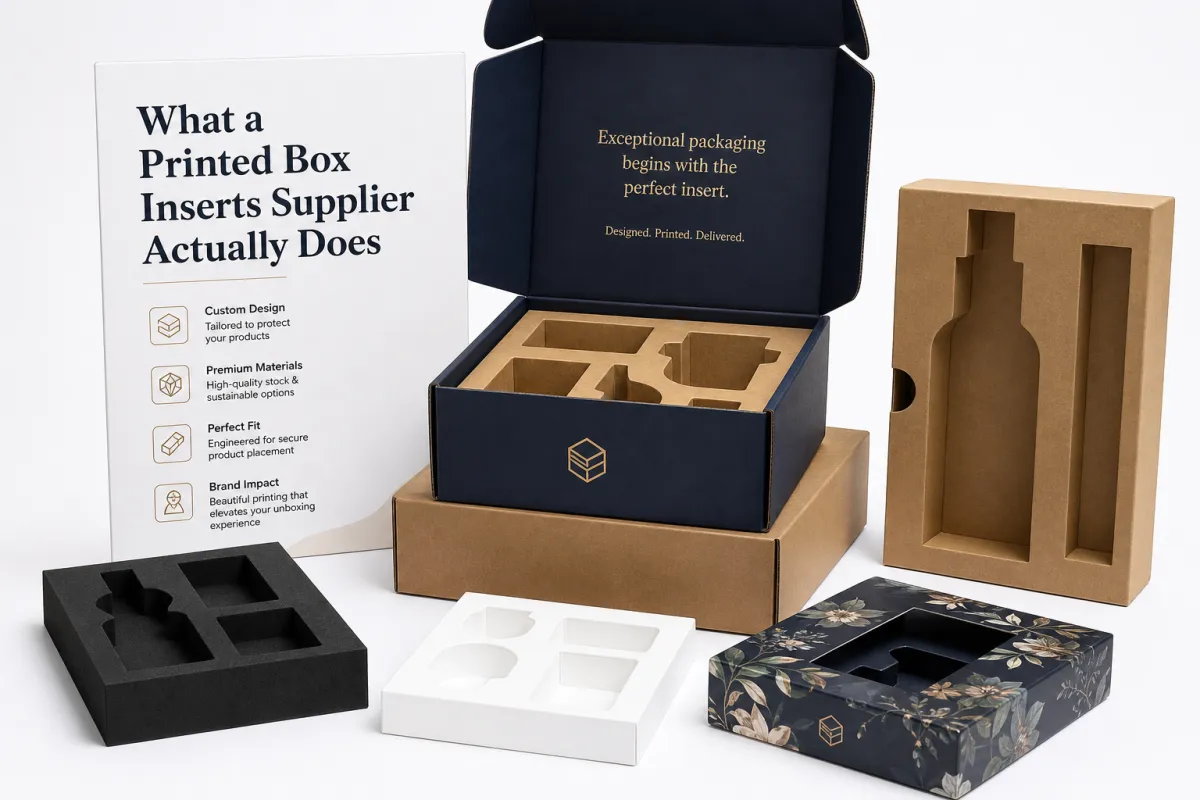
A printed box inserts supplier does more than run sheets through a press. The work starts with engineering. The supplier needs to understand the box size, the product shape, the number of pieces in the kit, and how much movement the contents can handle before damage starts showing up. The insert has to be built around both presentation and protection. If one of those gets ignored, the job is already wobbling.
Plain protective inserts stop items from rattling around. Printed inserts do that too, but they also add structure to the unboxing moment. A logo on the insert, a short setup guide, a QR code, or a care instruction can make the package feel organized instead of improvised. Brands shipping cosmetics, electronics, gift sets, subscription boxes, or food assortments usually feel that difference quickly because the insert is often the first branded surface a customer sees.
A printed box inserts supplier may work with folding cartons, rigid board, corrugated die-cuts, paperboard trays, or a mix of those materials. The right choice depends on the product load and the shipping path. A lightweight cosmetics kit can work well with 18pt SBS or coated paperboard. A heavier electronics set may need E-flute corrugated or a stronger chipboard base. A luxury gift box may call for 24pt or thicker rigid board with print on one or both faces.
The real difference between a basic insert and a printed one is not decoration. It is organization. Printed inserts can label each cavity, show assembly order, reduce packing mistakes, and cut down on customer confusion after opening. If you sell multi-piece kits, that matters. A supplier that understands that is worth more than a low quote from someone who only cares about ink coverage.
A printed box inserts supplier should act like a packaging partner, not a vendor that disappears after the PO clears. They should ask about product fragility, shipping method, fulfillment speed, shelf life if relevant, and whether the insert has to work on an automated packing line. If those questions never come up, the sample you get may look nice and fail the first time it meets a delivery truck. That happens more often than anyone wants to admit.
"A pretty insert that does not fit is just expensive confetti."
Common use cases include e-commerce starter kits, gift packaging, cosmetics boxes, tech accessory boxes, retail display packaging, influencer mailers, and subscription bundles. A good printed box inserts supplier will know how to balance material cost, print quality, and structure so the insert still performs after it has been stacked, dropped, and pushed through freight. That is the actual job. The rest is window dressing.
There is also a brand side to this that people underplay. A clean insert can make a small brand look established. A messy one makes a big brand look sloppy. Same box, same product, very different signal. That kind of detail is why packaging buyers keep coming back to the insert spec instead of treating it like an afterthought.
How a Printed Box Inserts Supplier Manages Process and Timeline
The process usually starts with spec collection. A serious printed box inserts supplier needs exact box interior dimensions, product dimensions, product weight, number of units per box, artwork files, print targets, and the final ship-to location. Send vague notes like "roughly this size" or "similar to the old one," and revisions are coming. Packaging is not a mind-reading exercise, even if a lot of people act like it should be.
Once the specs are in hand, the supplier should build or confirm the dieline. That flat layout controls folds, cut lines, cavity spacing, and any locking tabs. Proofing comes next. A proof may start digital, then move to physical if the run is complex or color matters a lot. For projects with strict fit requirements, a sample stage is worth the extra time because the actual product needs to be tested in the insert before the full run starts.
Typical timeline ranges are fairly predictable. Quick quoting often takes 1-3 business days if the spec sheet is clean. Sample or proof turnaround usually lands somewhere between a few days and about a week. Production commonly runs 2-4 weeks after approval, depending on quantity, print method, finishing, and paper stock availability. Rush runs can shrink the schedule, but they usually grow the cost. That is not a mystery. It is just production.
The most common delays are boring, which makes them even more annoying. Missing dimensions force the supplier to stop and ask questions. Unclear artwork creates extra proof cycles. Material backorders can push production by days or more. Freight decisions made late in the process can also wreck a schedule, especially if nobody left enough time for transit. A printed box inserts supplier that warns you about those issues before they turn into missed launches is doing the job properly.
Approval is where a lot of teams burn money. Before volume production starts, confirm the dieline, the print proof, the color target, and the fit. If the insert has to survive shipping, ask for some form of transit testing. For projects that need a formal method, standards like ISTA protocols or ASTM drop and vibration methods are useful references. If the insert uses paper from certified sources, FSC chain-of-custody documentation can matter too.
Build buffer time into launches. Seasonal drops, subscription launches, and multi-SKU kits almost always take longer than people expect because somebody wants one more revision after the artwork is already "basically done." Ask the printed box inserts supplier exactly what they need from you to keep the schedule moving. Cleaner inputs mean fewer ugly surprises later.
The other thing that slows projects down is approval by committee. Five people can look at the same insert and somehow all request different changes. One wants brighter print. One wants thicker stock. One wants the logo moved half an inch. That is how a two-week job turns into a six-week one. Try to get one clear decision-maker on the packaging side. It saves everyone a headache.
Printed Box Inserts Supplier Pricing: What Drives Cost
Pricing is where buyers either get smart or get fooled by a nice-looking quote. A printed box inserts supplier prices jobs based on material, thickness, print coverage, number of colors, die-cut complexity, finishing, and quantity. That is the short version. The longer version is messier: every choice creates a cost ripple, and some of those ripples do not show up until the insert is already in production.
Material is usually the biggest variable. Thin paperboard costs less, but it may not support the product well. Rigid board looks premium, but it adds material and tooling cost. Corrugated inserts cost more than basic card stock because they are stronger and more stable. Recycled or kraft stocks can be cost-effective, though the print look may be more muted. If the supplier has to add lamination, spot coating, or special finishing, the price climbs again.
Minimum order quantity matters a lot. Small runs carry a larger share of setup, tooling, and prepress cost per unit. Larger runs spread those costs across more inserts and usually bring the unit price down. For a rough buying framework, short runs of 250-500 units can cost meaningfully more per piece than runs of 2,500-10,000 units. That is normal. The bad news is that some buyers compare a short-run quote against a volume quote and then act surprised that the math looks wrong. It looks wrong because the assumptions are different.
There are also hidden costs people forget to ask about. Sample fees can apply. Custom tooling or die plates may be billed separately. Freight is not free, despite what a few polished quotes imply. Rush charges can sting. Rework on corrected artwork can add cost if the first file set was incomplete. A printed box inserts supplier should spell out these items before you sign anything, not after the first invoice lands.
| Insert Type | Typical Use | Ballpark Unit Cost at 5,000 Units | Cost Notes |
|---|---|---|---|
| 18pt SBS printed insert | Light cosmetics, accessories, sample kits | $0.10-$0.18 | Good for clean print and lighter loads; best with simple die cuts |
| 24pt rigid board insert | Premium gift boxes, luxury sets | $0.22-$0.45 | Higher material cost, stronger feel, better for presentation |
| E-flute corrugated insert | Electronics, shipping protection, heavier contents | $0.16-$0.32 | Stronger cushioning, usually more stable in transit |
| Kraft paperboard insert | Eco-focused kits, simple branded mailers | $0.08-$0.16 | Lower material cost, more natural look, print can be less vivid |
Those ranges are not promises. They are a practical starting point. A 1,000-piece run can easily land 30-70% higher per unit than a 5,000-piece run, depending on setup and material. A more complex structure, full-bleed print, or unusual cavity layout can push pricing up fast. On the other hand, simplifying the artwork and reducing print coverage can save real money without wrecking the package.
The smartest move is to compare landed cost, not just unit price. Include freight, sample cost, waste allowance, and reprint risk. A low quote that creates damaged products or customer complaints is not cheap. It is just delayed expense with better branding on the invoice. If a printed box inserts supplier cannot explain where the dollars go, that is a red flag the size of a shipping pallet.
One practical note: price swings can be regional too. Board availability, freight lanes, and labor all affect the quote. A supplier near your fulfillment center might cost a little more per sheet and still save money overall. I have seen that happen enough times to stop trusting the cheapest line item by itself. It is kinda useless without the rest of the math.
Key Factors to Compare Before You Choose a Supplier
Fit accuracy should come first, every time. The insert has to hold the product securely without crushing it, pinching labels, blocking closures, or forcing gymnastics on the packing line. If the cavity is too tight, workers slow down and the product may scuff. If it is too loose, the item moves in transit and damages itself or the box. Either way, the insert is failing. A good printed box inserts supplier will treat fit as a design problem, not a guess.
Print quality matters, but it should be judged in context. Fine type, logo sharpness, color consistency, and registration control all matter, especially for consumer-facing packaging. Ask for photo proofs, physical samples, or examples of previous work with similar material and coverage. White ink on kraft, deep black on uncoated stock, or a small logo on a dark insert can behave very differently than they do on a screen. Screens lie. Materials do not.
Material choice changes everything. Corrugated, SBS, rigid board, kraft, and recycled stocks each have strengths and weaknesses. Corrugated gives structure and cushioning. SBS offers smooth printability. Rigid board feels premium but may cost more and require careful handling. Kraft can support an earthy brand look, though color reproduction may be less saturated. A printed box inserts supplier worth dealing with will explain those tradeoffs plainly instead of pretending every substrate is equally magical.
Communication quality is a surprisingly good predictor of production quality. If the supplier asks the right questions early, catches missing dimensions, and pushes back when your artwork does not work structurally, that is a good sign. If the reply is just "yes, no problem" to everything, be careful. Packaging that is "no problem" on paper often becomes a problem right after the PO clears.
Compliance and logistics also matter. If the insert touches cosmetics, food, or electronics, basic cleanliness and material suitability are not optional. For products exposed to moisture or long transit times, the stock and coating need to survive real-world storage conditions. If you need retail-ready packaging, ask about shelf presentation and barcode placement. If the insert needs to support a sustainability claim, make sure the supplier can back up recycled content or certified sourcing instead of tossing out green buzzwords like confetti.
One useful way to compare suppliers is to rate them against a few concrete measures:
- Fit confidence: do they validate dimensions and product load before production?
- Print consistency: do sample colors, text, and registration hold up across the run?
- Material guidance: do they explain tradeoffs or just quote whatever you asked for?
- Response speed: do they answer with useful detail within a business day or two?
- Logistics clarity: do they explain lead time, freight, and packaging of the finished inserts?
If you want a quicker gut check, ask one simple follow-up: "What would make this job fail?" A strong printed box inserts supplier will answer with specifics. A weak one will answer with reassurance. Those are not the same thing.
Step-by-Step: Choosing the Right Supplier Without Guesswork
Start with a clean spec sheet. A printed box inserts supplier can only quote accurately if they know the box interior dimensions, the product size and weight, the insert function, the quantity, the artwork files, the color target, the shipping destination, and the delivery date. If the order has multiple SKUs, list each one clearly. If the insert has to support assembly on a fulfillment line, say that upfront. You are buying a production part, not a mood.
Next, shortlist suppliers by capability instead of hype. Do they handle the material you need? Can they print at the quantity you want? Have they made inserts with similar structural demands? A supplier that does great Luxury Rigid Boxes may not be the best choice for high-volume corrugated retail kits, and vice versa. The best printed box inserts supplier for your project is the one whose equipment and experience match your spec, not the one with the prettiest homepage.
Then ask for a sample or proof stage before placing the full order. Use that sample to test three things: fit, print clarity, and packing speed. If your team takes twice as long to load the product because the insert is awkward, that is a production problem, not a worker problem. The insert should reduce labor, not create it. In my experience, the most useful sample is the one handled by the people who will actually pack the order, not just by the brand team with the color chips and the opinions.
Compare quotes using the same assumptions. Same quantity. Same stock. Same artwork coverage. Same shipping term. Same proof scope. Otherwise the numbers are basically fiction in a nice font. One quote may look cheaper because it excludes freight or tool costs. Another may include a sample charge the others ignore. A disciplined buyer asks each printed box inserts supplier to quote the same version of the job and then compares the landed cost, not just the headline number.
For higher-risk launches, place a pilot run. This is especially useful for subscription kits, promotional bundles, or products with fragile components. A small run reveals whether the insert crushes corners, shifts in transit, or slows down the line. It also shows whether the supplier's timeline is real or just optimistic with better branding. People love optimistic timelines right up until the launch date starts breathing down their neck.
A simple decision flow helps:
- Confirm the product and box dimensions.
- Select the insert material based on weight and presentation.
- Request sample or proof approval.
- Compare landed cost across at least three quotes.
- Run a pilot if the project is high risk or high volume.
That is the boring answer. Boring answers usually save money.
Common Mistakes When Buying Printed Box Inserts
The biggest mistake is guessing dimensions. Do not measure only the product. Measure the product, the inside of the box, and the clearance needed for any cables, accessories, caps, lids, or protective wraps. A printed box inserts supplier can work with good numbers. Vague guesses lead to inserts that look fine on paper and fail in actual use.
Another common error is skipping transit testing. An insert can look great sitting on a table and still fail after stacking, vibration, compression, or drop impact. If the package will move through a rough carrier network, it needs to survive more than a desk test. Ask for a test method that reflects reality, even if the test is simple. The goal is not academic perfection. The goal is fewer broken products.
Chasing the lowest quote is another easy way to get burned. Cheap inserts often mean thinner material, weaker print, poor fit, or hidden charges that show up later. Sometimes a "savings" quote comes back with a surprise tooling fee, or a separate cost for the proof, or a material substitution nobody mentioned until the sample arrives warped. A good printed box inserts supplier is transparent early. A bad one is cheap right up until you need something fixed.
Approving artwork too fast is also a classic mistake. Small type disappears. Low-contrast logos vanish. Brand colors shift if the stock and ink system are not right. If the insert uses printed instructions, a QR code, or multiple callouts, the layout should be checked on the actual dieline, not just in a polished mockup. Once thousands of units are printed, that tiny error becomes a very expensive design lesson.
Finally, a lot of buyers forget replenishment planning. If the insert supports a steady SKU, lead time matters every month, not just at launch. Stockouts of inserts can stop finished goods from shipping, which is a very dumb place to get stuck because somebody forgot to reorder two weeks early. A reliable printed box inserts supplier should help you plan reorder points and keep the schedule realistic.
- Measure everything: box interior, product, and accessory clearances.
- Test transit: use stack, drop, or vibration checks that reflect your shipping path.
- Verify artwork: inspect small text, barcode size, and color contrast on the dieline.
- Plan inventory: keep enough insert stock to cover production and reorder lead time.
One more mistake deserves its own line: forgetting how the insert will be packed. Manual insertion, semi-automated pack-out, and full-line automation all favor different structures. If the supplier never asks how the product gets loaded into the box, that is a clue. Not a good one.
Expert Tips for Better Results from a Printed Box Inserts Supplier
Standardize wherever you can. If three product variants can share the same base tray or insert structure, do it. That reduces setup cost, makes reorders easier, and lowers the chance that one version gets out of sync with the others. A printed box inserts supplier will usually prefer repeatable structures too, because repeatability cuts down on mistakes. Everyone wins, which is rare enough in packaging to mention.
Use the printed surface for real work, not decoration alone. The insert can show assembly order, product names, compartment labels, batch identifiers, QR codes, or care steps. For kits with multiple parts, printed cues reduce packing errors. For customer-facing boxes, a short brand message or simple instruction can make the unpacking experience feel controlled instead of messy. The space is already there. Might as well earn its keep.
Ask for landed-cost comparisons, not just unit price. Freight, setup, waste, and reprint risk all affect the real margin. If one supplier is slightly more expensive per insert but gives a cleaner proof process and better fit, that can save money fast. A printed box inserts supplier should be willing to explain why one option costs more and where the extra money goes. If they cannot, they probably do not understand their own quote.
Build a small supplier scorecard. Keep it simple and honest. Rate fit, print quality, communication, sample speed, pricing transparency, and timeline reliability. After two or three projects, the pattern becomes obvious. Some suppliers are excellent at speed but shaky on color. Some are precise but slow. Some are fine until a revision is needed. That scorecard helps you pick the right partner for the next order instead of relying on memory and hope, which are terrible procurement tools.
Do not ignore sustainability claims. If recycled or certified paper matters to your brand, ask the supplier for proof, not just a nice sentence on a quote. FSC sourcing can support claims if the chain is documented properly. Recycled content may also matter for retailer requirements or internal brand standards. If your buyer says sustainability matters, the supplier should be able to back that up with documentation. Words are cheap. Paper trails cost more, but they matter.
Keep a copy of the approved proof, dieline, and final quote in one place. Future reorders go faster when nobody has to dig through old email threads to find the "real" version. That one habit saves time, and it also protects you if a reprint question pops up later. Not glamorous. Very useful.
Here is a practical buying order I use for better results:
- Confirm fit and function.
- Choose the material that matches the product load.
- Approve the proof before volume production.
- Compare landed cost, not vanity pricing.
- Lock in a reorder plan before the first run is gone.
That approach turns a printed box inserts supplier from a one-off vendor into part of your packaging system. That is where the real savings show up.
Frequently Asked Questions
How do I choose a printed box inserts supplier for small runs?
Ask for the minimum order quantity, sample cost, and whether the supplier supports short-run digital or small-batch production. Compare landed cost on a pilot quantity, not just the per-unit number, because freight and setup can dominate small orders. The best printed box inserts supplier for a small run is usually the one that can prove fit and print quality with a sample, even if they are not the cheapest quote.
What information does a printed box inserts supplier need for an accurate quote?
Provide exact box interior dimensions, product dimensions, quantity, target material, and the insert's role: display, protection, or organization. Share artwork files, color references, shipping destination, and any special requirements like moisture resistance or retail-ready finishing. The more precise the spec sheet, the fewer quote revisions and production surprises you will deal with. A good printed box inserts supplier should be able to quote from that without making you rewrite everything three times.
How long does a printed box inserts supplier usually take?
Simple quotes may come back in 1-3 business days, while sample or proof approval often takes a few more days depending on revisions. Production commonly lands in the 2-4 week range, but complex structures, larger runs, or freight delays can stretch that out. Build buffer time if the inserts are tied to a launch date, seasonal promotion, or subscription schedule. That buffer is cheap insurance.
Can a printed box inserts supplier match my brand colors exactly?
They can get very close, but exact results depend on stock choice, ink system, proofing method, and how tightly your color standards are defined. Use Pantone references or approved physical samples when color matters, because screen previews are not a reliable production target. Always approve a proof or sample before full production if color consistency is non-negotiable. That is especially true with kraft, recycled stock, or heavy coverage.
What should I ask a printed box inserts supplier before ordering?
Ask about dieline ownership, sample process, lead time, tooling costs, reprint policy, and what happens if the insert does not fit on arrival. Ask how they test fit and whether they can show previous work with similar product types or packaging structures. Ask for a clear breakdown of pricing so you can compare quotes without hidden assumptions. If the answers sound vague, keep looking. A decent printed box inserts supplier will not act offended by basic procurement questions.
Do printed inserts work for both retail and shipping boxes?
Yes, but the structure changes. Retail-ready inserts usually care more about presentation, color, and alignment with shelf display. Shipping inserts care more about compression, vibration, and keeping the product from shifting. A supplier that understands both can help you avoid overbuilding the retail version or underbuilding the transit version, which is a mistake I see a lot.
If you want packaging that looks sharp and ships clean, start with fit, then print quality, then landed cost. That order saves more money than chasing the lowest quote ever will. For brands working with Custom Logo Things, a good printed box inserts supplier should feel like part of the packaging team, not a random vendor. Get the sample, verify the dieline, compare the real numbers, and lock the spec Before You Order volume. That is the move that prevents the ugly surprises later.
The short version: make the supplier prove the insert fits before you buy a pile of them. Once the dimensions, artwork, and test sample are all approved, the rest is just execution. That is the cleanest path to better packaging and fewer headaches.