Buyer Fit Snapshot
| Best fit | printed box sleeves wholesale branding for packaging buyers comparing material specs, print proof, MOQ, unit cost, freight, and repeat-order risk where brand print, material, artwork control, and repeat-order consistency matter. |
|---|---|
| Quote inputs | Share finished size, material target, print colors, finish, packing count, annual reorder estimate, and delivery region. |
| Proofing check | Approve dieline scale, logo placement, barcode or warning zones, color tolerance, and any recyclable or compostable wording before bulk production. |
| Main risk | Vague material claims, crowded artwork, or missing packing details can create delays even when the unit price looks attractive. |
Fast answer: Printed Box Sleeves Wholesale Branding: MOQ, Samples, Lead Time, and Quote Checks should be specified like a repeatable production item. The safest quote includes material, print method, finish, artwork proof, carton packing, and reorder notes in one written spec.
What to confirm before approving the packaging proof
Check the product dimensions against the actual filled item, not only the sales mockup. Ask for tolerance on folds, seals, hang holes, label areas, and retail display edges. If the package carries a logo, QR code, warning copy, or legal claim, reserve that space before decorative graphics fill the panel.
How to compare quotes without losing quality
Compare board or film grade, print process, finish, sampling route, tooling charges, carton quantity, and freight assumptions side by side. A lower quote is only useful if the supplier can repeat the same color, closure quality, and packing count on the next order.
printed box sleeves wholesale looks basic until you put it next to a plain carton or a fully custom box. Then the whole thing starts making sense. A sleeve can take an ordinary package and make it look finished, branded, and ready for a shelf, a photo shoot, or an unboxing video that does not feel awkward. That is why buyers keep circling back to it for launches, seasonal runs, and product refreshes.
The appeal is practical, not magical. You print one visible surface instead of rebuilding the entire box structure, so the cost-to-impact ratio usually lands in a better place than people expect. For brands that want a stronger presentation without signing up for a full structural redesign, printed box sleeves wholesale is a clean, sensible option.
Why printed box sleeves wholesale works for brand impact
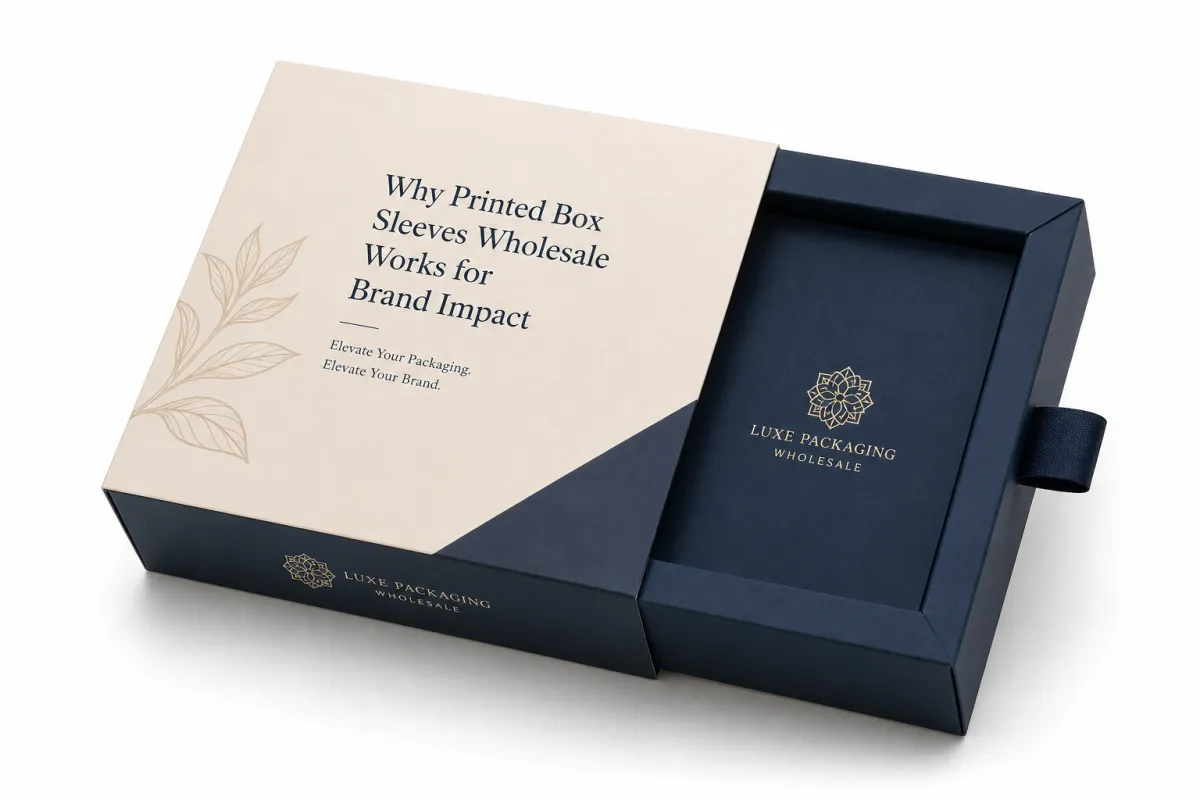
From a packaging buyer’s point of view, printed box sleeves wholesale solves a common headache: the carton does its job, but the outside does not sell the product very well. The box might be sturdy. It might ship fine. It might even be the right size. None of that matters much if it looks forgettable on a shelf or flat on camera.
The reason printed box sleeves wholesale pulls its weight is simple. It gives you a lot of visible print area without forcing you to rebuild the whole package. There is room for a logo, product name, scent or flavor family, campaign copy, QR code, color blocking, regulatory text, or a short promo message. That makes it useful for retail displays, ecommerce unboxing, and gift packaging that needs a better first impression without changing the base carton.
I've seen this format work best when the buyer wants a fast visual upgrade and wants to keep the underlying box simple. Subscription boxes, candle sets, cosmetics, apparel accessories, food gifts, and tech bundles are all good fits. In those cases, printed box sleeves wholesale adds branding without asking the factory to reinvent the package from scratch. That saves time. It also saves a few headaches, which is honestly half the battle.
"If the box already does the structural job, stop trying to force a full redesign just to get prettier graphics. Add a sleeve, make the outside earn its keep, and leave the carton alone."
That is the real advantage. printed box sleeves wholesale gives you shelf presence, lower tooling risk, and easier version changes across SKUs. Holiday runs. Limited editions. Regional variants. All of that is easier when the base box stays the same and the sleeve carries the update. Packaging teams like this because it keeps a small change from turning into a giant internal argument.
It also helps with brand discipline. A sleeve creates one controlled message zone. The design does not have to fight inner flaps, seams, or odd structural panels on the carton itself. When the layout is planned well, printed box sleeves wholesale makes the package look more intentional than a plain box with a sticker ever will. Stickers have their place. This is not that place.
Here is the rule I use with buyers: if the packaging already functions and the goal is better presentation, printed box sleeves wholesale is usually the smarter spend. If the box itself is weak on fit, protection, or strength, a sleeve will not rescue it. Packaging still has to protect the product first. Pretty does not cancel physics. I wish it did, but no.
- Best fit: launch campaigns, multipack bundles, subscription boxes, and retail-ready kits.
- Less ideal: heavy products that need the outer carton to carry more structural load.
- Buyer benefit: faster artwork changes and less risk than a full custom box rebuild.
printed box sleeves wholesale also helps when you need brand consistency across different sizes. One sleeve style can often be adapted for several carton formats with minor dimensional changes. That keeps the visual system cleaner and keeps procurement from turning into a guessing game. Nobody needs another guessing game in packaging.
Another practical upside: sleeves are easy to test. I like that because a quick mockup usually shows pretty fast whether the design feels premium or just busy. If the sleeve looks off in hand, it will look worse in the market. Simple rule, but it saves people from a lot of wasted print runs.
Printed box sleeves wholesale product details: what you are actually buying
At the simplest level, printed box sleeves wholesale is a wraparound printed band that slides over an existing box, tray, or product bundle. The sleeve may close with a tuck, a glue point, a friction fit, or a locking tab. The box underneath provides the structure. The sleeve handles the branding. That division of labor matters more than most people expect.
A sleeve is not a replacement for the carton. It is a presentation layer. When you buy printed box sleeves wholesale, you are buying a format that upgrades visual impact while leaving the base package intact. That is why the sleeve works so well for quick launches and repeatable programs where the box body does not need to change every time the artwork changes.
Most sleeve builds include board stock, printed exterior, and sometimes an interior print if the client wants a stronger unboxing moment. Other common options include a die-cut window, perforation for easy opening, and finish choices such as matte, gloss, soft-touch, or spot UV. Each one changes the feel of the package and the price of printed box sleeves wholesale in a very direct way. Packaging pricing is pretty honest once you know what to look for.
There is a practical reason buyers like this format. You can keep one strong carton and use sleeves to manage seasonal artwork, campaign messaging, or product variants. That is easier than ordering entirely new boxes every time a product line changes. For brands with a lot of SKUs, printed box sleeves wholesale is often the cleaner operational choice.
The structure is especially useful in retail packaging, ecommerce presentation, and bundling jobs where the product stays the same but the visible story changes. A candle set can look like a premium gift. A plain mailer can look retail-ready. A cosmetics bundle can look like a coordinated collection instead of a random stack of items. That is why printed box sleeves wholesale keeps showing up in buying plans.
When you specify this product, be exact. Ask for folded dimensions, printable area, seam position, closure style, and fit tolerance. If the sleeve needs to slide on easily, that is one spec. If it needs to hold tightly so it does not shift in transit, that is another. printed box sleeves wholesale only works well when those details are nailed down before artwork starts wandering around.
In practice, the best orders begin with the box itself. Measure the finished carton length, width, and height. Confirm the overlap. Note any flap or tray clearance. Then ask for a dieline before the design team builds the art. That saves time, reduces rework, and keeps logos and copy out of folds and seams. It is not glamorous. It is just how good packaging gets made.
If you are working with multiple SKUs, make the measurements boringly consistent. That sounds dull because it is, but boring is good in packaging. The less drama in the specs, the fewer surprises on press and in assembly.
Specifications for printed box sleeves wholesale: materials, sizes, and print
Material choice is where printed box sleeves wholesale either feels premium or feels cheap. There is no magic stock. You pick the paper or board based on product weight, print goals, shipping conditions, and the look you want at retail. Common options include SBS, kraft, coated art paper mounted to board, and lighter carton stocks for smaller inserts or folded sleeves.
For a clean retail finish, many buyers prefer 14pt to 18pt board equivalents, or about 250gsm to 400gsm depending on the build and how stiff the sleeve needs to feel. Heavier products and more demanding transit conditions usually push the spec upward. That is one reason printed box sleeves wholesale should be quoted with the actual product weight in mind, not just the outer dimensions. A sleeve that looks fine on paper can still fail the second it gets handled like a real package.
Size control is not optional. The sleeve has to match the box perimeter and depth closely enough to stay aligned, but not so tightly that assembly becomes a problem. Too loose and it looks sloppy. Too tight and the line slows down. For printed box sleeves wholesale, a small tolerance issue can turn into a larger production headache than the artwork itself.
Print setup is another place where buyers make avoidable mistakes. CMYK works for most jobs. PMS makes sense when brand colors need to stay consistent across multiple runs or product families. If color is critical, ask for a proofing step and do not skip it. With printed box sleeves wholesale, the difference between a clean match and a weak one is often visible the minute the package lands on a shelf.
Finishing changes the character of the piece. Matte gives a quieter premium feel. Gloss pushes color and contrast. Soft-touch creates a higher-end tactile impression. Spot UV, foil, and embossing add contrast and visual hierarchy, but they also add cost and complexity. If you are quoting printed box sleeves wholesale, treat those effects as line items, not afterthoughts. That little habit saves budget and avoids late-stage drama.
Structural details matter too. Confirm seam placement, closure style, die-cut windows, and whether the sleeve has to survive stack pressure, warehouse handling, or retail hanging. If the package ships through parcel networks, think about transit abuse. If you want to test the package against shipping reality, the ISTA testing framework is worth a look. That is not theory. It is the practical side of transit performance.
For paper sourcing, ask whether the material can be supplied with responsible forestry documentation. If that matters to your brand story, the FSC standard is the reference most buyers know. A lot of packaging claims get fuzzy fast, so I prefer clear documentation over decorative language. printed box sleeves wholesale should be specified with the same discipline you would use for any other production component.
Short version: the more precise your spec, the fewer surprises you get. That sounds obvious because it is. Yet a lot of orders still start with "we just need sleeves" and end with revision after revision because nobody defined the board, the fit, the finish, or the print target. printed box sleeves wholesale is easiest when the buyer brings real measurements and a clear finish plan.
If your product line is sensitive to display lighting, ask for a physical proof under conditions that resemble the real shelf. Print can look one way in a studio and another under warm retail lights. That is one of those annoyingly practical details people discover after the fact. Better to catch it early.
Printed box sleeves wholesale pricing and MOQ: what changes the quote
Pricing for printed box sleeves wholesale comes down to a handful of variables, and none of them are mysterious. Quantity is the biggest one. Board stock comes next. Then print coverage, finishing complexity, die-cutting, and assembly requirements. If you change those inputs, the quote changes. That is not a problem. That is how packaging pricing works.
MOQ usually reflects setup cost more than raw material. A shorter run means the prepress work, tooling, and press setup are spread across fewer units, so the price per sleeve rises. A larger run drops the unit cost fast. That is why it helps to request quotes at two or three volume levels when you are buying printed box sleeves wholesale. You want to see where the pricing bends and where the savings actually start.
Artwork can move the number more than people expect. Full-bleed graphics, multiple PMS colors, heavy ink coverage, foil, embossing, or spot UV all add cost. A simple one-color kraft sleeve is a different animal than a full-color sleeve with a metallic logo and a window cut. When buyers compare printed box sleeves wholesale quotes without checking those details, they end up comparing apples to a truckload of oranges.
Ask about hidden costs early. Tooling. Samples. Proofing. Freight. Rush production. Those line items can quietly change the final landed price, and nobody likes a packaging budget surprise three days before launch. With printed box sleeves wholesale, the cheapest unit price is not always the best deal if freight or rush charges wipe out the savings.
If the sleeve is for a short campaign, optimize for speed and flexibility. If it will stay in production for months, push for lower unit cost and cleaner finishing. That is the buying logic. Not heroic. Just sensible. printed box sleeves wholesale should be priced around how long it will actually be used, not around a fantasy version of scale that never arrives.
| Use case | Typical spec | Estimated wholesale unit price | Notes |
|---|---|---|---|
| Basic retail sleeve | CMYK print on SBS or coated stock, matte finish | $0.18-$0.32 at 5,000 units | Good for standard branding and clean shelf presentation |
| Kraft presentation sleeve | 1-2 color print on kraft stock, simple tuck closure | $0.22-$0.40 at 3,000 units | Works well for natural or artisanal positioning |
| Premium branded sleeve | Full-color print, soft-touch or spot UV, tighter fit | $0.28-$0.55 at 5,000 units | Often used for cosmetics, gifts, and higher-margin retail lines |
| Special finish sleeve | Foil, embossing, window cut, or complex die cutting | $0.40-$0.80+ at 5,000 units | Best for limited editions and premium launches |
Those numbers are working ranges, not a promise. A larger quantity lowers the unit price. A heavy finish pushes it up. A simple sleeve is cheap because it is simple. printed box sleeves wholesale only becomes expensive when the spec starts acting like a custom luxury piece.
One more point buyers forget: the cheapest quote is not the best quote if it arrives late or fits poorly. Bad fit costs more than a small unit price difference. Reprints cost more than sample approval. And if the launch slips, the packaging savings disappear into lost sales. That is the part people notice after the order, not before it.
For procurement teams, I usually suggest comparing not just unit price but landed cost per usable sleeve. That means factoring in freight, sample approval, and any rework risk. It is a more honest way to judge printed box sleeves wholesale, and it keeps the spreadsheet from lying to everybody.
Printed box sleeves wholesale process and timeline
The cleanest printed box sleeves wholesale projects follow a predictable path: quote, spec confirmation, dieline approval, artwork setup, proofing, production, finishing, packing, and shipping. Nothing glamorous there. Still, if one step gets rushed or skipped, the whole schedule starts wobbling.
Most delays start with bad input. Wrong measurements. Missing overlap. Artwork that arrives before the dieline. Color references that are vague instead of specific. Too many decision-makers who all want the final say. That is the usual mess. Good printed box sleeves wholesale work depends on clean information at the start, not wishful thinking halfway through.
Simple sleeves usually move faster than sleeves with foil, embossing, or complicated window cuts. Those extras add setup and can extend the production timeline. Shipping time matters too, and sometimes it matters more than production. A buyer who only thinks about factory lead time is not looking at the full schedule. That is how launches get squeezed for no good reason.
A decent proofing workflow should include a digital proof for layout and a physical sample if the fit is tight or the color is critical. If the sleeve must align to a carton edge, or if the brand colors need to be exact, do not approve mass production without checking the sample. For printed box sleeves wholesale, one proof can save a lot of bad inventory.
I also like to see a timeline broken into real steps rather than one vague promise. For example: 1 to 2 business days for artwork check, 2 to 4 for proofing, 7 to 15 for production depending on finish, and then freight on top. That is more useful than "fast turnaround" because it gives the buyer actual control points. printed box sleeves wholesale becomes much easier to manage when everyone knows what happens next.
The upside of sleeves is flexibility. Because the structure is simpler than a full custom box, revisions are often easier and new versions can be scheduled without rebuilding the packaging system. That matters for seasonal changes and SKU expansions. If you are juggling multiple versions, printed box sleeves wholesale gives you a cleaner way to stay organized.
Buyers who share accurate dimensions and artwork early usually get fewer revisions and a more predictable delivery window. That is not luck. It is process. If the specs are solid, the order moves. If they are fuzzy, the schedule drifts. printed box sleeves wholesale rewards disciplined buyers and punishes vague ones. Packaging is funny that way. Not really funny, actually. Just true.
The main thing is to build in time for the boring steps. Boring steps are where good packaging gets saved. Skip them, and you end up paying for it later in reprints or rushed freight. Nobody likes either one.
Why choose us for printed box sleeves wholesale
People do not buy printed box sleeves wholesale because they want packaging trivia. They buy it because they want sleeves that fit, print cleanly, and arrive when promised. Those three things sound basic because they are basic. Yet they are the difference between a package that sells and a package that creates complaints.
Our focus is production control. That means consistent materials, tight color management, and file checks that catch problems before they turn into bad cartons. A sleeve that looks good on screen and disappointing in hand is a waste of time, money, and shelf space. With printed box sleeves wholesale, details matter more than adjectives.
A good supplier should help with dielines, quote comparisons, finish selection, and fit guidance. If the only thing you get is a spec sheet and a long wait, that is not service. That is paperwork. We approach printed box sleeves wholesale as a buying decision, not just a print order. You need input on the practical stuff: board feel, closure style, color match, and whether the sleeve should slide freely or hold tight.
Flexibility matters too. Short runs. Repeat orders. Multi-SKU programs. Campaign updates. Those are real buying patterns, and they do not all fit one template. If your packaging partner can only handle one narrow type of order, the relationship gets annoying very fast. printed box sleeves wholesale should support the way you actually buy packaging, not the way a sales brochure imagines you do.
We also keep an eye on trust signals that matter to buyers: sample availability, clear communication, honest lead times, and support for both startup quantities and larger wholesale volumes. That is why a lot of customers start with a small test run and then move into repeat orders once they see the fit and finish are consistent. That pattern makes sense. It is also how printed box sleeves wholesale earns a second order.
If you are comparing programs, our Wholesale Programs page is the right place to start. It gives you a straightforward view of volume buying, and it is a better use of time than guessing at packaging math from memory. If you want to talk through repeated SKUs or campaign sleeves, the same Wholesale Programs page can point you in the right direction without the usual sales fog.
Honestly, the best packaging suppliers are the ones that make the buyer look organized. That means fewer surprises, cleaner specs, and sleeves that show up ready to use. printed box sleeves wholesale should feel like a controlled production job, not a rescue mission.
I also think transparency matters here. If a sleeve design is a bad fit for the carton, say so early. If a finish is going to push the budget too far, say that too. Buyers do not need flattery; they need straight answers.
Next steps for printed box sleeves wholesale orders
Start with the box you already use. Measure the finished length, width, and height. Confirm the wraparound perimeter. Decide whether the sleeve covers the full box or only the front and sides. Those are the facts you need before printed box sleeves wholesale can be quoted properly.
Then gather the artwork essentials. Logo files. Copy. Barcode placement. Brand colors. Finish preference. Any required legal or regulatory text. If those elements are missing, the proofing stage slows down and the final package gets weaker. printed box sleeves wholesale is much easier when the creative brief is not a moving target.
Ask for a quote at multiple quantities. That lets you compare test volume against production volume and see where the unit cost drops enough to matter. If your product is likely to become a repeat line, that comparison is useful. If it is a short campaign, you may care more about speed and finishing than the absolute lowest price. Either way, printed box sleeves wholesale should be priced with actual usage in mind.
If the sleeve needs a tight fit, a precise color match, or retail display credibility, ask for a dieline and a sample. That is not being difficult. That is being smart. Sloppy fit is visible. Off-color print is visible. You do not want to find that out after a full run of printed box sleeves wholesale is already packed and in transit.
Lock the timeline before you commit. Approve the proof. Confirm the shipping method. Schedule the launch around production plus freight, not just the factory lead time. That one habit prevents a lot of launch day stress. It also keeps printed box sleeves wholesale from becoming the thing everyone blames when the calendar was the real problem.
If you are ready to move, send specs, artwork, and target quantity for a fit check and a quote. That is the cleanest next step, and it saves time on both sides. For brands that need packaging to look better without rebuilding the carton, printed box sleeves wholesale is still one of the most practical options on the table.
printed box sleeves wholesale works because it balances presentation, flexibility, and cost in a way full custom boxes often cannot. Use the right stock, define the fit, check the proof, and ask for a quote that reflects real quantities, not guesses. Do that, and you get a sleeve that does its job instead of just sitting there looking pretty.
What are printed box sleeves wholesale used for?
They upgrade plain cartons or bundled products with branded print without redesigning the whole box. printed box sleeves wholesale works well for promotions, retail display, subscription packaging, and seasonal campaigns. It is a practical choice when you want better presentation and lower packaging risk.
How do I measure for printed box sleeves wholesale?
Measure the finished box length, width, and height, then confirm the wraparound perimeter and any overlap or tuck area. That keeps the sleeve from ending up too loose or too tight. Ask for a dieline before artwork starts, because printed box sleeves wholesale gets much cleaner when the layout matches the real box.
What affects the price of printed box sleeves wholesale most?
Quantity, board stock, print coverage, finish choices, and die-cut complexity usually drive the quote. Special effects like foil, embossing, or spot UV add cost. Freight and proofing can also change the final landed price, so printed box sleeves wholesale should always be priced with the full job in mind.
What is a normal MOQ for printed box sleeves wholesale?
MOQ depends on size, material, and print setup, so there is no single fixed number. Smaller runs usually cost more per sleeve because setup is spread across fewer units. A quote at two or three volumes helps you see the best break point for printed box sleeves wholesale.
How long does printed box sleeves wholesale production take?
Simple jobs move faster than orders with foil, embossing, or Custom Die Cuts. Artwork approval and sample checks can add time if the specs are not ready. Shipping time should be planned separately from production lead time, because printed box sleeves wholesale is only on schedule when transit is counted too.


