Buyer Fit Snapshot
| Best fit | Printed Boxes Premium Quality projects where brand print, material claims, artwork control, MOQ, and repeat-order consistency need to be specified before quoting. |
|---|---|
| Quote inputs | Share finished size, material target, print colors, finish, packing count, annual reorder estimate, ship-to region, and any compliance wording. |
| Proofing check | Approve dieline scale, logo placement, barcode or warning zones, color tolerance, closure strength, and carton packing before bulk production. |
| Main risk | Vague material claims, crowded artwork, missing packing details, or unclear freight terms can make a low unit price expensive after revisions. |
Fast answer: Printed Boxes Premium Quality: What Actually Matters should be specified like a repeatable production item. The safest quote records material, print method, finish, artwork proof, packing count, and reorder notes in one written spec.
Production checks before approval
Compare the actual filled-product size with the drawing, then confirm tolerance on folds, seals, hang holes, label areas, and retail display edges. Reserve space for logos, QR codes, warning copy, and material claims before decorative graphics fill the panel.
Quote comparison points
Review material grade, print process, finish, sampling route, tooling charges, carton quantity, and freight assumptions side by side. A quote is only useful when the supplier can repeat the same color, closure quality, and packing count on the next order.
Printed boxes premium quality is not something you can fake for long. The first time someone lifts the carton, opens the lid, or runs a thumb across a folded edge, the truth comes out pretty fast. The print may be beautiful, sure, but if the board feels flimsy or the closure behaves badly, the whole package starts to drift away from the premium category.
I have stood at enough press checks and sample reviews to know that packaging is judged in a matter of seconds. People notice square corners, clean folds, accurate color, and whether the box actually protects what is inside. Printed boxes premium quality lives in those details. It is the difference between a carton that feels considered and one that looks expensive only from a distance.
For buyers, the real work is understanding that premium packaging is a system, not a finish. Board grade, print method, structure, coating, assembly, and quality control all have to line up. If one part slips, the result can feel ordinary even if the artwork is strong. If the whole spec is balanced, the box carries confidence before the product is even revealed.
A glossy coating can hide a few sins, but it cannot rescue weak board, sloppy registration, or a dieline that was never truly fit for the product. A box that crushes in transit or opens with a fight loses its premium feel in a hurry. Printed boxes premium quality should be judged by performance first, appearance second, and decoration last.
The goal is not to stack on effects just because they sound fancy. The goal is printed boxes premium quality that matches the product, the shipping route, and the brand position without paying for details that do not pull their weight. That sounds simple. In practice, it takes discipline, a clear spec, and a supplier who is willing to say no to a bad idea.
What Printed Boxes Premium Quality Really Means
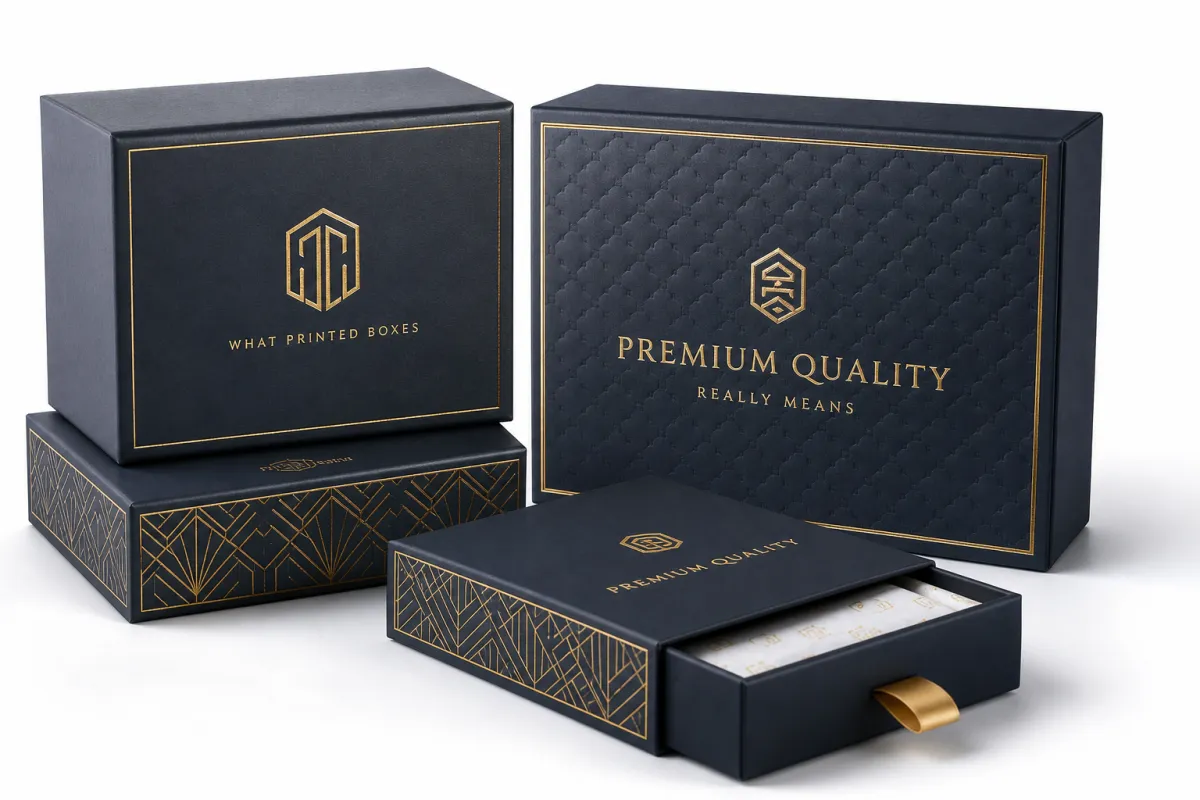
Printed boxes premium quality starts with the box doing its job properly. Accurate sizing, crisp folds, strong corners, and print placement that stays true to the dieline all matter. A polished graphic cannot hide a lid that bows, a flap that pops open, or rough edges that catch the eye in the wrong way. Buyers notice those things right away, and customers do too.
The visible side matters, of course. Clean color, sharp type, controlled ink density, and an even finish all contribute to the impression. Still, printed boxes premium quality is larger than surface appearance. It is about creating a carton that feels intentional from every angle. The panels line up. The score lines are neat. The coating behaves consistently. The structure supports the product without feeling overbuilt or clumsy.
Foil, embossing, and high-gloss finishes often get treated like shortcuts to a premium look. They can help, but they are not magic. A box with foil on weak board still feels cheap because the hand feel tells the truth. A simple printed carton on better material can feel more refined because the structure carries the experience. That surprises people until they handle both versions back to back.
Visual luxury and real packaging performance are different things. Visual luxury is what the box communicates on a shelf or in a product photo. Real performance is what happens when the carton is stacked, shipped, opened, and handled by impatient humans in the real world. Printed boxes premium quality needs both. If either side fails, the value drops quickly.
A practical way to define premium packaging is to look at materials, printing, construction, and finishing together, not as isolated upgrades. Packaging standards groups like ISTA focus on distribution performance for a reason. A nice-looking box that cannot survive transit is not premium. It is just an expensive mistake wearing good graphics.
A premium box should feel convincing in the hand before anyone studies the branding. If it feels weak, the print cannot carry the entire job.
That definition keeps printed boxes premium quality grounded in practical terms. Think clean registration, sturdy structure, consistent finish, accurate dimensions, and packaging that protects the product while presenting it well. That combination earns the premium label. Not one shiny coating. Not one luxury embellishment. The whole package has to hold together.
From a buyer's perspective, printed boxes premium quality also has to match the use case. A subscription box, a retail carton, and a rigid gift box are built for different demands. A strong supplier asks what the box must survive, what it must communicate, and how it will be opened. Skipping those questions is guesswork, and guesswork gets expensive real quick.
How Printed Boxes Premium Quality Is Made
Printed boxes premium quality starts before ink ever reaches paper. It begins with file setup, dieline accuracy, and a spec sheet that leaves very little room for confusion. If the artwork sits on the wrong template, every later step becomes harder. The printer can correct some issues, but not enough to rescue a flawed plan.
The production chain usually runs through artwork preparation, dieline confirmation, proofing, plate or file preparation, printing, cutting, scoring, folding, gluing, and final inspection. Each step can strengthen the outcome or weaken it. Strong prepress keeps the layout safe and the colors consistent. Accurate cutting and scoring create crisp folds. Clean gluing keeps the carton square instead of warped.
The print method changes the result as well. Digital printing works well for shorter runs, fast revisions, and variable data. It is often the practical answer for lower quantities because setup is lighter. Offset printing gives better control over consistency and color on larger orders. Flexographic printing is common in utility packaging and some shipping formats, where speed and economy matter more than fine detail. Printed boxes premium quality can come from any of these methods, but the method has to fit the run and the brand goal.
Artwork quality carries more weight than many buyers realize. Files need proper bleed, enough resolution, and safe zones that keep logos and text away from trim lines. Tiny type should be set in clean vector form. Spot colors need deliberate handling instead of wishful thinking. If a supplier asks for PDF/X files, live fonts, or a specific dieline format, that is not busywork. It is how printed boxes premium quality stays predictable from proof to production.
Quality usually slips in a few familiar places: board that is too weak, prepress that was rushed, finishing that was pushed too quickly, or a plant mixing spec standards inside the same run. A quote may say “premium carton,” but thin board and uneven lamination will tell a different story. Buyers sometimes blame the print when structure is the real problem. Other times they blame structure when the file setup was the weak point. Either way, process control sits at the center.
That process control is part of why printed boxes premium quality often costs more than a plain carton. The box is not magical. The cost reflects checkpoints that reduce waste and keep the run stable. If you want examples of formats that can be matched to different specs, see Custom Packaging Products for a wider look at packaging styles and print options.
The simple rule is this: premium results come from repeatable process control, not from one flashy finish. A foil stamp can look excellent. It can also look careless if the board warps or the artwork shifts by a fraction. Printed boxes premium quality depends on how tightly the whole job is managed, from file prep through final carton assembly.
Material, Finish, and Structural Factors That Change Quality
Material is where printed boxes premium quality either starts to feel real or quietly falls apart. For folding cartons, common board choices include 250gsm to 400gsm SBS or C1S/C2S artboard, depending on product weight and the presentation needed. For rigid boxes, 1200gsm to 2000gsm greyboard with wrapped print sheets is typical. For shipping or mailer formats, E-flute and similar corrugated constructions often make more sense. The right board is not the fanciest board. It is the board that matches the product and the trip it will take.
Finish changes perception quickly, but it should not be used as a rescue plan. Matte lamination creates a cleaner, more modern feel and cuts glare under retail lighting. Gloss can make color read more boldly and help graphics stand out from a distance. Soft-touch brings a velvety surface that feels refined in the hand, although it can scuff if handling is rough. Spot UV, foil, embossing, and debossing work best as accents rather than camouflage for weak structure. Printed boxes premium quality is strongest when the finish supports the design instead of shouting over it.
Durability matters too. Aqueous coating is practical for many cartons and can improve scuff resistance without adding much weight. Lamination offers more protection and usually a more polished feel. Foil can add real visual lift, but it also adds tooling and setup complexity, which means more cost and more chances for a bad die line to show itself. Fancy is never free. Packaging buyers learn that lesson early, and if they do not, the sample stage usually teaches it for them.
Structure carries as much weight as surface. A tuck-end carton, a sleeve, a two-piece rigid box, a magnetic closure box, and a mailer all communicate differently. Inserts, dividers, and reinforced corners change the experience too. A rigid setup with a proper lid and tray feels more substantial because the architecture supports the presentation. A folding carton can still deliver printed boxes premium quality, but only if the fit, board, and closure are set with care.
Subtle cues are what people notice first. Sharp edges. Even coating. No toner flaking. Clean folds that do not crack. A box that opens without tearing the lip or fighting the customer. Those details make printed boxes premium quality feel believable. When they are missing, the packaging drifts toward bargain-bin territory fast, no matter how polished the mockup looked on screen.
If you are comparing packaging formats, it helps to think in terms of use case rather than decoration. A heavy skincare jar, a gift set, and a light accessory box all need different board strength and different finishing priorities. For broader planning, the range of branded packaging options can help you match structure to function before money goes into the wrong build.
One tradeoff deserves an honest look: richer decoration usually means more production complexity. Every added layer brings risk. More finishes mean more registration points. More die work means more setup time. More hand assembly means higher labor cost. Printed boxes premium quality is worth paying for, but only if the added features improve the box instead of turning it into a delicate science project.
Production Process, Timeline, and Lead Time
Lead time is where many packaging plans become too optimistic and then fall apart. Printed boxes premium quality needs time for proofs, approvals, sampling, production, and transit. A supplier can move quickly, but they cannot skip the physical steps. If the structure is custom, the color control is tight, or the finish is complex, the schedule has to reflect that reality from the start.
A realistic timeline often looks like this: spec confirmation in 1-2 days, artwork proofing in 1-3 days, structural sampling in 3-7 days if a physical prototype is needed, mass production in roughly 7-20 business days depending on quantity and finish, then shipping time on top. Those numbers move with order size and capacity, but they stay much closer to reality than the vague “soon” that sometimes appears in quotes. Printed boxes premium quality usually demands more coordination than a plain stock carton. That is normal.
Sampling deserves special attention. If the box includes inserts, tight tolerances, soft-touch lamination, foil, or a magnetic closure, a sample can save a full run from costly mistakes. You want to see how the lid closes, how the board bends, how the print reads under normal light, and how the finish behaves after handling. A flat proof on a screen does not tell you that. It only proves the file exists.
For products shipped through distribution, not just handed over a counter, transport testing matters too. FSC certification is useful when you want traceable sourcing and responsible fiber claims, while ISTA-style testing helps assess how a carton performs in the supply chain. If your packaging must survive stacking, vibration, or drops, ask for a distribution test or a similar method. Printed boxes premium quality that fails on arrival is not really premium. It is damage in a polished shell.
Good suppliers communicate milestones clearly: proof approval, sample approval, production start, in-process checks, and ship date. They also point out likely bottlenecks. That might be foil tooling, white ink on dark stock, unusual insert assembly, or a paper grade with a longer sourcing window. Surprises at the end of the run are the worst kind, because they arrive when everyone is already committed and nobody wants to hear “we’ll figure it out later.”
Order size changes timing too. Smaller runs can move faster in some cases, but they are not automatically simpler. Short-run premium packaging often needs more careful setup because the cost of a mistake is higher per box. Larger runs may take longer in absolute time, yet they often stabilize more easily once production is dialed in. Printed boxes premium quality depends on the supplier matching the workflow to the order size instead of forcing one template onto every job.
Printed Boxes Premium Quality: Cost, Pricing, and MOQ
Printed boxes premium quality has a cost structure, and it helps to talk about ranges rather than fantasies. Price depends on quantity, board grade, print method, finishing, structure, and whether the box needs inserts or special assembly. MOQ matters because setup costs have to be spread across the run. If you order too few units, the unit price climbs fast. That is not greed. That is arithmetic.
Here is a practical view of pricing. The ranges below are directional, not promises, because artwork coverage, board thickness, and finishing all move the number.
| Box Type | Typical MOQ | Approx. Unit Price Range | Best For | Notes |
|---|---|---|---|---|
| Basic folded carton | 500-1,000 | $0.45-$1.20 | Light products, simple retail packs | Best when print coverage is moderate and finish is simple. |
| Mid-tier branded carton | 1,000-5,000 | $0.18-$0.55 | Cosmetics, supplements, accessories | Good balance of print quality, structure, and unit cost. |
| Rigid gift box | 500-2,000 | $1.20-$4.00 | Premium sets, launches, presentation packs | Higher labor, heavier board, and more complex finishing. |
| Special finish premium box | 1,000-3,000 | $0.80-$2.80 | Foil, emboss, spot UV, soft-touch | Finish choices can move pricing more than size does. |
That table is a starting point, not a shopping cart. A tiny carton with full coverage and foil can cost more than a larger plain one. A rigid box with a simple wrap may price lower than a folding carton with a difficult insert. Printed boxes premium quality is priced on complexity, not just dimensions. Buyers who compare quotes without normalizing the spec usually compare the wrong thing, and then they wonder why the numbers are all over the map.
MOQ is also a strategic decision. A lower MOQ raises the unit price but limits inventory risk. A higher MOQ usually improves unit cost, but it ties up cash and storage space. There is no universal winner. It depends on sales velocity, launch risk, and how quickly the design may change. I have seen brands save money on the paper and lose it on storage. That is not smart buying. That is just moving the problem to a different shelf.
Here is a clean way to compare quotes for printed Boxes Premium Quality:
- Match board grade first.
- Match size and dieline second.
- Match finish selection third.
- Confirm whether inserts, windows, or foil tooling are included.
- Check freight, duties, and art revision fees before comparing the final number.
Cheap quotes can hide cost in the margins. Sometimes freight is high. Sometimes setup fees appear late. Sometimes the quote uses thinner board or a lower-grade lamination and hopes no one asks. That is why the lowest number on the page is often not the best deal. Printed boxes premium quality should be judged on the full delivered cost and the actual spec, not the headline price alone.
A practical spend framework helps. Budget boxes focus on basic protection and simple branding. Mid-tier branded packaging balances appearance and durability. True premium printed boxes premium quality suits launches, gifts, retail presentation, and products where packaging is part of the perceived value. If the box helps sell the product, it deserves a bigger share of the budget. If it only sits there, keep it simpler.
Common Mistakes That Make Printed Boxes Look Cheap
The fastest way to ruin printed boxes premium quality is to design around decoration before structure. A pretty mockup can survive on a screen. It does not survive in a warehouse. If the board is too light, the corners crush. If the dieline is off, the panel alignment looks sloppy. If the closure is weak, the box feels unfinished. Structure first, then everything else.
Bad artwork files are another classic problem. Low-resolution logos, compressed images, thin type set too small, and colors built without a proper print strategy all create trouble. A run can only be as good as the source files. If the supplier has to guess, the result usually looks guessed. Printed boxes premium quality needs art built for print, not just resized from a marketing deck.
Overcomplication causes damage too. Too many finishes. Too many fonts. Too many design ideas fighting for space on one small surface. The box starts to look expensive in a messy way, which is still messy. Strong packaging usually has a clear hierarchy: brand, product name, one or two supporting claims, and maybe one finish accent. That is enough. The carton does not need to compete with a poster.
A box can be expensive and still look cheap. The usual problem is not the spend. It is the lack of discipline in the design and production choices.
Another mistake is checking samples under the wrong lighting. A soft-touch carton that looks rich in an office can read darker or flatter in retail. A matte black box can show fingerprints and dust more than expected. White boxes can shift tone depending on the paper base. If color and contrast matter, review samples under lighting that matches the final use case. That small step saves embarrassment later.
The customer experience matters just as much. If the box tears badly, opens awkwardly, or forces the customer to fight the closure, the premium feeling dies on contact. Printed boxes premium quality should feel calm in the hand. The opening action should make sense. Inserts should hold the product without rattling. The experience has to support the brand message, not work against it.
If you want to see how packaging style choices affect the final look and feel, compare the available custom packaging products before locking the spec. A better structural choice often beats a more expensive finish. That quiet decision is often what separates decent packaging from packaging people remember.
Next Steps for Printed Boxes Premium Quality
If the goal is printed boxes premium quality that earns its keep, start with the product itself. Measure the item accurately. Weigh it. Decide how it will be shipped, stacked, and opened. Then choose the box style that supports those realities. A clear spec beats a vague concept every time.
Request quotes with the same details across every supplier. Same dimensions. Same board. Same finish. Same quantity. Same insert requirements. Otherwise the numbers become theater. Good packaging buying depends on comparing like with like, and printed boxes premium quality is too expensive to evaluate with loose assumptions.
Before ordering a full run, ask for a sample or prototype if the box has custom sizing, special finishes, or tight color requirements. Yes, it adds time. No, that is not wasted time. It is cheap insurance. A sample can catch fit problems, print issues, and assembly headaches before they become a pallet of regret.
Prepare your artwork properly. Use the supplier’s dieline. Keep logos sharp. Leave safe zones. Confirm bleeds. Share brand guidelines if the colors need to stay consistent across other packaging or labels. If you already know the target ship date, say it early. A supplier can quote more accurately when the timeline is real instead of hopeful.
Here is a simple checklist that keeps printed boxes premium quality on track:
- Confirm product size, weight, and handling conditions.
- Choose the right box style for display, shipping, or gifting.
- Select board grade before choosing finishes.
- Match print method to order volume and color needs.
- Ask for a sample on any custom structural or finish-heavy project.
- Compare quotes using identical specs and delivery assumptions.
- Review the finished sample under real lighting before approving mass production.
That sequence is not flashy, but it works. Boring is often a compliment in packaging. Boring means repeatable. Boring means fewer surprises. Boring means the boxes arrive as expected and the brand does not have to explain why “premium” showed up looking like it lost a fight with a conveyor belt. If you want printed boxes premium quality, build it step by step and keep the unglamorous parts in view.
For brands exploring options across custom packaging products, the best results usually come from choosing one clear priority: better structure, better print, or better finishing. You can have all three, but the budget has to stay honest. Printed boxes premium quality is not a mystery. It is a sequence of smart choices that make the box feel right, protect the product, and support the sale.
What makes printed boxes premium quality instead of standard packaging?
Premium quality usually comes from better board stock, cleaner print, tighter structural fit, and a finish that looks intentional rather than generic. The box should also protect the product properly, not just photograph well. A strong premium box feels sturdy in hand and opens without tearing or warping.
How much do printed boxes premium quality usually cost?
Pricing depends on quantity, material, print method, size, and finishes, so there is no honest single price. Small runs cost more per unit because setup work is spread across fewer boxes. Premium features like foil, embossing, or rigid construction push the price up fast.
How long does production usually take for premium printed boxes?
Simple orders can move quickly, but proofing, revisions, and custom structures add time. Lead time depends on artwork readiness, finishing complexity, and current production load. Physical samples are worth the extra time when color or fit matters.
What file setup helps avoid blurry or dull printed boxes?
Use high-resolution artwork, proper bleed, and safe zones so cutting does not clip key design elements. Keep logos and small type sharp and avoid low-quality images pulled from web files. Match the supplier’s dieline and color requirements before final approval.
Should I request a sample before ordering a full run?
Yes, especially if the box includes custom sizing, inserts, special finishes, or strict color matching. A sample catches structural and print issues before they become expensive mistakes. It is a small cost compared with scrapping a whole batch.
Printed boxes premium quality is worth the extra attention because the box is not decoration; it is part of the product experience, the shipping protection, and the brand story all at once. Get the board right, get the print right, get the structure right, and the box does its job without drama. The practical takeaway is simple: lock the spec early, sample before you commit, and judge the finished box in the conditions where it will actually live.


