Buyer Fit Snapshot
| Best fit | printed carton sleeves cost for packaging buyers comparing material specs, print proof, MOQ, unit cost, freight, and repeat-order risk where brand print, material, artwork control, and repeat-order consistency matter. |
|---|---|
| Quote inputs | Share finished size, material target, print colors, finish, packing count, annual reorder estimate, and delivery region. |
| Proofing check | Approve dieline scale, logo placement, barcode or warning zones, color tolerance, and any recyclable or compostable wording before bulk production. |
| Main risk | Vague material claims, crowded artwork, or missing packing details can create delays even when the unit price looks attractive. |
Fast answer: Printed Carton Sleeves Cost: Pricing, Specs, and MOQ should be specified like a repeatable production item. The safest quote includes material, print method, finish, artwork proof, carton packing, and reorder notes in one written spec.
What to confirm before approving the packaging proof
Check the product dimensions against the actual filled item, not only the sales mockup. Ask for tolerance on folds, seals, hang holes, label areas, and retail display edges. If the package carries a logo, QR code, warning copy, or legal claim, reserve that space before decorative graphics fill the panel.
How to compare quotes without losing quality
Compare board or film grade, print process, finish, sampling route, tooling charges, carton quantity, and freight assumptions side by side. A lower quote is only useful if the supplier can repeat the same color, closure quality, and packing count on the next order.
Printed Carton Sleeves Cost: Pricing, Specs, and MOQ
Buyers usually judge Printed Carton Sleeves cost the wrong way. The first instinct is to line up quotes, circle the lowest number, and call it disciplined sourcing. It sounds tidy. It usually misses the point. A sleeve is doing sales work long before anyone notices the board grade, the coating, or the fold style. On shelf, a clean printed wrap can make a plain carton read like a premium pack, and that changes the economics faster than a few cents ever will.
Two sleeves can look nearly identical in a mockup and still land in different cost bands once the spec turns real. Board weight, ink coverage, finishing, fit, and assembly method all pull in different directions. One version may look cheaper because the quote is slimmer; the other may win because it wastes less board, runs faster, or lets a brand raise retail price. That is the part most estimates miss, and it is usually the reason printed carton sleeves cost comes in above or below expectations.
Printed Carton Sleeves Cost: Why Small Changes Matter
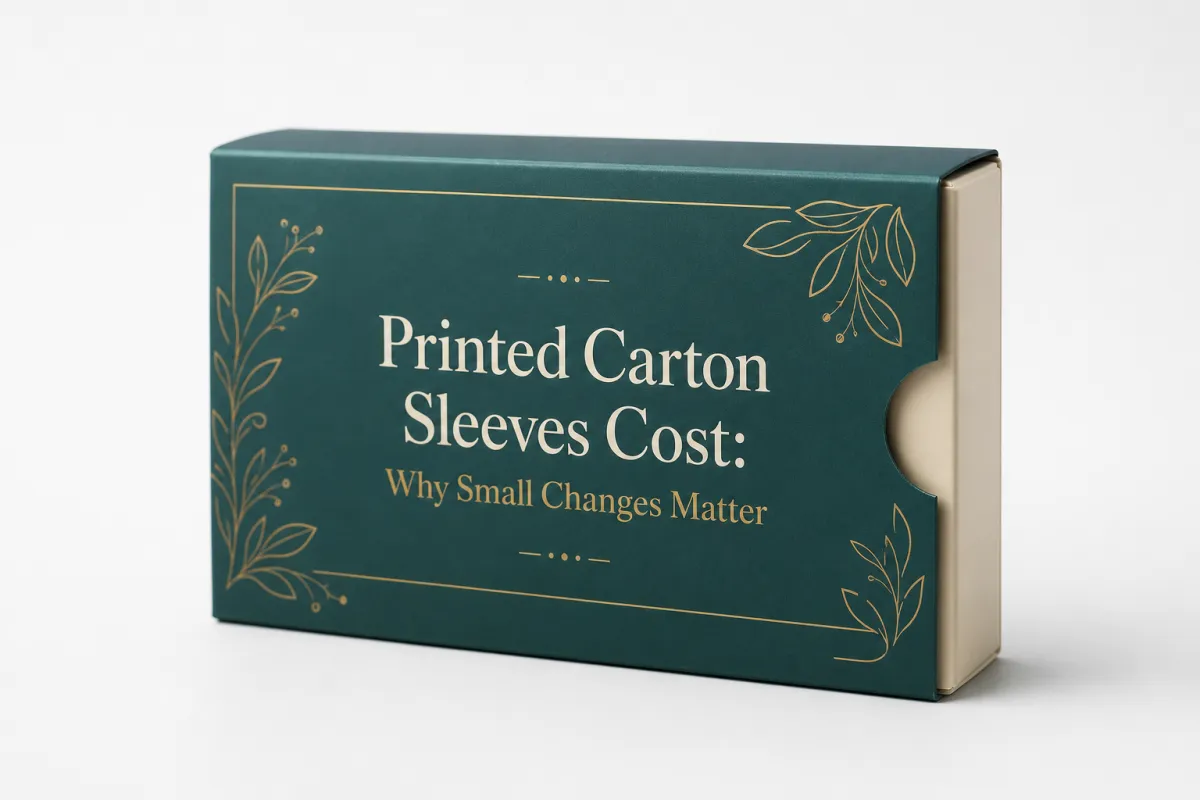
On a crowded shelf, a sleeve can alter perceived value in seconds. That is not marketing poetry; it is retail behavior. A plain carton with a sharp sleeve often feels more deliberate, more giftable, and more expensive than the same carton left naked. For that reason, printed carton sleeves cost should be judged against revenue impact, not against print expense alone.
Small changes create bigger swings than buyers expect. A one-color sleeve on 18pt board sits in a different economic lane from a full-coverage sleeve on coated SBS with matte lamination and foil. The mockup may not show the gap. Production will. A quote built from artwork alone can miss the real picture because the spec is where the cost lives. Color count, board surface, trim tolerance, and finishing steps all influence sleeve pricing in ways that are easy to underestimate.
Packaging teams tend to ask whether a sleeve can be printed. The better question is whether the sleeve earns its place. A modest increase in printed carton sleeves cost can make sense if it replaces a full carton redesign, speeds a seasonal refresh, or allows multiple versions of the same base pack to share one structure. That tradeoff matters most in gift sets, subscription boxes, limited runs, and retail lines that change graphics more often than the carton itself.
"The lowest quote is not always the lowest landed cost. A sleeve that needs a remake, a second proof, or a tighter fit than the carton can handle will raise the real printed carton sleeves cost quickly."
I have seen teams get fixated on a 6-cent difference and then spend days untangling a fit problem that should have been caught in the dieline stage. That is the part people do not see in a spreadsheet. Timing matters too. A sleeve can reach market faster than a complete carton redesign because the inner pack stays fixed. That reduces risk for launches with narrow windows, staggered SKUs, or frequent campaign changes. In practice, printed carton sleeves cost belongs in the same conversation as speed to shelf, reuse of the base carton, and the chance to update graphics without replacing the whole package.
Value Proposition for Printed Carton Sleeves
A sleeve is not meant to do every packaging job. It is a branding layer. That is exactly why it works so well around a tray, carton, pouch, or inner box that already handles the structural side of the pack. The sleeve carries the visual message; the inner structure carries the product. For many brands, that division keeps sleeve pricing lower than a full custom carton while still producing a sharper retail presentation.
The best applications are easy to recognize. Seasonal programs need artwork that can change without forcing a new box. Product line extensions often share a base pack but need distinct claims, hues, or flavor cues. Giftable packs need more presence on shelf without rebuilding the structural shell. Subscription packaging benefits because the outer graphics can rotate from month to month while the format stays fixed. In each case, printed carton sleeves cost becomes a flexibility expense, not just a packaging expense.
Compared with a fully custom carton, sleeves often reduce setup complexity. Buyers may avoid new internal structures, major tooling, and repeated board testing. That does not mean sleeves are always the cheaper route. Heavy coverage, specialty finishing, and tight die tolerances can push printed carton sleeves cost higher faster than people expect. Even so, many programs get better value because the base carton remains unchanged and only the brand layer needs to move.
There is also a practical merchandising angle. Retail buyers and store teams like packaging that can be refreshed without overhauling the whole pack. A sleeve can carry a promo, a QR code, a limited edition message, or a retailer-exclusive colorway. That kind of flexibility is why many sourcing teams keep sleeves in their back pocket instead of treating them as a last-minute fix. It is a pretty handy format, honestly.
- Retail refresh: update graphics without changing the base carton.
- Seasonal campaigns: switch artwork on a shorter cycle.
- Multi-SKU lines: keep one inner pack and vary the outer message.
- Gift packaging: raise perceived value without rebuilding the structure.
- Launch testing: bring a product to market with lower tooling risk.
The business case is measurable. Better shelf visibility can improve conversion. Faster SKU updates can reduce obsolete packaging. Reusing the base carton can cut waste. Each of those outcomes feeds back into sleeve pricing, because a low unit price means little if the sleeve does not improve the commercial picture.
Printed Carton Sleeves Cost Breakdown
To understand printed carton sleeves cost, split the quote into parts instead of treating it as one number. Pricing usually begins with the substrate, then adds print method, finishing, die cutting, folding or gluing, and freight. Setup costs matter most at low volumes because fixed prep gets spread across fewer units. As quantity rises, unit cost usually falls sharply. That is why a sleeve can feel expensive at 500 pieces and far more competitive at 10,000.
The practical rule is simple. For a straightforward sleeve on coated board, the board itself may be only a modest slice of the total. Prepress, color management, cutting, and assembly can weigh more than buyers expect. Add soft-touch lamination, foil, embossing, or a specialty coating, and printed carton sleeves cost climbs fast. A small design edit may sound cosmetic, yet in production it can require plates, another pass, or more handling.
| Option | Typical MOQ | Typical Unit Price | Best Fit | Main Cost Drivers |
|---|---|---|---|---|
| Digital printed sleeve on SBS board | 500-2,000 | $0.32-$0.78 | Short runs, pilots, artwork changes | Lower tooling, higher unit cost, faster proofing |
| Offset printed sleeve on 14-16pt board | 3,000-10,000 | $0.14-$0.30 | Stable SKUs, stronger bulk pricing | Setup charges, plates, color consistency |
| Kraft or recycled sleeve | 5,000+ | $0.15-$0.33 | Natural look, eco-positioned products | Board choice, ink coverage, coating limits |
| Premium finish sleeve with foil or emboss | 5,000+ | $0.24-$0.55 | Gift sets, prestige retail, seasonal launches | Tooling fees, extra finishing steps, slower throughput |
Those ranges are planning numbers, not guarantees, but they still show the shape of the market. Printed carton sleeves cost usually reacts most to quantity, board grade, and finish level. A 2-color sleeve with no coating lives in one cost lane. A full-bleed sleeve with soft-touch and foil lives in another. The gap is not random. It comes from the number of steps needed to produce the job cleanly.
Hidden variables matter too. Artwork changes can add prepress time. Tighter tolerances can slow the line and increase inspection. Rush schedules often raise printed carton sleeves cost through overtime or expedited freight. Even the choice between flat shipment and pre-glued delivery can alter labor on receiving and pack-out. Ask for separate line items wherever possible: unit price, setup charges, tooling fees, sample costs, and freight. That is the cleanest way to compare suppliers on equal footing.
If two quotes differ by only a few cents, read the fine print. A lower unit number can disappear once setup, plates, sample revisions, and shipping are folded into the full printed carton sleeves cost.
Volume breakpoints deserve attention. Request pricing at several quantities, such as 1,000, 5,000, 10,000, and 25,000. The step between tiers often tells you more than a single quote ever will. One supplier may look expensive at low volume, then become the better buy once the order climbs. Another may look good on the front end and lose once freight and setup are added. A quote with only one quantity hides that decision.
For teams with multiple SKUs, this is where the spreadsheet can get interesting. A sleeve that looks slightly more expensive per unit may actually be the smarter choice if it shares a common blank size across several flavors or markets. The cost of one smart spec can get spread across the line. That is a better use of money than chasing a tiny savings on a pack that will need a redesign three months later.
How much do printed carton sleeves cost?
For a simple digital run, a sleeve may fall into the low tens of cents per piece once quantity and board are factored in. Offset pricing usually gets more efficient as the order grows, and premium finishing raises the bill quickly. In practical sourcing terms, a 500-piece pilot often carries a much higher unit price than a 5,000-piece run, even when the artwork is identical. That spread is the normal shape of printed carton sleeves cost, not a pricing anomaly.
As a rule of thumb, the quote improves when the job becomes repeatable: one board stock, one finish, one stable dieline, and one production method. If the sleeve is being used for a seasonal refresh, a launch test, or a limited gift set, the price often reflects speed and flexibility more than raw materials. That is why buyers should compare total landed cost, not just the press number.
One honest caution: supplier rates vary by region, equipment, and labor model, so no web article can give you a universal price that holds everywhere. A quote from a domestic short-run plant can look very different from a high-volume offshore estimate, even before freight or lead time are added. The useful move is to compare like with like. Same board, same finish, same quantity, same delivery terms. That is how printed carton sleeves cost becomes a real decision rather than a rough guess.
Product Details and Print Options
The sleeve structure shapes both the appearance and the budget. Open-ended sleeves are simple and efficient. Wraparound sleeves cover more surface and can make a basic carton feel more intentional. Tuck-style wraps and promotional sleeves can add a stronger retail signal, though they may also need extra die work or manual assembly. That is why printed carton sleeves cost tracks so closely with construction, not just with artwork.
Print method changes the equation as well. Digital printing usually makes the most sense for smaller runs, frequent artwork changes, and jobs that need quick proofing. Offset printing becomes stronger when color consistency, image sharpness, and scale matter more. The crossover point is rarely dramatic. It depends on how much volume is needed to absorb setup charges. Stable SKU, steady demand, repeatable graphics: offset gets more attractive. Unstable graphics, frequent updates, and short launch windows: digital often protects the schedule and the sleeve pricing plan.
Ink coverage can move the bill in ways that buyers do not always expect. Full-bleed graphics and heavy solids require more control than minimal layouts with white space. Multiple spot colors can add complexity too. A design built around one strong brand color, a clean mark, and restrained texture often prints more predictably than a dense composition with gradients and deep backgrounds. That affects both output quality and printed carton sleeves cost.
Finishing choices send a message to both shopper and budget. Matte coatings feel quieter and more editorial. Gloss reads brighter and more commercial. Soft-touch lamination adds a tactile premium, but it also adds cost and can change how the board behaves during scoring and folding. Aqueous and UV coatings each have different strengths depending on abrasion resistance, speed, and visual effect. Foil and embossing can be powerful, though they should be used with restraint unless the margin supports them. Otherwise, printed carton sleeves cost rises faster than the brand value does.
Product category matters as well. Cosmetics may need stronger visual contrast and a tighter fit around high-end cartons. Food packaging may trigger different material and compliance decisions. Apparel sleeves often care more about bold branding and color than intricate structural features. Electronics usually need clear instruction placement and barcode readability. The same sleeve idea can move across those categories, but the spec almost never stays identical, and that changes the final quote.
From experience, the cleanest sleeve jobs are the ones where the design team, packaging engineer, and buyer all look at the same spec sheet before artwork is finalized. That sounds obvious, but it is kind of amazing how often those conversations happen too late. A beautiful layout cannot rescue a dieline that leaves no room for a barcode, a legal line, or a fold allowance. Once the layout is locked, those mistakes get pricey.
- Digital printing: faster changeovers, lower MOQ, higher unit cost.
- Offset printing: stronger consistency at scale, better for bulk pricing.
- Matte or soft-touch: premium feel, higher finishing cost.
- Gloss or UV: brighter shelf pop, often more economical than soft-touch.
Specifications That Affect Fit, Feel, and Compliance
Fit is where many sleeves either work cleanly or become a problem. The numbers that matter most are product width, depth, height, sleeve overlap, and visible panel area for branding. A sleeve that is too loose shifts on shelf. A sleeve that is too tight can scuff, crack, or slow assembly. Once fit problems begin, printed carton sleeves cost is no longer the only issue; rework and delay join the bill.
Board choice is another major lever. SBS board offers a smooth printable surface and strong color reproduction. Kraft can create a more natural, textured look. Recycled board can support sustainability goals, although print brightness and response can differ. Coated stocks usually deliver sharper image quality, while uncoated or lightly coated stocks can feel more tactile. None of these options is universally best. The right answer depends on the product, the shelf environment, and the finish target. That is why printed carton sleeves cost has to be read alongside material specs.
Structural details shape performance too. Some sleeves need to slide easily over an inner carton. Some need enough friction to stay in place without adhesive. Others must support tamper evidence, stacking pressure, or retail handling. If the product sits in a freezer, faces condensation, or ships through rough distribution, the sleeve may need more resilience than a standard promotional wrap. Those requirements can raise printed carton sleeves cost, but they can also prevent damage, returns, or poor shelf presentation.
Compliance is not uniform across product types, and that is where a buyer should slow down. Ingredient panels, warning copy, symbols, barcodes, and legal text can change the layout and the minimum readable size. If the sleeve wraps a food or beauty item, panel placement may matter more than graphic styling. If the sleeve carries a fiber sourcing claim, the paperwork needs to match the claim. For that, the FSC site is a useful reference point.
If the pack is headed through distribution rather than sitting in a display tray, transport conditions deserve attention too. A sleeve can look perfect in a prototype and still fail under vibration, compression, or abrasion. The ISTA test methods help frame how the package should be handled in transit. That matters because a sleeve that survives testing may protect the product and avoid a far higher hidden cost later. In that sense, printed carton sleeves cost should be compared with the cost of damage risk, not just the printer invoice.
One practical rule keeps coming up in real sourcing work: tighter tolerances and heavier materials usually raise the quote, but they can also reduce rejects and rework. If a sleeve has to align with a window, barcode, or tamper feature, do not under-spec the board or the die line just to lower the front-end number. The lowest printed carton sleeves cost often becomes the most expensive choice once the first production problem appears.
Process and Timeline for Ordering Sleeves
A clean sleeve project usually follows a predictable path: discovery, quote, dieline review, artwork setup, proofing, production, and delivery. The sequence is familiar. The details are where the job either stays on track or slips. If dimensions are wrong at the start, everything slows down. If artwork is late, the press date moves. If approval authority is unclear, the proof can sit untouched. Those delays do not just touch the calendar; they also affect printed carton sleeves cost when rush charges or reprints enter the picture.
Sampling deserves more attention than it usually gets. Digital proofs are fast and useful for layout and basic color direction, but they do not reveal everything. Physical samples are better when fit, finish, or sleeve movement matters. A sample can show whether the wrap hangs too loose, whether a coating feels too slick, or whether the board reacts badly at the score lines. That extra step adds time, yet it usually reduces the risk of a more expensive mistake later. A small delay up front is cheaper than changing a full run after production begins, and that is a direct argument for handling printed carton sleeves cost with discipline.
Timing depends on complexity. A simple sleeve with ready artwork and standard board can move faster than a premium sleeve with foil, embossing, or custom structural changes. A realistic planning range for many jobs is 12-15 business days from proof approval for a straightforward offset run, while specialty finishes or unusually large quantities may take longer. Digital short runs can be quicker. Freight adds another layer. Domestic shipping may take a few days, and international transit can extend the schedule further. Launch plans need buffer time, not only production time.
Common bottlenecks are easy to name and easy to avoid:
- Missing product dimensions or unclear tolerance limits.
- Artwork revisions after proof approval.
- Late confirmation on colors, finishes, or coatings.
- No final sign-off on legal or compliance text.
- Underestimated freight time or receiving delays.
For buyers comparing suppliers, the shortest schedule is not automatically the best one. The useful schedule is the one that fits the real job. A quote that promises speed may still cost more if it adds emergency setup fees, extra proof cycles, or expedited shipping. The goal is a schedule that keeps printed carton sleeves cost under control without raising quality risk.
I would also flag one thing that gets missed a lot: the handoff between artwork approval and production approval. If those are treated as the same milestone, somebody is gonna approve the wrong file, and then the shop ends up working off stale specs. Build one clear sign-off point and keep version control tight. It is not glamorous, but it saves money.
Why Choose Us and Next Steps for Printed Carton Sleeves Cost
For a buyer comparing options at Custom Logo Things, clarity is the real value. A good quote should connect printed carton sleeves cost to the exact structure, board, finish, and quantity requested. That makes the comparison honest. It also shows whether a slightly higher quote is actually the smarter buy because it includes better fit control, cleaner proofing, or less waste.
A few comparison points matter more than others. Response speed matters, but not as much as quote accuracy. Proofing clarity matters because a vague proof invites revisions that were avoidable. Quantity breakpoints matter because they show where the unit number starts to improve. A clear separation between setup charges and unit price helps reveal whether the quote is front-loaded or genuinely efficient. Those details separate an informed purchase from a guess.
The best sleeve is usually the one that fits the product, the retail environment, and the target margin. If the product needs a premium signal, soft-touch or foil may earn its place. If the line changes often, digital may be the smarter route. If volume is stable, offset may produce a better cost per piece. If the main job is to refresh a base carton, a simple printed wrap can do more than an expensive structural redesign. That is the practical side of printed carton sleeves cost.
Start with the product, then the sleeve. Measure the carton, set the quantity range, define the finish, and ask for a quote that lists tooling fees, setup charges, and unit cost separately. That is how printed carton sleeves cost becomes easier to compare.
Next steps are straightforward:
- Measure the product or inner carton and confirm the sleeve fit.
- Choose a target MOQ and ask for pricing at several volume breakpoints.
- Gather artwork files and note any color, barcode, or compliance needs.
- Request sample options if fit or finish could affect the final decision.
- Compare the total landed cost, not only the quoted unit number.
That process keeps the discussion grounded in facts. It also helps buyers avoid the common trap of choosing the lowest line item and discovering later that the real printed carton sleeves cost is higher because of reprints, freight, or production delays. If the spec is clean, the quote is easier to trust, and the packaging decision is easier to defend.
The short version: get the dimensions right, quote multiple volumes, and separate setup from unit price before you commit. That one habit usually tells you more than the headline number ever will.
FAQ
What affects printed carton sleeves cost the most?
Quantity usually has the largest effect because setup costs are spread across more units. Board grade, print coverage, and specialty finishes can move the price quickly. Tighter fit requirements or custom structures can add prep time and labor. Rush production and freight can raise the total landed cost even when the unit price looks competitive, so printed carton sleeves cost should always be reviewed as a full package.
What is the MOQ for printed carton sleeves pricing?
MOQ depends on print method, material, and whether custom tooling is required. Digital runs can often begin at lower quantities than offset or specialty-finish jobs. Ask for pricing at several volumes so you can see the breakpoints clearly. The best quote usually shows where the unit cost drops enough to justify a larger order, and that is where printed carton sleeves cost starts to improve.
Are printed carton sleeves cheaper than custom cartons?
Often yes, especially when the sleeve wraps a standard inner pack or tray. They can reduce tooling and redesign costs because the base carton stays unchanged. Savings depend on size, artwork coverage, and whether premium finishes are added. Compare total packaging spend, not only the sleeve price, before deciding. That is the fairest way to judge printed carton sleeves cost against a full carton program.
How long do printed carton sleeves usually take?
Simple jobs move faster than complex sleeves with specialty finishes or tight tolerances. Proofing and artwork approval are often the first schedule bottlenecks. A physical sample can add time, but it reduces the risk of fit issues later. Build in shipping time and a buffer for final receiving checks before launch, because printed carton sleeves cost can rise if the schedule has to be rescued.
What do I need for an accurate printed carton sleeves quote?
Send product dimensions, target quantity, and whether the sleeve is for retail or shipping use. Include artwork files, preferred finishes, and any color or compliance requirements. Share the material you want to wrap or the insert the sleeve must fit around. If you are unsure, ask for a spec review first so the quote matches the real packaging need, and so printed carton sleeves cost is based on the right assumptions.
If you have dimensions, artwork, and a target MOQ ready, the printed carton sleeves cost conversation gets much easier. That is the point where the quote stops being a guess and starts becoming a useful buying tool. The takeaway is simple: lock the spec before you chase the price, and the numbers will usually make a lot more sense.


