Buyer Fit Snapshot
| Best fit | Printed Carton Sleeves Wholesale projects where brand print, material claims, artwork control, MOQ, and repeat-order consistency need to be specified before quoting. |
|---|---|
| Quote inputs | Share finished size, material target, print colors, finish, packing count, annual reorder estimate, ship-to region, and any compliance wording. |
| Proofing check | Approve dieline scale, logo placement, barcode or warning zones, color tolerance, closure strength, and carton packing before bulk production. |
| Main risk | Vague material claims, crowded artwork, missing packing details, or unclear freight terms can make a low unit price expensive after revisions. |
Fast answer: Printed Carton Sleeves Wholesale: Pricing, Specs, Timing should be specified like a repeatable production item. The safest quote records material, print method, finish, artwork proof, packing count, and reorder notes in one written spec.
Production checks before approval
Compare the actual filled-product size with the drawing, then confirm tolerance on folds, seals, hang holes, label areas, and retail display edges. Reserve space for logos, QR codes, warning copy, and material claims before decorative graphics fill the panel.
Quote comparison points
Review material grade, print process, finish, sampling route, tooling charges, carton quantity, and freight assumptions side by side. A quote is only useful when the supplier can repeat the same color, closure quality, and packing count on the next order.
Printed Carton Sleeves Wholesale: Pricing, Specs, Timing
Printed Carton Sleeves Wholesale sound simple until a sleeve lands a few millimeters off, drags on the line, hides the SKU, or turns a perfectly usable carton into a pile of rework. I’ve seen that happen more than once, and it usually starts with a spec sheet that looked “close enough” on screen. The upside is still hard to ignore: a well-built sleeve gives a pack branding, identification, and retail presence without the weight, board usage, or freight load of a full custom box.
What makes the format so useful is that it solves a visible packaging problem without forcing a full structural redesign. If the carton, tray, or bundle already does the heavy lifting, the sleeve can carry the branding, the product name, the barcode, and the shelf message. That keeps the job focused. It also keeps the bill of materials lighter than a full printed carton, which matters a lot once a program starts scaling.
Why Printed Carton Sleeves Wholesale Work So Well in Shipping
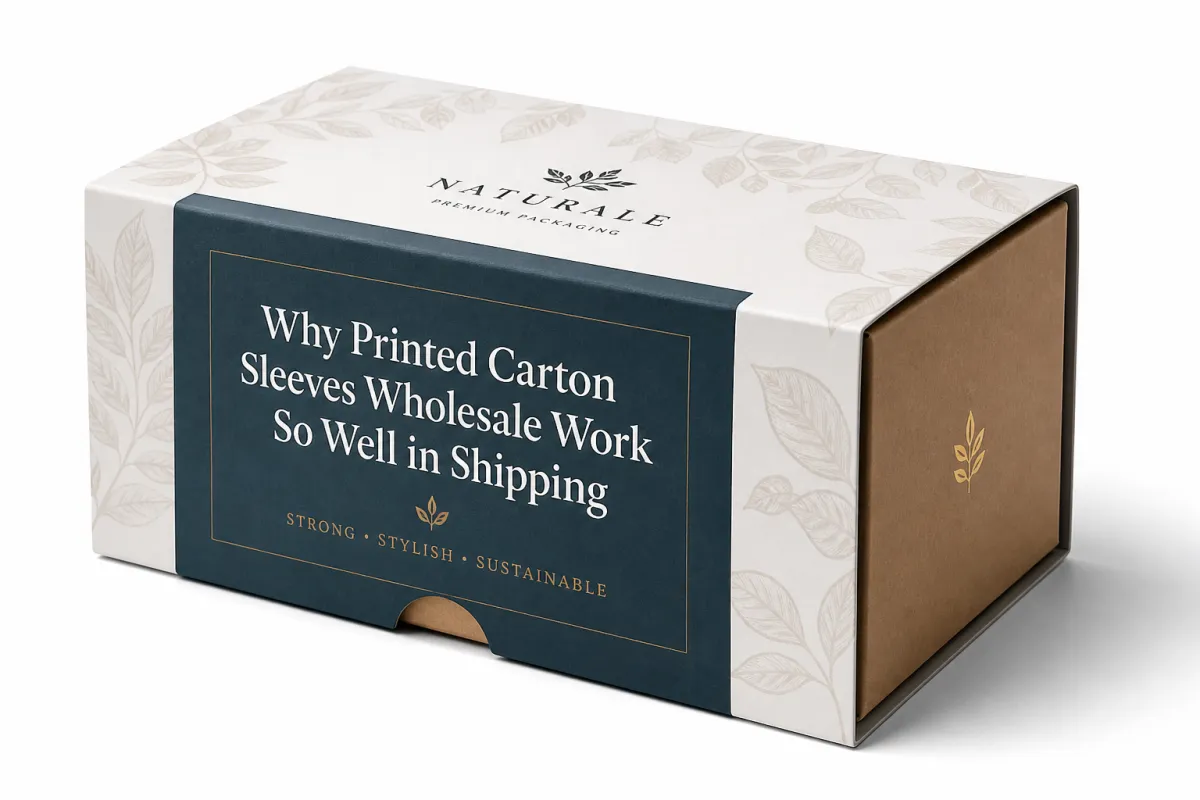
Shipping operations like formats that do one job well. A sleeve can label a shipment, separate SKUs, and give a retail-ready appearance while leaving the protection to the inner pack. That makes it useful for multipacks, subscription programs, club packs, seasonal assortments, and promotional sets that need to move through warehouse handling and still look organized on shelf.
Wholesale buying changes the math in a good way. Once the dimensions and construction are locked, repeat runs become easier to quote, easier to inspect, and easier to reorder. Setup costs spread across more units. Print consistency gets easier to hold. Inventory planning stops depending on guesswork. The savings come from repeatability, not from a pretty sales pitch.
The common pain points are familiar to any packaging team. Plain shipping cartons look unfinished. SKUs get mixed when the outside panel gives no clue. Retail presentation slips when the pack has no branded face. Unit cost creeps up whenever a one-off version is needed. Printed carton sleeves wholesale reduce that mess without asking the buyer to reinvent the carton.
I have seen buyers spend too much time trying to solve this with bigger structural changes than they need. The better move is often simpler: keep the base pack stable, then use the sleeve to handle the visible work. That approach keeps ordering clean and avoids a lot of unnecessary tooling. If you are comparing larger packaging runs, the Wholesale Programs page is a useful place to sort through options.
- Bundles: sleeves hold multi-item packs together and keep the message visible.
- Subscription goods: they create a consistent branded face without changing the inner box.
- Seasonal SKUs: artwork can change faster on a sleeve than on a full carton.
- Retail-ready cartons: the sleeve can carry shelf impact while the carton handles protection.
For shipping teams, the real value of printed carton sleeves wholesale is control. Flat storage, easier counting, easier reorders, fewer surprises at packing. That does not sound glamorous, yet it usually saves more money than a flashier packaging idea ever will.
What Printed Carton Sleeves Wholesale Actually Include
Printed carton sleeves wholesale are folded wraps that sit around a carton, tray, tuck box, or product bundle. They carry branding, product information, barcode placement, regulatory copy, and the visual layer that the base pack does not need to carry on its own. The sleeve becomes the outer face of the packaging system while the inner pack keeps the structure intact.
Several constructions show up often. Open-ended sleeves slide over the pack and rely on fit, fold depth, or a tuck to stay put. Glued sleeves arrive pre-formed and can be faster to handle on a busy line. Lock-style wraps add a little more retention for products that move around in transit. Flat-pack scored sleeves are often the easiest to store and the most efficient to ship before assembly because they reduce inbound cube.
Printed carton sleeves wholesale often make more sense than labels or full custom cartons when the inner pack already exists. A label can identify the item, but it rarely gives the same shelf presence or finished look. A full carton can be attractive, yet it adds board, freight volume, and more tooling. The sleeve lands in the middle, which is often the best place for a buyer who wants visible branding without overspending on structural packaging.
Print and finish choices should match the actual use. CMYK works well for most artwork. Spot colors are useful when a brand needs a precise logo shade. Matte coating softens the visual tone. Gloss coating lifts contrast and gives graphics more punch under store lights. Soft-touch creates a richer hand feel, though it should only be used when the budget and handling profile support it. Foil and embossing can be effective, but only if the pack benefits from them. Decorative work that slows production and adds cost does not help much if the sleeve is headed straight into a shipping carton.
Another practical benefit gets overlooked more often than it should: these sleeves store flat. Flat-packed inventory lowers inbound cube, keeps warehouse aisles cleaner, and makes kitting or packing easier to stage. For operations teams, that flat format can be the difference between a tidy receiving area and a stack of awkward sleeves nobody wants to sort.
A standard order usually includes the dieline, the printed board, score lines, cut shape, and any optional finishing. If the supplier is organized, the quote should also show how the sleeve folds, how it fits, and how it packs. If those details are vague, the quote is not ready yet.
Printed Carton Sleeves Wholesale Specifications That Matter
Printed carton sleeves wholesale live or die on the spec sheet. A small dimension error can leave the sleeve loose, make it grab too tightly, or slow the line down. Finished length, panel width, depth, overlap, and bleed are not decorative fields on a form. They are the actual job.
Start from the real product or carton dimensions, not the rough estimate somebody mentioned in a meeting. The finished sleeve needs enough clearance to slide on cleanly, but not so much clearance that it looks sloppy. Overlap matters too. Too little overlap and the sleeve can open or shift. Too much overlap and you are paying for board that adds no value. For tight-fit applications, a tested sample is worth more than a guess. Packaging does not reward guesswork twice.
Material choice matters just as much as the measurements. Paperboard grades differ in stiffness, surface quality, and how they accept print. A thinner board may reduce cost, but it can wrinkle, buckle, or read as flimsy on shelf. A heavier board can improve presentation and help the sleeve hold its shape in transit, though it may add cost and fold less easily. Recycled content can support sustainability goals, but the brightness and print surface still need checking if color accuracy matters. If the sleeves will sit in humid storage, ask how the board behaves under those conditions before approving the run.
Print method changes the result. Digital printing usually fits shorter runs, faster artwork changes, and multiple SKU versions. Offset printing usually fits larger repeat orders and cleaner production at scale. The better choice depends on quantity, artwork complexity, and how tight the brand wants color control to be. For a quick test batch, digital often wins. For a stable, repeatable program, offset usually makes more sense.
Buyers should also ask for production tolerances. A sleeve meant to fit a carton should not vary widely from one batch to the next. If the tolerance range is too loose, line workers end up forcing parts together and slowing the packout. Small spec errors have a way of turning into labor costs, and labor costs are the part of packaging budgets that can get ugly fast.
There are freight and storage details people forget until the pallet shows up. Confirm that the sleeves ship flat. Confirm master carton counts. Confirm the pallet pattern before shipment. If the finished sleeves will wait in a warehouse before use, moisture exposure needs attention. A sleeve that looks fine under shop lights can still warp, curl, or pick up edge damage if storage conditions are poor.
For technical sanity checks, packaging buyers often use industry references. The Institute of Packaging Professionals at Packaging.org is helpful for terminology and context, and ISTA test methods are a common reference point for shipment testing. If the brief includes sustainability claims, ask for FSC-certified board through the Forest Stewardship Council at fsc.org.
A sleeve that fits first and impresses second beats a beautiful sleeve that slows the line.
That is the basic rule behind printed carton sleeves wholesale. Fit comes first. Then finish. Then freight. In that order.
Printed Carton Sleeves Wholesale Pricing and MOQ
Printed carton sleeves wholesale pricing comes down to a few familiar variables: dimensions, board grade, print colors, coating, structural complexity, finishing, and total quantity. There is nothing mysterious hiding in the quote. The mistake is treating the unit price as if it tells the full story. It does not.
MOQ often matters less than the point where setup costs stop distorting the price. A smaller order may be possible, but the unit cost can be sharp if the run is too short to absorb prepress and tooling. A larger order can bring the cost down quickly, but only if the warehouse can store and use the inventory. Printed carton sleeves wholesale are one of those purchases where the cheapest unit price and the smartest decision are not always the same thing.
I prefer asking for tiered pricing across several volumes. Request a short-run quote, a pilot-run quote, and a production-run quote. That shows where the economics improve and whether the supplier is actually giving you meaningful volume breaks. If you only ask for one quantity, the picture stays blurry, and blurry pricing is usually the first sign that a budget will drift.
Here is a practical comparison of common printed carton sleeves wholesale options. These are planning ranges, not promises, because exact pricing moves with the spec and the market.
| Option | Typical Use | Approx. Unit Price | MOQ Range | Usual Lead Time | Notes |
|---|---|---|---|---|---|
| Digital printed sleeve, standard board | Short runs, artwork tests, multiple SKUs | $0.22-$0.45 | 500-2,000 | 7-12 business days after proof approval | Good for speed and version changes |
| Offset printed sleeve, standard board | Repeat orders, stable artwork, medium to large volumes | $0.12-$0.28 | 3,000-10,000 | 10-18 business days after proof approval | Better economics once setup is spread out |
| Offset sleeve with coating or premium finish | Retail presentation, gift sets, premium bundles | $0.18-$0.40 | 5,000-20,000 | 12-20 business days after proof approval | Soft-touch, foil, or embossing pushes price up |
Those numbers help because they frame the tradeoff. A cheaper sleeve can still cost more if it tears, prints unevenly, or causes packing trouble. A premium finish can be money wasted if nobody sees the sleeve outside the warehouse. Printed carton sleeves wholesale work best when spend is planned, not improvised.
Hidden costs deserve their own attention. Die setup can matter. Plate charges can matter. Proofing can matter. Freight absolutely matters. If the order is too large for the storage plan, warehousing becomes a cost too. A quote that looks attractive on paper can get expensive once handling and transit are included. Buyers should compare landed cost, not just the unit number on the page.
One more practical point: seasonal artwork changes the pricing structure. Faster turnaround, more versions, and more artwork changes usually point toward digital or hybrid production. Stable artwork and repeatable specs usually favor offset. Printed carton sleeves wholesale get more efficient once the design stops changing every season.
Printed Carton Sleeves Wholesale Process and Timeline
Printed carton sleeves wholesale usually move through a predictable order flow: brief, dieline review, artwork prep, proof approval, sample or dummy confirmation, production, packing, and shipment. The process looks simple on paper. The quality of the brief decides whether it stays simple or turns into a long email trail that nobody wants to read twice.
Timing depends on whether the sleeve is a repeat order or a new structure. Repeat orders are faster because the fit has already been proven and the artwork has already been signed off. New sleeve structures take longer because someone has to confirm dimensions, folding behavior, and print layout. First-time buyers often think the print run is the only clock that matters. It is not. Prepress and approval can add real time.
Most delays show up in the same places. Missing dimensions are a common one. Unclear copy is another. Barcode placement gets missed often, especially when the sleeve needs front-facing graphics and regulatory text at the same time. Last-minute artwork changes after proof review can consume days. If the buyer does not know the exact carton or product measurements, the schedule starts wobbling immediately.
A realistic planning framework helps a lot. Proofing and prepress can move quickly when the artwork is clean and the spec is settled. Production takes longer, especially if coatings or premium finishes are involved. Freight should stay in a separate bucket because transport time is not the same thing as manufacturing time. I have seen buyers blame the supplier for a late arrival when the actual issue was that production and transit got folded into one impossible promise.
Rush orders are possible, but speed always trades against something. It can narrow finish choices. It can raise price. It can do both. If the sleeves support a launch event, a seasonal drop, or a fixed retail date, say that early. If the schedule is flexible, let production run on a sane timeline. Printed carton sleeves wholesale respond better to clarity than urgency.
A clean timeline usually looks like this:
- Day 1-2: quote review, dimensions confirmed, and artwork brief locked.
- Day 3-5: dieline and digital proof review.
- Day 6-8: sample confirmation or final approval.
- Day 9-18: production, finishing, and packing.
- Transit: freight time added separately based on destination.
That is not a universal promise. It is a planning model. Printed carton sleeves wholesale can move faster or slower depending on quantity, finish, and how clean the artwork arrives. If a supplier gives a quote without walking through these steps, they are skipping the part that actually controls on-time delivery.
Why Buyers Choose Our Printed Carton Sleeves Wholesale Program
Printed carton sleeves wholesale buyers tend to care about the same things: stable color, predictable reorders, packaging that works inside the shipping flow, and clear communication when something needs attention. That is where a good wholesale program proves its value. It is not about sounding polished. It is about not creating extra work for the customer.
Logistics teams want flat-packed supply, reliable carton counts, and pallet information they can use without chasing someone for clarification. Procurement wants pricing that can be compared without decoding hidden variables. Brand teams want the print to stay consistent from run to run. Operations wants the sleeves to fit without line stoppages. Printed carton sleeves wholesale only work if all four groups can live with the outcome.
Quality control is another reason buyers stay with a supplier that handles the basics well. Dieline checks catch bad fit before production starts. Proof review catches artwork issues before anything gets printed. Registration accuracy matters if logos, icons, or small type need to stay sharp. Repeat-run consistency matters because nobody wants the second order to look like a different product. Trust in packaging usually gets built one clean run at a time.
Printed carton sleeves wholesale also reduce friction in routine ordering. Fewer back-and-forth revisions. Clearer specs. Faster answers when a change is needed. Better tracking on what was approved and what shipped. That sounds dull because it is dull, and dull is often exactly what buyers want.
If you are comparing packaging support for larger runs, our Wholesale Programs page gives a better starting point than trying to assemble a one-off quote by email. If your project is part of a broader packaging rollout, keeping the sleeve spec aligned with broader sourcing requirements helps keep teams from drifting into mismatched versions or duplicated work.
There is also a sustainability angle that does not need theater. FSC-certified board, sensible material choices, and right-sized packaging reduce waste more effectively than slogans do. Flat-packed sleeves, only printing what is needed, and avoiding oversized structures already put the program ahead of many rushed packaging orders.
That is the point, really. Printed carton sleeves wholesale should make packaging easier to manage, not harder. A supplier should clear confusion away, not add more of it.
What to Send Before Ordering Printed Carton Sleeves Wholesale
Printed carton sleeves wholesale quotes are only as good as the information you send. If the brief is vague, the price will be vague. If the dimensions are wrong, the sleeve will be wrong. There is no clean way around that. A solid quote starts with a solid pack spec.
Send the product dimensions, sleeve style, board preference, print colors, finish, quantity, destination, and target delivery date. If the sleeve needs to wrap a real item or fit a tight carton, include a sample or photos. If the sleeve has to hit a specific shelf position or barcode placement, say that up front. The more complete the brief, the less time gets wasted on revisions and assumptions.
It also helps to explain how the sleeves will actually be used. Will they be packed by hand or on an automated line? Will they sit in a warehouse for weeks? Do they need to survive repeated handling at retail? Will the inner pack be a tray, a tuck box, or a bundle? Those details change the spec. They also change the price, which is why they need to be clear before the quote goes out rather than after approval.
Ask for a sample or printed proof if fit matters more than speed. That is especially true for printed carton sleeves wholesale jobs with tight tolerances, unusual folds, or premium branding that needs to align across panels. A good proof can save a lot of waste. A rushed approval can create a bad run at scale, and that is a far more expensive mistake.
Comparing quotes only works if the specs match. One supplier may quote a lighter board, another may include coating, and a third may be using different dimensions entirely. That is why apples-to-apples comparison matters. If the spec sheet changes from supplier to supplier, the price discussion becomes noise.
Use this checklist before you request printed carton sleeves wholesale pricing:
- Dimensions: finished sleeve size, overlap, and carton or product measurements.
- Board: paperboard grade, caliper, and any recycled or FSC requirement.
- Print: CMYK, spot colors, barcode needs, and any special ink requirements.
- Finish: matte, gloss, soft-touch, foil, embossing, or none.
- Quantity: current order and likely reorder volumes.
- Use case: manual packing, automated packing, retail display, or shipping only.
- Delivery: ship-to address, deadline, and whether freight timing is flexible.
Once the dieline is locked and the proof is approved, the order gets much easier to manage. After that, confirm packing counts, check the pallet plan, and set the reorder point before inventory runs low. That is how printed carton sleeves wholesale stay efficient instead of turning into an urgent scramble.
If your packaging team is balancing multiple SKUs, it helps to align the sleeve order with the broader sourcing plan through the Wholesale Programs page so the job does not drift into mismatched specs or duplicated work.
Printed carton sleeves wholesale work best when the buyer gives the supplier something concrete to build from. Not a mood board. Not a vague note about wanting “premium but affordable” packaging. A real spec. That is the difference between a quote that helps and a quote that wastes time.
How do printed carton sleeves wholesale orders differ from custom cartons?
Printed carton sleeves wholesale add branding and product information to an existing pack, while custom cartons replace the outer box entirely. Sleeves usually use less material, store flat, and cost less than a full printed carton when the inner pack already exists. They fit best when the goal is visibility, SKU control, or retail presentation rather than full structural packaging.
What is a realistic MOQ for printed carton sleeves wholesale?
There is no single universal MOQ for printed carton sleeves wholesale because size, print method, and finishing all affect the economics. Short runs are possible, but the unit price usually improves once setup costs are spread over larger quantities. Ask for pricing at several tiers so you can see the point where the order becomes efficient.
How long do printed carton sleeves wholesale orders usually take?
The timeline for printed carton sleeves wholesale depends on proof approval, artwork readiness, production complexity, and shipping distance. Simple repeat orders move faster than new sleeve structures with first-time dieline checks. Plan production and transit separately so freight does not get mixed up with manufacturing time.
What information do I need for an accurate quote on printed carton sleeves wholesale?
Send the sleeve dimensions, quantity, board preference, print colors, coating, and destination for printed carton sleeves wholesale quotes. Include product photos or a sample if the sleeve needs to wrap a real item or fit a tight carton. The more complete the brief, the less time gets wasted on revisions and assumptions.
Can printed carton sleeves wholesale be made for shipping and retail at the same time?
Yes, printed carton sleeves wholesale can serve shipping and retail if the sleeve is designed to handle rougher movement, stack cleanly, and still look good on shelf. The trick is balancing durability, print clarity, and pack efficiency instead of overbuilding the structure. A good sleeve should work in the warehouse first and the store second, not the other way around.
If you want a clean, practical buying path, printed carton sleeves wholesale should be treated like any other production packaging order: lock the spec, confirm the proof, compare landed cost, and keep the reorder plan realistic. The best next step is simple and a little unglamorous, but it saves money: finalize the dieline, approve one physical sample, and price the order at more than one quantity before you commit.


