Buyer Fit Snapshot
| Best fit | Corrugated Tray Boxes Bulk Order projects where brand print, material claims, artwork control, MOQ, and repeat-order consistency need to be specified before quoting. |
|---|---|
| Quote inputs | Share finished size, material target, print colors, finish, packing count, annual reorder estimate, ship-to region, and any compliance wording. |
| Proofing check | Approve dieline scale, logo placement, barcode or warning zones, color tolerance, closure strength, and carton packing before bulk production. |
| Main risk | Vague material claims, crowded artwork, missing packing details, or unclear freight terms can make a low unit price expensive after revisions. |
Fast answer: Corrugated Tray Boxes Bulk Order: Pricing, Specs, Timing should be specified like a repeatable production item. The safest quote records material, print method, finish, artwork proof, packing count, and reorder notes in one written spec.
Production checks before approval
Compare the actual filled-product size with the drawing, then confirm tolerance on folds, seals, hang holes, label areas, and retail display edges. Reserve space for logos, QR codes, warning copy, and material claims before decorative graphics fill the panel.
Quote comparison points
Review material grade, print process, finish, sampling route, tooling charges, carton quantity, and freight assumptions side by side. A quote is only useful when the supplier can repeat the same color, closure quality, and packing count on the next order.
A Corrugated Tray Boxes bulk order is never just a purchase order with a quantity attached. It is a working decision about how product will move through a line, sit on a pallet, travel through a warehouse, and show up at the receiving dock in one piece. I have seen tray programs look inexpensive on paper and then quietly get expensive through extra labor, corner crush, or those annoying little rework moments that slow everything down.
That is why a corrugated tray boxes bulk order deserves careful spec work up front. Dimensions, board grade, flute choice, stack height, print area, and moisture exposure all change how the tray behaves once production starts. A tray that is sized correctly can keep packing stations moving, reduce pallet waste, and protect the product without adding more board than the job needs.
For buyers, tray boxes tend to make the most sense where speed and visibility matter. Produce teams like the open top because loading is fast and inspection is easy. Parts departments use trays for kitting and staging. Retail programs depend on them for shelf-ready replenishment, where the tray becomes part of the display instead of disappearing behind it. In those cases, a well-planned tray often replaces a more complicated container at a lower total handling cost, especially once the repeat run is locked in.
The better question is not whether the tray can hold the product. The better question is whether it will keep its shape during production, palletize cleanly, and protect the load without wasting board. That shift in thinking usually leads to a better buy and a much cleaner reorder path.
Why a corrugated tray boxes bulk order lowers handling costs
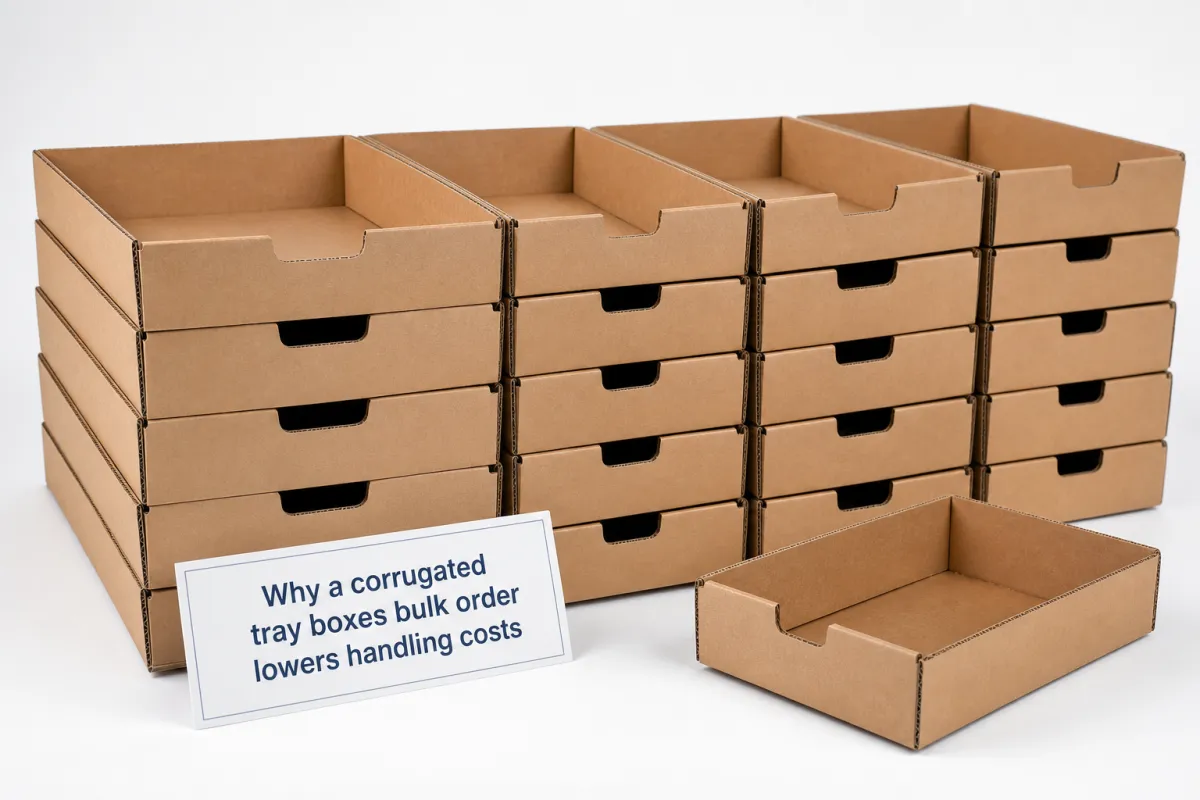
A corrugated tray boxes bulk order lowers handling costs because one approved design can carry through several production cycles without constant changes or re-approval. Once the inside dimensions, flute orientation, and stack pattern are settled, reordering gets a lot simpler. That matters on a busy line, where even a small delay can throw off labor planning for the rest of the shift.
The tray price is only one part of the story. The bigger cost often shows up later in labor spent forcing an undersized tray into place, product damage caused by weak corners, or the time lost when trays buckle during transit. A properly specified corrugated tray boxes bulk order trims those hidden costs by matching the tray to the load, the route, and the way the tray will actually be handled in the real world.
Open-top trays are especially handy for produce, industrial parts, bakery items, and retail-ready goods because workers can reach the contents quickly and check fill levels at a glance. A packer can see right away whether the tray is filled correctly. A receiver can inspect the load without tearing it apart. For a lot of programs, that reduced handling is the reason a corrugated tray boxes bulk order becomes the default format.
Pallet efficiency is another place where savings show up. If the tray footprint fits the unit count and pallet pattern, void space drops, the stack sits more steadily, and the load can usually be built to a useful height without crossing compression limits. That is not packaging theory for its own sake. That is the kind of everyday gain that keeps a warehouse from wasting motion and board.
Retail-ready programs also benefit from presentation. A clean front panel, a consistent top edge, and a dependable print area can make shelf replenishment look orderly, which matters when the tray itself becomes part of merchandising. A corrugated tray boxes bulk order works best when it supports both logistics and appearance in the same piece.
"The cheapest tray on paper is not always the cheapest tray in operation. If the spec is off, the labor bill is gonna find you later."
That is the real reason a corrugated tray boxes bulk order is a cost-control decision. The goal is not to overbuild. The goal is to buy exactly enough structure for the product, the route, and the way people will handle the tray in the warehouse and on the line.
What corrugated tray boxes are made to do
Corrugated tray boxes bulk order buyers usually want the same outcome: a container that loads quickly, stacks reliably, and gives workers fast access to the product. A tray box is an open-top corrugated structure built for that kind of use. Compared with a fully enclosed carton, it is easier to fill, easier to inspect, and often easier to use in a shelf-facing or staging environment.
The construction details matter more than many first-time buyers expect. Single-wall board is common for lighter items and shorter routes, while double-wall board is a better fit when the tray will face higher compression, rougher handling, or several stack levels. In a corrugated tray boxes bulk order, the converter may recommend B flute, E flute, or BC flute depending on the weight, print requirements, and how the tray will live day to day.
Fresh produce and chilled goods bring moisture into the picture, and that changes the conversation. Vent holes, cutouts, and board selection affect condensation, airflow, and how the tray behaves in cold rooms. A corrugated tray boxes bulk order for produce may look simple from the outside and still require careful structural planning. The open top helps, but the board still has to survive a humid chain of handling without softening too early.
Display trays add another layer of purpose. A clean front lip, consistent side panels, and print that holds up under retail lighting can turn a basic shipper into a shelf-facing unit. That does not mean every tray needs full-color graphics. Many buyers find that one-color branding, item codes, and handling marks are enough. The best corrugated tray boxes bulk order is the one that supports the actual merchandising task without piling on unnecessary print cost.
Tray geometry also affects line speed. A standardized footprint and depth make it easier for operators, pickers, and semi-automated equipment to handle the tray without constant adjustment. If the tray will travel through a pack line, the dimensions should be checked against machine clearance, bundle height, and pallet pattern before the corrugated tray boxes bulk order is approved.
Buyers who want to compare tray options with a broader packaging program often look at related categories such as Custom Shipping Boxes, browse other Custom Packaging Products, or review Wholesale Programs when recurring replenishment is part of the plan.
Industry standards matter too. Transport testing guidance from ISTA can help confirm whether the tray and pallet pattern are fit for the distribution environment, while fiber sourcing questions may point buyers toward FSC options when certified paperboard is required. A thoughtful corrugated tray boxes bulk order belongs inside that wider performance and sourcing framework, not outside it.
Specifications to lock in before you place the order
Before any corrugated tray boxes bulk order moves ahead, the dimensions need to be pinned down with more precision than many buyers expect. Inside length, inside width, inside depth, overhang, and clearance for inserts or wrapped bundles all change how the tray performs. A tray that looks close on paper can still waste pallet space or pinch the product during loading.
Start with the product itself. What does each unit weigh? How many pieces sit in the tray? Will the product settle, shift, or swell during handling? Those answers decide whether single-wall board is enough or whether a stronger build is warranted. In a corrugated tray boxes bulk order, lighter goods often run fine in standard single-wall board, while heavier stacks or longer routes may call for a sturdier configuration. Dense loads tend to care more about compression strength than visual finish.
Then look at the environment. Will the tray live in a dry warehouse, a refrigerated room, or a humid lane with temperature swings? Moisture changes board behavior, especially on open-top formats that do not get the protection of a closed carton. For a corrugated tray boxes bulk order, that is where coatings, wet-strength options, or a different flute choice may be worth the added spend. Not every program needs them, but enough do that the question deserves a real discussion.
Stacking and top load deserve equal attention. A tray used only for single-layer presentation is one thing; a tray stacked four high on a pallet is another. Buyers should ask how much compression the tray must tolerate, whether it needs to survive cross-docking, and how much stack height is expected in transit. A corrugated tray boxes bulk order should be specified around the hardest part of the journey, not the easiest.
Printing and converting choices also influence both cost and timing. A simple die-cut tray with one-color branding is easier to run than a more customized structure with vent holes, reinforced corners, or special thumb cuts. If your corrugated tray boxes bulk order needs a product window, a perforated front panel, or an internal coating, say so early. Those features are manageable, but they affect tooling and production scheduling.
Board grade and flute profile
One useful way to think about a corrugated tray boxes bulk order is to match the board grade to the actual mechanical demand. E flute can be a smart choice when print quality matters and the tray is meant for lighter retail items. B flute often gives better crush resistance for general shipping and produce work. BC flute steps up for heavier loads or tighter stack conditions. Board ratings such as 32 ECT or 44 ECT can narrow the discussion, but the final answer still depends on tray geometry, print coverage, and how the tray will be handled once it is in use.
Moisture and surface treatment
If the tray will sit around refrigeration, ice, or humid storage, moisture performance should be part of the quote. Some corrugated tray boxes bulk order programs need a water-resistant coating, while others simply need a different board selection and a smarter stack pattern. The point is to ask early instead of waiting for a trial run to expose a weakness. That is how buyers avoid losses later.
"Give me the product weight, the stack height, and the shipping environment, and I can usually tell you where the tray needs help. Leave those out, and the quote is only half useful."
For buyers who want a more formal packaging review, ISTA profiles and compression testing language can help frame the spec, but every corrugated tray boxes bulk order still needs a project-specific sheet. The strongest results come from tying the tray design to the real load, the real route, and the real handling method.
Pricing and MOQ for corrugated tray boxes bulk order
Pricing for a corrugated tray boxes bulk order usually comes down to five variables: board grade, tray size, print complexity, tooling, and quantity. Larger runs tend to lower the unit price because the plant can spread setup time across more pieces and reduce waste per unit. Smaller runs, especially with unusual dimensions or heavier print coverage, often carry a higher per-tray cost.
One common mistake is comparing quotes that are not built the same way. A quote that includes tooling, freight, and proofing is not directly comparable to a low number that leaves those pieces out. For a meaningful corrugated tray boxes bulk order comparison, ask each supplier to show the same details: board spec, cut style, print method, lead time, freight terms, and whether samples are included. Once the comparison is clean, the decision becomes a lot easier to trust.
Minimum order quantity changes with the design. Stock-style trays or simpler converted shapes may allow a lower MOQ, while fully custom dies, special cuts, or higher-color graphics may require a larger commitment. In a corrugated tray boxes bulk order, MOQ is often shaped by sheet size and machine setup as much as by the buyer's target volume. That is why tiered pricing helps. A good quote should show what happens at 2,500, 5,000, and 10,000 pieces, not just one number.
Here is a practical way to think about the cost tiers. These are common planning ranges, not promises, because board-market swings, print coverage, and freight distance can move the final figure:
| Tray option | Typical build | Relative unit cost | Best fit |
|---|---|---|---|
| Standard open-top tray | Single-wall, one-color print, simple die-cut | Lowest | Lighter products, warehouse staging, simple retail replenishment |
| Reinforced tray | Heavier board, stronger corners, limited branding | Moderate | Stacked loads, mixed handling, longer distribution routes |
| Display tray | Higher print coverage, clean front panel, custom cut features | Moderate to higher | Shelf-ready retail programs, branded merchandising, club store use |
| Moisture-focused tray | Coated board, performance-focused spec, stronger flute choice | Higher | Produce, chilled logistics, damp or humid environments |
For budgeting, many buyers like to request a corrugated tray boxes bulk order quote with three versions: cost-focused, balanced, and performance-focused. That makes the tradeoffs visible. You can see where price rises because of stronger board, where it rises because of print, and where a small design change could save money without hurting function.
As a rough planning reference, simple tray programs may sit near the low end of commercial corrugated pricing, while stronger or printed trays move upward depending on size and order count. For example, a 5,000-piece corrugated tray boxes bulk order might price very differently from a 20,000-piece run even when the tray looks similar, because larger runs benefit from better material utilization and lower setup cost per unit. That is normal. The useful part is comparing like for like and making sure a lower headline number is not hiding missing services.
If the program will be reordered on a schedule, ask about replenishment planning. A well-managed corrugated tray boxes bulk order can be set up so the next run matches the approved spec without structural changes or avoidable delays. That consistency is where the long-term savings usually show up.
Process and timeline for corrugated tray boxes bulk order
The order flow for a corrugated tray boxes bulk order is straightforward when the buyer comes in prepared. It usually begins with a quote request, followed by structural review, artwork confirmation, proof approval, production scheduling, and delivery. The entire process moves faster when dimensions, product weight, and shipping details are already in hand.
Timeline is usually shaped by three factors. First is how fast art gets approved. Second is whether the tray needs tooling or a sample build. Third is the plant schedule for the chosen board and print method. A simple corrugated tray boxes bulk order with clear specs can move quickly. A more customized tray with special cuts, moisture treatment, or heavier print requirements needs more room for testing and review.
From a buyer's point of view, the most effective way to avoid delay is to prepare the practical details early. Have the inside dimensions ready. Know the target load weight. Confirm stack height and pallet pattern. Provide the destination ZIP code, freight expectations, and any handling constraints such as cold storage or retail-ready display. With that information, a corrugated tray boxes bulk order can be quoted with far less guesswork.
Sample approval deserves special attention. If the tray must fit a pallet pattern, a line guide, or a retail shelf precisely, a flat proof or pre-production sample can save an expensive mistake. The cost of one sample is small compared with the cost of a full corrugated tray boxes bulk order that is off by a quarter inch and throws off the packing operation.
What to prepare before requesting quotes
- Inside dimensions: length, width, and depth of the tray.
- Product data: unit weight, bundle count, and any fragile points.
- Handling conditions: dry warehouse, chilled storage, humid route, or mixed.
- Stacking needs: top-load, pallet height, and expected stack levels.
- Print needs: logo, item code, traceability marks, or retail graphics.
- Volume targets: first run quantity and expected replenishment volume.
That checklist makes a corrugated tray boxes bulk order easier to quote accurately and easier to approve the first time. It also helps the converter spot risk early, which is where the real value sits. A clear spec shortens the path from draft to approved production, and that is what most operations teams want.
For buyers who need packaging support beyond one tray format, it helps to keep the conversation connected to broader supply options, including Wholesale Programs and the wider mix of Custom Packaging Products. A good supplier should be able to show where a corrugated tray boxes bulk order fits within the rest of the packaging system instead of treating it as a one-off purchase.
Testing references are worth mentioning here too. ISTA transit profiles, compression planning, and warehouse handling expectations can all inform the spec. A thoughtful corrugated tray boxes bulk order should be built with those realities in mind, not just with a die line and a logo.
Why choose us for corrugated tray boxes bulk order
Custom Logo Things is a strong fit for a corrugated tray boxes bulk order because the focus stays on practical packaging decisions rather than decorative extras. That matters. Buyers usually do not need a tray that only looks good in a sample room. They need a tray that behaves correctly on a line, survives stacking, and comes back in repeat runs with the same dimensions and print placement.
We approach a corrugated tray boxes bulk order the way a packaging buyer would: by looking at board selection, flute direction, tray geometry, freight handling, and replenishment planning together. That helps prevent two common mistakes. One is buying features that raise cost without improving performance. The other is underbuilding a tray that looks fine until it reaches a warehouse or a humid dock.
Clear quote breakdowns matter too. A buyer should be able to see what is driving the price: board grade, print coverage, custom cutting, or special coating. That is especially useful in a corrugated tray boxes bulk order, where even a modest design change can move the per-unit cost in a noticeable way. Transparent pricing makes it easier to Choose the Right spec instead of chasing the lowest number by habit.
Repeat consistency is another real advantage. Once a tray is approved, the next corrugated tray boxes bulk order should match the same dimensions, the same cut quality, and the same stacking behavior. That consistency protects the packing operation and keeps the reorder process much simpler, which is where many buyers finally see the long-term value.
If you want a wider view of packaging formats and support options, the team can help connect your tray program with the rest of your shipping or display lineup. A corrugated tray boxes bulk order is often part of a larger packaging system, and it should be reviewed that way.
For buyers who want practical sourcing aligned with fiber responsibility, FSC-certified board options may be available depending on the program. For buyers who care about shipping performance, a test-minded corrugated tray boxes bulk order paired with sensible compression and transit planning is usually the safest path. That is the kind of straightforward guidance that helps teams make a clean decision.
Next steps for a corrugated tray boxes bulk order
The smartest next step for a corrugated tray boxes bulk order is to turn the idea into a locked specification. Gather the product dimensions, target load weight, stack height, print needs, and destination details before asking for the final quote. That keeps the conversation focused on the tray that will actually be used, not a rough approximation that only looks right from a distance.
It also helps to compare at least two spec options. One should be cost-focused and one should be performance-focused. That comparison shows where extra board strength is worth the money and where a simpler build will do the job just as well. In many cases, a corrugated tray boxes bulk order becomes much easier to approve once the team can see the tradeoff side by side.
If the fit is critical, ask for a sample or dieline review. A small sizing mistake can affect pallet efficiency, shelf presentation, or line handling across the full order. For a corrugated tray boxes bulk order, that is the kind of check that pays for itself quickly.
Replenishment should be discussed upfront as well. If the tray will be reordered on a regular schedule, make sure the spec is documented so future runs stay consistent. That is one of the biggest advantages of a well-managed corrugated tray boxes bulk order: once the structure is approved, the buyer is not solving the same problem over and over.
Use this simple checklist before you request a formal quote:
- Confirm inside dimensions and product count per tray.
- Define weight, stack height, and handling environment.
- Choose print level and branding requirements.
- Decide whether a sample or flat proof is needed.
- Ask for tiered pricing at multiple quantities.
- Verify freight, lead time, and reorder expectations.
A corrugated tray boxes bulk order works best when it is treated like a locked manufacturing spec. Once size, strength, and timing are agreed, the first run is easier to approve and the reorders are much easier to manage.
If you are ready to move, send the spec, request a detailed quote, and compare the options against the actual handling requirements. That is how a corrugated tray boxes bulk order turns into a dependable packaging program instead of a one-time purchase.
FAQ
What is the minimum order for a corrugated tray boxes bulk order?
MOQ depends on tray size, board grade, print method, and whether the design needs a custom die or can run as a simpler converted shape. Smaller, standard-style trays usually allow lower minimums than highly customized trays with special cuts or heavy graphics. The most useful approach is to ask for tiered pricing so you can see where the unit cost improves as volume increases in a corrugated tray boxes bulk order.
How do I choose the right board grade for corrugated tray boxes bulk order?
Match the board grade to product weight, stacking load, and the handling environment, not just to the tray's visual appearance. Single-wall is often enough for lighter goods, while heavier or stacked loads may need stronger board or reinforced construction. If the trays will be used in cold, damp, or humid conditions, ask about moisture performance and coating options before approving the corrugated tray boxes bulk order.
Can corrugated tray boxes bulk order include printing or branding?
Yes, most tray boxes can be printed with logos, handling marks, item codes, or simple merchandising graphics. One-color or limited-color printing is usually the most cost-efficient for bulk orders. Keep the print goal aligned with the tray's job; functional labels and traceability marks often matter more than heavy decoration in a corrugated tray boxes bulk order.
How long does a corrugated tray boxes bulk order usually take?
Lead time depends on proof approval, tooling needs, order size, and current production scheduling. Straightforward tray builds move faster than custom structures that need samples or design revision. Have dimensions, artwork, and shipping details ready early to avoid delays during quoting and production for your corrugated tray boxes bulk order.
What information do I need to request a quote for corrugated tray boxes bulk order?
Provide inside dimensions, product weight, stack requirements, board preference if known, and whether the tray needs printing. Include destination ZIP code, target quantity, and whether you need a sample before full production. The more exact the spec, the more accurate the quote and timeline will be for a corrugated tray boxes bulk order.