Printed Clothing Labels Quote for cosmetics usually starts with a practical question: are you pricing labels for staff apparel, tote bags, event kits, or a small run of branded pieces that have to look finished on day one? The answer matters because the cheapest quote is often missing something important, whether that is a fold style, proofing step, packing method, or freight. If the number does not show those details, it is not a clean comparison. It is only a starting point.
Cosmetics teams tend to work against tight launch windows, fixed retail dates, and short production runs, so a label that looks affordable on paper can become expensive once the missing pieces are added back in. A better quote request is simple: define the label’s use, the construction, the finish, the quantity breakpoints, and the delivery target before anyone prices it. That gives you a number that can actually be used in budget approval instead of one that turns into a revision later.
printed clothing labels quote for cosmetics: why a small sample run can save money
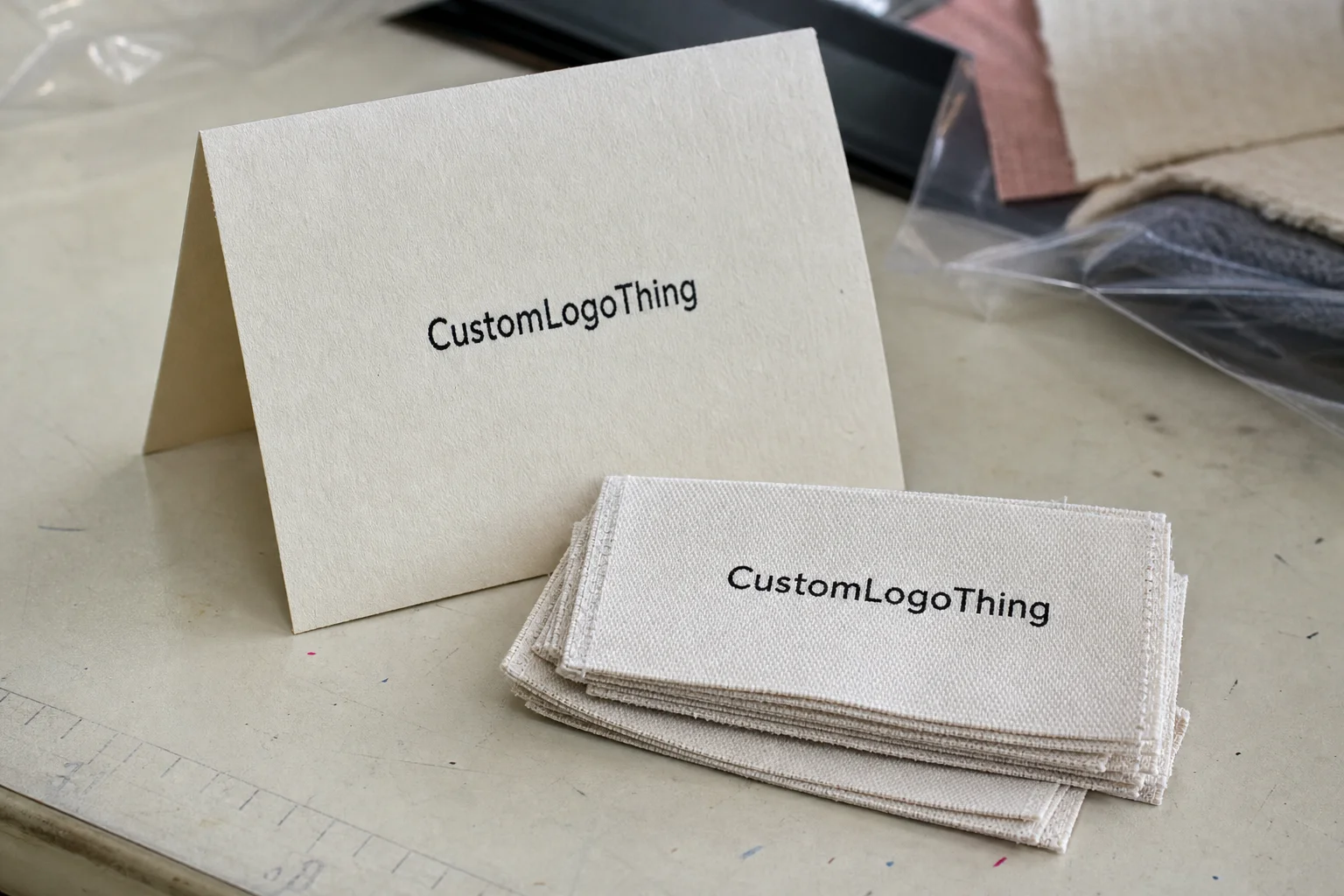
Cosmetics buyers rarely need labels for only one use case. The same brand may need sewn-in labels for retail staff apparel, printed labels for promotional merchandise, and neat presentation pieces for gift-with-purchase kits. That mix changes the price picture quickly. A label that is comfortable on a shirt may not be the right choice for a tote bag or a boxed set, and a finish that works on an outer garment may look too shiny inside a premium package.
A small sample run is often the safest first step. It shows how the label behaves on real fabric, whether the print remains legible at arm’s length, and whether the finish matches the rest of the brand system. It also exposes issues that are easy to miss on screen: rough edges, overly thin type, a fold that creates bulk in the seam, or a material that feels harsher than expected against skin. Those problems are cheap to catch early and costly to discover after a full run.
The lowest number is not always the best number. If a quote excludes folding, proofing, packing, or freight, the missing line items can erase the savings later. That matters more for cosmetics launches because the labels are usually tied to a hard deadline, not an open-ended inventory plan. A cleaner process is to compare full specs against full specs, then decide which option fits the use case rather than chasing the lowest headline price.
That is why a Printed Clothing Labels Quote for cosmetics should read like a production plan, not a guess. The more specific the request, the less room there is for unwanted changes after approval.
Label constructions that hold up on apparel, inserts, and gift sets
Most cosmetics brands end up choosing from a small set of proven constructions. Satin polyester is common because it gives a soft hand feel and a polished surface without pushing the price too high. Polyester taffeta sits on the practical side of the range and usually makes sense when the brief is utility, volume, or controlled cost. Cotton gives a more natural look, but it can raise the unit cost and is not always the best choice if the garment will see repeated laundering. Woven-look printed labels can look more premium at close range, though the price rises when the artwork is detailed or the registration has to be tight.
The use case should drive the material, not the other way around. A sewn-in apparel label needs stable print edges, low irritation against skin, and enough durability to survive stitching and washing. A label attached to a tote, pouch, or cosmetic case needs to sit neatly and read clearly in retail light. A piece that goes inside a gift set may never be washed at all, but it still has to look deliberate when the customer opens the box. The same logo can produce very different outcomes depending on the material, the fold, and the trim.
Folding style matters more than many buyers expect. End fold, center fold, book fold, and straight cut each change both the appearance and the labor needed to finish the order. A straight cut label may be cheaper, but a folded label often gives a cleaner sewn result and protects the edges better. If the order also includes hang tags, insert cards, or carton components, ask whether any of those items are FSC-certified. That is a separate decision from the label itself, but the wider package system usually gets reviewed as one unit by the brand team.
| Construction | Best use | Typical price range at 5,000 pcs | Buyer note |
|---|---|---|---|
| Satin polyester | Staff apparel, soft-touch branded garments | $0.12-$0.24 each | Balanced for hand feel, appearance, and durability |
| Polyester taffeta | Utility apparel, higher-volume runs | $0.09-$0.18 each | Usually the most price-efficient standard option |
| Cotton | Natural-look merch, premium gift sets | $0.18-$0.35 each | Useful for softer brand stories, but usually costs more |
| Woven-look printed | Premium branding, visible retail pieces | $0.14-$0.30 each | Helps when the label has to look refined at close range |
These ranges are directional, not fixed. One-color artwork on standard polyester stays efficient, while multiple print colors, custom folds, or special trim can push the number upward. A buyer who only sees the unit cost without the setup and finishing logic is not seeing the full picture.
Artwork, sizing, and finish specs to confirm before approval
A tight quote begins with tight artwork. Before anything is approved, confirm the finished size, print colors, quantity, attachment method, fold style, and any special treatment such as heat-cut edges or sewn hems. If the label is small, the logo should be checked at actual size, not only on a monitor. Thin lines, delicate typography, and metallic tones can disappear or soften if the file is not built for the print method.
Vector artwork is still the cleanest starting point because it keeps the shape sharp when the supplier scales or positions the design. High-resolution raster files can work in some cases, but they leave less room for correction if the art needs to be adjusted. Cosmetics branding often leans on pale neutrals, fine serif type, and precise spacing, so small file issues show up fast. When the label is tiny, even a slight shift in stroke weight can change the look more than people expect.
Color deserves its own review. Brand teams often care about a very specific black, blush, cream, or gold tone, and those shades can shift depending on the material finish. A matte satin label reads differently from a glossy one even if the ink formula stays the same. That is why a sample or digital proof is worth reviewing carefully. It is the easiest place to catch a mismatch before the full production run starts.
The cleanest order is the one with the fewest assumptions. If the supplier has to guess the size, fold, or coverage, the quote is only as good as those guesses.
The final check should reflect real use, not just a clean artwork file. If the label will be stitched into apparel, placed inside a retail kit, or shown on a hanger in store, the proof should show trim, fold, and placement. That level of detail usually shortens approval back-and-forth and keeps the final Printed Clothing Labels Quote for cosmetics aligned with the approved build. If you already know the label family you need, reviewing Custom Labels & Tags can help narrow the construction before you ask for pricing.
Pricing, MOQ, and unit cost: what changes the quote
Material, print complexity, finishing, quantity, setup, and packing drive the price. Those are the real levers. If the artwork is a single color on a standard polyester label, the cost stays manageable. Add multiple colors, a custom fold, or premium trim and the number rises quickly. The problem with a quote that only shows the per-piece figure is that it hides the setup burden. On small runs, a modest setup fee can matter more than a few cents in print variation.
MOQ has a bigger effect than many buyers expect. A 500-piece order may sound convenient, but the unit cost can be high enough that a 1,000-piece or 2,500-piece run makes more sense if the brand expects a repeat order. That matters for cosmetics companies that rotate staff apparel, event merchandise, or seasonal gift sets. A useful quote request should show at least three breakpoints so the team can see how the price moves as the quantity changes.
Here is the kind of comparison that helps a buyer make a decision without guessing:
| Quantity | Typical unit price | What changes |
|---|---|---|
| 500 pcs | $0.28-$0.55 | Higher setup share, less efficient packing |
| 1,000 pcs | $0.18-$0.36 | Better amortization of setup |
| 2,500 pcs | $0.13-$0.28 | Better unit economics for repeat use |
| 5,000 pcs | $0.09-$0.24 | Often the most efficient tier for standard builds |
Rush production, split shipments, and custom packing can change the final cost even when the label itself is simple. Freight is another hidden variable, especially for smaller batches that have to move by air rather than by consolidated sea shipment. If the launch date is fixed, ask about the timeline before approving the quote. A precise quote should show what is included, what is optional, and what changes if the order is revised after approval.
For broader packaging terminology and how components fit together in a finished package system, Packaging.org is a useful reference. For transport and handling questions, the International Safe Transit Association is a practical benchmark when you want to think about how finished goods hold up in shipping.
Process, proofing, and turnaround from files to delivery
The process should be simple: send the specs, receive the quote, review the proof, approve the artwork, move into production, then ship. Where things slow down is usually the file stage. If the submission is missing dimensions, colors, or fold information, the supplier has to stop and ask questions. That delay is avoidable, and it often matters more than the actual machine time.
Typical turnaround for a standard run is often 12-15 business days after proof approval, but that only holds when the file is ready and the materials are in stock. Revisions extend the schedule. A change in quantity can trigger a reprice. If the shipping destination is remote or the cartons need to be split across sites, transit time becomes the real constraint. That is why launch planning should include the proof window, not just the production window.
Sample approval is worth the extra step when the label touches skin, appears in a retail display, or sits inside a high-visibility kit. The sample gives the buyer a chance to judge hand feel, edge quality, fold behavior, and print clarity before committing to the full run. I would usually rather see a team approve the material and fold first than approve a loose digital image and hope the finished product matches. That approach reduces the risk of a last-minute substitution that changes the look or the feel.
For cosmetics teams working backward from a fixed launch date, the practical sequence is clear: lock the specs, allow time for proof corrections, leave space for production, then add shipping time on top. That is the point where a Printed Clothing Labels Quote for cosmetics becomes a real order plan instead of a rough estimate.
How to judge supplier reliability for cosmetics-brand labels
Reliable quoting is specific. A serious supplier should tell you the material options, MOQ, print method, fold style, proofing workflow, and exactly what is included in the price. If the answer stays vague, the order usually becomes vague later. Cosmetics brands need predictability because the label is part of a larger merchandising or launch schedule, not a standalone purchase.
Quality checks are not abstract. Clean cutting, consistent print registration, stable color from batch to batch, and repeatable finishing across reorders matter more than broad claims. If the brand expects to restock apparel or repeat a gift set, the real test is whether the second order matches the first. That consistency is often what separates a usable supplier from a risky one.
Communication matters just as much as production skill. Clear file checks, written approval notes, and a traceable record before production starts reduce the chance of disputes later. If the supplier confirms the build in writing and flags anything that could affect the finish or timeline, that usually signals a more organized operation. If they avoid specifics, assume the quote may not hold.
Buyers who want predictable replenishment should treat the label quote as a sourcing decision, not a one-line price check. A short internal spec sheet helps keep every reorder on the same baseline. That makes supplier comparison fairer and also makes future audits easier if you need to explain why one run used one construction and another used a different one.
There is also a practical benefit to that discipline: it keeps the team from approving a low quote built on vague assumptions and then paying for the correction later. The best supplier is not the one that sounds the most polished. It is the one that can explain the build clearly, confirm the lead time, and keep the second order aligned with the first.
What to send next for an accurate order quote
To get a quote that is actually useful, send the quantity, finished size, label type, artwork file, print colors, fold style, finish preference, and target delivery date. Add the intended use too, because a sewn-in apparel label, a merch tag, and a kit component are not the same product in production terms. The more specific the brief, the less room there is for guesswork.
If you are comparing two materials or two finishes, ask for alternate pricing in the same request. That often reveals that the slightly more expensive option is the better buy because it reduces rejection risk or gives the final piece a cleaner appearance. If the order is tied to a launch date, include the shipping destination and any non-negotiable milestone. That lets the supplier tell you whether the schedule is realistic before you place the order.
For cosmetics buyers, the most efficient request is the one that does not force the supplier to chase missing information. One file, one spec list, one deadline, one point of contact. That is the shortest path to a practical number. If you need the quote moved forward, use Contact Us and include the finish, fold, and quantity breakpoints you want priced side by side.
FAQ
What affects a printed clothing labels quote for cosmetics brands the most?
Material choice, print method, finishing, and order quantity usually have the biggest impact on price. Artwork complexity and proofing needs can add setup time or extra charges if the file is not production-ready. Packing format and shipping destination can also change the final landed cost.
What MOQ should I expect for printed clothing labels for cosmetics?
MOQ depends on the material and construction, but lower quantities usually carry a higher unit cost. A quote should show at least one or two quantity breaks so you can compare the cost difference clearly. If you expect reorders, it is often smarter to quote the next tier up and compare the savings.
How fast can you turn around a printed clothing labels order?
Quote turnaround is usually fastest when the buyer sends exact dimensions, quantity, artwork, and finish details up front. Production timing depends on proof approval, material availability, and whether the order needs special finishing. Rush orders may be possible, but they should be confirmed in writing with the timeline and shipping method.
Can you quote printed clothing labels from a rough logo file?
Yes, but a rough file usually means the quote is only preliminary until the artwork is checked for size, clarity, and color accuracy. Vector files or high-resolution artwork help tighten the estimate and reduce proof revisions. If the logo is not final, ask for a quote with the best available assumptions and a note on what could change.
What should I include to get the most accurate printed clothing labels quote for cosmetics?
Include quantity, finished size, label type, print colors, fold style, and finish preference. Add the intended use, deadline, shipping destination, and whether you want alternate pricing at different quantities. The more specific the spec sheet, the faster the supplier can quote without follow-up questions.


