Why the label is the first premium signal customers feel
A Printed Clothing Labels Quote for beauty brands should start with how the label will feel in use, not just how the artwork looks on screen. The inside label is often the first tactile brand moment a buyer notices. Before they see packaging or a hangtag, they feel the trim against the skin.
Beauty-focused apparel sells comfort as much as appearance. A robe with a scratchy label, a salon apron with a stiff edge, or a sleep set with a label that curls after washing can make the product feel cheaper than the fabric itself. That matters in salon retail, spa uniforms, gift sets, private-label loungewear, and subscription inserts because the item is judged in use.
From a buyer's point of view, label selection is part of the product spec. It has to balance softness, print clarity, wash durability, and compliance text. If the logo is right but the hand-feel is wrong, the label still misses the mark.
A label that feels smooth on the skin can do more for repeat purchase behavior than a louder logo ever will.
That is why the quote should reflect how the label will behave on the actual garment. A spa uniform needs a different construction than a satin sleep set. A launch kit may prioritize presentation, while a recurring uniform program usually cares more about wash performance and batch consistency.
For broader trim and tag options, see our Custom Labels & Tags page, or Contact Us if you need a spec checked before pricing.
Material and finish options that suit beauty apparel
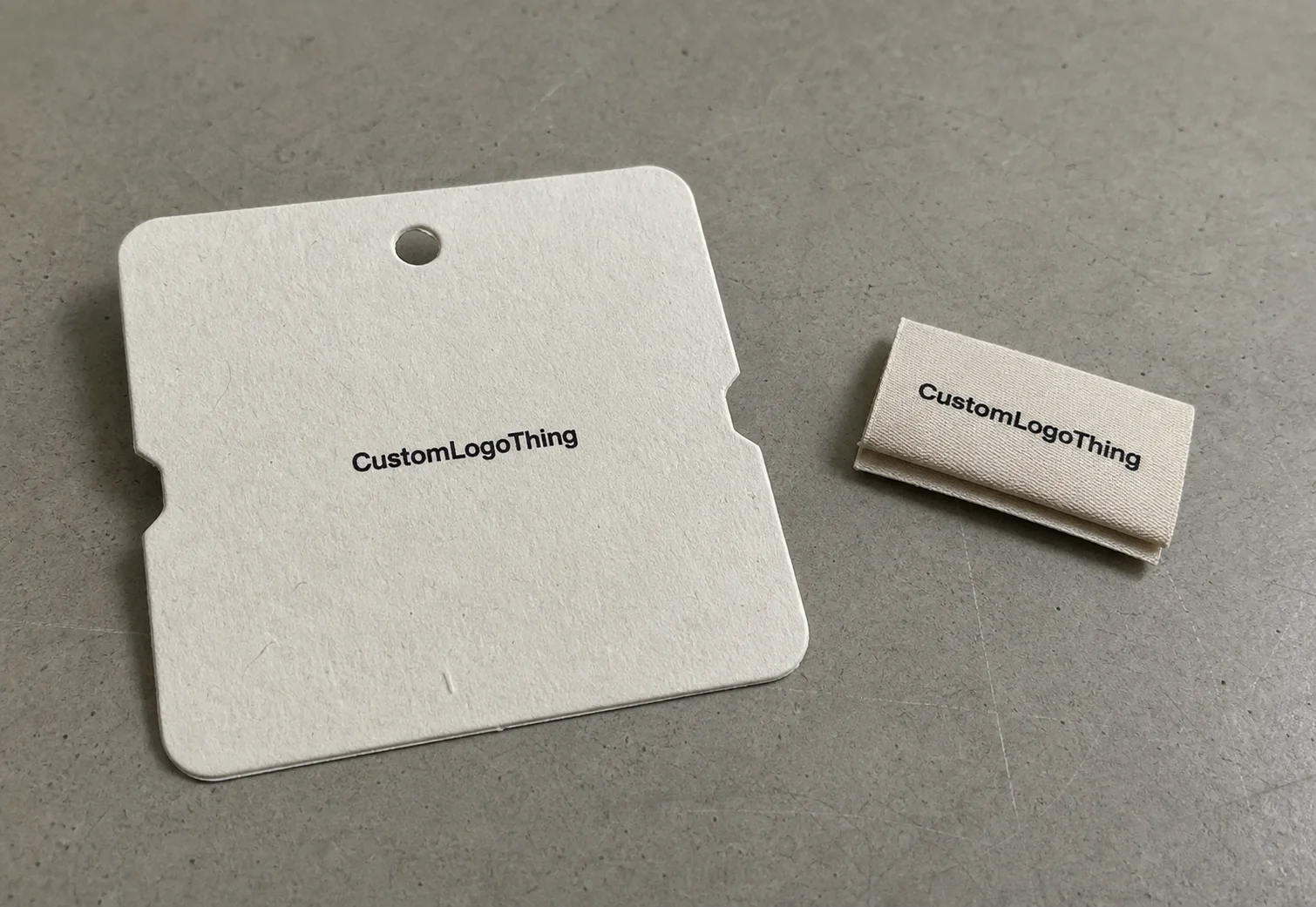
Material choice drives both the feel and the final quote. Satin is usually the first stop for beauty apparel because it has a smooth face, a polished look, and a comfortable hand against skin. Taffeta is a little crisper and often holds up well through repeated laundering. Woven labels have more texture and a traditional premium feel, while printed labels can carry small type and fine logo details well when the artwork is clean.
For robes, salon capes, lounge sets, and soft knit items, the label needs to sit flat without feeling heavy. Fold style and edge finish matter as much as material. Center fold, end fold, and loop fold all behave differently once sewn in. A heat-applied label may reduce sewing time, but it has to match the fabric finish and wash plan or it can lift early.
Beauty brands usually care about four things in the finished piece: logo reproduction, legible care text, skin comfort, and a premium look after washing. There is no universal best material. The right answer depends on how the item is worn, how often it is washed, and whether the label touches bare skin or stays hidden inside a lining.
Here is a practical way to compare common options for beauty apparel orders:
| Material / Finish | Best Use | Typical Quote Range at 5,000 Pieces | Buyer Notes |
|---|---|---|---|
| Satin printed label | Robes, sleepwear, soft beauty sets | $0.14-$0.24 per unit | Soft hand, polished appearance, good for detailed logos and small type |
| Taffeta label | Uniforms, aprons, higher-wash items | $0.12-$0.22 per unit | More structure, usually better abrasion resistance, can feel less luxurious than satin |
| Woven label | Premium retail pieces, long-life programs | $0.18-$0.32 per unit | Strong brand presence, durable through repeated wash cycles, texture is part of the look |
| Printed heat-applied label | Quick-turn launch kits, low-hand-feel needs | $0.20-$0.40 per unit | Can reduce sewing steps, but adhesive choice and fabric compatibility matter |
Those numbers are practical ranges, not promises. Quantity, print coverage, fold type, and packing method can move pricing in either direction. Smaller runs usually carry a higher unit cost because setup and proofing are spread across fewer pieces.
For orders moving through retail distribution or gift-set packaging, transit expectations can matter too. If packaging is part of the launch program, testing references from ista.org help set the right shipping and pack-out standards. If any printed insert or secondary paper component is being sourced with environmental claims, fsc.org explains chain-of-custody basics clearly.
Specification checklist for an accurate quote
An accurate quote starts with clear inputs. If the spec sheet is loose, the pricing will be loose too. The best requests include the finished size, material, print colors, fold type, quantity, attachment method, and the artwork file.
The details that most often change the number are the ones buyers assume can wait. Font size matters because tiny type may require a cleaner print process. Line thickness matters because ultra-fine lines can break down on small labels. Pantone references matter if the brand expects consistent color across collections, and artwork format matters because a flattened JPG is not the same as a vector file prepared for production.
Compliance text should also be decided early. That includes care instructions, fiber content, country-of-origin text, and any legal copy required for the target market. If a beauty brand sells robes, sleepwear, or uniforms in more than one region, the label content needs to be planned before the price is locked.
Reorder planning matters too. If a brand expects seasonal drops, ask for the annual usage estimate, the number of SKUs, and whether labels should be packed by style, size, or collection. That information helps keep the quote honest because split packing and multi-SKU handling add labor.
In practice, a clean spec sheet usually contains:
- Finished size in inches or millimeters
- Material choice and finish
- Fold style or attachment method
- Print colors, including Pantone references if needed
- Artwork file format and font notes
- Care text, fiber content, and country-of-origin copy
- Total quantity and pack-out preference
If any of those items are still undecided, say so. It is better to call out the open points than to force a quote around a guess. A short conversation before pricing usually saves more time than corrections after proof approval.
Printed Clothing Labels Quote for Beauty Brand Orders
Here is how a Printed Clothing Labels Quote for beauty brand orders is usually built. The main cost drivers are material choice, label size, print complexity, fold or finish type, quantity tier, and whether the labels are sewn, cut, or packed separately. Each of those variables changes either raw material use or labor time.
MOQ has a direct effect on unit cost. A 1,000-piece starter run may be possible, but the price per label will almost always be higher than a 5,000-piece run because setup and proofing are absorbed across fewer labels. If the brand can move up one quantity tier, the savings per unit are often enough to improve margin without creating waste.
The most useful pricing request is itemized. Ask for setup, production, finishing, and shipping to be shown separately. That makes comparison easier and avoids the trap of a low total that hides freight or finishing fees.
Some add-ons are worth asking about immediately:
- Folded presentation for premium retail packs
- Branded packaging or bundled sets by SKU
- Barcode matching for internal inventory control
- Split packing by style, size, or collection
- Rush handling if the launch date is fixed
Here is a practical example of how buyers often think about quote structure:
| Quote Component | What It Covers | Why It Changes Price |
|---|---|---|
| Setup | Artwork prep, file checks, proof creation | Fixed labor that does not shrink much with smaller quantity |
| Production | Printing, cutting, folding, finishing | Depends on material, ink coverage, and run length |
| Pack-out | Sorting, counting, bundling, custom packing | More SKUs or split packs add handling time |
| Freight | Shipping method and delivery speed | Expedite requests or heavy pack-outs increase transport cost |
A clean quote should also spell out what is not included. If artwork changes are extra, if reproofs carry a charge, or if special packaging is priced separately, you want that visible before approval. That is how buyers avoid surprises and keep launch budgets under control.
Production steps, approval, and lead time from artwork to delivery
The production path is straightforward, but the schedule can slip if the inputs are vague. It usually starts with artwork review, then moves to a digital proof, then approval, then printing, finishing, inspection, and dispatch.
The most common slowdowns are easy to spot. A brand sends a logo file but not the care copy. A buyer approves size but changes the fold after seeing the proof. Someone asks for a color correction after the proof has already been built. These issues can reset the production clock if the spec is not stable.
Lead time depends on quantity, material, finishing, seasonality, shipping method, and whether the order needs special pack-out. For a typical quote, many buyers are looking at roughly 12-15 business days from proof approval for standard production, with freight added on top. Complex pack-outs, rush requests, or reproofs extend that window.
There is also a quality-control angle. A proper run should be checked for print sharpness, cut consistency, edge finish, and count accuracy before it ships. For buyers operating under ISO-style internal controls, that repeatability is part of how the brand avoids visible variation between batches.
How we keep private-label reorders consistent across collections
Private-label and white-label buyers usually care about the same thing: the trim should support the brand quietly and predictably. It should not draw attention to itself unless the design calls for that. More importantly, it should come back the same way on reorder, even if the collection changes around it.
That starts with stable specs. Once the finished size, fold, material, and artwork are locked, a good production partner keeps those references intact so the next run matches the first one closely. Color stability matters here, but so does physical consistency. If the cut size drifts or the edge finish changes, the label can feel different even if the logo still looks right.
Buyers also benefit from direct, plain-language proof support. If the chosen label will not sit well on a brushed knit, that should be said before production. If the care text is too small for the chosen format, that should be flagged early. Honest guidance keeps the run usable instead of merely printable.
For beauty collections, repeatability often shows up in the details most people overlook:
- Sharp text that stays readable after washing
- Consistent trim width across batches
- Uniform edge finish so the label lays flat
- Stable placement on reorder for the same style
- Clear packing by SKU so production teams can move quickly
That kind of consistency becomes more valuable as the line grows. A single launch can tolerate a little friction. A recurring private-label program cannot. The more the brand scales, the more important it is that the quote, Proof, and Reorder record all point to the same approved spec.
What to send next to get a fast quote and move into production
If you want a quick and reliable response, send the core information together rather than piece by piece. The shortest path to a useful quote is the finished size, preferred material, fold style, quantity, artwork file, and needed-in-hand date. If the care text or country-of-origin line is still open, say so clearly so the quote can be built around a realistic draft.
I also recommend asking for two versions of the price if the project is still flexible. A standard production run gives you the best benchmark, while a lower-MOQ starter run shows the cost of testing the market without overcommitting inventory. Seeing both side by side makes the tradeoff obvious.
Before approval, check the proof line by line. Spelling errors are the obvious risk, but small issues cause just as much trouble: a logo shifted too close to the fold, a color that needs correction, or care text that is too dense for the selected label size. If the proof is approved cleanly, production can move without avoidable resets.
For Beauty Brands That need a straightforward next step, bundle the artwork and spec notes together and send them in one request. That is the fastest way to Get a Printed Clothing Labels Quote for beauty without back-and-forth delays and move into production with a label that fits the garment and the line.
What do you need for a printed clothing labels quote for beauty brands?
Send the finished size, material preference, fold style, quantity, attachment method, and artwork file in one request. Include any care text, fiber content, or country-of-origin copy so the quote matches the final production spec. If you want tighter pricing, add your target ship date and whether you can accept an alternate material or finish.
How low can the MOQ be for beauty clothing label orders?
MOQ depends on label material, size, print complexity, and finishing, so there is no single universal minimum. Smaller runs are usually possible, but the unit cost is higher because setup and proofing are spread across fewer pieces. If you can increase quantity slightly, the price break is often meaningful enough to justify the larger run.
Which label material works best for beauty robes and salon apparel?
Satin is a strong choice when you want a softer hand and a cleaner premium look against skin. Taffeta is often better when the label needs more structure and stronger durability through repeated wash cycles. Woven labels suit brands that want a textured, long-lasting trim with a more traditional premium feel.
How long does production usually take after proof approval?
Production timing depends on quantity, material, and finishing, so the quote should include a realistic lead time after approval. Any change to artwork, fold, or compliance text can reset the schedule if the proof needs to be updated. Shipping time is separate from production time, so both should be checked before you commit to a launch date.
Can you adjust the artwork after the quote is sent?
Yes, but even a small change can affect pricing if it alters colors, size, text, or finishing requirements. Minor edits are usually simple to update before proof approval, while larger changes may require a revised quote. It is better to finalize the label copy first so the approval stage does not slow down production.