Printed Clothing Labels Quote for Fitness: What Buyers Need to Specify Before They Ask for Pricing
Printed Clothing Labels Quote for fitness only becomes useful once the brief answers the practical questions that matter in production. A label for activewear has to deal with stretch, friction, sweat, and repeated washing, and those factors change both the material choice and the price. If the request only says “custom label” or “logo tag,” the quote may look tidy, but it will not tell you whether the label can survive the garment it is meant for.
Fitness apparel is harder on labels than casualwear. Compression tops flex more. Sports bras sit closer to skin. Leggings move at the waistband and seams, then get washed often and hot-dried more often than most fashion basics. A label that seems fine on a mockup can fail in real wear through cracking, curling, fading, or irritation. The buyer usually notices after the first few wash cycles, which is exactly when a cheap spec becomes expensive.
A better quote starts with the garment, not the artwork. The supplier needs to know where the label goes, how it attaches, what the fabric can handle, and how the finished piece should feel on the body. That is the difference between a number and a production plan.
Why fitness labels fail when the brief is vague
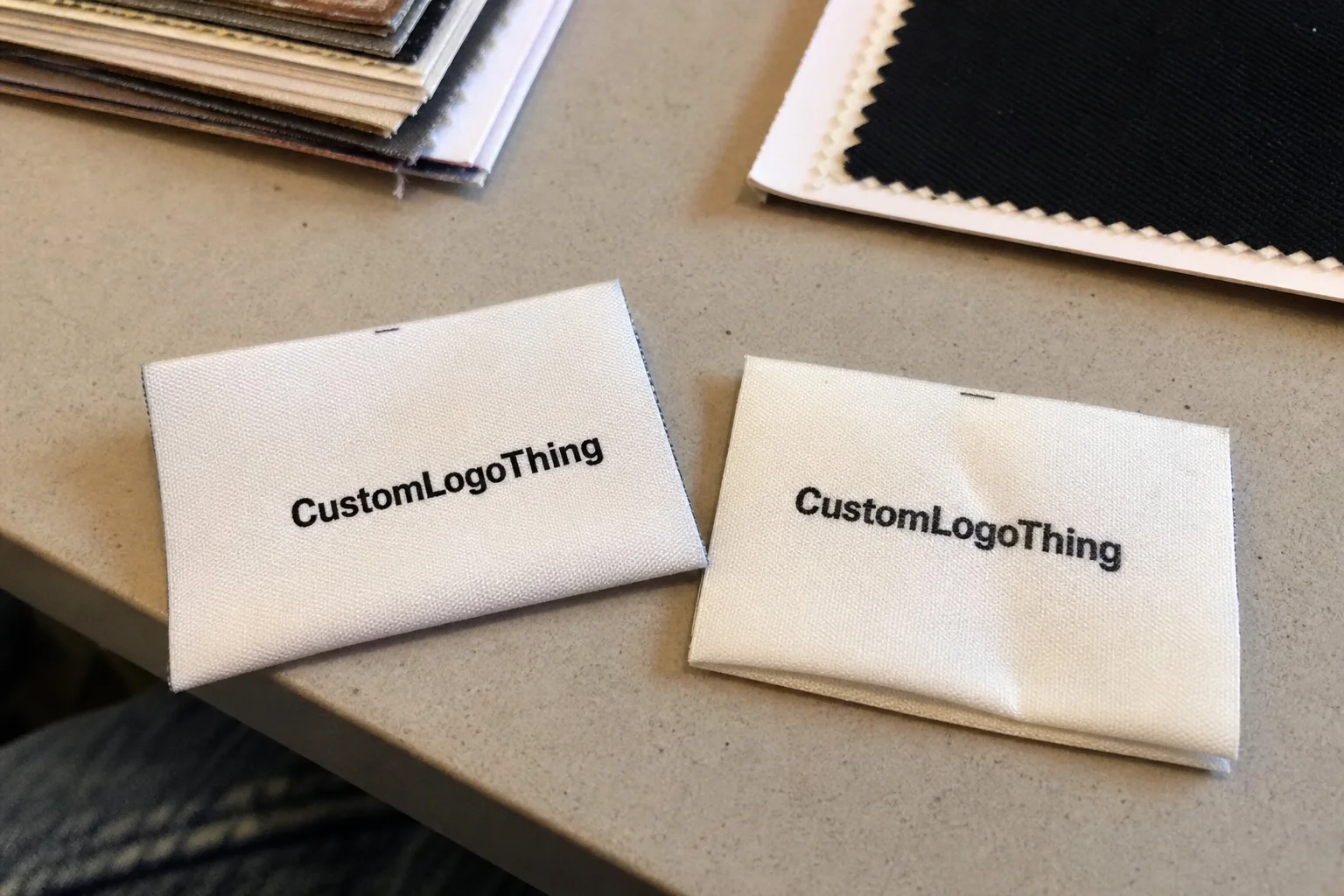
Most label problems are caused upstream. The artwork is often fine. The missing piece is the production brief. Buyers send a logo, a size, and maybe a color preference, then expect the supplier to fill in the rest. For fitness apparel, that leaves too much to chance.
A neck label on a loose cotton tee can tolerate more variation than a label on a close-fit performance top. Activewear demands a tighter spec because the garment itself is more demanding. Stretch, skin contact, and washing frequency expose weak ink, poor adhesive, rough edges, and oversized constructions very quickly. The result is not just visual wear. It can also create irritation, which is a fast way to damage a brand’s reputation.
The hidden cost shows up in production too. If the label is too stiff, it slows down application. If it curls, it becomes harder to sew or place consistently. If the size marking fades, returns and complaints follow. None of that is rare. It is what happens when the brief leaves out the details that determine performance.
A label that looks acceptable in a proof can still fail in use if the substrate, finish, and attachment method were never matched to the garment.
That is why a serious Printed Clothing Labels Quote for fitness should begin with the garment type, the fabric blend, the expected wash care, and the application point. A premium activewear line and a budget gym basic may both need labels, but they do not need the same construction. If the brief pretends they do, the quote will be misleading from the start.
For buyers who already know the product family they are working within, starting with Custom Labels & Tags helps narrow the options quickly. If the order has multiple SKUs or a more technical application, sending the garment details through Contact Us is the cleaner route. It gives the supplier enough context to recommend the right format instead of guessing.
Label formats that work on activewear and gym gear
There is no universal best label for fitness wear. There are only formats that fit certain garments better than others. A printed neck label may be ideal for a training tee. A heat transfer label may be better for leggings, bras, or other garments where a sewn-in tag would interfere with comfort. Care labels still matter for compliance, but the format should not add bulk where the garment sits close to the body.
The common options are straightforward:
- Printed neck labels for tees, tanks, hoodies, and lighter training layers where a soft interior finish matters.
- Heat transfer labels for leggings, bras, and fitted tops that need a clean interior without tag bulk.
- Size strips for clear size identification at the neck, waistband, or side seam.
- Care labels for fiber content, wash instructions, and origin details.
- Brand marks for small logo placements on waistbands, hems, cuffs, or chest areas.
Placement deserves more attention than it usually gets. A label positioned in a high-stretch zone may look fine flat on the table, then distort once the garment is worn. A side seam label can twist. A waistband print can crack if the graphic was not designed for elongation. In practice, the label has to be engineered around the garment pattern and movement, not applied as an afterthought.
Comfort is not a soft preference here. It is part of the product spec. Activewear sits close to the skin, often under heat and moisture, and a rough label becomes noticeable quickly. For that reason, a thin transfer, a soft printed finish, or a low-profile satin label usually performs better than a bulky sew-in label on performance garments.
Brand presentation still matters, just with a lighter hand. Buyers often want the quiet look of a woven label without the scratchiness, or a tonal print that feels more refined than a heavy block of text. That is a practical request, not a luxury one. Matte finishes, restrained contrast, and a clean edge treatment can make the label feel intentional without making it visually loud.
Material and print specs buyers should lock in first
Three decisions control most of the quote: substrate, print system, and attachment method. Once those are fixed, the rest of the pricing becomes much easier to interpret. If they are not fixed, the quote is just a rough estimate with too many assumptions hidden inside it.
Substrate choice matters because different materials behave differently under wash and stretch. Polyester and satin are common for soft printed labels and care tags. TPU and similar specialty films may be used where stretch performance and a cleaner edge are more important. Some fitness garments need a very soft hand feel; others need a label that holds detail under tension. The right answer depends on the product, not on a generic preference list.
Print detail changes the economics too. Buyers should confirm the number of colors, the smallest text that must remain readable, and whether the artwork is simple or dense. A one-color size mark and a multi-color logo with legal text are not the same job. Finishing details also matter: cut style, backing, fold type, and whether the label will be sewn, transferred, or inserted in packaging all affect price and performance.
For compliance-heavy orders, the care label should be planned with the garment specification from the beginning. Fiber content, country of origin, wash symbols, and size information need to be accurate and legible. If the buyer’s market has specific labeling expectations, those should be included in the brief rather than fixed later. Reprints are more costly than getting the text right the first time.
Durability testing should be part of the approval process. A proof can look sharp while still being a bad fit for the garment. Heat, repeated washing, and friction can expose cracking, fading, or distortion that was not visible in the artwork file. If a supplier cannot explain how a label behaves after laundry testing, that is a warning sign. It does not automatically rule them out, but it does mean the buyer should slow down and ask for more detail.
Packaging also affects the finished result, especially when the order is time-sensitive or shipped long distance. Crushed cartons and loose sorting waste good production work. For transit handling, the testing logic used by ISTA is a useful reference. It is not label-specific, but it is relevant to the way finished goods arrive.
If paper inserts, hang tags, or packing cards are part of the package, it is worth asking whether the stock can be sourced in FSC-certified options. That will not make up for a weak label spec, but it does keep the rest of the package aligned with the brand standard.
Printed clothing labels quote for fitness: pricing and MOQ
Price is shaped by more than quantity. A serious buyer should ask for the elements that sit behind the total: unit cost, setup, sample cost, and freight. A quote that rolls everything into one figure may be easier to read, but it is harder to compare.
Common cost drivers include label size, color count, substrate, finish, cut style, and whether any custom die-cutting or special packaging is needed. Tight text, multiple print layers, specialty films, and nonstandard folding all add cost. That is normal. The problem is not the cost itself; the problem is when the cost is hidden until the order is already moving.
MOQ depends on format. Simple printed neck labels often start at lower volumes than highly specialized transfer labels or custom constructions that need more setup. For a new fitness line, a test run may be enough at 500 to 1,000 pieces. Replenishment orders for a proven garment often move into 3,000 to 5,000 units, where the unit price improves because setup is spread across a larger run.
These are practical ranges, not fixed rules. Artwork complexity, material availability, and finish will change the numbers.
| Label type | Best fit | Typical MOQ | Indicative unit price | What affects price most |
|---|---|---|---|---|
| Printed neck label | Tees, hoodies, light training wear | 500-1,000 units | $0.08-$0.18 | Color count, text detail, finish |
| Heat transfer label | Leggings, bras, fitted tops | 500-1,500 units | $0.12-$0.28 | Stretch performance, adhesive system, artwork complexity |
| Satin care label | Soft-feel care and size information | 1,000-3,000 units | $0.05-$0.14 | Length, print coverage, compliance text |
| TPU or specialty transfer | High-sweat, close-fit performance garments | 1,000-5,000 units | $0.18-$0.35 | Stretch durability, finish, application method |
Price breaks usually appear around 500, 1,000, 3,000, and 5,000 units. That is where setup costs begin to matter less per piece. A useful quote should show those breakpoints clearly. If it does not, the buyer cannot tell whether a higher run is actually saving money or simply hiding a different cost structure.
The lowest quote is not always the best value. A label that cracks after washing, slows down application, or causes complaints can cost more in labor and replacement than a better-built label would have cost in purchase price. For fitness garments, value is tied to how the label behaves in use, not just how it looks in the inbox.
Process and turnaround from artwork to delivery
The production flow is simple in theory: request brief, confirm specs, submit artwork, review proof, approve sample or mockup, produce, inspect, and ship. In practice, the delays usually happen before production begins. A weak brief slows everything else down.
For first-time buyers, the longest step is often spec approval. That is normal. The supplier needs to know the garment type, the quantity split, the label placement, and whether the label will be sewn, heat-applied, or packed separately. Without that information, a quote can still arrive, but the project may stall later when the production team has to guess at missing details.
Lead time depends on the number of proof rounds, sampling, material availability, and freight method. A straightforward order with approved artwork can often move in about 12-15 business days after proof approval. More complex work, new materials, or repeated changes to the artwork can extend that. Rush production may be possible, but it usually leaves less room for variation and limits the amount of checking before the job runs.
Buyers should send vector artwork whenever possible. Screenshots and low-resolution files create avoidable delay. Include exact dimensions, the garment size range, and whether the order needs separate size splits or SKU sorting. If the labels are being used for a launch, say so. If they are a replenishment order, say that too. A supplier can plan much better when the request is specific.
Clean approvals shorten lead time more effectively than constant follow-up. The fastest project is usually the one that gets the right details at the start. That is not a marketing line; it is how production works when the brief is clear and the buyer is decisive.
What a reliable fitness label supplier should deliver
A reliable supplier does more than quote a unit rate. They should help the buyer choose a label format that matches the garment, warn about likely failure points, and keep the order aligned with actual use conditions. That matters in fitness apparel, where comfort and durability are part of the product itself.
Specific guidance matters more than broad promises. The supplier should be able to explain the difference between printed neck labels, heat transfers, and sewn constructions. They should also say when the artwork is too detailed for the label size or when a material is likely to struggle under sweat and repeated washing. That kind of feedback saves rework and prevents avoidable disappointment.
Quality control should cover print clarity, size accuracy, edge consistency, and application performance. If the order is folded, boxed, or sorted by SKU, that needs to be confirmed before production. A tidy label run can still become a problem if the count is off or the packing method is careless. On a factory floor, sorting mistakes cost time, and time is money.
A supplier who spots a bad spec early is more useful than one who says yes to everything and leaves the buyer to discover the problem later.
Trust also comes from consistency. Some vendors treat every label request as interchangeable. They are not. A label for a loose hoodie, where the inside can tolerate a little bulk, is not the same as a label for compression wear or a high-stretch training set. If the supplier talks about those jobs as if they are identical, they are either simplifying too much or working from stock that does not really fit the brief.
Shipping and packaging should be discussed with the same seriousness as print quality. Finished labels can arrive damaged if cartons are weak or handling is poor. If the supplier mentions carton strength, transit checks, and packing protection without being prompted, that usually indicates a more disciplined process. The job is not complete when the labels leave the press.
For buyers comparing several quotes, the best test is simple: ask each supplier to recommend the right construction based on stretch, sweat, and skin contact. The answers should not all be the same. If they are, the buyer probably is not getting a tailored recommendation.
Next steps to request a clean, usable quote
If you want a quote that is actually useful, send a complete brief in one message. Include garment type, label dimensions, quantity, artwork files, finish preference, and target delivery date. That is the minimum. If you already know the application method, add that too. If the order is for launch stock, a replenishment run, or private-label packaging, say so up front.
Do not bury the important details across a long email thread. Put the essentials at the top. If you are unsure which material fits best, ask the supplier to recommend one for sweat-heavy use, stretch, and direct skin contact. That is not an unusual request. It is the fastest way to avoid paying for the wrong construction.
Ask the quote to separate unit price, setup, sample, and freight. Without that split, the numbers are hard to compare. A low unit cost can hide a heavy setup fee. A cheap sample can still lead to the wrong final run. Buyers who work in apparel already know this, but it is easy to overlook when a quote arrives looking clean.
If you are ready to move, send the specifications through Contact Us and include a reference image or an existing label sample if you have one. If you want to review the construction types first, start with Custom Labels & Tags and narrow the choice from there. The more exact the brief, the less room there is for avoidable correction later.
For a Printed Clothing Labels Quote for fitness, the best path is still the practical one: clear garment details, realistic quantity, and a brief that tells the supplier how the label has to perform, not just how it should look.
Frequently Asked Questions
How do I get a printed clothing labels quote for fitness apparel?
Send the garment type, label size, quantity, artwork files, and preferred material in one brief. Ask for separate pricing on setup, samples, unit cost, and freight so the quote can be compared properly. If the spec is still open, ask for a recommendation based on stretch, sweat, and wash frequency.
What is the minimum order for fitness clothing labels?
MOQ depends on the format, finish, and whether the order needs custom cutting or special application. Printed labels usually support lower entry quantities than more specialized constructions. A better comparison is the price break at 500, 1,000, and 3,000 units because that shows how the cost scales.
Which label material works best for sweaty gym wear?
Choose a soft, durable material that remains legible after repeated wash cycles and heavy movement. Stretch and skin comfort matter most for close-fit tops and leggings. Ask for durability guidance before approving the artwork, not after the first wash test fails.
How long does production usually take after approval?
Lead time depends on proof revisions, sampling, quantity, and shipping method. A straightforward run can often move in about 12-15 business days after proof approval. Repeat orders are usually faster because the spec is already locked, while new materials or artwork changes can extend the timeline.
Can I get samples before placing a bulk order?
Yes, and for fitness apparel it is often the better choice if you are testing a new label format. Samples let you check hand feel, readability, size, and wash performance. If the timeline is tight, ask whether a digital proof is enough or whether a physical sample is worth the extra time.


