A Printed Clothing Labels Quote for tea towels looks straightforward until the practical details come into view. The number changes with the fabric, the fold, the amount of text, the way the label will be attached, and whether the order is meant for a retail shelf, a hospitality roll-out, or a simple internal stock program. The same artwork can land in a different price band once the supplier knows how the label is going to live on the finished product.
The cleanest quote starts with use case, not just artwork. A towel sold as part of a gift bundle has different expectations from a towel packed for restaurant service, and both differ again from a garment label sitting inside a neckline. If you already know the trim range will expand later, it helps to review the broader Custom Labels & Tags options before you settle the spec, because a label that works on tea towels may need a different construction for apparel or uniforms.
Why a printed clothing labels quote for tea towels starts with use case
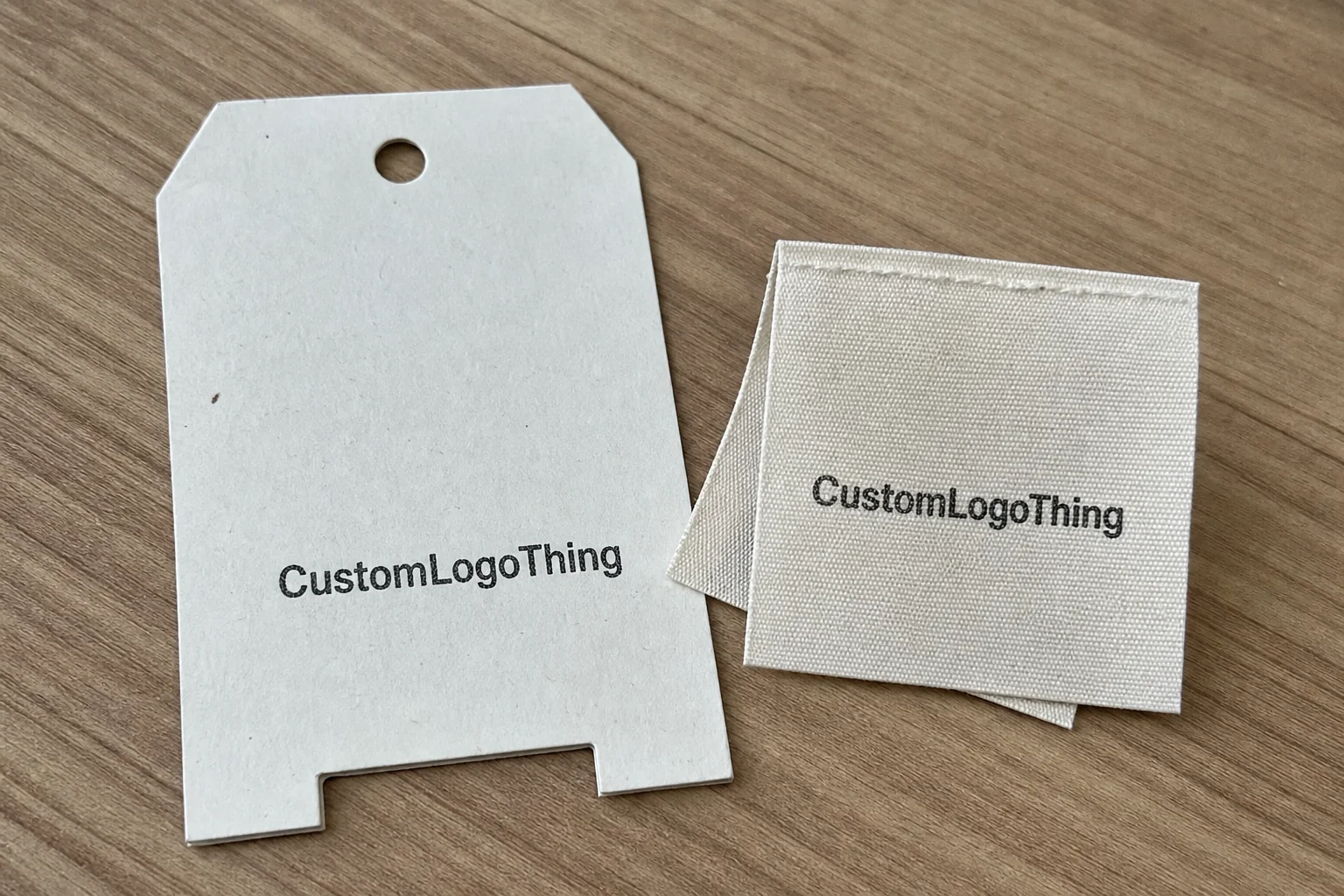
A quote for tea towel labels should begin with the product, the handling, and the point of attachment. That sounds basic, but it is the difference between a number that is useful and a number that needs to be rebuilt later. A label sewn into a thick hem is not the same as a label tucked into a lighter apparel seam, and a label that has to stay readable after repeated hot washes needs a different spec from one used for low-touch promotional stock.
Tea towels introduce a couple of constraints that are easy to miss if you only look at the logo. The hem can be bulky, the fabric can distort during stitching, and the label may have to sit flat through folding and packing. If the label is too stiff or too long, the edge will telegraph through the towel. If the print area is too small, the care text becomes hard to read once the fabric starts moving under production lights.
That is why the first quote request should include four things: quantity, exact text, intended placement, and whether this is a first run or a repeat. With those details in hand, the supplier can usually tell whether the requested build is realistic without a long back-and-forth. A Printed Clothing Labels Quote for tea towels gets much tighter once the supplier knows whether the label is visible on shelf, sewn into the seam, or packed separately for later application.
“A low unit price is only useful if the label still reads clearly after wash, folding, and handling. The real cost of a textile label includes durability, approval time, and the labor saved when the spec is right the first time.”
If the order sits inside a branded textile system, say so up front. A tea towel label that needs to match a hang tag, a woven neck label, or a larger packaging standard should be quoted with that context in mind. Otherwise the buyer may approve a piece that works on paper but feels off once it reaches packing or retail presentation.
Printed label materials and finishes that hold up in wash
The common starting point for printed textile labels is polyester, satin, or nylon. Polyester is usually the most practical option for wash durability and consistent print clarity. Satin gives a softer visual finish and a more polished hand, which is useful on retail-facing items where the label is part of the presentation. Nylon can be appropriate for certain sew-in uses, but it is not always the first choice for buyers who need a steady appearance across a long run.
Finish matters nearly as much as material. A low-sheen surface tends to hold small text better under retail lighting because it reduces glare. A smoother, slightly lustrous face can feel more premium, but the tradeoff is that small care copy needs careful layout to remain readable. For tea towels, where the label often sits close to a hem and is folded during packing, the safer route is usually a simple finish with high contrast and disciplined type size.
Attachment style changes the quote and the final look. A flat label is simple to apply, but a center fold, end fold, or loop fold can change how the label sits in the seam and how much room remains for text. On tea towels, that matters because the hem can be denser than expected. A fold that looks neat on a proof may create bulk once it is sewn into a real product, especially on finer woven cotton or heavier terry-style cloth.
Buyers should also think about what the label is actually doing. If it is brand identification only, the spec can stay compact. If it needs fiber content, care symbols, size, and origin text, it needs more space and a more careful hierarchy. The price difference between those two jobs is often not the print alone. It is the number of production decisions required to make the text fit without compromise.
For projects that involve packing, kitting, or shipment through e-commerce channels, it is worth checking basic handling standards from organizations such as ISTA. And if any paper insert or packaging sleeve is part of the order, FSC certification may matter to the buyer's procurement file. Those details do not change the label itself, but they can affect how the order is approved and booked.
Material choice also depends on the product family. A label that feels right for a cotton tea towel may not be ideal for a shirt collar or a uniform shirt. The safest approach is to send both artwork and a sample of the actual fabric, because the supplier can judge whether the trim needs to be softer, narrower, or more resistant to abrasion. That small step usually prevents the wrong substrate from being priced in as the default.
Specifications that keep text readable, compliant, and consistent
Most quote problems come from incomplete specifications, not from the material itself. The supplier can only price what is known. If the artwork is vague, the fold is undecided, or the text still needs to be checked, the estimate becomes padded for risk. That is why a good request includes the actual label copy, the finished size, the fold style, and the placement.
Readability has a physical limit. Tiny care text needs enough width and enough white space around it to survive production. A compact label can carry a logo, a size mark, and a few lines of care copy, but only if the line breaks are clean. As a working guide, labels under about 1.5 inches wide start to get tight once the label has to carry full compliance text. That does not make them impossible. It just means the layout has to be planned, not improvised.
Color choice also affects the quote. One-color black print is usually the most economical and the easiest to hold stable across repeat runs. Two-color or full-color work can look better for retail branding, but it adds setup complexity and increases the chance that small type will lose sharpness if the artwork is crowded. On dark towels, the contrast requirement becomes stricter, because a pretty label that cannot be read under normal light is not doing its job.
To keep the approval cycle clean, the buyer should send the artwork in a usable format and state the exact wording for any care text, origin line, or size line. If the project sits in the United States, textile content and origin labeling should be checked before proof approval. Correcting those details after production starts is expensive and, in many cases, unnecessary if the buyer verifies the text at the start.
- Artwork: vector file preferred, with fonts outlined if possible
- Text: exact wording for brand, care, size, fiber content, and origin
- Size: finished dimensions plus any fold dimensions
- Placement: seam, hem, side edge, neckline, or loose pack-in
- Durability: expected wash count, abrasion exposure, and drying method
For tea towel programs, a product photo or a quick placement sketch helps more than many buyers expect. The way a hem is built often determines whether a narrow label will sit properly or crumple after sewing. That is especially relevant for a Printed Clothing Labels Quote for tea towels, because the towel edge can be thicker than the buyer assumes when viewed only as artwork on a screen.
If the order may later roll into other trims, keep the approved dimensions and final copy on file. A tidy spec history makes future reorders faster and lowers the chance of small drift between batches. It is a simple production habit, but it pays off whenever a label program grows beyond one product line.
Quality checks that prevent avoidable rejects
The most useful quality checks are the ones that happen before production starts, not after the box is already packed. A proof should be checked for spelling, line breaks, logo placement, fold direction, and text size. Those issues sound minor until they appear on a finished label, where a missing space or a cramped line becomes visible on every unit.
Color control deserves its own check. Buyers often focus on whether the artwork looks right on screen, but printed textile labels depend on consistent ink density and registration. A charcoal logo that shifts a little cooler or darker from one run to the next may not stand out in a proof file, yet it will be obvious once the label is sewn into a towel and stacked with the rest of the range.
There is also a fit check that is easy to forget. The label should be reviewed against the actual fabric thickness, because a fold that is acceptable on a thin sample can become bulky on the real product. If the label is too long for the hem or too stiff for the cloth, the sewing team will compensate during application, and that usually changes the appearance in a way the buyer did not intend.
For repeat programs, the production team should save the final proof, the approved copy, and the exact dimensions used on the first run. That prevents small changes from sneaking in later. It also helps the warehouse or receiving team know what to expect when cartons arrive, which matters more than many buyers realize on replenishment work.
A practical buyer will ask whether the quote includes a digital proof or a sample, and what kind of approval is actually being offered. A digital mockup is usually enough if the artwork is already final and the goal is to check layout and spelling. A physical sample makes more sense when the color is sensitive, the label is unusually small, or the order is going into a premium retail program where finish matters as much as content.
Pricing, MOQ, and what drives unit cost
Textile label pricing is usually driven by five variables: quantity, size, number of colors, finishing style, and pack method. A simple one-color label with a standard fold is a different job from a two-color folded label that has to be sorted, packed, and shipped in a specific carton count. Rush timing can move the quote too, especially if the schedule leaves little room for proof revisions or production staging.
Minimum order quantity varies by supplier and by print method, but small pilot runs are common for first-time orders or wash testing. Those runs are useful because they expose the weak points in the spec before the buyer commits to a larger program. The tradeoff is obvious: setup cost is spread over fewer pieces, so the unit price is higher. That is normal, not a sign that the quote is inflated.
For planning, the following ranges are a practical reference point for standard printed textile labels. They are not fixed rates. Artwork density, fold type, packing requests, and substrate choice can move the number in either direction.
| Quantity | Typical unit cost | Best fit | What drives the price |
|---|---|---|---|
| 500 | $0.24-$0.42 | Pilot run, sample collection, first retail test | Setup and proofing are spread across fewer labels |
| 2,500 | $0.09-$0.18 | Smaller replenishment order | Better balance between setup and production volume |
| 10,000 | $0.04-$0.10 | Ongoing apparel or towel program | Press time and material volume usually improve unit cost |
These numbers are a planning tool, not a promise. A compact brand-only label with one color and no unusual finishing will usually sit below a decorated label with more text, more colors, and special handling. A buyer asking for a Printed Clothing Labels Quote for tea towels should ask for at least two or three quantity tiers, because that often shows the break point where the larger order starts to make sense.
The better comparison is not only the unit price, but the true landed cost. A lower per-piece number can be misleading if the quantity is too large for storage or if the buyer will end up scrapping leftovers after a design change. On the other hand, paying slightly more for a tighter spec can save time later if the same label will be reordered through the season.
Process and timeline from quote request to approved proof
The normal flow is simple: request the quote, review pricing, confirm the material and quantity, approve the proof, and release production. The part that slows most orders is not the print stage. It is the proof stage. A complete request with final artwork can move quickly. A request that still needs text changes, measurement checks, or placement decisions will sit in revision until those details are closed out.
Proofing should be specific. A buyer should know whether the supplier is sending a digital mockup, a color check, or a production-ready approval file. For most textile label work, a digital proof is enough if the artwork is final and the review is mainly about layout, spelling, and fold orientation. If the project is color-sensitive or tied to a premium product line, a physical sample may be worth the added time.
A realistic schedule for many label jobs is 1 to 3 business days for quote and proof review, then about 10 to 15 business days for production after approval. Rush orders can move faster, but only if the spec is complete and the artwork does not need cleanup. Once revisions start, the clock pauses until the buyer signs off. Approval time and manufacturing time should be treated as separate pieces of the schedule.
Mixed SKUs, special folding, unit bagging, or unusual carton counts can extend the lead time. So can seasonal demand and payment timing. If the tea towel order is tied to a retail launch or a replenishment window, the label order should be placed while the rest of the product line is still being finalized. Waiting until the finished goods are already boxed is a good way to turn a manageable label job into a rush.
For projects that need a fast turnaround, the most useful approach is to separate the order into two questions: how long will approval take, and how long will production take after approval? That distinction gives the buyer a real delivery picture. It also makes future reorders easier because the approved spec can be pulled forward instead of rebuilt from scratch.
Why buyers reorder with stable print quality and repeat specs
Repeat orders tell the buyer whether the label program is actually under control. If the first run had the right color, the right fold, and the right text placement, the second run should look the same. That consistency matters on tea towels because the label is often one of the first details a customer notices after opening the product or seeing it folded for display.
The best reorder systems keep the artwork, finished dimensions, fold style, carton counts, and packing method on file. That lowers friction on the next order and reduces receiving mistakes. The warehouse team knows what is coming, the production team knows what was approved, and the buyer does not have to explain the spec from scratch each time.
Color drift is a bigger issue than it looks on paper. A slight shift in black density or a cool-versus-warm gray can be visible once labels are sewn onto finished goods. Buyers who reorder successfully tend to watch for that kind of variation because they know small changes become obvious after the labels are attached and stacked with the rest of the line.
There is also a waste benefit. Stable specs mean fewer labels are scrapped during setup, fewer cartons are opened for sample checks, and fewer corrections need to be made at the sewing stage. That is one reason a label program can feel cheaper over time even if the first order did not have the lowest possible bid. The savings show up in labor and in reduced interruption, not just on the invoice.
For any team planning a repeat run, one clean approval record is more valuable than a folder full of half-finished versions. Keep the final copy, the measured dimensions, and the approved mockup together. That makes the next printed clothing labels quote for tea towels faster to generate and easier to compare against prior runs.
Next steps to get an accurate production-ready quote
The shortest route to a useful estimate is to send the exact label copy, the finished size, the artwork file, the quantity, the target delivery date, and the preferred fold or finish. If the order is going on tea towels or apparel, include a product photo and a short note about where the label will sit. That context often changes the recommendation more than buyers expect.
It also helps to ask for more than one quantity tier. A quote at 500, 2,500, and 10,000 pieces shows where the unit cost starts to improve and where storage or working capital may become the real constraint. That is a more practical comparison than a single price, especially if the order is tied to a seasonal retail window or a limited production batch.
A buyer who is still refining the spec can usually save time by checking whether the artwork, the copy, and the placement all agree before requesting final pricing. A request that already reflects the actual product is far more likely to return a quote that holds through production. A printed clothing labels quote for tea towels should be built around the real material, the real wash expectation, and the real quantity, not a placeholder spec that still needs to be rebuilt later.
- Send exact label copy, including care text and origin text if needed.
- Confirm the finished dimensions and fold style.
- Specify quantity and target delivery date.
- Attach artwork in a usable format.
- Include a product photo or placement note if the label needs to match a towel line, apparel collection, or uniform program.
What do I need to request a printed clothing labels quote for tea towels?
Send the artwork, finished label size, quantity, material preference, and the exact text that needs to appear on the label. Include whether the labels will be sewn in, folded, or packed separately so the quote reflects the real finishing cost.
Can I get a low-MOQ quote for printed clothing labels?
Yes, small runs are possible, but the unit price is usually higher because setup and proofing are spread across fewer labels. A better comparison is usually two or three quantity tiers so you can see where the price becomes more efficient.
Which printed label material works best for repeated washing?
Polyester-based printed label stock is usually the safest choice for wash durability and clear text reproduction. The final recommendation should also account for fabric softness, label placement, and how much abrasion the label will face.
How long does the process usually take after I approve the proof?
Production time depends on quantity, finishing, and whether the order needs a sample or artwork revision before release. Approval time is separate from manufacturing time, so the fastest orders are the ones with complete specs and final artwork.
What makes the unit cost go up on a printed clothing label order?
The biggest cost drivers are quantity, label size, number of colors, special folds, rush timing, and manual packing requests. A clean spec sheet keeps a printed clothing labels quote for tea towels tighter and reduces avoidable back-and-forth.