Buyer Fit Snapshot
| Best fit | Printed Corrugated Inserts Wholesale projects where brand print, material claims, artwork control, MOQ, and repeat-order consistency need to be specified before quoting. |
|---|---|
| Quote inputs | Share finished size, material target, print colors, finish, packing count, annual reorder estimate, ship-to region, and any compliance wording. |
| Proofing check | Approve dieline scale, logo placement, barcode or warning zones, color tolerance, closure strength, and carton packing before bulk production. |
| Main risk | Vague material claims, crowded artwork, missing packing details, or unclear freight terms can make a low unit price expensive after revisions. |
Fast answer: Printed Corrugated Inserts Wholesale: Specs and Pricing should be specified like a repeatable production item. The safest quote records material, print method, finish, artwork proof, packing count, and reorder notes in one written spec.
Production checks before approval
Compare the actual filled-product size with the drawing, then confirm tolerance on folds, seals, hang holes, label areas, and retail display edges. Reserve space for logos, QR codes, warning copy, and material claims before decorative graphics fill the panel.
Quote comparison points
Review material grade, print process, finish, sampling route, tooling charges, carton quantity, and freight assumptions side by side. A quote is only useful when the supplier can repeat the same color, closure quality, and packing count on the next order.
Printed corrugated inserts wholesale looks like a small line item until the first cracked product shows up on a receiving dock. Then it stops being “just packaging” and turns into an expensive lesson. A good insert keeps the product centered, cuts down on packing mistakes, and makes the box feel like somebody actually planned the shipment instead of hoping for the best.
Buyers do not keep ordering printed corrugated inserts wholesale because it sounds clever. They buy it because structure matters. Print helps with identification and branding, sure, but the real value sits in how the insert protects the product, speeds up pack-out, and keeps returns out of the picture. Pretty cardboard that fails in transit is still failed packaging, no matter how nice the mockup looked on a screen.
Why Printed Corrugated Inserts Wholesale Can Cut Real Costs
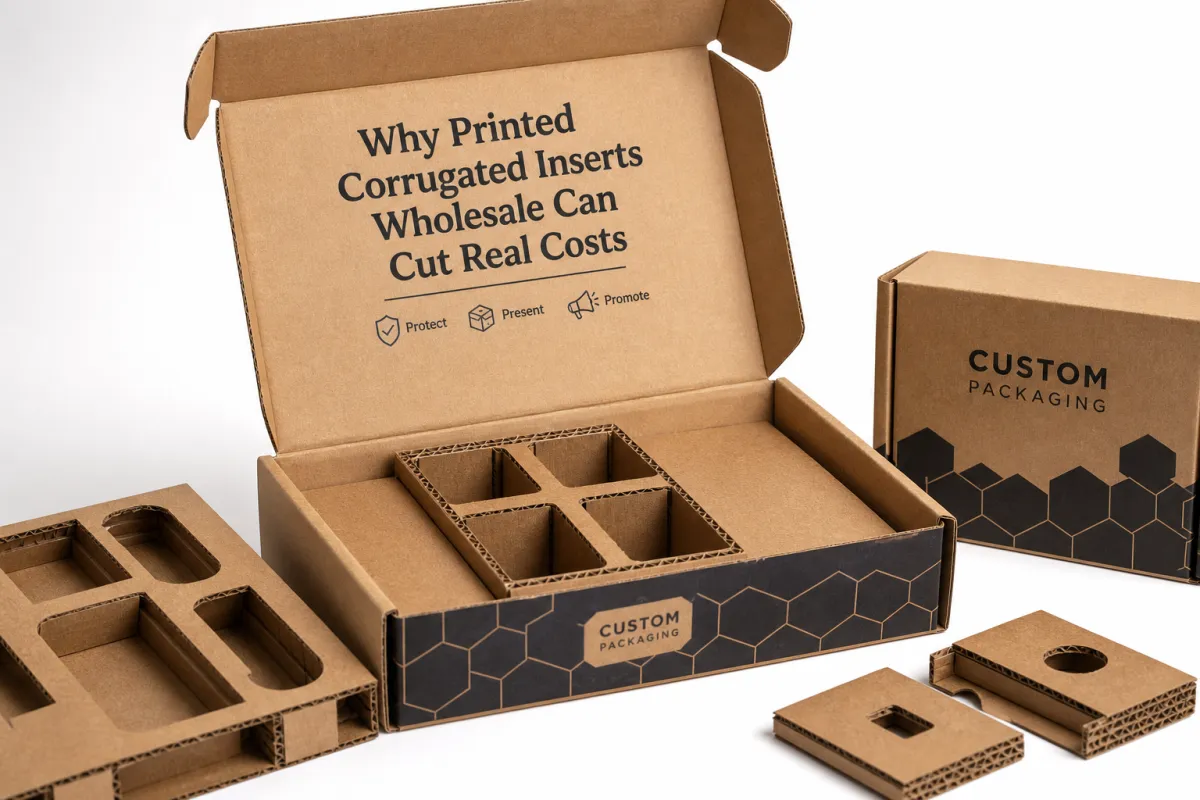
Printed corrugated inserts wholesale can lower total packaging spend in ways that do not show up if you only compare unit price. One insert can replace bubble wrap, loose kraft, foam scraps, and the extra labor needed to make everything stay put. That is not flashy. It is just cheaper.
The savings usually come from fewer dunnage materials, less movement inside the carton, lower breakage, and a faster packing line. Those numbers matter fast when a team is shipping hundreds or thousands of units. Even a 20-second reduction per box becomes real money once it repeats all day. A fit that keeps the product from shifting also reduces scuffed corners, crushed edges, and those little transit disasters that become customer service tickets.
Branding still has a place. Handling marks, SKU codes, and small printed messages can make the inside of the package look organized instead of thrown together at the last minute. That said, the print is not the reason the buyer signed off. They signed off because the insert protects the product and makes the operation run better. Nobody opens a parcel and admires the insert like it is fine art.
“If the product rattles, the whole box feels cheap. If the insert fits tight and goes in fast, nobody is filing a complaint about cardboard.”
That is the real test. Printed corrugated inserts wholesale is not always the cheapest thing on a quote sheet. A thin insert that causes rework, breakage, or slow pack-out can cost more than a heavier design that simply does the job. For glass, candles, cosmetics, electronics, and subscription sets, the right insert usually beats loose fill by a mile.
Good packaging should be boring in the best possible way. The carton closes without a fight. The product stays put. The packing team does not have to improvise on every order. That is where the value shows up. Not in a brochure. In a warehouse. I have watched teams lose half a shift because an insert was off by a few millimeters. Nobody remembers the pretty artwork then. They remember the pile of reworked boxes.
Printed Corrugated Inserts Wholesale: Product Types and Fit Options
Printed corrugated inserts wholesale comes in several structures, and each one solves a different problem. Die-cut inserts work well for shaped products and tighter fit control. Slotted inserts handle partitions and multi-item kits. Layered pads help with stacking or vertical protection. Wrap-style supports can cradle odd shapes without forcing a full custom mold.
Fit starts with the carton, then the product, then the shipping route. That order matters. A good-looking mockup means very little if the item rattles because the carton is too deep or collapses under freight pressure. Printed corrugated inserts wholesale should be built around the actual product size, item weight, and how the package will move through the supply chain. Parcel shipment is not the same as palletized freight. Anyone pretending otherwise is selling trouble.
Print changes the function too. Some buyers need simple handling marks, orientation arrows, or SKU codes. Others need branding, reorder cues, or assembly instructions printed directly on the insert. In those cases, printed corrugated inserts wholesale can reduce mistakes because the packer sees the right slot, the right fold, or the correct side before the product even goes in.
Common use cases are easy to spot. Beverage brands need separation and crush resistance. Personal care kits need clean presentation and stable compartments. Electronics need anti-rattle support and clear orientation. Candle brands need protection around fragile edges. Gift sets need consistency because one crooked insert can make the whole thing look rushed. printed corrugated inserts wholesale handles all of those jobs, but only if the structure matches the product instead of the mood board.
The difference between a visual sample and a production-ready fit test is simple. The sample shows you what the insert looks like. The fit test shows you whether the pack-out team can use it fifty times without muttering under their breath. One of those matters far more than the other, and you already know which one tends to get ignored until too late.
Specifications That Matter Before You Approve a Sample
Printed corrugated inserts wholesale needs a real spec sheet before anyone approves a sample. The useful details are not complicated, but they do need to be nailed down. Start with flute type, board grade, thickness, print method, color count, and any coating or finish. Leave those vague and the sample may look decent while still being wrong for production.
Board choice drives a lot of the performance difference. Lighter board can cut cost and keep the package compact. Heavier board makes more sense for stacked loads, longer transit, or products with some actual weight behind them. In practice, printed corrugated inserts wholesale works best when the board spec matches the shipping environment, not just the shelf display. A nice-looking insert that collapses under pressure is still a bad insert.
Print method matters too. Flexographic printing is often the practical choice for simple graphics, handling icons, and flat color work. More detailed branding, tighter registration, or multi-panel layouts need tighter artwork control and proofing. If the logo has to land in one exact spot every time, say that early. Discovering print drift after the run is a waste of everyone’s patience and money.
For accurate pricing, a supplier needs more than a box size. Send the carton dimensions, product dimensions, product weight, desired orientation, shipping method, and expected monthly or annual volume. If the product is fragile, include the target drop protection. If it has to survive longer freight lanes, say that too. Printed corrugated inserts wholesale is one of those jobs where a missing detail can change both the quote and the performance.
Sample-stage checks should be blunt. Does the insert align correctly? Does it fold the way the dieline says it should? Are the edges clean? Is the print registered well enough to stay readable? Does the packing process feel predictable? If the sample fights the box, that is not a cosmetic complaint. That is a production problem. I usually tell buyers to test it with the person who will actually pack it, not the person who likes the rendering. Those are rarely the same person, and that is kinda the point.
If you want a technical benchmark, ask whether the design has been reviewed against common transport tests such as ISTA procedures for parcel handling, or against compression and box performance methods used in the packaging industry. If the sourcing plan includes recycled content or certified fiber, check the FSC standard early. Those details are not decoration. They decide whether the pack survives reality and whether the paper trail will hold up when somebody asks hard questions later.
Printed Corrugated Inserts Wholesale Pricing, MOQ, and Lead Times
Printed corrugated inserts wholesale pricing comes down to five things: size, board grade, print complexity, quantity, and tooling. Simple flat inserts keep setup costs lower. Custom die-cutting, extra folds, multiple print colors, and heavier board all push the price up. That is normal. Manufacturing likes to charge for complexity. Shockingly consistent behavior, really.
MOQ follows the same logic. Small runs cost more per piece because the setup work gets spread across fewer units. Larger orders usually bring the unit cost down quickly. For many buyers, simple repeatable inserts can start in the low thousands, while highly customized structures become more economical at 5,000 pieces or more. Printed corrugated inserts wholesale is a volume purchase, not a hobby project.
Here is a practical pricing range mindset for wholesale planning:
| Insert Type | Typical MOQ | Typical Unit Price Range | Best Fit | Notes |
|---|---|---|---|---|
| Simple slotted insert, single-color print | 1,000-3,000 | $0.14-$0.28 | Light products, basic separation | Lower setup cost, fewer folds |
| Die-cut insert with branded print | 3,000-5,000 | $0.22-$0.45 | Retail kits, cosmetics, candles | Better presentation, more tooling |
| Heavy-duty insert with partitions | 5,000+ | $0.30-$0.60 | Glass, electronics, stacked freight | Higher board grade, stronger protection |
| Complex custom structure with multi-panel print | 5,000-10,000+ | $0.40-$0.85 | Premium sets, multi-item shipping | More proofing, tighter production control |
Do not compare quotes by unit price alone. Total landed cost is the number that matters. Freight, tooling, sample revisions, and rework can move the real cost more than the quote sheet suggests. If one vendor looks cheap but charges extra for every change, the deal is not actually cheap. Printed corrugated inserts wholesale should be judged on the full job cost, not the headline number.
Lead times are usually easier on repeat orders than on first runs. A new project often needs artwork review, dieline checks, a sample or proof, and final approval. Once that is done, production can move inside a predictable window. As a rough planning range, samples may take a few business days to a couple of weeks depending on the method, while full production often lands around 12-20 business days after approval, plus freight. Complex work needs more time. That is not drama. That is print production.
Vague quote requests create vague pricing. If the supplier only gets a box size and nothing else, the quote will usually include a safety buffer. That is not a mystery. The better the brief, the less padding you pay for. And yes, the slow, boring version of this is still the cheapest version most of the time.
Printed Corrugated Inserts Wholesale Production Process and Timeline
Printed corrugated inserts wholesale follows a straightforward path when the buyer keeps the inputs organized. The usual sequence is inquiry, spec review, quotation, artwork check, sample or proof, approval, production, packing, and shipment. Simple path. Not always simple execution.
The usual slowdown points are easy to spot: unclear dimensions, late artwork changes, missing dielines, and sample revisions that should have been caught earlier. If the carton and product dimensions are still moving, the quote and the sample will wobble too. A disciplined approval process keeps printed corrugated inserts wholesale from turning into an expensive guessing game.
Use this approval checklist to keep the order moving:
- Confirm the outer carton dimensions and the insert placement.
- Provide the real product dimensions, weight, and fragile points.
- Lock the print side, ink colors, and any handling marks.
- Decide whether the insert holds one item, a set, or multiple SKUs.
- Approve the sample against the actual product, not a placeholder.
Repeat orders move faster because the supplier already has the spec history, dieline, and print setup on file. That is where good documentation pays off. If the first run was measured correctly, the next run does not need a new investigation. Printed corrugated inserts wholesale rewards the buyer who keeps records and punishes the one who trusts memory from six months ago.
For launches, seasonal restocks, and promotional sets, work backward from the ship date. Leave room for proof approval, sample confirmation, and freight movement. If the outer cartons are changing too, it helps to review them together with Custom Shipping Boxes so the insert and carton act like one system instead of two unrelated parts.
Clear communication saves money in the least glamorous way possible. One fast answer on a measurement can prevent three quote revisions, a wrong sample, and a deadline getting shredded. That kind of efficiency sticks with buyers because it keeps the whole team from playing packaging detective at 6 p.m.
Why Choose Us for Printed Corrugated Inserts Wholesale
Printed corrugated inserts wholesale is worth buying from a supplier that understands both design and production. That means accurate sizing, clean print quality, practical board recommendations, and quotes that do not hide basic details in a pile of fluff. Buyers do not need theater. They need parts that fit and a process that does not waste time.
At Custom Logo Things, the value is in helping buyers Choose the Right insert style for the actual product. Some jobs need a simple slotted layout. Others need tighter die-cut support or stronger partitions. A good supplier should tell you where a lighter board will work and where it will fail. That advice matters because printed corrugated inserts wholesale only pays off if the final pack-out is repeatable.
Quality control should be visible, not assumed. Sample checks should match the real carton. Production should be inspected before the full run moves forward. Sign-off should be clear enough that nobody is arguing about what got approved after the boxes are already on a truck. That sounds basic because it is basic.
Responsiveness matters too. A buyer managing a launch or a replenishment run does not need a supplier who disappears for three days and comes back with a shrug. If a spec changes, quick confirmation keeps the order alive. That matters even more for printed corrugated inserts wholesale, where a small measurement shift can affect the dieline, the fold, and the whole setup.
For volume buyers, it also helps to compare insert projects against broader packaging needs. Our Wholesale Programs are useful if you are planning a larger packaging rollout, and the same planning logic applies across cartons, inserts, and outer packs. The less fragmented the purchase order, the fewer surprises on the warehouse floor.
Wholesale buyers care about reliability more than clever copy. One missed shipment can trigger stockouts, delayed launches, and customer complaints that eat through margin. The goal stays simple: fewer surprises, better fit, cleaner buying. Printed corrugated inserts wholesale should make the packaging operation calmer, not busier.
One more practical point: if the supplier talks only about appearance and not about drop protection, compression, or pack-out speed, keep asking questions. A good insert is not just printed well. It works well. That distinction saves money and a lot of face-saving emails later.
Next Steps to Order Printed Corrugated Inserts Wholesale
Printed corrugated inserts wholesale is easier to buy once the basic inputs are gathered up front. Start with the product dimensions, carton dimensions, target quantity, print requirements, and the shipping condition the package has to survive. If the product is fragile, oddly shaped, or expensive to replace, include photos and a short note on where it tends to move or get damaged.
The strongest quote requests include real samples or at least detailed product images. Measurements matter, but they do not always reveal the awkward little details that cause fit problems. A chamfered corner, a raised cap, or a taller label can change how the insert behaves. That is why printed corrugated inserts wholesale should be quoted against the real item, not an idealized version of it.
Before mass production, ask for a sample or proof and test it with the actual product. Check for movement, easy insertion, clean closure, and whether the pack-out speed feels realistic for your team. If the insert adds two extra motions per box, that cost shows up every day. Fixing the design once is usually cheaper than living with a slow pack-out forever.
Use this decision path:
- Confirm the board grade and insert structure.
- Compare pricing with MOQ and tooling included.
- Check the lead time against your launch or replenishment date.
- Approve the sample only after the real product fits correctly.
- Place the order once the pack-out feels predictable, not merely acceptable.
That is the whole point. Printed corrugated inserts wholesale should be treated like a packaging component, not decoration. If it does not protect the product, it is just expensive cardboard. If it protects the product, speeds packing, and presents the item cleanly, then it has done its job.
Move from estimate to specification by confirming the dimensions, approving the sample, and placing the order only after the fit checks out. That is how you get a package that behaves the way you need it to, instead of the way a sales brochure promises. And if the sample still rattles, do not talk yourself into it. Fix it. Save yourself the headache.
FAQ
What affects printed corrugated inserts wholesale pricing the most?
Size and board grade usually move the price first. Print complexity, tooling, and order quantity come next. A clean quote for printed corrugated inserts wholesale should reflect the full spec, not just the insert dimensions. Freight can matter more than people expect, especially on bulky designs.
What MOQ should I expect for printed corrugated inserts wholesale?
MOQ depends on the production method, board type, and whether custom tooling is required. Simple repeat sizes can often run lower than highly customized shapes. If you are testing a new product, ask for the smallest economical run first so you are not sitting on a pile of packaging you barely needed.
How do I make sure the insert fits my product correctly?
Provide exact product dimensions, carton dimensions, and product weight. Ask for a sample or proof and test it with the real item, not a placeholder. Check for movement, easy pack-out, and clean closure before approving production. If the insert only fits after somebody forces it, it does not fit.
How long does it take to produce printed corrugated inserts wholesale?
Timeline depends on artwork approval, sample approval, tooling, and quantity. Repeat orders usually move faster because the supplier already has the setup on file. Build in extra time if you need custom print, complex die-cuts, or freight delivery. Rushing the approval stage is a classic way to make the whole job slower.
Are printed corrugated inserts better than foam or plastic inserts?
Corrugated inserts are often easier to recycle and can be more cost-effective at scale. They also work well when you want structure, branding, and product separation in one part. The best choice still depends on the fragility, weight, and shipping conditions of the product. Foam or plastic still makes sense in some cases, but corrugated is the cleaner default for a lot of brands.


