Buyer Fit Snapshot
| Best fit | Pallet Box Lid Supplier projects where brand print, material claims, artwork control, MOQ, and repeat-order consistency need to be specified before quoting. |
|---|---|
| Quote inputs | Share finished size, material target, print colors, finish, packing count, annual reorder estimate, ship-to region, and any compliance wording. |
| Proofing check | Approve dieline scale, logo placement, barcode or warning zones, color tolerance, closure strength, and carton packing before bulk production. |
| Main risk | Vague material claims, crowded artwork, missing packing details, or unclear freight terms can make a low unit price expensive after revisions. |
Fast answer: Pallet Box Lid Supplier: Board, Finish, Dieline, and Unit Cost should be specified like a repeatable production item. The safest quote records material, print method, finish, artwork proof, packing count, and reorder notes in one written spec.
Production checks before approval
Compare the actual filled-product size with the drawing, then confirm tolerance on folds, seals, hang holes, label areas, and retail display edges. Reserve space for logos, QR codes, warning copy, and material claims before decorative graphics fill the panel.
Quote comparison points
Review material grade, print process, finish, sampling route, tooling charges, carton quantity, and freight assumptions side by side. A quote is only useful when the supplier can repeat the same color, closure quality, and packing count on the next order.
Pallet Box Lid Supplier: How to Choose the Right Fit
A pallet box lid supplier can make your shipping life easier or quietly wreck it. I have seen a lid miss by a few millimeters and cause the whole top layer to bow, split, or slide just enough to create a mess in transit. Nobody notices while the pallet is still on the dock. The damage usually shows up later, after the truck is gone and everyone is already busy with something else. A good pallet box lid supplier helps protect the load, keep labor moving, and avoid paying for the same mistake twice.
If you buy pallet lids like they are all the same, the bill shows up somewhere else. Fit matters. Strength matters. Lead time matters. And yes, price matters too. Just not in the way the cheapest quote wants you to believe. Two lids can look identical on a screen and behave completely differently once they hit vibration, moisture, wrap tension, and a forklift driver who is not interested in babying the load.
What a pallet box lid supplier actually does
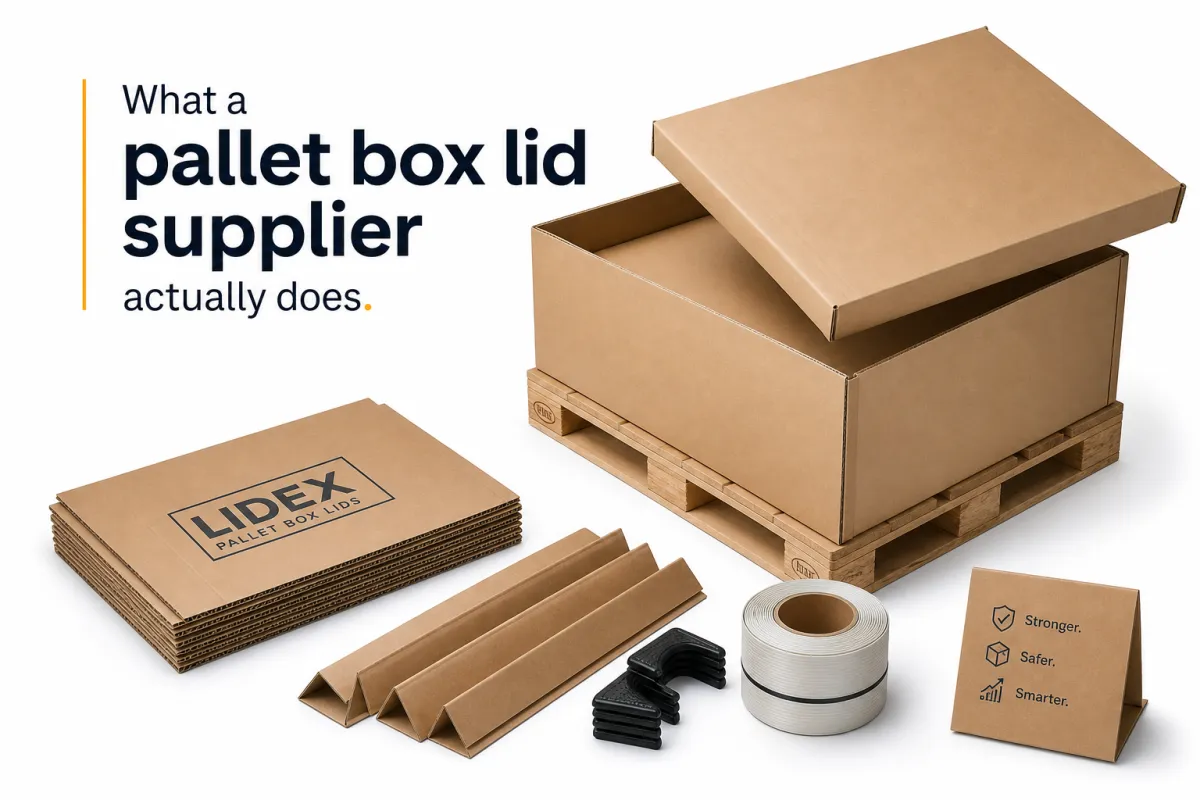
A pallet box lid supplier does more than sell a flat panel with a part number attached. The right supplier matches the lid to the box style, the load weight, the pallet footprint, and the way your team actually handles freight. That sounds basic until you see how often people skip it. A lid designed for a tidy warehouse move is not always the same lid you want for export, damp storage, or rough cross-dock handling. Different lane. Different stress. Different outcome.
In practical terms, a lid has three jobs: protect the contents, stabilize the stack, and make handling less annoying. If it does those three things well, you usually get fewer claims, cleaner warehouse flow, and less rework. If it does not, you get crushed corners, torn board edges, and someone on the dock reaching for tape like it is a personality trait.
Most buyers run into three broad lid types:
- Standard lids - fixed-size lids for repeat orders and predictable box dimensions.
- Reinforced lids - thicker board, added supports, or hybrid builds for heavier loads and rougher handling.
- Custom lids - built for nonstandard dimensions, special insert heights, branding needs, or export requirements.
The idea that one lid size can cover every operation is mostly fantasy. A fresh pallet, a reused pallet, a box with a liner, and a tall load held down with straps all behave differently. A decent pallet box lid supplier will ask how the shipment moves, not just what the drawing says. That is usually the first sign they understand the job instead of just the order form.
Practical rule: if a lid only works when everyone handles it gently, it is not a lid solution. It is a wish.
For brands that care about presentation, the supplier decision also affects how the pallet looks when it arrives. A lid that sits flat and prints cleanly looks deliberate. A lid that ripples, curls, or crushes makes the whole load look sloppy before it even clears the dock. That kind of thing can make a decent operation look kinda careless, even when the product inside is fine.
How pallet box lid supplier fit and build work
Fit is where a pallet box lid supplier earns their keep. A lid has to sit flush, resist bowing, and stay put while the load goes through stacking, vibration, temperature swings, and the occasional hard stop that makes everyone in the dock area look up at once. If the lid is too loose, it shifts. If it is too tight, it stresses the box and can crack at the corners. If it is too thin, it bows. If it is too rigid in the wrong way, it can get brittle and fail at the edge.
Material choice matters because each build behaves differently. Corrugated board is common for lightweight to medium loads and is usually easier to print and fold. Plywood gives more stiffness and handles heavier, rougher treatment better, though it adds weight and cost. Plastic lids can hold up in moisture-heavy environments and repeated use, but they usually cost more upfront. Hybrid structures mix board, core, or edge reinforcement to hit a specific performance target without overbuilding the whole lid.
The real fit variables are less glamorous than most product pages make them sound:
- Inside dimensions of the box, not just the pallet footprint.
- Wall thickness and how much the box expands under load.
- Stack height and how much compression the lid has to carry.
- Locking edges, tabs, or folds that keep the lid seated.
- Moisture exposure during storage, shipping, and unloading.
- Pallet overhang and whether the lid needs a flush or recessed edge.
A pallet box lid supplier that knows what they are doing will ask for more than a single outside measurement. They will want the actual load profile, the packaging sequence, and the handling method. That matters because a lid that fits beautifully on paper can still fail once the load is wrapped, strapped, or stacked three layers high in a humid container. In real life, poor fit leads to compressed corners, load shift, contamination, and slower handling because staff keep fixing things that should have been right the first time.
There is a labor impact too. A lid that drops on cleanly saves seconds per unit. That sounds tiny until you multiply it across hundreds or thousands of pallets. A lid that needs trimming, re-centering, or extra tape burns labor and encourages shortcuts. Shortcuts are how packaging mistakes become warehouse habits.
Key factors when choosing a pallet box lid supplier
Price is not the first question. It is usually the third or fourth. A smart buyer starts with strength, moisture resistance, and fit, then checks whether the pallet box lid supplier can make that spec consistently without turning every order into a drama series. Compression resistance matters because the lid has to carry top load without caving in. Moisture tolerance matters because board that looks fine in a dry room can soften quickly in a damp warehouse or export lane. Fit matters because a strong lid that does not sit correctly is still a bad lid.
Then comes the quote. Ask how the price is built. Is it unit price only? Does it include tooling? Setup? Print plates? Freight? Reinforcement? Coating? Edge treatment? Minimum order quantity? These are not minor add-ons. They are often where the actual spend lives. A quote that looks 12 percent cheaper on paper can become more expensive once you add shipping, sample revisions, and the rush fee because someone realized the dimensions came from the wrong drawing. That happens more than people admit.
Here is a quick comparison that helps buyers see the tradeoffs without pretending every lid solves the same problem.
| Material / Build | Typical Use | Strength Profile | Moisture Resistance | Typical Price Range |
|---|---|---|---|---|
| Single-wall corrugated | Light loads, clean warehouses, short domestic moves | Good for basic stacking, limited crush resistance | Low to moderate unless coated | $0.45-$1.20 per lid at 2,000-5,000 units |
| Heavy-duty corrugated / double-wall | Medium loads, export cartons, better stack performance | Moderate to strong compression performance | Moderate, improved with treatment | $0.85-$2.20 per lid at 2,000-5,000 units |
| Plastic | Reusable programs, damp environments, repeated handling | Strong and stable, depends on wall structure | High | $4-$15 per lid depending on size and design |
| Plywood | Heavy loads, rough transit, industrial use | Very strong, higher stiffness | Moderate | $6-$18 per lid depending on thickness and cut |
| Hybrid reinforced build | Special loads, high stack pressure, export or mixed conditions | Tailored to load, often strongest per use case | Depends on finish and core design | $8-$20+ per lid for custom runs |
The table is a starting point, not a law. Still, it shows why the cheapest option is not automatically the best option. A pallet box lid supplier with a clearer view of your load can often save more money by reducing breakage than by shaving a few cents off the piece price. That is especially true for shipments with high claims exposure or a lot of manual handling.
Supplier capability matters just as much. Some suppliers are fine at simple stock lids. Others are better for custom sizes, printed branding, export paperwork, or material sourcing that needs to stay aligned with compliance expectations. If sustainability matters, ask whether the fiberboard is FSC-certified. If shipping integrity matters, ask what testing they use and whether they can speak plainly about transit testing such as the programs documented by ISTA. That does not mean the supplier has to run a lab. It does mean they should understand how packaging behaves under real transport stress.
I also look at service factors that never show up in the glossy sample pack: response time, clarity on revisions, willingness to send a physical sample, and whether the supplier keeps batch-to-batch variation under control. A pallet box lid supplier that communicates clearly usually saves time in every other stage too. If their answers get fuzzy early, they do not magically become sharper after the PO lands.
Good quote, bad quote. One looks cheaper until you compare the actual spec. The other looks boring because it tells the truth.
Process and timeline: from brief to landed pallets
The cleanest orders usually follow the same path. First, you send dimensions, weight, stack height, handling notes, and any branding needs. Then the pallet box lid supplier confirms material options and suggests a structure. After that comes the sample, then approval, then production, then freight booking. Simple on paper. Messier in real life, because missing details have a nasty habit of turning a two-day question into a two-week delay.
Most delays come from the same places. Measurements are incomplete. Someone gives outer dimensions when the lid needs internal dimensions. Stack pressure is described as "moderate" instead of a load number. Artwork bounces between teams because the file format is wrong. Sample feedback keeps moving because people in operations, quality, and procurement all want different things. None of that is exotic. It is just what happens when the brief is fuzzy.
Here are practical timing ranges buyers can use:
- Stock lids: often 3-7 business days if inventory is ready and freight is straightforward.
- Simple custom corrugated lids: often 10-15 business days after proof approval.
- Reinforced or printed custom lids: often 12-20 business days, sometimes longer with complex artwork.
- Specialty builds or export orders: 3-6 weeks is a more realistic planning window.
Those ranges assume the supplier has the material available and the artwork is settled quickly. If tooling changes are needed, or if the lid has tighter tolerances than usual, add buffer. If the order needs to cross borders, add more buffer. Freight does not care about your launch date, and neither does a dock schedule that is already packed.
The safest habit is to plan backward from the ship date. Give yourself room for a sample revision, a warehouse test, and one unexpected delay. That is not pessimism. It is how you avoid paying rush charges because someone forgot that corrugated board is not made with magic.
A solid pallet box lid supplier will also tell you what they need from you to move faster. That usually includes the pallet footprint, box construction, product weight, storage environment, and any pass/fail criteria you care about. If they ask for those details up front, good. It means they are thinking like a production partner, not a coupon site.
Common mistakes when buying pallet box lids
The most common mistake is ordering by pallet size alone. That number is useful, but it is not enough. The actual boxed load, the wall thickness, and the way the lid nests over the box all change the fit. A pallet box lid supplier needs the real build, not just the footprint, or you end up with a lid that feels close enough until it arrives and proves otherwise.
The second mistake is buying the cheapest lid without checking compression strength. A low-cost lid may look fine in a static photo and still fail under stack pressure or humidity. That failure may not even happen on day one. Sometimes it shows up after a few hours in a warm dock, after wrap tension relaxes, or after a return trip when the load has already taken a beating. Seen it. More than once.
Third, buyers skip samples. I get why. Samples take time and nobody wants another approval loop. But a sample is cheaper than a pallet of damage. A lid can look acceptable on a CAD drawing and still fail in vibration, on a rough dock, or under cold storage conditions. You do not want to discover that after 600 units are already in transit.
Fourth, buyers ignore downstream handling. Does the load get moved by forklift twice or six times? Is it part of an automated stack? Does it sit in a humid container for ten days? Is it returned, reworked, or opened by the end user? A lid that is fine for one pass through a clean warehouse may be the wrong choice for repeated handling. A competent pallet box lid supplier should ask those questions before the order is locked.
Five mistakes I see all the time:
- Vague measurements - outer dimensions only, no tolerance, no wall thickness.
- Price-first selection - no strength check, no moisture check, no sample.
- Skipping real-world testing - no vibration, no stack test, no dock trial.
- Ignoring handling method - forklifts, conveyors, straps, and wrap are treated like extras.
- Forgetting the end of the trip - export, storage, and return handling are not considered.
That last one bites more buyers than they expect. A lid that works on the outbound shipment can fail on the return leg or the warehouse leg if the product is reused. A good pallet box lid supplier will ask whether the packaging is single-use or part of a reusable loop. That answer changes the spec more than people think.
Expert tips for comparing pallet box lid supplier quotes
Compare like for like. That sounds obvious, which is exactly why so many quotes get compared badly. Same dimensions. Same board grade. Same print method. Same coating. Same freight terms. Same order volume. Same tolerance. If any of those shift, the quote is not a true comparison. It is just a pile of numbers arranged to look useful.
Ask for a spec sheet that lists material thickness, load rating, dimensional tolerance, environmental limits, and any testing standard the supplier used. A quote without those details is where budgets go to die. A decent pallet box lid supplier should be able to explain whether the lid was designed around compression performance, moisture resistance, reusability, or some mix of all three. If they cannot explain the tradeoff, they probably do not understand it well enough to price it properly.
It also helps to request one or two samples and test them under your actual warehouse conditions. Not in a conference room. Not on a clean office floor. Under the same wrap tension, the same stack pattern, and the same handling path the product will see in real use. That test does not need to be fancy. It needs to be honest.
Here is the kind of quote comparison I recommend:
- Use the same brief for every supplier so the starting point is identical.
- Separate unit price from landed cost so freight and extras do not hide in the margin.
- Check batch consistency if the order repeats every month or quarter.
- Ask about defect handling so you know who pays if something arrives wrong.
- Request a timeline with approval checkpoints so delays are visible before they become urgent.
One more thing: a supplier that explains what they cannot do is often more trustworthy than one that says yes to everything. A pallet box lid supplier who pushes back on unrealistic compression targets or questionable measurements is probably saving you from a bad spec. That kind of honesty is worth money.
Better question: not "Who is cheapest?" but "Who can hit the spec, repeat it, and still deliver on time?"
Next steps to brief the right supplier
If you want better quotes, start with better information. Measure the box carefully. Note the product weight. Record the stack height. Describe how the pallets move through the warehouse, the truck, or the export lane. If the load sits in damp storage or gets handled by a forklift more than once, say so. A pallet box lid supplier can only design around the conditions you actually share.
I usually recommend a one-page brief. Keep it direct:
- Dimensions: internal and external, plus any tolerance.
- Quantity: first run and repeat volume.
- Load details: product weight, stack pressure, and top-load risk.
- Handling: manual, forklift, conveyor, wrap, straps, return loop.
- Branding: print coverage, colors, and logo placement.
- Compliance: export needs, FSC preference, or testing requirements.
- Timing: target ship date and any hard cutoff.
Once you have that brief, ask each supplier for a sample, a production timeline, and a quote that shows exactly what is included. If one quote leaves out freight, setup, or reinforcement, do not pretend it is cheaper. It is incomplete. A strong pallet box lid supplier should make the comparison easy, not hide the moving pieces behind vague language and pretty branding.
Then review the three things together: fit, price, and lead time. Not just one. Not the one that looks best on a spreadsheet. The one that keeps damage down, keeps the dock moving, and gives your team less to fix. That is the real value. That is why the right pallet box lid supplier matters, and why the cheapest quote is usually the loudest problem waiting to happen.
FAQ
How do I choose the right pallet box lid supplier for my shipment?
Start with the actual load: dimensions, weight, stacking pressure, and whether the shipment travels in humid or rough-handling conditions. Ask for samples, a written spec sheet, and a quote that separates unit price, setup costs, freight, and any extras. The best pallet box lid supplier is the one that explains the tradeoffs clearly and matches the lid to your handling process, not just the drawing.
What affects pallet box lid supplier pricing the most?
Material choice, thickness, reinforcement, custom sizing, and print requirements usually move the price more than anything else. Minimum order quantity and freight can change the final cost fast, especially for bulky lids shipping long distances. Cheapest is not always cheapest if the lid fails and creates damage, rework, or claims.
How long does a custom pallet box lid order usually take?
Stock lids can move quickly, but custom sizes usually need time for sampling, approval, production, and freight scheduling. If the design is complex or the supplier needs tooling changes, add extra buffer before your ship date. The safest approach is to work backward from the delivery deadline and leave room for one sample revision.
Can a pallet box lid supplier make lids for unusual box sizes?
Yes, most capable suppliers can make custom dimensions if you provide accurate internal and external measurements. The key is to share the box style, stacking method, and any clearance needed for inserts, straps, or stretch wrap. Odd sizes often cost more, but a proper fit usually pays for itself by reducing damage and handling issues.
What is the biggest mistake buyers make with pallet box lid suppliers?
They focus on price before checking fit, strength, and real shipping conditions. They skip samples and assume the lid will behave the same way in transit as it does on a desk. The result is usually crushed corners, shifted loads, or a second order to fix the first one.
Related packaging resources
Use these related guides to compare specs, costs, quality checks, and buyer decisions before making the final call.