Buyer Fit Snapshot
| Best fit | Printed Flat Pouches Wholesale projects where brand print, material claims, artwork control, MOQ, and repeat-order consistency need to be specified before quoting. |
|---|---|
| Quote inputs | Share finished size, material target, print colors, finish, packing count, annual reorder estimate, ship-to region, and any compliance wording. |
| Proofing check | Approve dieline scale, logo placement, barcode or warning zones, color tolerance, closure strength, and carton packing before bulk production. |
| Main risk | Vague material claims, crowded artwork, missing packing details, or unclear freight terms can make a low unit price expensive after revisions. |
Fast answer: Printed Flat Pouches Wholesale: Specs, Pricing, Lead Time should be specified like a repeatable production item. The safest quote records material, print method, finish, artwork proof, packing count, and reorder notes in one written spec.
Production checks before approval
Compare the actual filled-product size with the drawing, then confirm tolerance on folds, seals, hang holes, label areas, and retail display edges. Reserve space for logos, QR codes, warning copy, and material claims before decorative graphics fill the panel.
Quote comparison points
Review material grade, print process, finish, sampling route, tooling charges, carton quantity, and freight assumptions side by side. A quote is only useful when the supplier can repeat the same color, closure quality, and packing count on the next order.
Printed Flat Pouches Wholesale: Specs, Pricing, Lead Time is where packaging decisions stop being abstract and start turning into real production numbers. printed flat pouches wholesale may look like a simple format at first glance, yet the structure you choose, the way the artwork is built, and the buying plan behind the order can shape freight, shelf impact, and the daily pace of your fill line in ways that show up on the budget quickly.
When a brand wants a retail-ready package without moving into a heavier structure, printed flat pouches wholesale usually makes practical sense. The pouch stays slim before filling, stacks cleanly in storage, prints well across a broad front surface, and leaves enough room for branding, ingredients, barcodes, and required copy without making the layout feel cramped or cluttered. That balance is a big part of why buyers keep coming back to the format.
For buyers comparing packaging choices, the real question is rarely just “what does one pouch cost?” It is “what does the full package do for handling, fill speed, shipping cube, and shelf appeal?” That is where printed flat pouches wholesale earns attention, especially for food, supplements, dry goods, cosmetics, and sample programs that need a polished look without extra complexity. If you are sorting through sourcing options, our Wholesale Programs page is a useful place to begin before you request a quote.
Why Printed Flat Pouches Wholesale Can Lower Total Cost
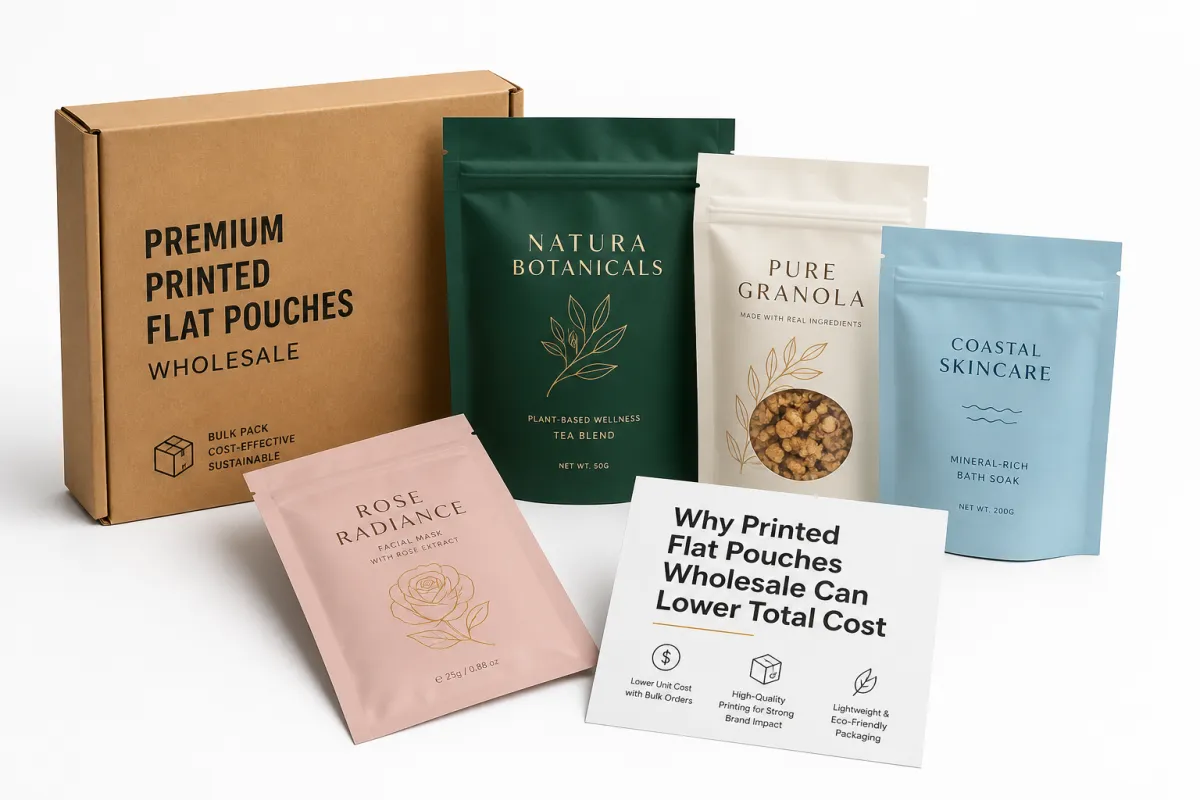
From a packaging buyer's point of view, printed flat pouches wholesale can bring the total cost down because the savings spread across more than one line item. The pouch itself may be economical, but the larger benefit often comes from lower shipping cube, easier storage, and cleaner pallet building. A flat pouch takes up very little room before filling, so more units fit in the same space and the plant can move product with less clutter across the floor. I have seen teams save more on freight and warehouse handling than they expected, simply because the package stopped carrying dead air around with it.
That slim profile also helps with freight. Pouches that ship flat can be palletized tightly, which reduces wasted space in cartons and trailers. The difference becomes noticeable when you are moving thousands of pieces at a time. Even a small gain in cube efficiency can matter once freight rates, warehouse space, and handling labor are all part of the calculation.
Another reason buyers keep coming back to printed flat pouches wholesale is the look. The format can feel more premium than people expect. Crisp print, a matte or gloss finish, and a front panel with clear visual hierarchy can make a plain pouch read as upscale on shelf. Some teams assume a heavier package always looks better. It does not. A well-specified flat pouch with clean typography and solid color control can outperform a more complicated package that was overdesigned or poorly executed.
This format works especially well in categories that need a tidy retail face and a manageable production flow:
- Food and dry snacks that need a fresh, clean presentation.
- Protein powders and supplements where branding space and barcodes matter.
- Cosmetics and personal care samples that depend on visual polish.
- Dry goods and specialty ingredients that need compact storage.
- Promo kits and trial packs that ship in volume and need to stay orderly.
When the product does not need a rigid container or a complex forming process, printed flat pouches wholesale is often the straightforward answer. It gives the brand a printable surface, the plant a format that is easy to manage, and the buyer a package that is easier to forecast and reorder.
Printed Flat Pouches Wholesale Product Details and Options
A flat pouch is built around two printable panels, sealed at the edges to hold product safely while keeping the package thin and efficient. Depending on the design, it may use side seals, bottom seals, or a lay-flat construction with no gusset. In printed flat pouches wholesale, the laminate matters as much as the artwork, because the film protects the contents while also creating the surface the brand will live on.
Common material structures usually include PET/PE, BOPP/PE, or more specialized laminations with barrier layers such as VMPET or EVOH for products that need stronger protection against moisture, oxygen, aroma, or light. Matte and gloss finishes are both common. Matte tends to create a softer, more restrained look, while gloss increases contrast and can make color stand out more sharply. The right choice depends on the brand style and the shelf environment, not on whatever happens to be trending in a mockup.
Print options matter more than many teams expect. In printed flat pouches wholesale, the artwork file is not just decoration; it is part of the production specification. Color accuracy, font size, image resolution, and safe zones all affect the final result. A crowded design can make the pouch feel smaller than it is. A clear hierarchy can make the package look high-end without adding extra finishing steps or extra cost.
Practical conversion features can be added when they serve a real use case:
- Tear notches for easier opening.
- Hang holes for peg display.
- Reseal features when the product is used in portions.
- Clear windows for visibility of the product.
- Degassing valves for certain coffee or fresh-pack applications.
Not every option belongs on every pouch. The best specification for printed flat pouches wholesale is the one that matches how the product behaves, how it will be filled, and where it will be sold. A product that sits in a dry warehouse for months has different needs than a moisture-sensitive supplement or a cosmetic sample that must handle repeated retail touchpoints.
Many buyers compare finish, film build, and conversion features side by side before approving artwork. That habit pays off, because the spec affects both the quote and the timeline. A simple pouch is not a lesser pouch; it is often the right pouch when the product and the market fit the format.
Printed Flat Pouches Wholesale Specifications: Sizes, Barrier, and Compliance
Before you place a printed flat pouches wholesale order, the first job is to lock down the measurements. Finished width, finished length, seal width, fill volume, film thickness, and closure type all belong on the spec sheet. A pouch that is even a few millimeters off can affect fill speed, product fit, or the way the package sits on a shelf. Small errors add up fast when you are ordering thousands of pieces.
Barrier requirements should be matched to the product, not guessed from a catalog. A dry snack sold quickly may only need moderate barrier performance, while a powdered supplement, herbal blend, or aroma-sensitive cosmetic sample may need stronger protection. For printed flat pouches wholesale, the film build should be selected with shelf life, storage conditions, and sensitivity to oxygen, moisture, or light in mind. There is no single laminate that fits every brand.
Compliance needs attention early, because fixing it later usually costs more time than most buyers expect. Food-contact requirements, regional labeling rules, barcode placement, and ingredient panel legibility should all be checked before production starts. If your packaging carries legal copy, keep the text in a safe area away from seals, folds, and high-wear zones. That simple step lowers the chance of rework and helps preserve print readability after transit and handling.
For transport validation, packaging teams often refer to ISTA, which publishes useful testing context for distribution hazards and package performance. If sustainability claims matter on the carton or outer pack, the certification framework at fsc.org is a practical reference point for paper-based components and chain-of-custody thinking.
Here is a useful checklist for printed flat pouches wholesale specs before quoting:
- Finished dimensions and fill target.
- Film structure and thickness.
- Finish: matte, gloss, or specialty coating.
- Seal type, tear notch, and opening method.
- Artwork zones, safe areas, and barcode placement.
- Barrier requirement by product behavior.
- Compliance notes for the target market.
The cleaner the spec sheet, the faster the proofing process usually moves. That is one reason printed flat pouches wholesale can be such a practical buying decision: the format is easy to define, easy to compare, and easier to reorder when documentation is tight from the start.
Printed Flat Pouches Wholesale Pricing, MOQ, and Quote Factors
Pricing for printed flat pouches wholesale is driven by several concrete variables, and the best quotes are the ones that show those variables clearly. Size is the first one. Larger pouches use more film and more ink coverage. Print coverage comes next, because full-surface artwork usually costs more than a simple, low-coverage design. Film structure, finish, closure features, and any special handling also affect the number.
MOQ is another point buyers should understand before comparing vendors. Smaller runs can be possible, but they usually carry a higher unit price because setup and production time are spread across fewer pieces. For many printed flat pouches wholesale orders, a common production range may sit somewhere around 3,000 to 10,000 pieces depending on size, print method, and construction. That is not a promise; it is the kind of working range buyers often see when they ask for real quotes rather than rough estimates. A trustworthy supplier should say where the range is flexible and where it is not.
A useful quote should make it easy to compare suppliers on the same basis. If one line item includes proofing, another includes shipping, and a third leaves out tooling, the numbers stop being comparable. Ask for the unit price, setup or plate charges if applicable, proofing steps, shipping method, and any accessory charges. For printed flat pouches wholesale, that level of detail is not fussy; it is the only way to judge value accurately.
| Option | Typical Use | Approximate Unit Range | What Affects Cost Most |
|---|---|---|---|
| Basic PET/PE flat pouch | Dry goods, samples, simple retail packs | $0.10-$0.18 | Size, print coverage, order volume |
| Matte finish with tear notch | Supplements, premium snacks, cosmetics | $0.14-$0.24 | Finish, artwork complexity, seal details |
| Barrier laminate with window or specialty look | Moisture-sensitive or aroma-sensitive products | $0.18-$0.32 | Film build, barrier level, added features |
| High-coverage custom printed pouch | Premium shelf presentation, larger rollouts | $0.22-$0.38 | Ink coverage, finish, production setup |
Those numbers are only planning ranges, and the actual quote depends on the exact specification. Still, they help a buyer understand why one printed flat pouches wholesale quote looks low at first but rises once the real structure is added. The lowest quote is not always the best value if it leaves you with weak barrier performance, uneven print consistency, or delays caused by under-specified artwork.
Most pricing confusion on printed flat pouches wholesale orders comes from incomplete specifications, not from the market itself. If the pouch size, finish, artwork coverage, and barrier target are clear, the numbers usually make a lot more sense.
If you want to reduce cost without harming performance, start with the structure. Simplifying a finish, standardizing a pouch size across several SKUs, or removing an unnecessary feature can bring the number down in a controlled way. That approach is usually smarter than chasing the cheapest line item and hoping the result still fits the product.
For buyers who want a broader sourcing conversation, our Wholesale Programs page is a useful place to align quantities, packaging goals, and print expectations before a quote is issued.
Printed Flat Pouches Wholesale Process and Timeline
The process for printed flat pouches wholesale is straightforward when the buyer comes in prepared. It usually starts with an inquiry that includes product type, pouch size, artwork files, quantity, finish preferences, and any barrier or compliance requirements. From there, the supplier reviews the request, confirms the build, and sends a quote that should reflect the real specification rather than a generic placeholder.
After pricing is approved, the proof stage begins. This is where many orders either stay on schedule or drift. In a proper proof review for printed flat pouches wholesale, the buyer should check dimensions, text accuracy, logo placement, color references, seal positions, barcode readability, and any warning or ingredient text. A proof is not just a visual preview. It is a production checkpoint that can save days, sometimes weeks, if it catches a problem early.
Lead time depends on several factors. Artwork readiness matters a great deal, because incomplete files create extra back-and-forth. Material availability can also change the schedule, especially if the pouch uses a specialty laminate or custom finish. Print complexity, quantity, and ship-to destination all play a role. For standard printed flat pouches wholesale jobs with clean files and quick approval, a realistic production window is often around 12 to 15 business days after proof approval, with more complex builds taking 18 to 25 business days before freight.
Where do delays usually happen? The most common ones are ordinary: missing dieline notes, low-resolution artwork, text edits after proof approval, or a change in finish right before production. The fastest order is usually the one that is fully specified before production starts. That is not a sales line; it is how packaging schedules stay manageable.
If you want to keep the timeline under control for printed flat pouches wholesale, send complete files, confirm the spec in writing, and approve proofs promptly. Every extra revision adds coordination time, and every unclear instruction adds risk. The people running the line want the same thing you do: a clean, accurate run with no surprises.
One useful habit is to ask for a proofing checklist before the design is finalized. That checklist should cover dimensions, fonts, legal text, barcode placement, color expectations, and seal-safe margins. If the supplier offers a prepress review, take it seriously. It is one of the simplest ways to reduce rework and keep printed flat pouches wholesale moving on time.
Why Choose Custom Logo Things for Printed Flat Pouches Wholesale
Custom Logo Things is a sensible partner for printed flat pouches wholesale because the value sits in process clarity, not in empty promises. Buyers need direct answers on size, material, finish, print coverage, and timing. A good supplier should sort those details quickly, explain tradeoffs in plain language, and keep the order moving without confusion. That kind of support matters as much as the pouch itself.
Packaging buyers do not just purchase a printed item; they purchase repeatability. With printed flat pouches wholesale, consistency in size, print quality, and finish is what protects the brand once reorder season starts. If the pouch ships one way on the first run and another way on the second, the customer notices, the filling line notices, and the inventory team notices. A steady process prevents those headaches.
Another reason to work with a packaging partner that understands the category is the review stage. Artwork, dielines, safe zones, and legal copy can be checked before production begins, which lowers the odds of costly mistakes. For printed flat pouches wholesale, that support is not extra polish. It is part of making sure the final product fits the real job it has to do.
Good sourcing also means understanding the realities of storage and freight. If a buyer overorders a pouch size that does not match sales velocity, the warehouse pays for it later in space and handling. If the order is too small, unit cost rises and reordering becomes more stressful than it should be. A supplier that respects those realities helps the customer plan inventory with less guesswork, which is exactly what makes printed flat pouches wholesale useful in the first place.
If you are comparing package programs and want to keep things simple, use our Wholesale Programs page as a starting point, then move into the exact build once the product, quantity, and artwork are defined. That keeps the process focused and prevents unnecessary revisions.
What should you expect from a strong partner? Clear quoting, timely proofing, accurate dimensions, and honest feedback if the spec needs adjustment. That is the kind of service that helps printed flat pouches wholesale perform the way buyers actually need it to perform, rather than the way a rushed mockup might suggest.
How to Plan Your Printed Flat Pouches Wholesale Order
The easiest way to plan printed flat pouches wholesale is to build the order around the product, not around the artwork first. Start with the fill type, target size, shelf life, and handling conditions. Then decide whether you need basic moisture protection, stronger barrier performance, a matte or gloss finish, and any opening or display features. Once those choices are clear, the rest of the conversation becomes much easier.
A complete spec sheet makes the first quote far more useful. At minimum, include the finished pouch dimensions, target fill weight or volume, film preference, print coverage, finish, and quantity. If the design has a barcode, ingredient statement, or regional compliance copy, include that as well. For printed flat pouches wholesale, clear documentation keeps the buyer from answering the same questions several times and usually shortens the whole approval cycle.
It also helps to request a proofing checklist before you send final artwork. That way, you can review the places where problems usually hide: trim lines, seal margins, text near folds, and the placement of logos or warnings. A proper proof review is one of the cheapest risk controls in packaging, especially when the order is large enough that a mistake would be expensive.
Quantities should be planned against demand and warehouse space at the same time. A buyer who knows how many units move each month can order printed flat pouches wholesale in a way that balances unit cost with storage pressure. There is no prize for filling the warehouse with packaging that will sit untouched for too long. There is also no reward for ordering too little and paying more to rush the next batch.
A practical planning sequence looks like this:
- Define the product and fill size.
- Choose the barrier level and finish.
- Gather print-ready artwork.
- Confirm compliance and barcode needs.
- Request a detailed quote.
- Review the proof carefully before approval.
If you follow that sequence, printed flat pouches wholesale becomes a controlled purchase instead of a reactive one. The format works because it is simple enough to move quickly, yet flexible enough to support serious branding and reliable production planning.
For the buyer, the next step is direct. Gather the measurements, count the artwork elements, decide on the finish, and send the request with enough detail to get a meaningful quote. The smoother the front end is, the better the result tends to be on the back end. That is especially true for printed flat pouches wholesale, where the whole job depends on getting the spec right before the line starts.
What is the minimum order for printed flat pouches wholesale?
Minimum order quantity for printed flat pouches wholesale depends on pouch size, print setup, and whether the build uses standard or fully custom materials. Smaller orders are often available, but the unit cost is usually higher because setup and production time are spread across fewer pieces. The most accurate way to judge MOQ is to request a quote with your exact dimensions, artwork count, and packaging requirements.
What materials are best for a printed flat pouch wholesale order?
The best material for printed flat pouches wholesale depends on the product. Dry goods often need a different barrier level than powders, cosmetics, or moisture-sensitive items. Common structures include PET/PE and BOPP/PE, with barrier layers added when freshness, aroma retention, or light protection matters. A good supplier should match the film structure to product behavior, shelf life goals, and filling method.
How long does printed flat pouches wholesale production usually take?
Production time for printed flat pouches wholesale depends on artwork approval, material availability, print complexity, and shipping method. A complete spec sheet and clean artwork files usually shorten the timeline because fewer proof corrections are needed. If you need a firm date, ask for lead time based on the exact order details rather than a generic estimate.
Can I get a sample before placing a wholesale order for printed flat pouches?
Yes, sample requests are often the best way to check size, finish, barrier feel, and print placement before committing to bulk printed flat pouches wholesale. You should review the sample under real filling and retail conditions so you can confirm fit, handling, and shelf appearance. If the artwork is finalized, ask whether you can review a proof or pre-production sample to reduce risk.
What file formats do you need for printed flat pouches wholesale artwork?
Print-ready vector files are usually preferred for printed flat pouches wholesale because they preserve logo sharpness and text clarity at production scale. Include linked fonts or outlined text, correct color references, and any dieline notes so the design can be reviewed accurately. If your files are not print-ready, ask for a prepress review before moving forward to avoid delays and rework.
For buyers who want packaging that is efficient, presentable, and practical to reorder, printed flat pouches wholesale is still one of the strongest options available. It gives you a slim footprint, a clean print surface, and a buying process that works best when the specs are clear from the start. The most useful next step is not to guess at a design or chase the lowest quote; it is to define the pouch, confirm the artwork, and request pricing from that exact build so the numbers and the timeline are grounded in reality.


