Buyer Fit Snapshot
| Best fit | Buy Custom Corrugated Mailers projects where brand print, material claims, artwork control, MOQ, and repeat-order consistency need to be specified before quoting. |
|---|---|
| Quote inputs | Share finished size, material target, print colors, finish, packing count, annual reorder estimate, ship-to region, and any compliance wording. |
| Proofing check | Approve dieline scale, logo placement, barcode or warning zones, color tolerance, closure strength, and carton packing before bulk production. |
| Main risk | Vague material claims, crowded artwork, missing packing details, or unclear freight terms can make a low unit price expensive after revisions. |
Fast answer: Buy Custom Corrugated Mailers: Specs, Pricing, Lead Times should be specified like a repeatable production item. The safest quote records material, print method, finish, artwork proof, packing count, and reorder notes in one written spec.
Production checks before approval
Compare the actual filled-product size with the drawing, then confirm tolerance on folds, seals, hang holes, label areas, and retail display edges. Reserve space for logos, QR codes, warning copy, and material claims before decorative graphics fill the panel.
Quote comparison points
Review material grade, print process, finish, sampling route, tooling charges, carton quantity, and freight assumptions side by side. A quote is only useful when the supplier can repeat the same color, closure quality, and packing count on the next order.
Buy Custom Corrugated Mailers: Specs, Pricing, Lead Times
Many brands decide to buy Custom Corrugated Mailers after a stock mailer starts showing its true cost in postage, filler, and damaged returns. I have seen that pattern more than once: a box or mailer looks close enough on paper, then the pack room reveals that the fit is loose, the product shifts, and the carrier bill creeps up because the outside dimensions are bigger than they need to be.
That is why companies focused on product packaging, branded packaging, and package branding stop treating mailers like an afterthought. They want a better fit, a cleaner presentation, and fewer surprises between the warehouse floor and the customer’s doorstep.
There is a practical side to this decision, too. Right-sized corrugated mailers can cut down on void fill, speed up pack-out, and hold the item more firmly during transit, which matters whether the shipment contains apparel, books, cosmetics, accessories, or small electronics. If the goal is to buy custom Corrugated Mailers That genuinely make operations easier, the details matter more than the sales language.
Custom Logo Things works best for buyers who want facts first. The sections below stay centered on the pieces that shape fit, cost, and schedule: structure, print, board grade, lead time, minimum order quantity, and the information a supplier needs before quoting. If the mailer is not the right format, it may be worth comparing it with Custom Poly Mailers or even Custom Shipping Boxes for heavier or less flat products, and broader Custom Packaging Products can help when a project needs more than one packaging format.
Why Buy Custom Corrugated Mailers Instead of Standard Stock
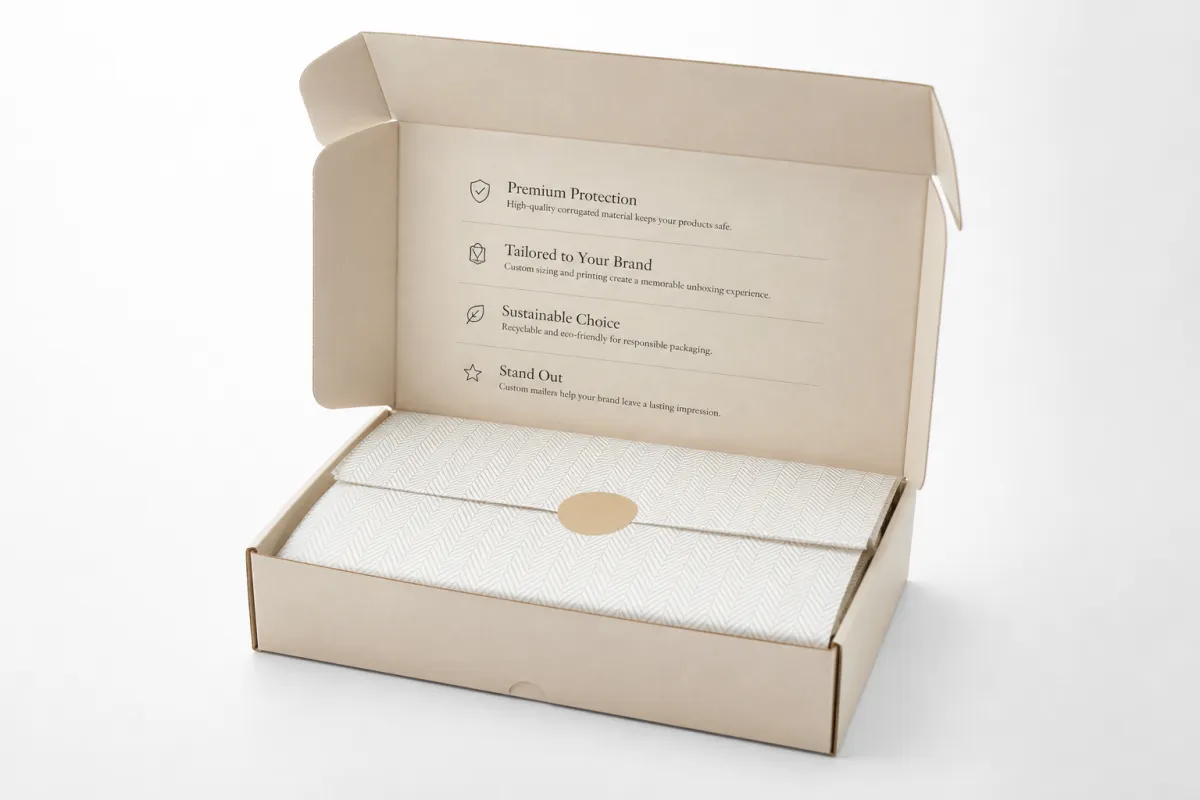
Standard stock mailers are easy to source, and for some products they do the job well enough. The issue starts when “well enough” means a loose fit, extra cushioning, or a package that arrives with scuffed corners because the item has room to move around. If you buy custom corrugated mailers sized to the packed product, the shipping profile usually becomes more predictable and the presentation more deliberate.
That matters in a warehouse, not just in a design review. A mailer that fits a folded T-shirt bundle, a boxed cosmetic set, or a stack of books can eliminate extra inserts and save seconds on every order. Across a production run, those seconds become real labor. If you buy custom corrugated mailers for a recurring SKU, the savings often show up in pack-out speed before they show up anywhere else.
Dimensional weight is another quiet cost center. Parcel carriers measure package size as well as weight, and a mailer that is only slightly oversized can jump into a pricier shipping tier even when the contents are light. That is one reason buyers buy custom corrugated Mailers for Apparel, subscription kits, and retail packaging programs where the product is flat or semi-flat. A tighter structure helps keep the outside dimensions honest.
There is also the customer-facing side. A custom mailer is a form of branded packaging that signals care before the package is even opened. That does not mean every mailer needs a loud graphic treatment. Sometimes a clean kraft surface, a simple one-color logo, and a sharp close fit do more for package branding than a busy full-coverage print. Clear design usually holds up better than crowded design, and honestly, it is gonna age better too.
A mailer that fits the packed product usually saves more money in the carton room than it costs in the design room.
That is the reason many teams buy custom corrugated mailers instead of relying on a shelf size that merely seems close. Better fit reduces movement, reduces wasted board, and makes the unboxing experience feel intentional. If the order volume is steady, repeatability matters just as much as appearance.
From a buyer’s point of view, the real question is not whether corrugated mailers can work. It is whether the mailer should be built around the product, the carrier network, and the brand presentation at the same time. When those three pieces line up, buyers buy custom corrugated mailers because the math and the packaging both improve.
Custom Corrugated Mailer Product Details That Affect Protection
To buy custom corrugated mailers with confidence, it helps to understand what is actually being specified. A corrugated mailer is a folded structure made from linerboard and a fluted medium, cut and scored so it can ship flat and pop into shape quickly. The board layers do the work: the liners provide surface strength, while the flute adds stiffness and some crush resistance.
Flute profile matters more than many first-time buyers expect. E flute is thinner and smoother, so it can work well for print-heavy branding and tighter dimensional targets. B flute offers a little more stiffness and a bit more crush resistance, while C flute is thicker and often chosen when the product has more weight or needs a sturdier feel. If you buy custom corrugated mailers for fragile goods, the flute choice should be made with the product load in mind, not just the logo.
Fold quality is another point that gets overlooked. A mailer that scores cleanly closes neatly, sits flat when packed, and opens without tearing at the corners. Poor score placement can lead to lifted flaps, weak tuck tabs, or a package that looks distorted once the product is inside. For branded packaging, that small structural flaw is obvious right away.
Print options also change how the mailer is built. Plain kraft mailers are common for low-graphic programs. One-color or two-color branding is a practical step up for many subscription and retail packaging projects. Full-surface print can create a stronger visual statement, but it usually affects ink coverage, setup time, and cost. If you buy custom corrugated mailers with heavy ink coverage or special coatings, expect more proofing and a longer production path.
Common use cases include apparel, books, skincare kits, sample packs, craft items, accessories, and small electronics. The format works especially well for product packaging that is flat, stackable, and not too tall. For heavier or less uniform products, custom printed boxes may be a better fit, but many brands buy custom corrugated mailers because the fold-up format reduces empty space and speeds packing.
There are also useful add-ons. Tear-strip openers can make the unboxing easier. Inserts can keep a bottle, device, or box from sliding inside. Light coatings can improve scuff resistance or moisture resistance, depending on the shipping lane. If the mailer needs a cleaner retail packaging look, matte finishes tend to feel more controlled than glossy ones. Each option has a cost, but each one also solves a real handling issue.
If the supply team has to buy custom corrugated mailers for repeated shipment, it is worth thinking beyond appearance. The best structure usually combines enough stiffness to survive carrier handling with enough precision to keep the contents from wandering inside the mailer. That balance protects the product and preserves the presentation.
Buy Custom Corrugated Mailers: Specifications to Confirm First
Before you buy custom corrugated mailers, the packed dimensions need to be confirmed in the same form the carrier will see them. That means inside length, inside width, and inside depth, not the loose product dimension from a catalog page. A product that measures eight inches wide by itself may need more clearance once inserts, sleeves, or protective wraps are added.
Product tolerance matters. A stack of books, a set of jars, or a flat electronics kit may shift if the interior fit is too generous, and a tight fit can be just as bad if the edges rub the board during insertion. Buyers who buy custom corrugated mailers for fragile or premium items usually ask for a packed sample or a photo of the assembled pack-out so the dimensions reflect reality, not guesswork.
There are a few basic specifications every quote should include. Board grade, flute type, print area, closure style, finish, and any special opening feature all affect the final build. If the mailer needs recycled content, a specific kraft tone, or a matte appearance, that should be stated early. If you buy custom corrugated mailers and leave those details vague, suppliers will fill in the blanks differently, and the quotes will not compare cleanly.
Carrier handling should also be considered. Some mailers will move through parcel sortation without issue; others need more attention to score strength, panel stiffness, or compression resistance. A careful buyer checks whether the design should be evaluated against typical ship tests such as drop or compression expectations, and many packaging teams refer to ISTA procedures for test direction and sampling logic. For a deeper look at packaging testing standards, the resources at ISTA are useful because they explain why carrier handling is not just a warehouse issue.
Another detail that affects the quote is orientation. Will the mailer always travel flat, or can it rotate in transit? Does the product sit centered, or is one side heavier because of accessories or inserts? These are practical questions, but they change how you buy custom corrugated mailers because they influence panel strength, closure security, and how much extra board the supplier may recommend.
- Inside dimensions: confirm length, width, and depth in the packed state.
- Board selection: specify flute profile and grade, such as E flute or B flute.
- Print coverage: note whether the design is plain kraft, one-color, or full-coverage.
- Closure style: define tuck tabs, locking tabs, tear strips, or adhesive features.
- Finish: call out matte, natural kraft, or any coating requirement.
- Shipping profile: describe weight, product fragility, and expected carrier handling.
Those details shorten the back-and-forth and make it easier to compare one supplier’s offer against another on equal terms. If two vendors both say they can buy custom corrugated mailers for your product, the one that asked sharper questions is usually the one that understands the job better.
There is also a sustainability angle worth mentioning. If the board needs to align with FSC sourcing goals, that requirement should be declared up front, and the chain-of-custody expectations can be checked through FSC. Buyers who want more environmentally conscious product packaging often use that requirement as part of the quote request, not as an afterthought.
Cost, Pricing, and MOQ for Custom Corrugated Mailers
Price is usually the first question buyers ask when they decide to buy custom corrugated mailers, but the unit cost is only part of the picture. Size, board thickness, print coverage, quantity, finishing steps, and whether a custom die or new setup is needed all shape the final number. A larger mailer may cost more in board, but a small mailer with heavy ink coverage and multiple finishing steps can also be expensive.
MOQ is tied closely to setup efficiency. The more custom the structure and print, the more pieces a supplier usually needs to make the run economical. Smaller orders are often possible, especially for simple structures, but the unit price rises because the setup cost is spread across fewer mailers. That is normal. It is one reason buyers buy custom corrugated mailers in quantity breaks instead of asking for a single number and calling it done.
Freight should not be ignored. Corrugated mailers may ship flat, but pallet configuration, pallet count, and delivery zone still affect landed cost. A quote that looks attractive on a per-piece basis can lose its advantage once shipping and handling are added. Buyers who buy custom corrugated mailers for recurring use should ask for landed pricing at least once, so the full picture is visible.
| Option | Typical MOQ | Unit Price Range | Best For | Notes |
|---|---|---|---|---|
| Stock kraft mailer | Low or none | $0.35-$0.95 | Fast replenishment, non-branded shipments | Little setup, but size may be close instead of exact |
| Custom unprinted mailer | 500-1,000 | $0.22-$0.55 at higher volumes | Fit-focused shipping with simple presentation | Good choice if you buy custom corrugated mailers mainly for dimensions |
| One-color branded mailer | 1,000-2,500 | $0.30-$0.75 at higher volumes | Branding with controlled costs | Often the best balance for package branding and budget |
| Full-surface printed mailer | 2,500+ | $0.45-$1.10+ | Retail packaging programs, premium unboxing | More artwork coverage usually means more proofing and setup |
Those ranges are only guides, not promises. A small mailer with simple artwork may price lower than a large mailer with minimal print, and board grade can shift the number faster than many buyers expect. Still, the table shows why so many teams buy custom corrugated mailers in volume tiers rather than assuming one quantity fits every budget.
Comparing like for like is essential. If one quote uses a lighter board, smaller dimensions, or less print coverage, it is not the same offer even if the headline price looks better. The cleanest way to buy custom corrugated mailers is to compare identical specs: same dimensions, same flute, same print, same finish, same delivery terms, and the same sample or plate assumptions.
Transparent quotes should also show what is included. Sample costs, plates, die charges, proofing, and shipping should be clear. Buyers are better off seeing the whole structure of the quote than discovering that a low number was built on exclusions. That is especially true for first runs, where a change in artwork or size may adjust the final cost more than the quantity does.
Process, Timeline, and Turnaround for Your Order
The order path is usually straightforward, but the timeline depends on how complete the information is at the start. A standard workflow looks like this: inquiry, spec review, quote, artwork approval, sample or proof review, manufacturing, packing, and shipment. If you want to buy custom corrugated mailers without delays, the fastest route is to send complete information on day one.
Simple unprinted runs move faster than branded runs. If the mailer is a basic kraft structure with standard dimensions, the production window may be relatively short once the specification is approved. If the project includes print, special scoring, coatings, or structural changes, the schedule can extend because the setup and approval steps take more time. That is not a problem; it is simply the way corrugated work is built.
In practical terms, many simple runs may land in the 7-12 business day range after approval, while branded orders often take 12-20 business days or more depending on artwork readiness and die setup. More complex projects can run longer. Buyers who buy custom corrugated mailers for a launch or replenishment cycle should build in time for proof corrections, not just manufacturing.
Missing specs extend the schedule faster than the factory itself does. If the packed dimensions are unclear, if the artwork file is low resolution, or if the finish is not specified, the order stops moving while questions are answered. Buyers who buy custom corrugated mailers with fixed launch dates should gather everything early: final dimensions, artwork files, quantity target, shipping destination, and preferred delivery window.
Here is the kind of checklist that helps:
- Final packed dimensions: inside length, width, and depth.
- Product details: weight, fragility, inserts, and accessories.
- Artwork files: vector logo, print areas, and color targets.
- Quantity target: one working quantity plus two or three comparison breaks.
- Ship-to info: destination, receiving hours, and any dock restrictions.
- Deadline: launch date, replenishment date, or carrier cutoff.
A good supplier will flag risks early. If the order is tight on time, if the artwork needs cleanup, or if the structure is unusually large, the production team should say so before the quote is accepted. That honesty matters. Buyers buy custom corrugated mailers to reduce surprises, not create new ones.
For teams that ship regularly, planning ahead also makes reorders easier. Once the dieline, artwork, and board spec are locked, the next order becomes a repeat job instead of a new project. That is where the real efficiency comes from: fewer approvals, fewer mistakes, and a cleaner path from purchase order to pack line.
Why Choose Custom Logo Things for Corrugated Mailers
Custom Logo Things should be the kind of packaging partner that helps a buyer make a practical decision, not a flashy one. That means attention to fit, board selection, print coverage, and production discipline. If you want to buy custom corrugated mailers for a product line that ships every week, the value is in getting the structure right the first time, then keeping the process steady on reorders.
A packaging team with real experience knows that mailer design affects more than appearance. It affects pack-out efficiency, warehouse handling, carrier performance, and the way the customer receives the product. That is true for branded packaging and for plain utility packaging alike. Good packaging design is not decoration first; it is a job that has to function under pressure.
There is also a comparison benefit. If one SKU belongs in a mailer, another may belong in a different format entirely. A flatter, lighter product can fit a mailer well, while a bulky kit may move better in a box. That is why it helps to look at Custom Packaging Products as a wider group rather than assuming one format solves everything. Some buyers even start by comparing mailers with Custom Shipping Boxes before they settle on a final structure.
The best supplier communication is plain and direct. If the board needs to be heavier, say so. If the print area is too small for a logo treatment, say so. If the order is going to strain the schedule, say so. Buyers who buy custom corrugated mailers want that kind of clarity because it lets them approve specs with confidence and keeps the process from drifting.
For brands that care about package branding, the right supplier also understands the difference between a mailer that looks good in a proof and a mailer That Actually Works in shipping. That is not the same thing. A design can look polished in a mockup and still be weak at the score lines, too loose around the item, or too expensive for the margin. The job is to balance presentation and performance without pretending one matters less than the other.
If a corrugated mailer is not the best answer, that should come out early. Sometimes a project is better served by a poly mailer, sometimes by a folding carton, and sometimes by a heavier shipping box. That honest filtering is part of the service buyers should expect when they buy custom corrugated mailers from a supplier that treats packaging as a manufacturing choice, not a guess.
In practice, the right partner saves time by translating product requirements into manufacturing-ready details. That makes approvals faster, comparisons easier, and reorder management simpler. It is the kind of support that matters most once the packaging becomes part of the operating rhythm instead of a one-time project.
Next Steps to Buy Custom Corrugated Mailers with Confidence
If you are ready to buy custom corrugated mailers, start with the packed product, not the logo. Measure the item in its final shipping configuration, decide whether you need print or a plain kraft surface, and choose a target quantity that makes sense for your storage space and cash flow. That simple prep shortens the quoting cycle and makes the first response more useful.
One sample package can help a great deal. A photo of the packed item, plus any insert or sleeve that travels with it, gives the supplier a much clearer view than a spec sheet alone. That is especially helpful if the product is delicate, oddly shaped, or likely to shift. Buyers who buy custom corrugated mailers with a real sample in hand usually get better-fitting results.
It also helps to ask for comparison pricing at two or three quantity breaks. The best unit cost often appears at a larger run, but the best business decision is not always the lowest unit cost. Inventory space, working capital, and forecast reliability all matter. A buyer may buy custom corrugated mailers at a slightly higher unit cost if the smaller run protects cash flow and keeps storage manageable.
Be clear about delivery expectations. If samples are needed, say so. If proof approval may take a few days, plan for that. If the order must ship by a specific cutoff, state that before the quote is finalized. People buy custom corrugated mailers successfully when the timeline is real, not aspirational.
For the next request, send these items together: packed dimensions, artwork, quantity, material preference, ship-to location, and target date. That is enough for a supplier to build a meaningful quote and tell you whether the structure should be adjusted before production. In many cases, the most efficient path is simply to buy custom corrugated mailers with a clean spec sheet, a modest print plan, and a quantity that matches the forecast instead of the wish list.
If you want the shortest path to a solid quote, send the dimensions, artwork, quantity, and timeline now. That is the practical way to buy custom corrugated mailers without wasting time on revisions, and it gives Custom Logo Things the information needed to recommend the right board, the right structure, and the right production plan.
FAQ
How do I buy custom corrugated mailers for my product size?
Measure the packed item, not the loose product, and confirm the inside length, width, and depth with enough clearance for a secure fit. Share the product weight, any inserts or accessories, and whether the mailer needs a tight tuck closure or a tear-open feature. If the item is delicate or has unusual geometry, ask for a sample or proof before you buy custom corrugated mailers in volume.
What affects the price when I buy custom corrugated mailers?
Size, board grade, print coverage, quantity, and finishing features are the biggest pricing drivers. Freight, pallet counts, and whether the order needs special tooling or samples can also change the landed cost. The cleanest way to compare offers is to ask for pricing at several quantity breaks, then compare like for like before you buy custom corrugated mailers.
What MOQ should I expect for custom corrugated mailers?
MOQ depends on print method, setup work, and the size of the mailer, so it is not the same for every design. Smaller runs are often possible, but the unit cost usually rises because the setup is spread across fewer pieces. A supplier should explain the MOQ clearly and show how price changes as the quantity increases if you plan to buy custom corrugated mailers repeatedly.
How long does it take to get custom corrugated mailers made?
Timeline depends on artwork readiness, approval speed, quantity, and whether the order needs structural sampling. Simple unprinted runs usually move faster than branded mailers with custom print and finishing. The best way to keep the schedule on track is to send complete specs and final artwork at the start, especially if you need to buy custom corrugated mailers for a fixed launch date.
Can custom corrugated mailers help lower shipping damage?
Yes, when the mailer is sized correctly and the board selection matches the product weight and handling conditions. A snug fit reduces movement, which helps protect corners, edges, and printed surfaces during transit. Protection improves further when inserts, coatings, or tear features are chosen for the specific product, which is one more reason buyers buy custom corrugated mailers instead of forcing a stock size to do a better job than it can manage.
Choose the packed dimensions first, then the board, print, and quantity. If you can send those four pieces clearly, you are already most of the way to a quote that makes sense, and that is usually the smartest way to buy custom corrugated mailers without getting tangled in revisions or avoidable cost.

