Buyer Fit Snapshot
| Best fit | Printed Foam Inserts Wholesale Order projects where brand print, material claims, artwork control, MOQ, and repeat-order consistency need to be specified before quoting. |
|---|---|
| Quote inputs | Share finished size, material target, print colors, finish, packing count, annual reorder estimate, ship-to region, and any compliance wording. |
| Proofing check | Approve dieline scale, logo placement, barcode or warning zones, color tolerance, closure strength, and carton packing before bulk production. |
| Main risk | Vague material claims, crowded artwork, missing packing details, or unclear freight terms can make a low unit price expensive after revisions. |
Fast answer: Printed Foam Inserts Wholesale Order: Pricing, Specs should be specified like a repeatable production item. The safest quote records material, print method, finish, artwork proof, packing count, and reorder notes in one written spec.
Production checks before approval
Compare the actual filled-product size with the drawing, then confirm tolerance on folds, seals, hang holes, label areas, and retail display edges. Reserve space for logos, QR codes, warning copy, and material claims before decorative graphics fill the panel.
Quote comparison points
Review material grade, print process, finish, sampling route, tooling charges, carton quantity, and freight assumptions side by side. A quote is only useful when the supplier can repeat the same color, closure quality, and packing count on the next order.
Printed Foam Inserts wholesale order planning starts with a detail that buyers sometimes underestimate: the insert is part packaging, part instruction, and part first impression. A customer lifts the lid and sees the foam before anything else. If the cut looks sloppy, the print is faded, or the part sits crooked, the whole package feels less certain. I have watched that happen in live packing rooms, and the reaction is almost physical. People slow down, and once they slow down, the line gets expensive.
A good insert does more than keep a product from rattling around. It tells the packer where each piece goes, it helps the customer understand the kit without a separate sheet, and it makes the box feel intentional rather than improvised. That is why a printed foam inserts wholesale order can carry more business weight than the line item suggests. The insert is a small object, but the consequences of getting it wrong can ripple into transit damage, rework, and awkward unboxing experiences that nobody wants to explain later.
Think of a compact electronics kit with a main unit, a charger, cables, and a manual. Put those items into a well-marked foam layout and the pack-out team moves with confidence. Put them into a loose block with unclear cavities and the whole process turns into guesswork. A printed foam inserts wholesale order is valuable precisely because it reduces that guesswork. The savings show up in fewer packing errors, fewer claims, and less time spent rechecking the box after the fact.
The economics are a little sneaky. The insert can reduce labor, reduce returns, and reduce the need for separate labels or instructions, all while looking like a decorative piece. In practice, it behaves more like a production aid than a cosmetic accessory. That is the part buyers sometimes miss on a first quote. The unit price matters, sure, but the real question is whether the insert speeds the system up or quietly slows it down.
A sample insert that feels loose in your hand will usually act loose on the line too. Fit, print position, and packing rhythm have to work together before volume starts moving.
Before asking for pricing on a printed foam inserts wholesale order, gather the basics: overall dimensions, product weight, carton size, target quantity, artwork files, and a note about how the insert will sit inside the package. If the item is for retail display, e-commerce shipping, or a closed industrial kit, say that upfront. Those use cases sound similar, but the foam density, print clarity, and handling margin can change a lot from one to the next. A supplier can guess, but guessing is how quotes drift.
If you are building out a broader sourcing process, our Wholesale Programs page and FAQ cover the ordering flow and the questions that usually surface first.
Printed Foam Inserts Wholesale Order: materials, print methods, and fit
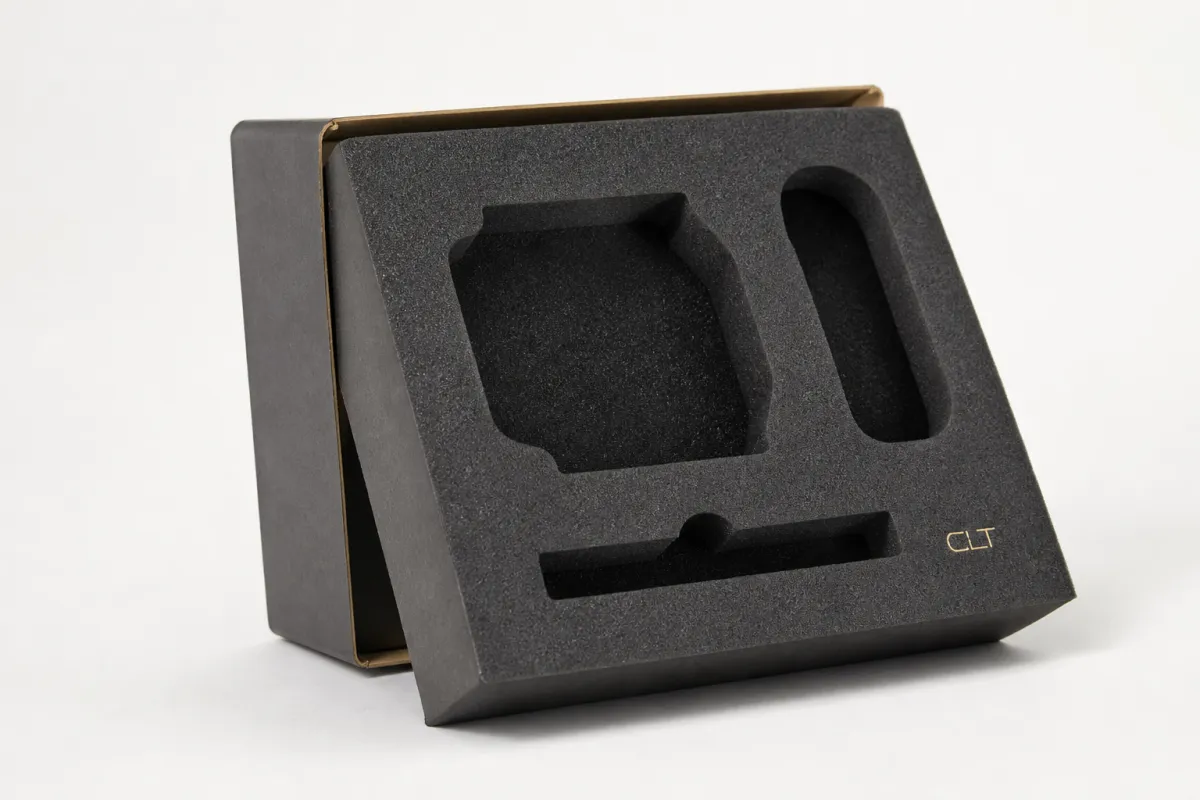
The first choice in a printed foam inserts wholesale order is the foam itself. PE, EVA, and PU are the most common options, and they do not behave the same way. PE foam is firmer and usually gives cleaner cavity walls, which makes it useful for tools, electronics, and shipping inserts that need structure. EVA feels smoother and often reads as more premium, which is why it shows up in branded kits and presentation packaging. PU is softer and cushions delicate items well, although it can be less precise around hard edges and repeated handling. None of them is universally "best." The right one depends on the product, the box, and how many times the insert will be touched.
Density changes the outcome more than many buyers expect. Low-density foam compresses easily and can work well for light objects, but it may lose shape faster or show print less sharply. Higher-density material holds form better and tends to look cleaner, though it can raise cost and make cutting more demanding. In a printed foam inserts wholesale order, that is the balancing act: enough firmness to protect the item, enough surface quality to present well, and enough resilience to keep the insert usable after repeated packing. That balance is where the budget usually lands.
Print method matters just as much as the foam family. Screen printing is often a solid choice for bold logos, part numbers, or simple marks that need strong coverage. Pad printing can handle smaller details or uneven areas. Hot stamping may fit premium work if the foam surface takes it cleanly. Labels can be the practical answer for smaller runs or artwork that changes often. For a printed foam inserts wholesale order, the best print method is not the most dramatic one; it is the one that survives actual handling without fading, peeling, or smearing after the packer has touched the insert fifty times.
Fit is where projects either become quiet workhorses or daily annoyances. A cavity that is too tight slows loading and can scuff the product during insertion. A cavity that is too loose lets parts drift and makes the box feel half-finished. The most useful printed foam inserts wholesale order usually includes details such as die-cut cavities, layered builds, finger notches, beveled edges, or lift points for easy removal. Each of those tweaks changes packing speed and user experience in a real, measurable way.
Color contrast deserves more attention than it usually gets. Black foam with white or silver print reads clearly. Lighter foams often need darker ink to keep part numbers and orientation marks visible. If the print sits too close to the cavity edge, the mark can distort when the foam flexes. If it sits too deep, the product can hide it completely. A clean printed foam inserts wholesale order keeps the message visible after the box has been opened, closed, and handled several times. That sounds simple, but it is where a lot of packaging programs go sideways.
| Foam type | Typical fit and feel | Print result | Wholesale use case | Indicative cost impact |
|---|---|---|---|---|
| PE | Firm, structured, and good at holding cavity edges | Clear marks on flatter surfaces | Tools, electronics, parts kits, shipping inserts | Usually moderate, often the best value for repeat orders |
| EVA | Smoother feel, more polished presentation | Good for logos and orientation marks | Gift sets, branded kits, consumer product packaging | Often a bit higher than PE, especially with custom finish requirements |
| PU | Softer cushioning with lighter support | Works for simple marks, less ideal for sharp detail | Delicate components, light protective packaging | Can be cost-effective, but may need more design care for durability |
The insert also has to play nicely with the rest of the package. A printed foam inserts wholesale order rarely stands alone; it sits inside a carton, a sleeve, or a shipper, and sometimes it has to line up with molded trays, instruction leaflets, or kitting stations. If the outer package is small, the foam needs disciplined dimensions. If the kit has multiple parts, the cavity layout should follow the packing sequence instead of fighting it. That is the difference between an insert that looks fine in a PDF and one that actually helps the line move.
For teams comparing pack structures and terminology, packaging.org is a useful neutral reference for packaging language and material basics, especially when internal teams need to align on names and test expectations.
Specifications that decide whether the insert works in production
A reliable printed foam inserts wholesale order needs a spec sheet that leaves little room for interpretation. Start with the basic dimensions: length, width, and thickness. Then document each cavity size, wall thickness, cavity depth, and any pull-tab or lift-point detail. Even a good-looking insert can become annoying if the cavity depth is off by a few millimeters or if the product sits proud of the surface and presses into the carton lid. That kind of mistake is small on paper and huge on the line.
Material performance specs matter too. Compression resistance tells you how the foam behaves under load. Rebound tells you whether the cavity springs back after repeated use. Abrasion and dusting tell you how clean the insert will stay after handling, especially in premium presentation packaging. A printed foam inserts wholesale order should also account for whether the insert will be opened and closed many times or whether it only needs to survive one shipment and one unboxing. Those are different jobs, and the foam should be chosen accordingly.
Print specs need the same discipline as cut specs. Artwork should be supplied as a clean vector PDF or AI file for line work, with clear color targets and a defined print area. Minimum line thickness matters because thin strokes can disappear on textured foam, and small type can blur if the surface is too soft. For a printed foam inserts wholesale order, I usually want the buyer to say whether the mark belongs on the face, the edge, or inside a recessed area, because placement changes how the print reads once the product is installed. That one detail can save a sample round.
- Document part numbers for each cavity so reorders stay consistent.
- List tolerances for width, height, and depth instead of assuming the shop will infer them.
- Note surface finish if the insert must look clean under retail lighting or product photography.
- Call out handling icons if the packer needs orientation cues or lift points.
- State any static-sensitive needs if the product cannot tolerate ordinary foam behavior.
That last point is not a footnote. Some products need anti-static or conductive foam, while others simply need low-dust presentation foam that will not leave residue on a polished face. A printed foam inserts wholesale order for a static-sensitive device, a precision instrument, or a regulated kit should be scoped around product conditions, not just outer dimensions. If the application includes transit simulation or packaging validation, ISTA is a useful reference for distribution test methods many packaging teams use as a baseline.
Where paperboard or outer collateral is part of the pack, FSC-certified material selection can matter as well. That does not change the foam itself, but it can influence the broader sourcing story if the program includes cartons, sleeves, or instruction inserts. A well-run printed foam inserts wholesale order should fit into the larger packaging system rather than sit beside it like an afterthought. The cleaner the spec sheet, the easier the reorder.
Cost, pricing, and MOQ for a printed foam inserts wholesale order
Pricing for a printed foam inserts wholesale order usually comes down to a few drivers the buyer can actually control: foam thickness, density, cavity count, cut complexity, print colors, and how much raw material gets wasted between parts. A simple single-cavity insert in a common foam can cost far less than a multi-part layout with tight tolerances, multiple print steps, and a dense sheet of nested cutouts. The quote often looks tidy, but the production math underneath it is not tidy at all.
MOQ exists because setup time has to land somewhere. In a printed foam inserts wholesale order, there may be file prep, sample work, cutting setup, print alignment, and packing labor before the first sellable piece appears. If the run is tiny, those fixed costs hit very few units. If the run is larger, the unit price drops because the same prep work is spread across more inserts. That is why buyers often see a meaningful break once quantity crosses a certain threshold. Sometimes the break is modest; sometimes it is the difference between a program that pencils out and one that does not.
As a planning range, many wholesale foam insert jobs land around $0.18 to $0.45 per unit for simpler builds at higher quantities, while more complex or premium presentations can move into the $0.80 to $3.00+ per unit range depending on print coverage, cavity count, material choice, and cut precision. Tooling or setup charges may run from $100 to $600 on smaller custom programs, and sample fees can be modest or waived if the project is moving into volume. Those figures are not promises. They are working numbers, the kind buyers can use to sanity-check a quote instead of staring at one and hoping it makes sense.
| Order tier | Typical setup profile | Indicative unit range | What usually lowers cost | What usually raises cost |
|---|---|---|---|---|
| Entry wholesale run | Simple cavity, one print color, standard foam | $0.45-$1.20 | Fewer cavities, common material, simpler artwork | Custom tooling, small quantity, multiple revisions |
| Mid-volume program | Multiple cavities, clear part marking, tighter fit | $0.25-$0.85 | Repeat order, stable artwork, efficient nesting | Thick foam, high waste, detailed print placement |
| Premium or complex build | Layered foam, custom finish, more demanding print | $0.80-$3.50+ | Consolidated SKUs, shared insert geometry | Small run, tight tolerances, special surface requirements |
One trap buyers fall into is comparing quotes that are not actually equivalent. A printed foam inserts wholesale order can look cheaper because one supplier quoted a thinner foam, a looser cavity, no sample approval, or a simpler print area. Another quote may include the exact dimensions, the correct print method, and a production-ready finish. If you want a fair comparison, confirm the same material, the same dimensions, the same cavity count, the same print area, and the same packing method before judging price. Otherwise you are comparing apples to a box of oranges.
It can also make sense to consolidate SKUs. If several product variants share the same footprint, a single standard insert may be more economical than multiple custom builds. That lowers inventory complexity, reduces the chance of the wrong insert being packed, and often improves reorder discipline. For a company like Custom Logo Things, the useful quote is not the cheapest one on paper; it is the one that gives a buyer a realistic cost basis for a repeatable printed foam inserts wholesale order.
If the insert will be reordered often, think about stock strategy instead of only one-time demand. A slightly larger MOQ can reduce unit price enough to justify keeping a small buffer on hand. That buffer can protect production against rush jobs, last-minute retail launches, or replacement needs after a packaging revision. In other words, the right printed foam inserts wholesale order is not always the smallest one. It is the one that fits the way the business actually packs and ships product, which is a different question entirely.
Process, timeline, and lead time for a printed foam inserts wholesale order
A well-run printed foam inserts wholesale order follows a predictable path: inquiry, quote, artwork review, sample or proof, production, and final packing. The order may look straightforward from the outside, but each stage protects the next one. A clear inquiry gives a better quote. A careful proof reduces rework. A clean approval keeps the run from getting stuck on avoidable questions halfway through the schedule. That is the part of the workflow nobody notices until it goes wrong.
The biggest delays usually come from missing information. Undecided print colors. Low-resolution files. Product dimensions that are "close enough" instead of measured. A carton size change after the sample is already approved. Each one can slow a printed foam inserts wholesale order because foam work depends on physical fit, not just visual approval. If the product is fragile, high-value, or unusually tight in the carton, late changes are more expensive than many buyers realize. A day lost in setup can turn into a week lost in production.
Typical lead time depends on complexity. Simple runs can move quickly once artwork and dimensions are locked. More involved builds, especially layered foam, precise cavities, or multi-step print work, need extra setup and verification. A practical expectation is often 10 to 20 business days after proof approval for many custom programs, with more time needed if the project includes a sample round, special material sourcing, or detailed fit checks. For a printed foam inserts wholesale order, the schedule is best protected by locking the specifications early and resisting the urge to tweak the layout after the sample has been signed off. That urge is common, and it is usually expensive.
Proofing is where money gets saved. A good proof checks print placement, cavity alignment, and fit before the full order starts. It should answer practical questions: Does the logo sit where the customer will see it? Does the foam allow easy insertion without scuffing? Does the product sit flush, or does it ride too high? A printed foam inserts wholesale order that skips proofing may look faster on day one, but it often costs more when a full run has to be adjusted later. Fast is nice. Right is better.
The fastest orders are usually the ones that arrive with the least confusion. If the dimensions, artwork, carton size, and packing method are approved early, production can move with far fewer interruptions.
There are a few approvals that should be locked first: insert size, product orientation, foam type, and print location. Once those are fixed, the rest of the printed foam inserts wholesale order becomes easier to manage. If the buyer still needs a decision on print color or surface finish, that should happen before tooling or sample work begins. The more uncertainty removed up front, the less likely the order is to drift. That sounds obvious, but in practice it is where a lot of schedules wobble.
For buyers who need a consistent reorder rhythm, keeping a photo record of the approved sample is a smart move. It helps if the product team changes hands later, and it gives everyone a shared reference point for the next printed foam inserts wholesale order. That kind of continuity matters in wholesale packaging because the first run is only half the job; the reorders are where process discipline starts to pay back.
Why choose us for wholesale foam insert sourcing
What buyers usually want from a printed foam inserts wholesale order partner is not a sales pitch. They want practical guidance, honest quoting, and steady follow-through. That means material recommendations based on the product, not a generic catalog guess. It means print advice that fits the surface, not the priciest decoration option in the room. It means a quote that reflects the real build so the project does not unravel when the sample arrives. Simple, but not easy.
Repeatability matters just as much as the first run. A strong printed foam inserts wholesale order should come back with the same cavity fit, the same print placement, and the same visual finish whenever the customer reorders. That consistency is what keeps packaging from becoming a moving target. If the insert is part of the customer experience, even small changes in foam color, density, or print positioning can become visible very quickly. Consumers may not know what changed, but they notice that something did.
Communication matters too. Buyers often adjust dimensions, change artwork, or revise pack-out logic during development. A sourcing partner should answer clearly and fast enough to keep those changes from becoming delays. That is especially useful in a printed foam inserts wholesale order where the difference between a workable insert and a frustrating one may be only a few millimeters of cavity depth or a slightly different print placement. A tiny miss can snowball.
The best programs are usually the ones that balance protection, presentation, and cost without trying to overbuild every detail. Sometimes a simple PE insert with one clean mark is the right answer. Sometimes a more polished EVA build is justified because the box is part of the product story. A thoughtful printed foam inserts wholesale order should support the product and the pack line, not force the buyer to pay for features that do not add real value. That part is kind of the whole point.
If your broader sourcing plan also includes board cartons, sleeves, or printed literature, an FSC-certified paperboard option can fit naturally into the same discussion. That does not change the foam specification, but it can help procurement align the package with a broader sustainability brief. The most practical sourcing conversations stay grounded in the product, the packaging line, and the reorder plan, which is exactly where a printed foam inserts wholesale order should be managed.
Next steps for your printed foam inserts wholesale order
If you are preparing a printed foam inserts wholesale order, the fastest way to get a useful quote is to gather the basics before you reach out. Measure the product carefully. Record the weight. Take photos from multiple angles. Note any fragile edges, painted surfaces, lenses, connectors, or other areas that should not rub against the foam. Those details help the supplier understand not just the size of the insert, but how the insert has to behave once production starts.
Next, send the artwork, the print placement notes, the target quantity, and the carton or tray dimensions together. A printed foam inserts wholesale order is much easier to quote when the full package is visible at once. If the product sits inside a shipper and a retail sleeve, mention that. If the insert has to support a multi-part kit, list the parts by name and part number so the cavity layout can be tied to the actual packing sequence. The more complete the request, the less guesswork there is in the quote. That saves time on both sides.
For fragile or high-value products, request a prototype or sample before locking quantity. A small proofing step can reveal a cavity that is too tight, a print mark that lands in the wrong place, or a lift point that does not give enough finger room. That is a minor cost compared with correcting a full run. A good printed foam inserts wholesale order should be tested the way it will be used: packed, closed, shipped, opened, and checked again. If it fails in that sequence, it is not ready.
When comparing vendors, keep the checklist simple and concrete:
- Foam type and density
- Print method and print area
- MOQ and price breaks
- Lead time and proofing steps
- Freight terms and packing method
- Repeat order support with saved specs and artwork
If you already have a reliable spec sheet, use it. If you do not, build one now and save it with the product record. That single file can make future reorders easier to quote, easier to inspect, and easier to approve. For a recurring printed foam inserts wholesale order, the spec sheet becomes the anchor that keeps production from drifting after the first launch. It also stops memory from becoming the source of truth, which is where packaging programs get messy.
Send the product dimensions, weight, artwork, quantity target, and carton details, and the order can be quoted with far more accuracy. That is the cleanest path to a reliable printed foam inserts wholesale order, and it is usually the difference between a packaging component that causes friction and one that disappears into the workflow exactly as it should.
What information should I send for a printed foam inserts wholesale order quote?
Send product dimensions, weight, quantity, artwork files, and any notes about how the insert will sit inside the carton or tray. If you already know the foam type, include that too, along with the print area and any brand color targets. The more complete the first request is, the faster the quote will reflect the real build instead of a rough placeholder.
How does MOQ affect printed foam inserts wholesale order pricing?
MOQ is usually tied to setup time, cutting efficiency, and print preparation, so smaller runs carry more cost per piece. A larger wholesale order lowers the unit cost by spreading the fixed work across more inserts, which is why pricing often improves at higher quantities. If the insert will be reordered often, it can be worth planning the MOQ around a practical stock level rather than a one-time demand spike.
Which foam type is best for printed foam inserts wholesale orders?
PE is often chosen for durable protection and cleaner cavity edges, while EVA is a good fit when the package needs a more polished look. PU can work well for softer cushioning, but the right choice depends on product weight, fragility, and the type of finish the brand wants to show. The best answer is always application-specific, so the foam should be selected after checking the product, the carton, and the handling conditions.
How long does a printed foam inserts wholesale order usually take?
Timeline depends on the complexity of the insert, the print method, and whether a sample or proof is needed before full production starts. Simple runs move faster than multi-layer or highly detailed builds, especially when dimensions and artwork are approved early. The most reliable way to protect lead time is to lock the specifications first and avoid late changes after sampling begins.
Can I reorder the same printed foam insert later without starting over?
Yes, if the original specifications, artwork, and cavity dimensions are saved, repeat orders are usually much smoother. Before reordering, confirm that the product has not changed in size, weight, or finish, because even a small change can affect the fit. Keeping a clear spec sheet from the first order makes future wholesale runs easier to quote and faster to place.


