Buyer Fit Snapshot
| Best fit | Printed Hang Tags Bulk Order projects where brand print, material claims, artwork control, MOQ, and repeat-order consistency need to be specified before quoting. |
|---|---|
| Quote inputs | Share finished size, material target, print colors, finish, packing count, annual reorder estimate, ship-to region, and any compliance wording. |
| Proofing check | Approve dieline scale, logo placement, barcode or warning zones, color tolerance, closure strength, and carton packing before bulk production. |
| Main risk | Vague material claims, crowded artwork, missing packing details, or unclear freight terms can make a low unit price expensive after revisions. |
Fast answer: Printed Hang Tags Bulk Order: Specs, Pricing, Turnaround should be specified like a repeatable production item. The safest quote records material, print method, finish, artwork proof, packing count, and reorder notes in one written spec.
Production checks before approval
Compare the actual filled-product size with the drawing, then confirm tolerance on folds, seals, hang holes, label areas, and retail display edges. Reserve space for logos, QR codes, warning copy, and material claims before decorative graphics fill the panel.
Quote comparison points
Review material grade, print process, finish, sampling route, tooling charges, carton quantity, and freight assumptions side by side. A quote is only useful when the supplier can repeat the same color, closure quality, and packing count on the next order.
Printed hang tags bulk order buyers usually arrive with one deceptively simple question: where does the money actually go? The answer is rarely the ink coverage alone. Setup, proofing, finishing, inspection, and packing discipline often move the unit cost more than a small change in paper stock, especially once the job crosses from a modest run into a true printed hang tags bulk order with repeat quantities and multiple SKUs.
That matters because bulk buying is not just about a lower sticker price. A well-structured printed hang tags bulk order reduces reorders, keeps garment presentation consistent across retail channels, and makes it easier to standardize launch calendars. From a packaging buyer’s point of view, the best result is plain: fewer surprises, fewer revisions, and tags that arrive ready to attach without slowing the packing line.
There is also a hard business reason to care. A 1,000-tag run and a 10,000-tag run can look identical on a screen, yet the economics are very different once die-cutting, press setup, inspection, and finishing labor are spread across the quantity. That is why a printed hang tags bulk order should start with clean specs, stable artwork, and a clear approval path. Handle those three pieces early and the rest of the job gets a lot more predictable.
For brands comparing vendors, the smart move is to compare apples to apples. Ask about material, size, finish, hole position, attachment style, proof process, and what is actually included in the quoted price. That is the quickest way to turn a printed hang tags bulk order from a vague request into a controlled production plan. I have seen teams save days simply by asking one more question before sending files, and honestly, that is often the difference between a calm launch and a scramble.
Printed Hang Tags Bulk Order: Why Volume Changes the Math
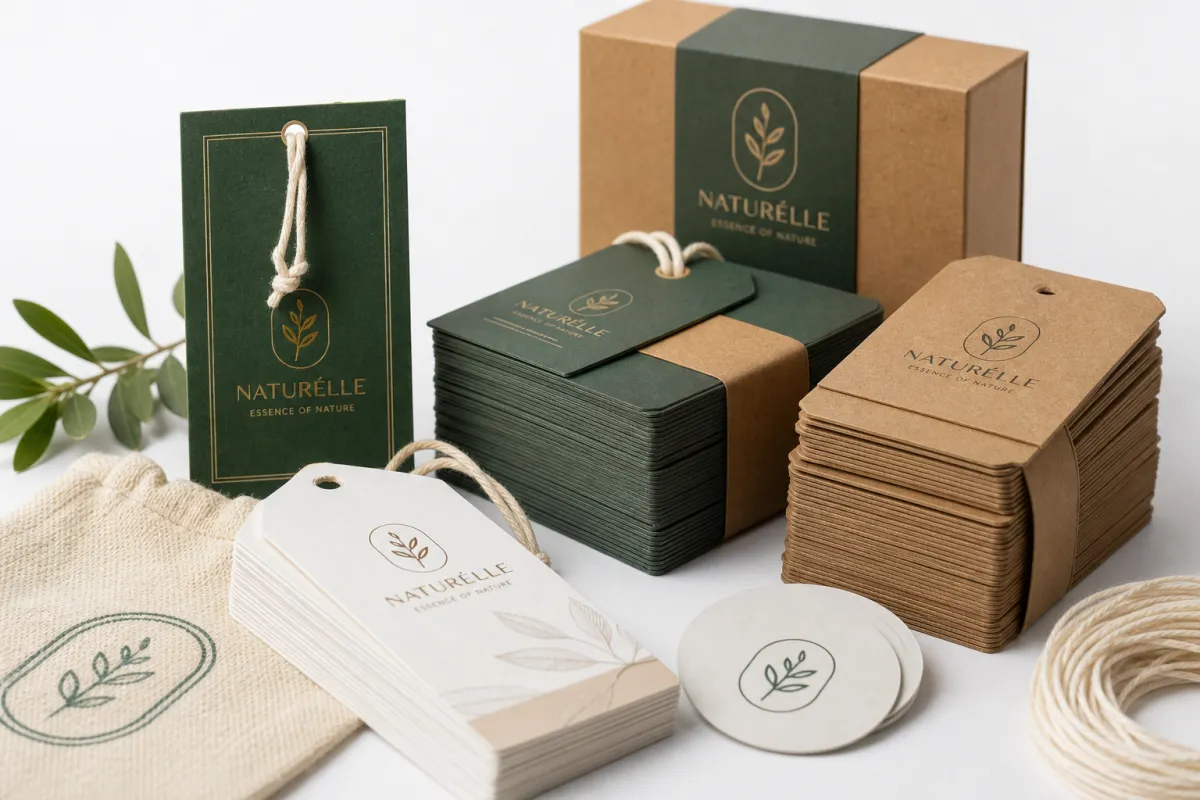
Volume changes more than the invoice total. It changes how the work is planned. In a printed hang tags bulk order, the quote is usually built from fixed costs and variable costs. Fixed costs include file handling, plate or press setup, die creation if the shape is custom, and proofing time. Variable costs include paper, ink, finishing, labor, and packing. Once quantity rises, the fixed portion gets spread across more pieces, which lowers the per-unit number even if the artwork stays the same.
That is why a 1,000-tag job and a 10,000-tag job are not twins. They may share the same logo and dimensions, but the economics are different. A short run often carries more pressure on setup and handling, so a buyer may see something like $0.20 to $0.45 per tag for a standard structure, while a larger printed hang tags bulk order can drop into the $0.05 to $0.18 range depending on stock, colors, and finish. Those ranges are not promises; they are the kind of numbers that usually show up once the specs are real instead of theoretical.
There is another reason bulk changes the math: consistency becomes more valuable than chasing tiny savings per tag. A brand with 12 SKUs can lose time, and sometimes money, if each reorder requires a new proof cycle or a different supplier interpretation of the artwork. A disciplined printed hang tags bulk order gives you one approved standard, then repeats it with less friction. That reduces the risk of mismatched color, shifted hole placement, or a finish that looks slightly different from batch to batch.
From a packaging buyer’s point of view, the strongest bulk orders are built around repeatability. Clean dielines, locked color targets, and stable attachment specs matter because they protect the next reorder as much as the first shipment. In a printed hang tags bulk order, a small improvement in process discipline can save more than a minor stock upgrade. That is where a lot of buyers get it wrong: they negotiate paper first, then discover the real cost came from rushed proofs and avoidable revisions.
There is also the value of fewer reorders. If a brand burns through tags quickly, the production team ends up pausing to restock. That is expensive in ways that never show up on the tag invoice. A larger printed hang tags bulk order can smooth that cycle, especially for seasonal apparel, accessory launches, or private-label goods with steady demand. The business case is clear: lower per-unit cost, fewer interruptions, and a presentation system that stays aligned across every SKU.
A clean spec sheet can save a week. In bulk tag work, the fastest quote is usually the one with the fewest assumptions.
Printed Hang Tags Bulk Order: Materials, Shapes, and Finishes
Material choice sets the tone before a customer reads a single word. For a printed hang tags bulk order, the most common options are coated paper card, uncoated card, textured paper, and heavier premium board. Coated stocks, such as 14pt or 16pt C1S and C2S, are common for retail apparel because they hold color well and keep small logos crisp. Uncoated stocks feel quieter and more natural, which can suit heritage brands, artisanal goods, or products that already have a tactile story to tell. Textured papers can work well for premium lines, but they should be chosen with care because heavy texture can soften fine type or thin lines.
Shape matters just as much. A standard rectangle is easiest to produce and often the least expensive option in a printed hang tags bulk order. Rounded corners add a smoother finish and reduce dog-eared edges during transit. Custom die-cuts create a more distinctive silhouette, but the extra tooling and slower finishing can raise the minimum. Folded tags are useful when a brand needs more room for care copy, origin statements, or barcode placement. Oversized tags can raise perceived value, but they should be used deliberately, because bigger tags also cost more to print, cut, pack, and ship.
Finish choices can shift both the look and the production schedule. Matte is the safest route for readability and a clean retail feel. Gloss can make color pop, though it is not always ideal for luxury positioning. Soft-touch lamination adds a velvety surface and works well for higher-end apparel, but it adds cost and may increase lead time. Foil stamping, spot UV, and embossing all have a place in a printed hang tags bulk order, yet each one needs more planning because registration and curing introduce another layer of control. If the design already has strong typography and color, the smartest finish may be the one that gets out of the way.
Attachment style is the last piece buyers sometimes underestimate. String, twine, safety pins, and plastic loops all affect packing speed. If a warehouse team is attaching tags at scale, the difference between pre-threaded string and a separate tie operation is not trivial. In a printed hang tags bulk order, the attachment method should match the labor available on the line. A fashion label may want natural twine for brand feel, while a hardware brand may prefer a simple loop that is fast, cheap, and durable.
Brand use case should drive the build. A luxury accessory tag might use thicker stock, rounded corners, foil, and a soft-touch laminate. A workwear line might choose a more durable uncoated card with a laminated front and simple black print for fast identification. A printed hang tags bulk order should not be designed in a vacuum. The strongest tag is the one that supports the product, the shelf, and the packing workflow at the same time.
There is a practical sourcing angle here too. If a brand cares about paper responsibility, FSC-certified paper can be part of the conversation. The certification does not make the tag better by itself, but it does give procurement teams a cleaner paper trail for sourcing decisions. For broader packaging standards and materials guidance, industry resources such as FSC and packaging.org are useful references when teams need more than a sales quote.
For businesses with multiple product lines, it is often efficient to standardize core shapes and only vary the finish by collection. That keeps a printed hang tags bulk order manageable across seasons. A label that looks strong on one stock can become expensive if every SKU needs a different die-cut or attachment style. Consistency usually wins unless the product genuinely needs a special structure.
Printed Hang Tags Bulk Order Specifications That Control Quality
The fastest way to improve a printed hang tags bulk order is to define the specs before the quote goes out. The minimum list should include finished size, bleed, paper weight, print sides, color mode, hole position, attachment method, and any special finish. If a buyer sends only a logo and a rough size idea, the quote will be slower and the risk of revision will be higher. A clean spec sheet reduces guesswork and usually shortens the proof stage.
Size and bleed deserve special attention. If the tag is 2 x 3.5 inches, the dieline should show the final trim and the bleed area clearly, usually 0.125 inch on each side unless the supplier specifies otherwise. That prevents text from sitting too close to the edge. In a printed hang tags bulk order, edge proximity matters because even a small shift in cutting can make a premium tag look careless. Color mode should also be set correctly; most bulk print jobs require CMYK, and any spot colors should be named accurately in the file.
Artwork setup becomes more important once multiple SKUs share one template. If the logo is close to the edge, if the barcode must sit in a fixed box, or if a care message changes by product family, the file needs room for that complexity. The most efficient printed hang tags bulk order is usually the one that keeps one master template and swaps only the variable text. That reduces rework and makes proofing faster because the team is checking a known structure instead of reviewing a new layout every time.
Buyers also need to think about compliance content. Care instructions, country of origin, fiber content, recycling language, and barcode placement can all be part of the design. A tag does not have to become crowded to carry useful information. It just needs disciplined hierarchy. In a printed hang tags bulk order, the better approach is often to reserve one face for branding and one face for product details. That gives the designer breathing room and keeps the sales floor view clean.
Quantity splits matter more than many first-time buyers expect. If one design needs 6,000 pieces and another needs 2,000, the production plan changes. Press scheduling, packing, and carton labeling all need to reflect the actual split. When a printed hang tags bulk order includes several versions, the quote should show the quantity by design instead of a single lump total. That makes the cost structure honest and helps the buyer compare vendors without hidden assumptions.
Specification Checklist
- Finished size: exact width and height, not a rough estimate.
- Bleed: usually 0.125 inch unless the supplier says otherwise.
- Stock: 14pt, 16pt, textured board, or another defined paper weight.
- Print sides: one side, two sides, or variable data on selected panels.
- Finish: matte, gloss, soft-touch, foil, spot UV, embossing, or none.
- Hole position: centered, top left, top middle, or custom placement.
- Attachment: string, twine, pin, loop, or supplied separately.
- Data: barcode, QR code, price, SKU, care text, and compliance copy.
That checklist is simple, but it solves most of the avoidable delays in a printed hang tags bulk order. Buyers sometimes assume the printer will fill in the blanks. Sometimes that works. Often it does not. The more exact the brief, the fewer revisions later, and the more likely the first proof will resemble the final product instead of a placeholder.
One final quality issue: image resolution. If the tag includes photography or texture-heavy graphics, the source files should be prepared properly, not pulled from a low-resolution web asset. Fine logos, small type, and barcodes are less forgiving in production than they look on a screen. A printed hang tags bulk order deserves print-ready files because quality problems multiply quickly when a run is measured in thousands.
How Much Does a Printed Hang Tags Bulk Order Cost?
Pricing in a printed hang tags bulk order is shaped by a handful of variables, and quantity is only one of them. Paper stock, number of print sides, finish complexity, die-cutting, and attachment labor all matter. A basic single-color rectangle on standard card is one thing. A foil-stamped, soft-touch, custom-shaped tag with threaded twine is another. The quote should reflect that difference clearly, because those production steps do not cost the same.
MOQ is usually a manufacturing decision, not a marketing one. A supplier sets a minimum because the job has a setup threshold. Once the press is ready, the die is loaded, and the team is checking color, the operator wants enough quantity to justify the changeover. That is why a printed hang tags bulk order with simple shapes and standard finishes can often support lower minimums than a custom die-cut with two specialty processes. The equipment and labor need to be paid for somehow.
Buyers often ask where the biggest savings come from. Usually, the easiest wins are standardizing size, reducing the number of special effects, and keeping the attachment method simple. A printed hang tags bulk order becomes more efficient when one template can serve several SKUs. If the brand can tolerate the same stock across the line, unit pricing often improves because the supplier is not resetting the job for every variation. Even a small reduction in complexity can do more for price than a tiny change in paper thickness.
Here is the part many teams miss: the lowest unit price is not always the best total value. A quote that looks cheap may exclude proofing, die creation, attachment labor, or freight. Another quote might include those items and still come out ahead once the project is fully landed. In a printed hang tags bulk order, transparent quoting matters more than aggressive headline pricing. The clearest estimate is the one that tells the buyer what is included and what would trigger an extra charge.
| Option | Typical Use | Approx. Unit Cost at 1,000 | Approx. Unit Cost at 10,000 | Notes |
|---|---|---|---|---|
| Standard 14pt C1S, full color, no finish | Apparel basics, accessory tags | $0.18-$0.32 | $0.05-$0.11 | Usually the most economical starting point for a printed hang tags bulk order. |
| 16pt stock, matte or aqueous coating | Mid-tier retail, elevated everyday goods | $0.22-$0.38 | $0.07-$0.14 | Better stiffness and a cleaner retail feel. |
| Textured or premium uncoated board | Luxury, artisan, boutique collections | $0.28-$0.48 | $0.10-$0.20 | Texture can affect type sharpness and finish consistency. |
| Foil, soft-touch, or spot UV | Premium positioning, limited drops | $0.35-$0.65 | $0.12-$0.28 | Higher setup and finishing complexity; best used with a clear brand reason. |
Those figures are directional, not a contract. They change with artwork coverage, quantity, and labor plan. Still, they help anchor the conversation. In a printed hang tags bulk order, buyers should expect the per-unit cost to fall as quantity rises, but not linearly. The first few thousand pieces absorb setup, proofing, and any specialty finishing. Past that, the cost curve usually softens.
Timing of payment can also affect planning. Some buyers want the cheapest route and are willing to accept a longer lead time. Others need a firm launch date and would rather pay for priority production. That tradeoff is normal. What matters is that the printed hang tags bulk order is quoted with the correct assumptions from the start, not revised after a missing detail changes the production path.
For brands with repeat programs, a bulk pricing conversation often works best when the supplier knows the reorder pattern. If the same tag will be used every season, the first run may carry a heavier setup burden, but later runs can benefit from a more efficient repeat process. That is one reason recurring buyers often compare not only price, but also proof memory, file retention, and reorder handling. Those operational details can be worth more than a small discount on paper.
Printed Hang Tags Bulk Order Process and Timeline
The order flow for a printed hang tags bulk order is usually straightforward, but it still needs discipline. It starts with a quote request, then moves into specification review, artwork upload, proofing, production, finishing, packing, and shipping. Each stage has a purpose. If one stage is rushed or skipped, the next stage tends to expose the problem later, often when the job is already in motion.
Proofing is usually the stage that deserves the most attention. A digital proof can catch spelling errors, misaligned barcodes, incorrect hole position, and color issues before the press run begins. For a printed hang tags bulk order, the proof approval step is where many timelines either stay on track or drift. If the artwork is ready and the decision-maker responds quickly, the order moves. If approvals have to pass through several teams, the schedule stretches.
Typical turnaround depends on complexity. A simple tag with standard stock may ship faster than a custom-shaped, foil-stamped tag that also needs individual packing. Many bulk jobs fall into a window of roughly 10 to 18 business days after proof approval, though that can change with seasonality, order volume, and shipping method. A printed hang tags bulk order with multiple SKUs or variable data often needs more time because each version has to be checked and packed accurately.
There is a practical way to speed things up without sacrificing control. Send print-ready files, keep one contact responsible for approvals, and avoid mid-run design changes. Those three habits do more for turnaround than most rush requests. In a printed hang tags bulk order, delays usually come from missing details, not from the press itself. The production team can only move as quickly as the information allows.
Multiple SKUs deserve special planning. If one order includes six tag designs, the supplier may need separate proof lines, separate packing instructions, and separate carton labels. That adds time, even when the visuals are close. A printed hang tags bulk order with variable text or barcode changes is best handled with a master template and a clean quantity split by version. That makes the handoff smoother and reduces the chance of a mix-up in the finishing area.
Shipping should be planned with the warehouse, not after production is done. If the tags are needed for a seasonal launch or a retail reset, the receiving team should know carton counts, pack configuration, and delivery dates early. That is the kind of small operational detail that keeps a printed hang tags bulk order from becoming a bottleneck. The tags are not finished until they have reached the place where they will actually be used.
For buyers who want a stronger reference point on shipping-related testing or distribution planning, ISTA offers useful standards and test methods that packaging teams often consult when they are checking how printed materials move through the supply chain. Tags themselves are light, but the broader pack-out still benefits from disciplined handling.
One useful planning habit is to work backward from the launch date. If the tags are needed on the sales floor by a specific week, leave time for proofing, production, transit, and intake. A printed hang tags bulk order can look quick on paper and still slip if the approval chain is slow. Backward scheduling is less glamorous than a rush promise, but it is usually more reliable.
Why Choose Us for Printed Hang Tags Bulk Order
Custom Logo Things is built for buyers who want the process to be clear, not theatrical. For a printed hang tags bulk order, the strongest advantage is process discipline: consistent color checks, careful prepress review, and stable production control. That matters more than slogans. A tag that prints accurately the first time is worth more than a flashy promise that has to be corrected later.
Repeatability is a real asset. Brands that reorder the same hang tag across multiple seasons need the artwork to behave the same way every time. That means keeping the dieline stable, saving the production notes, and matching the prior run as closely as possible. In a printed hang tags bulk order, repeat business should feel like a continuation of the same standard, not a fresh guess each time.
There is also a practical benefit to working with a packaging partner that understands more than one SKU at a time. Hang tags often sit alongside labels, inserts, cartons, and retail display materials. That is why many teams pair tag work with Custom Labels & Tags when they want the branding system to feel consistent, or use Wholesale Programs when the volume is recurring and the order pattern is already known. A printed hang tags bulk order is easier to manage when it fits into a broader packaging plan.
Direct production oversight also helps with cost control. When there are fewer handoffs, there are fewer chances for file drift, wording errors, or missed instructions. That is not a glamorous point, but it is an important one. A printed hang tags bulk order needs tighter communication than a one-off sample because the cost of a mistake rises with quantity. Good process protects margin.
Trust, in this category, should be earned through clarity. Buyers Should Know what stock is being used, how the proof is handled, what the expected lead time is, and what will happen if the artwork needs a correction. That level of openness is more useful than a big promise. For any printed hang tags bulk order, fewer errors and faster feedback are what keep the project moving.
From an operations viewpoint, the best supplier is the one that helps reduce decision fatigue. If the quote clearly lists stock, finish, attachment, and quantity split, the buyer can approve faster. If the proof mirrors the final layout closely, the internal sign-off is easier. That is the kind of service a serious printed hang tags bulk order buyer should expect, because it saves time on both sides of the transaction.
Next Steps for Your Printed Hang Tags Bulk Order
If you are preparing a printed hang tags bulk order, start with six decisions: quantity, finished size, stock, finish, attachment method, and delivery location. Those six inputs are enough to produce a far more accurate quote than a vague request. If any of them are still undecided, narrow them down before asking for pricing. Precision lowers the risk of revisions and usually produces a cleaner estimate.
Next, send the artwork files, brand colors, barcode data, care copy, and quantity split by design. If the job has multiple SKUs, state the split clearly. If the tag needs to match previous packaging, send the prior sample or the prior spec sheet. The more the supplier knows, the less room there is for interpretation. That is especially true in a printed hang tags bulk order where one missing detail can slow the entire proof cycle.
Ask for a digital proof before production begins. That is not a delay; it is a safeguard. Corrections are far easier before the press run than after thousands of pieces are printed. If the order includes special finishing, confirm how those effects will be represented in the proof. A printed hang tags bulk order should feel controlled at every step, not improvised after the job is already underway.
For brands that need support beyond a single tag order, the FAQ page can help answer common questions about files, approvals, and production timing. And if the project is part of a larger rollout, keep the packaging plan aligned so the tags do not arrive before the rest of the materials are ready. That kind of coordination keeps a printed hang tags bulk order from turning into storage clutter.
Here is the simplest path to an accurate estimate: send the exact quantity, the exact size, the stock preference, the finish, the attachment, and any compliance text in one message. Then compare each quote on the same terms. That is the fastest way to evaluate a printed hang tags bulk order without getting distracted by vague discounts or incomplete offers. When the specs are clear, the answer is usually clearer too.
The strongest printed hang tags bulk order is the one that balances cost, presentation, and production control. Compare vendors on the full picture, not just the per-unit number. If you want a cleaner starting point, send the details early and ask for a proof-ready quote; that is the quickest path to a reliable estimate for your printed hang tags bulk order.
FAQ
What is the usual MOQ for a printed hang tags bulk order?
MOQ depends on stock, size, and finish, but bulk pricing usually improves once setup costs are spread across more pieces. A simple single-color rectangle may support a lower minimum than a custom die-cut with foil or soft-touch lamination. For the clearest quote, send exact quantities by design instead of a rough estimate for the printed hang tags bulk order.
How long does a printed hang tags bulk order take after proof approval?
Lead time depends on print method, finishing, and quantity, but proof approval is usually the point where production timing starts in earnest. Standard jobs can move faster, while special effects, multiple SKUs, or variable data add time. If the artwork is ready and approvals are quick, a printed hang tags bulk order can often stay within a practical production window instead of drifting.
What file format works best for a printed hang tags bulk order?
Print-ready vector files are preferred because they keep type sharp and logos clean at production scale. A proper dieline, correctly named colors, and bleed on all sides reduce back-and-forth during proofing. If the file is not print-ready, ask for prepress review before placing the printed hang tags bulk order so issues are caught before the press run.
Can I mix multiple designs in one printed hang tags bulk order?
Yes, but the order structure matters because different designs can affect setup, packing, and pricing. Grouping SKUs under one size and finish usually keeps the job more efficient than mixing many formats. Ask for quantity splits per design so the printed hang tags bulk order quote reflects the real production plan instead of a blended average.
Which finish is best for a printed hang tags bulk order on apparel?
Matte and uncoated stocks are common for apparel because they feel clean, photograph well, and keep text readable. Gloss, foil, and spot UV can elevate premium lines, but they should match the brand position and budget. The best finish is the one that supports the garment, the shelf display, and the packing workflow in the printed hang tags bulk order.


