For ecommerce teams, the Printed Hang Tags for ecommerce fulfillment reorder planning guide is not really about tags alone. It is about keeping product moving through the warehouse without losing the brand details that make each item feel finished. A late tag order can stall packing, force substitutes, and create a chain reaction that touches inspection, kitting, and outbound schedules.
The best tag program does three things well: it looks right, it ships on time, and it can be reordered without rebuilding the job from scratch. That matters whether you sell apparel, accessories, subscription items, or giftable products that need pricing, care instructions, origin details, or a QR code tied into fulfillment.
There is also a quieter advantage. Consistent hang tags make receiving easier, help staff sort SKUs faster, and reduce the odds of mixed inventory. Those are small efficiencies on paper, but in a warehouse they add up quickly.
How printed hang tags support ecommerce fulfillment
One of the most common fulfillment problems is simple: tags run out before the product does. That sounds minor until the pack line is waiting on a missing component. A pause of even a few hours can turn into overtime, rescheduling, or a rushed substitution that looks cheap next to the rest of the product.
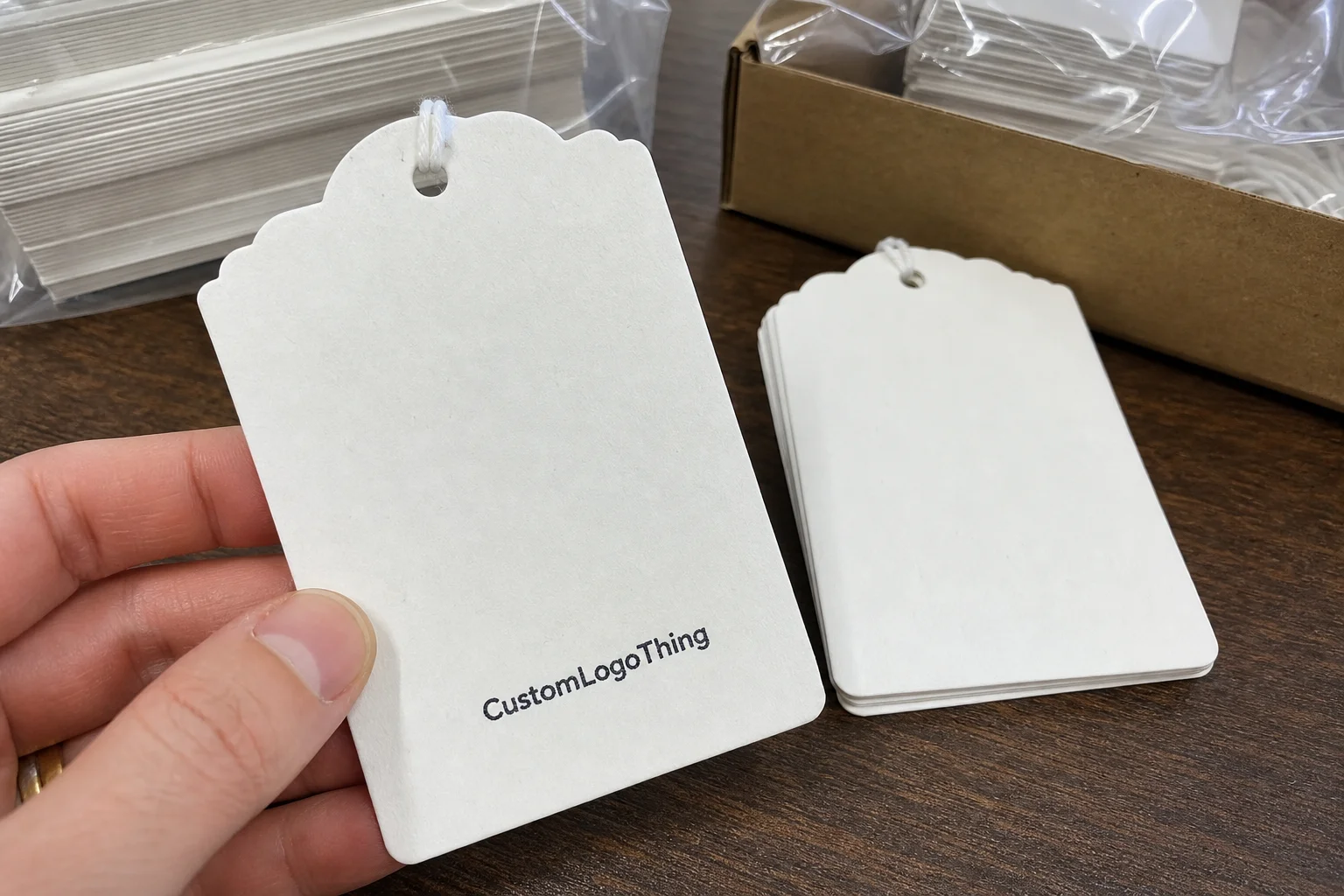
Printed Hang Tags reduce that friction because the information is already built into the piece that goes on the product. For ecommerce, that can mean a branded front, SKU or barcode on the back, care instructions, size info, a QR code, or retail pricing. The practical gain is consistency. Once the same spec is used across repeat orders, fulfillment staff learn the format and the line moves with fewer checks.
Reorder planning should be tied to sales velocity, not just what is left in the box. A carton that looks full can disappear quickly if weekly shipment volume rises. For many brands, a basic threshold based on average weekly use plus a buffer for proofing and transit is enough to avoid a scramble.
“The cleanest tag program is usually the one people barely have to think about. It is there, it matches, and it keeps fulfillment moving.”
Hang tags also shape the first physical impression of the product. That matters in apparel and accessories, where the tag may be the only printed item the customer handles before opening the package. A flat, generic tag can make a product feel rushed even if the packing itself is careful.
For brands that want consistent packaging across product lines, tags are often ordered alongside Custom Labels & Tags so artwork, stock, and finishing choices stay aligned from one replenishment cycle to the next.
Tag formats, materials, and finishes that work in fulfillment
Printed Hang Tags come in more formats than most first-time buyers expect. Standard rectangles, rounded corners, euro-slot tags, and folded tags are common. Custom die-cuts are also used, though they usually make more sense when the tag needs to reinforce brand identity rather than simply carry information.
For fulfillment, the best format is usually the one that balances handling speed with enough surface area for the required copy. A tag that is too small forces cramped text and barcode placement. One that is oversized can be harder to bundle, store, or attach at scale.
Material choice has a direct effect on both appearance and durability. Coated cardstock in the 14pt to 18pt range gives sharp color and a clean retail look. Uncoated paper feels more natural and writes on more easily if staff need to add information by hand. Kraft stock fits rustic or eco-positioned brands, while textured premium stocks are more common for apparel or gift items that need a stronger tactile impression.
If the tag will be handled often or packed with product that rubs during transit, a heavier board or a protective finish is usually worth considering. That extra protection can reduce edge wear, scuffing, and curling, all of which make a tag look older than it is.
Printing method affects both cost and speed. Digital printing is usually the practical choice for shorter runs, variable art, or faster turnaround. Offset printing tends to make sense at higher quantities because the per-unit economics improve as volume rises. Specialty methods such as foil stamping or embossing can create a more premium result, but they also add setup time and increase the chance of delays if approvals are not locked down early.
Finishes deserve the same kind of scrutiny. Matte and gloss coatings are common. Soft-touch lamination creates a richer feel, while spot UV and foil can highlight logos or key graphics. Full lamination adds durability, though it can also increase thickness and make some tags feel more rigid than necessary. The right choice depends less on trend and more on whether the finish supports the product position.
Attachment details should be decided early. Some brands want tags supplied flat for in-house kitting. Others need pre-punched holes, strings, ribbon, elastic loops, or assembled tag-and-loop sets that can go straight into the pack line. The more assembly required, the more labor and variation enter the job. If speed matters, ask whether the added convenience is worth the added cost.
| Tag option | Best for | Typical cost impact | Operational note |
|---|---|---|---|
| 14pt coated cardstock | General ecommerce apparel and accessories | Lowest to moderate | Good print clarity and easy handling |
| 18pt premium stock | Higher-end retail presentation | Moderate | More rigid and substantial in hand |
| Kraft paper stock | Natural, artisan, eco-positioned brands | Moderate | Works best with simpler ink coverage |
| Soft-touch or laminated finish | Premium goods and repeated handling | Higher | Improves feel, adds protection, may extend production time |
If you are comparing options, start with use case, not finish. A subscription accessory tag does not need the same treatment as a retail apparel tag that hangs on display for weeks. That distinction can save real money over the life of the program.
Spec planning, artwork, and compliance for reorders
The best time to plan a reorder is before the first press run ships. Once the artwork is approved, a smart buyer builds a master spec sheet that records every detail needed for a repeat order: dimensions, stock, finish, hole placement, string type, color notes, and any static copy that must stay unchanged. That one document can save hours later when replenishment needs to move quickly.
Artwork should be built for the final use, not just for the mockup. A hang tag might need a logo, product name, SKU, barcode or QR code, size marking, care instructions, country of origin, and pricing. If variable data is part of the program, keep it separate from the static design so future updates do not force a full redesign. That matters for SKU families that share a template but change barcode, size, or price from one product to another.
File preparation details matter more than most people expect. Use a proper dieline, include bleed, keep text inside safe zones, and make sure the barcode has enough contrast to scan reliably. In retail-adjacent workflows, barcode placement should be checked on a proof rather than assumed. If the packout process relies on scanning, a cramped layout or low-contrast code can slow the line and create avoidable rework.
Compliance copy is another area where reorders can drift. Care instructions, fiber content, origin statements, warnings, and pricing may be required depending on the product category and market. Even a small update can invalidate old artwork. A tag that looked approved last season may now be outdated, which is why the current version should always be documented in one place.
For buyers who want a broader reference point on packaging and shipping expectations, the ISTA site is useful for transit and packaging test methods, especially when tags are packed with other components or need to survive distribution without damage. If sustainability is part of the purchasing brief, the FSC certification resources are a practical place to start discussions about responsible paper sourcing.
A reorder-ready checklist usually includes:
- Exact finished size and shape
- Paper or board stock with weight and finish
- Print method and number of colors
- Hole placement and attachment method
- Static text versus variable data fields
- Packing format such as bulk flat-packed or assembled
- Approved reference sample for future reorders
That level of detail is what makes a printed hang tags for ecommerce fulfillment reorder planning guide useful in procurement. Without it, every reorder becomes a fresh conversation. Fresh conversations cost time, and time is usually what fulfillment teams do not have.
Cost, MOQ, and unit price factors
Pricing for Custom Hang Tags is driven by a handful of predictable variables: material weight, print coverage, quantity, number of colors, finishing complexity, die-cutting, stringing, and packing requirements. When buyers request a quote without dimensions or finish details, the number can only be a rough estimate. The tighter the specification, the tighter the pricing.
For a practical frame of reference, a simple digitally printed tag on coated cardstock may land around $0.12 to $0.25 per unit at modest quantities. A more finished piece with lamination, foil, or special assembly can move into the $0.30 to $0.65 range or higher depending on volume. Those numbers are not universal, but they are useful for understanding where the budget goes.
MOQ changes by production method. Digital printing usually supports lower quantities because setup overhead is lighter. Offset printing tends to become more attractive at larger volumes, where press time is spread across more units. Specialty finishing can push MOQ upward because foil dies, embossing plates, or custom tooling need enough volume to justify the setup.
Storage and cash flow matter too. Larger orders usually reduce the unit price, but they also tie up space and working capital. If sales are steady, that tradeoff can be reasonable. If product lines change often, standardizing one or two tag formats across several SKUs is often a better move than ordering unique tags for every item.
A buyer who uses one 2 x 3.5 inch tag across multiple apparel lines, for example, can often improve pricing and simplify replenishment at the same time. There is less artwork variation, less receiving confusion, and fewer surprises when the next order is due.
Assembly is one of the easiest ways to push cost upward. Pre-stringing, card insertion, bundling by SKU, or special carton labeling can all be useful, but they introduce labor. If a tag will be attached inside the warehouse anyway, flat-packed product may be the more efficient choice. If the pack line is already overloaded, paying for pre-assembly may save more in internal labor than it adds to the quote. The math is specific to each operation.
| Order style | Typical MOQ | Unit cost tendency | Best use case |
|---|---|---|---|
| Digital, flat tags, simple print | Low to moderate | Higher than large offset runs, but flexible | New launches, small SKUs, test runs |
| Offset, standard size, no special finish | Moderate to high | Lower at volume | Core programs with stable demand |
| Special finish with assembly | Usually higher | Highest | Premium goods where presentation matters |
For repeat orders, the most accurate quotes usually come from a supplier that has the dimensions, approved artwork status, quantity tiers, and packing method in front of them. That is the difference between a broad estimate and a procurement number you can actually use.
Production lead times and reorder timing
The production path is straightforward, but each step adds time if something changes. It usually starts with quotation, then artwork review, then proof approval, followed by printing, finishing, inspection, packing, and shipment. If the order includes custom die-cutting, foil, embossing, or stringing, the schedule extends because there are more operations to coordinate.
Artwork approval is often the biggest variable. If barcodes need to be revised, legal copy has to be checked, or the color match is off, the job pauses. That pause is usually what turns a manageable timeline into an urgent one. A clean proof cycle is the fastest way to protect the delivery window.
Repeat orders are faster than first-time jobs because the spec and art are already on file. In many cases, a straightforward repeat can move through production in roughly 10 to 15 business days after approval. Jobs with special finishes or larger assembly requirements may take longer. Transit time sits on top of that, so buyers should plan from approval date to dock date, not just from print date to ship date.
For ecommerce fulfillment, reorder points should be based on current weekly usage plus a buffer for proofing and shipping. If you only reorder when inventory looks low, you have already left yourself little room to solve problems. A simple spreadsheet that tracks SKU velocity, average depletion, and minimum stock level is often enough to prevent a last-minute scramble.
Lead times can also shift with seasonality. Apparel launches, holiday gifting, and promotional campaigns tend to create a rush on print capacity, which can stretch schedules even when the job itself is simple. Buyers who order at the same cadence every month usually have fewer surprises than teams that treat hang tags as an afterthought.
It also helps to keep one internal owner for the tag program. When responsibility moves between merchandising, operations, and procurement without a clear handoff, files go missing and approvals slow down. A single point of contact does not make the job glamorous, but it does make it easier to keep repeated orders on schedule.
For teams managing broader wholesale replenishment, the structure on Wholesale Programs can fit well when tag demand rises across multiple products and the purchasing rhythm needs to be more standardized.
What to expect from a reliable reorder supplier
A good reorder supplier does more than print the same artwork twice. They keep color consistent, die cuts consistent, and hole placement consistent, because those details determine whether a repeat order is actually usable. If the new batch does not match the prior batch, the warehouse may need to separate inventory or rework the packout process.
Communication matters just as much as press quality. As SKU counts grow, a program can get messy unless the supplier understands which elements are fixed and which can change. A reliable partner will ask the right questions upfront: Is this a straight reorder? Has the barcode changed? Is the finish staying the same? Do you need tags packed by SKU or bulk packed by count?
Quality control should be visible, not vague. Proofing, sample checks, and documented specs reduce the odds of problems on recurring jobs. Packing instructions should be clear as well, especially if different SKUs need to be separated, labeled, or split into multiple cartons for receiving efficiency.
Some suppliers can support inventory and fulfillment needs by staging shipments, packing by SKU, or splitting a larger run into scheduled deliveries. That can help brands avoid overflow storage while still locking in better pricing on a bigger production run. Not every program needs that level of support, but when it does, it can save a lot of internal handling.
There is also a difference between a supplier that treats every order as new and one that retains production history well. If prior approvals, proofs, and spec sheets are easy to retrieve, the next reorder is less likely to drift. That file discipline matters more than most buyers realize until something goes wrong.
How to reorder without delays
If you are preparing a reorder, gather the current approved sample, the dimensions, the artwork files, and an estimate of six to twelve months of tag usage before you request pricing. That gives the supplier enough information to quote accurately and helps you decide whether the next job is a true repeat or a spec change.
Then check storage and velocity. If a product line sells steadily, a larger reorder may be the more efficient move. If sales are uneven or the assortment changes often, a smaller run with a lower MOQ may be safer. Either way, the goal is the same: keep tags available before the product reaches packout.
Approvals should move quickly, especially if the barcode, care copy, or price block is changing. A slow proof cycle is the easiest way to turn a simple reorder into an urgent one. Set the reorder point early, and keep one person responsible for confirming that the spec on file still matches the current product line.
The cleanest process is usually the least dramatic one. Standardize the spec, save approved files in one place, track usage by SKU, and place the next order before inventory turns tight. That is how hang tags stop behaving like an emergency purchase and start functioning like a stable part of the fulfillment system.
For teams that want a practical operating rhythm, the best approach is often:
- Use one master spec sheet for each tag family
- Lock artwork before the first production run
- Track weekly usage and set a minimum stock level
- Approve proofs quickly, especially for barcodes and legal copy
- Reorder before safety stock is consumed
That discipline is the real value behind printed hang tags for ecommerce fulfillment reorder planning guide. It cuts delays, keeps the presentation consistent, and gives the warehouse a component it can count on.
What should I include when reordering printed hang tags for ecommerce fulfillment?
Include the previous approved sample or spec sheet, dimensions, material, finish, hole placement, string or attachment type, and exact quantity needed. Provide current artwork files and note any changes to SKU, barcode, pricing, or regulatory copy so the next run matches your fulfillment needs.
How do I lower unit cost on printed hang tags without hurting quality?
Standardize one tag size and material across multiple products when possible, because shared specs usually improve pricing and simplify replenishment. Choose finishes carefully and avoid unnecessary embellishment if the tag only needs to support brand presentation and barcode readability.
What MOQ should I expect for custom hang tags?
MOQ depends on size, paper stock, print method, and whether finishing or assembly is required. Digital runs often support lower quantities, while offset and specialty finishing usually favor larger order volumes for better unit economics.
How long does a repeat order of printed hang tags usually take?
Repeat orders are typically faster than first-time jobs because the spec and artwork are already approved. Lead time still depends on quantity, finishing, and whether the order needs a revised proof, but approved repeat specs help shorten the process.
Can printed hang tags be made for multiple SKUs in one production run?
Yes, multiple SKUs can be produced in one run if the base spec stays consistent and only the variable data changes. Using a shared template for size, stock, and finish makes kitting and reorder planning easier for ecommerce fulfillment teams.
If the goal is fewer stockouts and less friction at packout, the answer is rarely a more complicated tag. It is a clearer spec, a cleaner approval process, and a reorder plan that starts before inventory gets thin. That is what keeps the tag program predictable, even when order volume is not.