Logo Printed Hang Tags bulk orders do one job especially well: they make a product look decided. That sounds minor until you compare two otherwise similar items on a rack or in a box. The one with a clean, well-built tag usually reads as more finished, more intentional, and easier to trust. The tag is small, but the signal is not. Paper feel, print sharpness, cut accuracy, and string quality all arrive before the buyer has handled the product itself.
For apparel, accessories, gift packaging, and seasonal programs, bulk ordering is less about novelty than control. Once a tag spec is set, it can carry the logo, SKU, price, barcodes, care information, and country-of-origin copy without turning cluttered. That is why buyers keep returning to logo Printed Hang Tags bulk instead of chasing small print jobs that drift from one run to the next.
There is a second reason bulk makes sense: retail programs do not forgive inconsistency. If one round prints on a brighter white stock and the next lands on a duller sheet, the mismatch shows up fast. If the hole placement shifts, the string hangs crooked. If the logo density changes, brand color starts to look improvised. None of those failures is dramatic by itself. Together, they make a line look unstable.
Why logo printed hang tags bulk orders stand out on the shelf
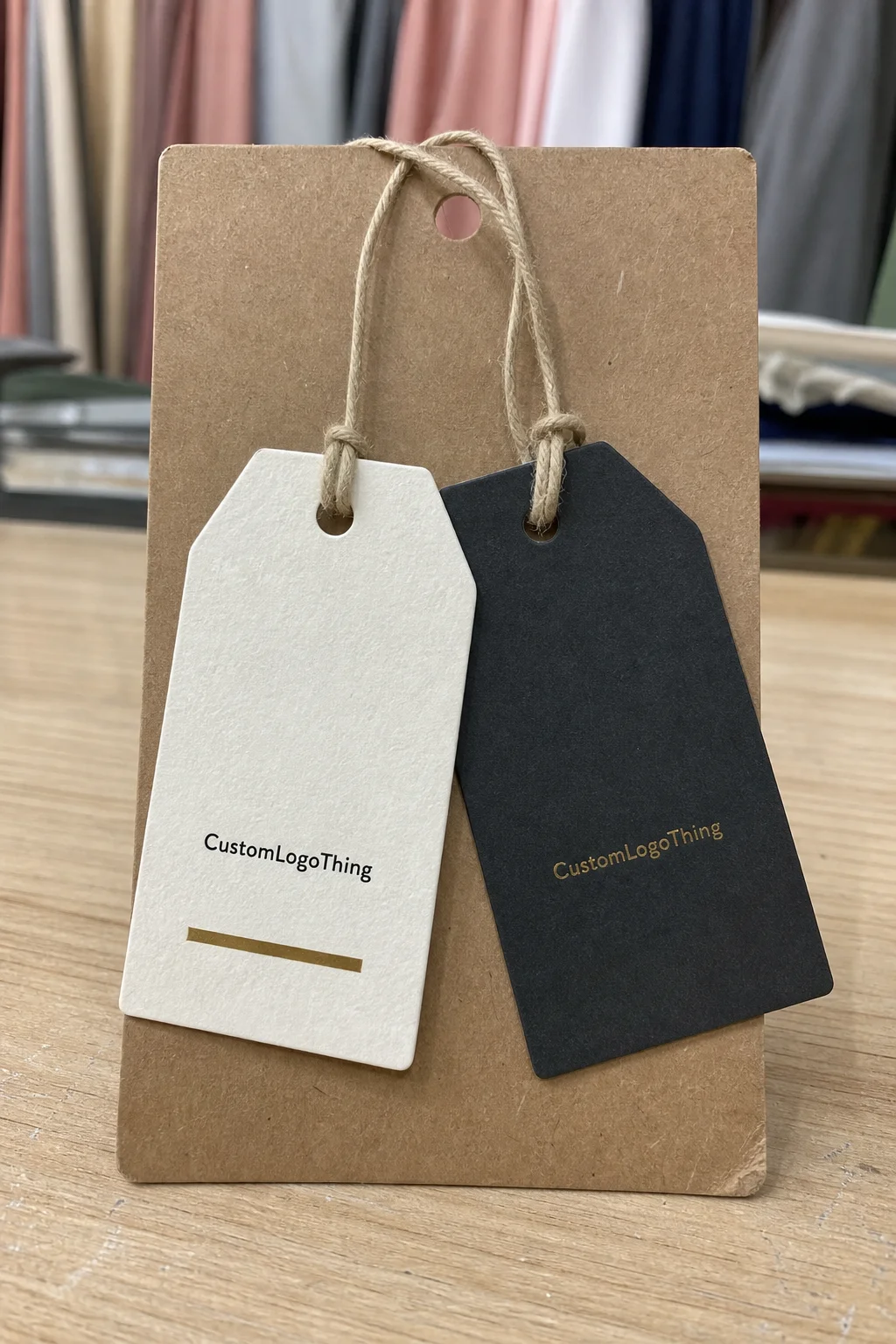
A hang tag does more than identify a product. It creates the first framing device the buyer sees, and it often determines how polished the rest of the package feels. In a store, that role is practical, not decorative. A clear tag helps the buyer understand size, price, and product identity quickly. It also gives the retailer a place to put required information without crowding the garment or the carton.
That function becomes more important when the assortment grows. One product line may include several colorways, multiple sizes, and repeated replenishment. Bulk production keeps the visual language stable across all of it. The paper stock stays the same. The ink density stays the same. The hole size, cut shape, and finish stay the same. That consistency is what makes a line look managed rather than patched together.
There is also a subtle operational benefit. A tag that is designed well can reduce questions at the point of sale because it puts the right information in the right order. Logo first. Product name next. Then size, SKU, barcode, and care notes. If all of that is arranged with enough breathing room, the tag helps the retail process instead of competing with it.
A good tag should shorten the time it takes to understand a product, not extend it.
If the brand already uses coordinated packaging pieces, pairing tags with Custom Labels & Tags keeps the system visually consistent across inserts, stickers, and retail identifiers. That matters more than people expect. Repeated finishes and aligned typography make a range feel like one program instead of several disconnected print orders.
Paper stock, coating, and finish choices that fit the product
Material choice changes both the look and the behavior of the tag. A 14pt or 16pt cover stock is common because it hangs cleanly without feeling flimsy. For a softer or more natural presentation, kraft stock or an uncoated sheet works well. For sharper graphics and stronger contrast, matte or gloss coating can help the print read more clearly. Soft-touch lamination pushes the feel toward premium, though it should be used only when the product positioning justifies the added cost and the slightly longer production path.
Thickness alone does not decide whether a tag performs well. Corner shape, coating, and hole placement matter just as much. Rounded corners reduce edge wear during packing and shipping. A 3 mm or 1/8 inch hole is a common choice because it supports consistent stringing and lowers the chance of tearing. If the tags will be handled repeatedly before purchase, heavier board stock usually holds up better than a lighter sheet, especially on larger garments or bundled accessories.
Finish selection should be disciplined. Spot UV can highlight a logo or a product name, but it only helps if the rest of the layout stays restrained. Foil can add contrast and a more premium tone, yet it also magnifies registration issues if the art is not tight. Embossing gives a tactile cue that can work well on a minimal design. The mistake is to treat finish as decoration rather than structure. If the paper, typography, and spacing already carry the design, extra effects may only add cost.
Recycled board deserves serious consideration, especially for brands that already talk about material responsibility in the product itself. FSC-certified paper is widely used in packaging work, and the organization’s guidance is a practical reference for certified sourcing: FSC. For a more natural retail tone, uncoated recycled stock usually looks honest rather than unfinished. Duplex board can also be useful: one side presents cleanly, while the reverse keeps material cost in check.
One buyer mistake shows up often enough to mention. A tag that looks beautiful under studio light can behave very differently under store lighting. Gloss can flare. Kraft can absorb color and mute contrast. Soft-touch can show scuffing sooner than expected if the tags are packed loosely. A sample in the right stock is more useful than a perfect render.
Die cuts, stringing, and artwork specs that keep print clean
Good artwork starts with dimensions, not with the logo file. Final size, bleed, safe area, and hole placement need to be set before proofing. If the logo sits too close to trim or the barcode is crowded by the hole, the finished tag can look careless even when the press work is technically correct. That is one of the fastest ways to lose polish on a shelf.
Content hierarchy matters just as much as layout geometry. The buyer should see the logo and product name first. After that comes size, SKU, barcode, and price. Care instructions and legal notes belong lower in the stack, but they still need enough contrast to read cleanly. If every line fights for the same attention, the tag turns noisy. Bulk orders magnify that problem because the same mistake gets repeated hundreds or thousands of times.
Variable data needs planning early. A static design is one workflow. Unique size codes, serial numbers, color names, or QR codes are another. Barcode contrast should be tested against the final stock, not guessed from a screen preview. Vector art is the right choice for logos and linework. Raster images should be supplied at print quality, usually 300 dpi at final size or better. Anything less invites soft edges, and small-format print rarely hides them.
A simple preflight list helps keep the job under control:
- Final trim size and bleed
- Safe area around the hole and edges
- Front and back content placement
- Barcode data or serialized list
- String, fastener, or attachment method
Die choice deserves attention too. A custom shape can be a strong branding move, but it adds tooling and often slows approval. Standard rectangles, rounded rectangles, and simple hang shapes usually move faster and cost less. If the tag does not need a custom silhouette to do its job, the extra die work is often money spent on the wrong detail.
For broader packaging references, Packaging.org is useful when you want an industry-level view of materials and production topics. It is not a substitute for supplier specs, but it is a solid way to sanity-check assumptions before approving a run that will be produced at scale.
Cost, pricing, and MOQ tradeoffs on larger tag runs
Pricing for logo Printed Hang Tags bulk orders usually comes down to a small number of variables: stock, print sides, finish count, die complexity, packing method, and freight. Setup costs matter more than many buyers expect. A simple tag with one or two colors may cost very little per piece once the run gets large enough. A more elaborate spec can look reasonable on paper and still become expensive once foil, embossing, specialty coating, and custom cutting are added back in.
As quantities rise, unit price usually falls because setup is spread across more pieces. The drop is often most noticeable in the middle of the order curve. After that, savings tend to flatten while material and labor become the main cost drivers. If a supplier offers tiered pricing, the key question is where the curve levels off. That tells you whether a larger order is genuinely efficient or just larger.
MOQ depends on the production method. Standard digital or offset paper tags often start lower than tags with special finishes or custom structures. That difference is not arbitrary. Specialty work demands more setup, more handling, and more inspection. If a project includes multiple SKUs, the better path is usually to standardize what can be standardized: the stock, the hole size, the layout grid, and sometimes even the base art. Fewer variables keep the quote cleaner and the reorder path simpler.
| Order profile | Typical unit price at 5,000 pieces | Main cost drivers | Best fit |
|---|---|---|---|
| Uncoated 14pt, one or two colors | $0.11-$0.18 | Simple setup, light finishing, standard die | Basic apparel tags, price-driven programs |
| Matte 16pt, full color front and back | $0.16-$0.28 | Higher ink coverage, two-sided layout, modest finishing | Retail lines that need sharper branding |
| Soft-touch or foil-enhanced stock | $0.28-$0.45 | Extra coating, specialty finishing, longer press and post-press time | Premium apparel, gift, or presentation packaging |
When you request a quote, ask for setup, plates, dies, finishing, freight, and remake terms to be itemized separately. That makes comparison more honest. A low headline price is not useful if it hides a high freight charge or an expensive correction policy. If a vendor handles recurring programs, Wholesale Programs can make replenishment easier to manage and can clarify how pricing shifts across repeat orders. For buyers managing repeat logo Printed Hang Tags bulk runs, transparency usually matters more than a marginal difference in the first quote.
There is another tradeoff that rarely gets enough attention: pack format. Bulk tags can be shipped loose, banded, carton-packed by SKU, or stringed and counted. Each format affects labor, verification, and the chance of a mixed pack. If the tags are going straight into garments, a slightly higher packing charge may be cheaper than having the warehouse sort them later.
Production steps, proof approval, and turnaround planning
The fastest orders are usually the ones approved cleanly the first time. The workflow is straightforward: file review, digital proof, print, finishing, trimming, hole punching, stringing or packing, and shipment. Each step can add time if the artwork is incomplete or if the spec changes after the proof is issued. A small correction early is far less expensive than a late correction after material has already been committed.
Proof approval is the main handoff. It is not a formality. A buyer who checks trim, barcode placement, spelling, size callouts, and color references before signing off usually gets a more predictable result than one who treats the proof as a preview only. If the proof is wrong, the production run will be wrong in a very expensive way.
Turnaround depends on quantity, stock availability, and finish complexity. A simple standard run can move quickly. A job with foil, embossing, or variable data takes longer. For many bulk paper tag programs, 12 to 15 business days after proof approval is a reasonable planning range, though that can shift if stock has to be sourced or if the packing instructions are unusual. Rush work is possible in some cases, but it narrows the options and usually increases the cost.
Shipping and handling matter once the tags leave production. If the order is being packed with garments or boxed products, the tags need to survive the same conditions the rest of the order faces. Bent corners, crushed stacks, and loose stringing are preventable problems. The packaging logic used in transit testing, such as the guidance available through ISTA, is useful here even if a full test program is not necessary. The point is simple: the print is only valuable if the finished piece arrives usable.
Proofing discipline also improves reorder speed. When the supplier keeps the approved file, stock choice, and finishing notes tied to the SKU, a repeat order can move much faster than a fresh build. That is one of the quiet advantages of bulk work: the first run may demand more attention, but the next run often becomes almost procedural if the documentation is clean.
How to compare suppliers for color control and reorder consistency
Not every vendor handles repeatability well. A strong first proof does not guarantee a clean second run six months later. The real test is consistency: stable ink density, accurate die cutting, clean hole placement, and a reliable way to match the approved file on reorder. That is where experienced suppliers separate themselves from the ones that only look competitive on price.
Ask how proofs are archived. Ask what happens if a SKU returns with a minor artwork update. Ask whether the supplier can sort by size or color, split shipments, and coordinate with other packaging pieces. Those are ordinary questions for a buyer running a real program, and the answers usually reveal whether the operation is organized or merely optimistic. A vendor who is vague on basic production controls often becomes expensive later.
Color control deserves special attention. A deep black logo, a specific brand blue, or a warm kraft stock can drift noticeably if press conditions are not managed well. A buyer does not need laboratory language, but they do need a supplier who can explain how color is matched, how reruns are checked, and what tolerance is used for reorders. That matters more in bulk, because a weak batch can affect an entire season’s presentation.
A practical comparison framework looks like this:
- Responsiveness on specs and proof corrections
- Clarity on paper, finish, and finishing options
- Consistency across repeat orders
- Ability to manage SKU sorting and repacking
- Transparency on lead time, freight, and remake terms
One more check is worth asking for: whether the supplier can provide a physical sample or press-match reference before production begins. A screen proof is useful, but it will not reveal how a matte stock absorbs ink or how foil behaves against a textured sheet. Physical confirmation catches the kind of mismatch that does not show up in file review. For logo Printed Hang Tags bulk programs, that step often saves more time than it costs.
If a supplier cannot answer these points clearly, the lower quote may not be the better value. Buyers tend to discover that the cheapest run becomes expensive once reprints, delays, or mixed stock are added back into the program. For recurring orders, the supplier that holds standards steady usually saves more money over time than the one that simply starts cheaper.
What is the usual MOQ for custom hang tag bulk orders?
MOQ depends on stock, size, and finish complexity, but standard paper tags usually start lower than specialty versions with foil, embossing, or custom structures. If you have multiple SKUs, ask whether artwork can be standardized or tooling can be shared so the order clears a better production threshold. Tiered pricing is useful because it shows exactly where unit cost starts to improve. For many buyers, that is the practical starting point for logo printed hang tags bulk planning.
Which paper stock works best for printed hang tags on apparel?
Most apparel tags use a sturdy cover stock that holds color well and feels substantial in hand. Matte and uncoated stocks are common for a natural or premium look, while gloss can sharpen color and contrast. Heavier or textured stocks work well when the tag needs to feel durable or align with a more elevated brand position. The right choice depends on the garment, the store environment, and the image you want the buyer to read in the first second.
Can barcodes or QR codes be added to custom hang tags in bulk?
Yes, but the artwork needs enough quiet space and contrast for reliable scanning. Provide the exact barcode data or a serialized list before proofing so the printer can verify placement and legibility. A scan test on the proof or sample is the safest way to confirm that the finished tag will work at retail. That step is small, but it prevents a lot of avoidable trouble.
How long does production take after proof approval?
Turnaround depends on quantity, stock availability, and whether the order includes special finishes or extra finishing steps. Simple standard runs usually move faster than jobs with foil, embossing, or variable data. A clean approval process makes the schedule far easier to hold, which is why a buyer who reviews the proof carefully often gets better results than one who rushes the signoff. For logo printed hang tags bulk orders, a clear approval deadline is one of the best tools for keeping the ship date stable.
How can I lower unit cost on a bulk hang tag order?
Standardize the size and stock, reduce the number of finishes, and avoid custom structures that add tooling or setup. Combine SKUs where possible and approve artwork quickly so the job does not sit in prepress longer than necessary. Ask for a quote that separates setup, finishing, and freight so you can compare options with a clean view of the actual cost. That is usually the most reliable way to keep logo printed hang tags bulk orders moving without paying for extra complexity that does not improve the tag.


