Printed Hang Tags for Cosmetics brands usually rise or fall on a few quiet decisions that buyers often underprice on the first round: finish, size, die-cut shape, print sides, and how the tag is attached. Paper weight matters, but it is rarely the main swing factor. In beauty packaging, a tag has to do more than identify a SKU. It has to support the product story, survive handling, and still look deliberate after it has been tied, boxed, shipped, and touched by retail staff ten times.
That is why the lowest quote is not always the best value. A tag that prints cleanly but scuffs easily, curls at the corners, or loses color under store lighting can create more waste than the invoice suggests. The useful question is not “How cheap can this be?” It is “Which spec gives the right shelf signal for the least amount of friction?”
Cosmetics buyers who order tags regularly learn the same lesson in different forms. A polished finish can change perception more than a heavier board. A standard shape can look better than a custom silhouette if the artwork is strong. And a well-managed proof can prevent a reprint that would erase any savings from chasing a lower per-piece rate.
Why a simple finish change can move your quote more than thicker stock
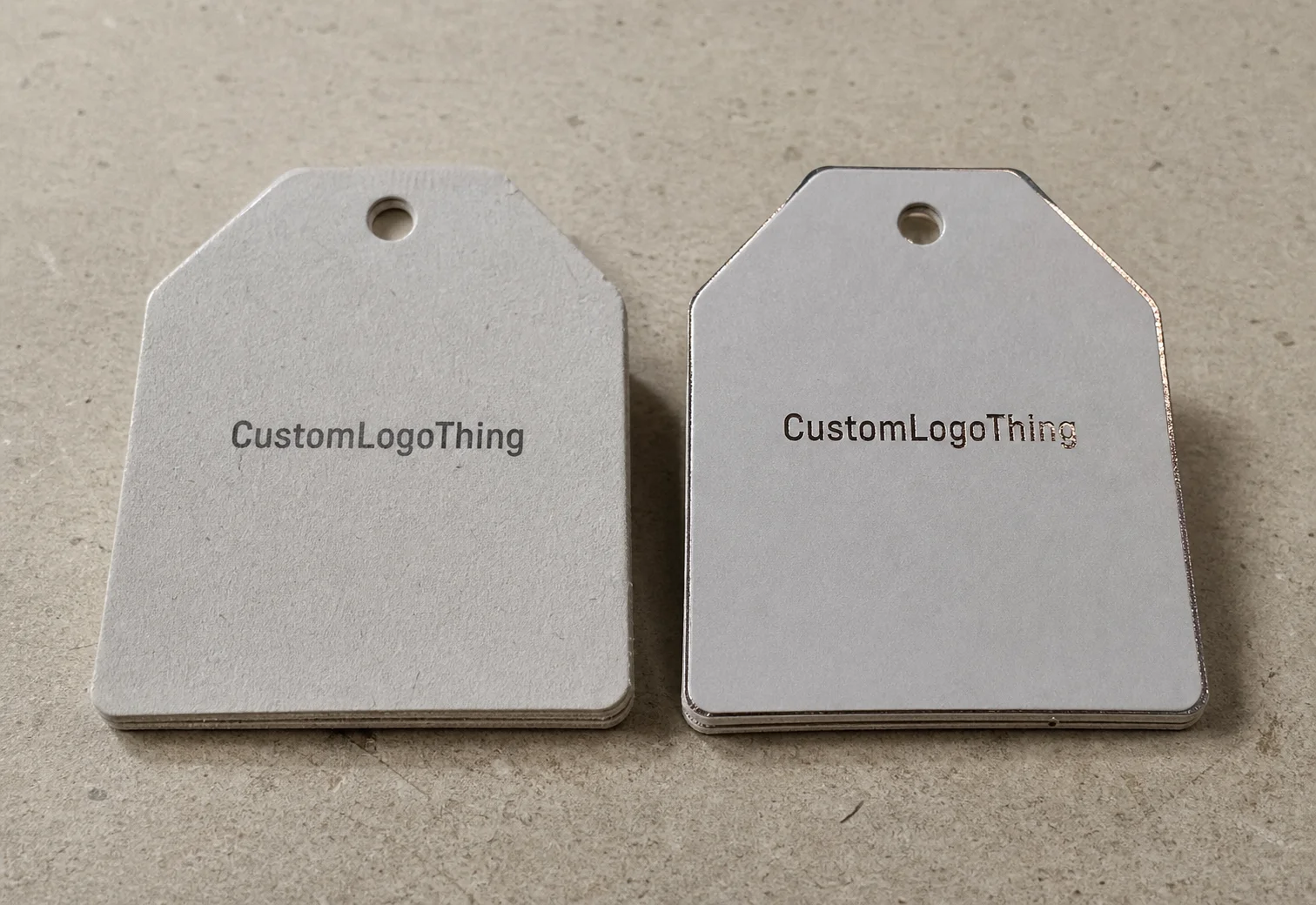
On hang tags, surface treatment often shifts the quote more than a jump from 18pt to 24pt board. Foil stamping, spot UV, embossing, soft-touch lamination, and complex die work all add setup time and one more stage where registration can drift. A heavier sheet sounds premium, but buyers usually read the surface first. In packaging terms, the eye sees finish before it measures caliper.
That is especially true in beauty. Skincare usually wants a restrained, controlled look. Makeup can tolerate more gloss and contrast. Fragrance tends to sit between the two, where texture and negative space often do more work than decoration. A matte tag with strong typography can feel more expensive than a busy tag with three special effects stacked on top of each other.
A tag should support the product, not compete with it. If the carton or bottle already carries the visual weight, the hang tag only needs to reinforce the same message cleanly.
There is also a practical reason to avoid overbuilding. Every extra process introduces another point of failure. Soft-touch can show rub marks on corners. Foil can crack on tight curves. Heavy coating can make the tag curl if the stock is thin or the humidity changes during shipment. The best quote is usually the one that balances appearance with handling reality.
Paper stocks, coatings, and print effects that fit beauty packaging
The stock sets the baseline feel. C1S gives you one coated side and one uncoated side, which is useful if the front carries branding and the back needs barcode contrast or writable space. C2S prints well on both sides and works for tags that need a more uniform, polished look. Kraft brings warmth and a natural cue. Uncoated board feels tactile and less clinical. Textured stocks lean premium if the design is restrained rather than crowded. Soft-touch laminated board feels expensive, but it also changes how the tag handles in transit and under friction.
Match the surface to the category rather than forcing one style across the whole line. Matte or soft-touch usually fits skincare because the category sells calm, cleanliness, and control. Gloss, foil, or spot UV often suits color cosmetics because those products need more visual lift. Textured or kraft stocks work well for natural, ingredient-led, or minimalist brands that want the package to feel less synthetic. The wrong stock can make a clean design look cheap; the right stock can make a modest design feel expensive.
Color management matters more than many briefs admit. Pantone on coated paper does not read the same on kraft or uncoated stock. Black looks richer on a coated surface and flatter on absorbent paper. White ink can help on dark stocks, but opacity is never absolute, so it needs to be checked on press or in a proper proof. If the brand uses precise color rules across cartons, labels, and hang tags, ask for a production method that can hold that consistency rather than assuming all stocks behave the same way.
Back-side content changes the quote less than many teams expect, but it changes the usefulness of the tag a great deal. Some tags need barcode space, ingredient notes, batch references, care language, or promo copy. Others need only a logo and a web address. If the back panel becomes crowded, the tag stops feeling premium. Keep the text readable, leave quiet space around the barcode, and resist the urge to squeeze one more line into a layout that was already full.
For sustainability claims, ask for FSC-certified board or chain-of-custody paperwork where it matters. The FSC standard is a real procurement signal; vague “eco-friendly” language is not. If the supplier cannot explain board sourcing, coating differences, or how the stock will behave in packing, they are probably quoting from memory rather than from process.
One more practical point: request rub resistance information if the tag will be handled in store or packed tightly with other pieces. A soft-touch finish can show scuffing sooner than buyers expect. A matte laminate may look flat on screen but hold up better in shipping. The sample should be judged in real light, not just on a monitor.
Sizes, die-cuts, and attachment details to lock before quoting
Size should follow the package, not a trend. A small bottle usually needs a compact tag that stays readable without hiding the primary label. Gift sets can support a larger face because the carton gives the design more room. Sachets and sample packs often need something narrow and efficient. In practical terms, many cosmetics tags fall around 1.5 x 2.5 inches for small items, 2 x 3.5 inches for standard retail pieces, and 2.5 x 4.25 inches for gift sets or launch bundles.
Die-cut shape affects both price and perception. A square tag with rounded corners is efficient and easy to run. A circle or oval can feel softer and more boutique if the artwork supports it. Custom silhouettes create more brand character, but they also add tooling complexity and more waste at the trim stage. A reinforced hole is worth paying for if the tag will be attached and removed repeatedly. A stitched or eyeleted hole can look polished on gift packaging, but it is not the default answer for every line.
Attachment hardware changes the look and the budget. Cotton cord feels natural. Ribbon reads more giftable. Elastic works for quick attachment but feels less refined. Standard string is the cheapest route, and not always the wrong one. Metal eyelets improve durability and can make the hole area look finished, but they also introduce another step and another cost line. If the product is premium, the attachment should look intentional rather than improvised.
- Square or rounded-corner tags: Efficient, easy to quote, and clean for most skincare and makeup lines.
- Circle or oval tags: Softer visual feel, useful for boutique or natural brands.
- Custom silhouettes: Stronger brand character, higher setup and die costs.
- String or cotton cord: Economical, familiar, and practical for volume runs.
- Ribbon or eyelets: Better for premium presentation, with added unit cost.
File prep saves time and money. Use proper bleed. Keep all text inside a safe area. Leave enough room around the hole so the top edge does not feel crowded after cutting. Barcode contrast should be checked on the actual stock color, not on a white screen. If legal text is required, size it for real-world readability after finishing, not for a presentation slide. A tag that looks balanced in the mockup but feels cramped in print is a common, avoidable waste.
When the tag has to match another package component, ask for the dieline early. A few millimeters can matter more than brands expect. A hole placed too high can split a narrow top panel. A tag that is too wide can crowd a bottle neck or hang awkwardly off a carton flap. Small geometry issues become obvious the moment the product is assembled.
Printed hang tags for cosmetics brands wholesale pricing factors
The pricing drivers are straightforward once you separate setup from unit cost: quantity tier, print method, number of sides, stock choice, finish complexity, die-cut shape, and attachment hardware. Printed Hang Tags for Cosmetics Brands wholesale pricing factors are rarely mysterious after that. What looks like a low quote can turn into a more expensive job once the supplier adds finishing, tooling, packing, or freight that was left vague in the first email.
MOQ usually works in tiers. Lower quantities are possible, but the unit price rises because setup is spread across fewer pieces. Larger runs usually unlock better per-unit pricing, especially when the spec stays simple. If you are comparing suppliers, make sure they are quoting the same paper weight, the same finish, the same hole style, and the same packing method. Otherwise the numbers are not comparable. They are just four different jobs wearing the same name.
| Spec type | Typical MOQ | Typical unit price at 5,000 pcs | Cost driver |
|---|---|---|---|
| Simple C2S tag, one side, standard shape | 500-1,000 | $0.12-$0.22 | Low setup, standard cutting, basic print run |
| Matte or soft-touch tag, two sides | 1,000 | $0.20-$0.38 | Extra side coverage, coating or lamination |
| Foil or spot UV detail | 1,000-2,000 | $0.28-$0.55 | Secondary pass and alignment control |
| Custom die-cut with ribbon or eyelet | 2,000+ | $0.35-$0.90 | Tooling, hardware, and extra handling |
Those numbers move with quantity, shipping method, and artwork complexity, so treat them as working ranges rather than fixed thresholds. But the direction stays the same. Simplify the shape, limit the finishes, and standardize the attachment. That is how brands protect margin without flattening the visual quality that cosmetics buyers expect.
A useful buying move is to price two versions side by side: a clean base spec and one upgraded version. For example, compare a matte tag against a foil-and-soft-touch version, then compare both at 1,000, 3,000, and 5,000 pieces. The unit gap usually shrinks faster than expected as volume rises, but only if the spec stays disciplined. If the line has multiple SKUs, keeping one shared size and one shared finish often saves more than negotiating a small discount on a complicated order.
If a quote is lower because it hides setup, finishing, or freight, it is not a better quote. It is just a quieter one.
Another small cost factor is packing format. Flat-packed tags in clean cartons are easier to store and ship than loose bundles that arrive bent. If the run is large, ask how many tags fit per carton, how corners are protected, and whether the stacks are counted or weighed. Those details do not sound glamorous, but they control how much usable inventory lands on the receiving dock.
Proofing, production steps, and turnaround from artwork to shipment
The workflow should be predictable. First comes the spec review. Then the quote. After that, the supplier should send a digital proof with dimensions, colors, hole placement, and finish notes. Revisions follow if needed. Once approved, production starts: print, finish, cut, punch, inspect, pack, and ship. If the process feels vague, delays usually appear later in the schedule.
Digital proofing is fast and useful for layout checks. Physical sampling costs more and takes longer, but it is worth it when color, texture, or finish are critical to the brand. A soft-touch sample can look acceptable on screen and feel wrong in hand. Foil can shift under retail lighting more than expected. If the tag is tied to a launch or a retail presentation, paying for a sample is often cheaper than reprinting the entire run.
Typical turnaround depends on complexity. Simple printed tags can move in about 7-10 business days after proof approval. Tags with foil, embossing, unusual die-cuts, or tight sampling requirements often need 12-18 business days, sometimes longer if artwork changes late. Shipping time is separate from production time. That distinction matters because a quote that sounds fast can still miss the launch if freight is not included in the calendar.
Most delays come from the same few issues: missing bleed, incorrect barcode data, unresolved Pantone references, or a proof approved with visible problems still sitting on the page. The fastest jobs usually share the same discipline. One final file package. One decision-maker. One round of changes, not five. That sounds obvious until a brand tries to approve packaging by committee.
Quality control should include more than a cursory glance. The checks that actually prevent problems are simple:
- Verify dieline alignment before print.
- Confirm hole position and edge distance.
- Check barcode quiet zones and contrast on the chosen stock.
- Inspect foil, UV, and lamination under angled light.
- Count cartons and inspect corner protection before release.
For transit discipline, it helps if the supplier understands handling standards rather than only print output. Hang tags are not fragile like glass, but bent corners, crushed stacks, and scuffed finishes still create waste. The packaging side of the job matters as much as the print side, especially if the tags are being stored before a seasonal launch or split across multiple distribution points.
What separates a reliable cosmetics packaging supplier from a cheap one
A reliable supplier can explain the process without hand-waving. They should offer dieline support, consistent color management, a clear QC step before shipment, and a direct answer when artwork does not fit the die. In-house printing and finishing help, but only if they are backed by discipline. A cheap quote with no process is just future friction.
Repeatability matters more than a one-time low price. Cosmetics brands reorder seasonal tags, promo tags, and launch tags constantly. If one run looks rich and the reorder shifts in color or finish, the line feels inconsistent immediately. That is a brand problem, not just a print problem. Ask how specs are archived, how reorders are matched, and whether the supplier can repeat a prior job without rebuilding it from zero.
Communication quality is part of the total cost. A supplier that spots artwork issues early saves reprint risk, late freight, and launch stress. Response speed matters too. If a vendor takes two days to answer a simple file question, the rest of the timeline will not improve on its own. Good packaging support is plain, fast, and specific.
What tends to separate the better suppliers from the rest is not flashy sales language. It is the boring stuff handled correctly, every time:
- Clear dielines before artwork is finalized.
- Stable color references tied to real stock.
- Proofs that show hole position, finish, and trim edge clearly.
- Flat-packed cartons with corner protection.
- Reorder records that preserve the original spec.
Practical buyers check those details before they check the sample photo. A pretty mockup is easy. A repeatable shipment that arrives flat, counted, and close enough to the approved proof is the part that keeps the line moving.
What to lock before requesting a fast, accurate quote
Send the supplier the basics in one pass: final size, quantity, stock preference, print sides, finish, attachment method, ship-to location, and deadline. Add the artwork file, barcode requirements, color references, and whether the tag needs to match another packaging component. The cleaner the brief, the cleaner the quote. That is not marketing language. It is how production work actually gets priced.
Ask for tiered pricing at realistic volume breaks. A jump from 2,000 to 5,000 pieces can change the unit math enough to justify a slightly larger run, especially if the launch includes more than one SKU. Also ask whether a simpler spec can deliver the same shelf presence. In many cases, a clean stock, accurate print, and one strong finish outperform a cluttered spec that tries to do too much at once.
If the finish or texture affects brand perception, request sample photos or a physical proof before approval. If the line is going into retail, that step can prevent expensive surprises on launch day. And if the team expects to reorder, lock the spec sheet now rather than rebuilding it later. The most efficient packaging programs are the ones that make repeat orders boring.
There is a second benefit to standardizing the tag spec. Once the size, stock, and finish are fixed, the brand can compare future quotes honestly. The buyer can tell whether a price moved because the market changed, because the volume changed, or because a supplier quietly changed the build. That level of clarity matters more than a one-time discount.
Frequently Asked Questions
What affects printed hang tag pricing the most for cosmetics brands?
Quantity tier is the biggest lever, followed by finish complexity, die-cut shape, and whether the tag is printed on one side or both. Foil, spot UV, embossing, and special attachment hardware usually raise unit cost faster than a small change in paper weight. If the goal is stronger shelf presence without a large price jump, keep the shape standard and spend on one strong finish instead of stacking extras.
What MOQ should I expect for custom cosmetics hang tags?
MOQ varies by supplier and spec, but simple printed tags are usually available at lower minimums than heavily finished or custom-shaped tags. Digital or short-run production can reduce MOQ, but the per-unit price will usually be higher than a larger offset run. If you need multiple SKUs, standardizing stock and size can help keep the line consistent while staying inside a manageable MOQ.
Which stock and finish work best for skincare, makeup, or fragrance tags?
Soft-touch or matte stocks usually fit premium skincare because they feel clean and controlled. Gloss, foil, or spot UV usually works better for makeup launches that need more shine and shelf pop. Textured or kraft stocks are a better match for natural or ingredient-led fragrance brands that want an earthy, less synthetic look. The right answer still depends on the carton, bottle, and retail lighting around the product.
How long does wholesale hang tag production usually take?
Simple orders can move quickly once the artwork is approved, while special finishes and custom shapes add extra production time. A digital proof is usually faster than a physical sample, but a physical proof is worth it if color or finish is critical. Shipping time is separate from production time, so the real deadline should include both.
What do you need to quote printed hang tags accurately?
Provide the final size, quantity, stock, print sides, finish, hole style, string or ribbon choice, and ship-to location. Include the artwork file, barcode requirements, color references, and whether the tag has to match existing packaging. If you need a specific launch date, share it up front so the quote reflects realistic production and transit timing.