Printed label tags are often the first physical proof of quality a buyer handles. Stock choice, print clarity, and finish shape that impression before the garment is even tried on.
They sit alongside woven labels, hang tags, and care labels in the apparel packaging stack. Each piece has a different job: a woven label is permanent, a care label is functional, and printed label tags are usually the removable piece that carries brand, size, price, SKU, or compliance details.
If you are comparing options for a launch or refresh, the right spec is usually less about the fanciest finish and more about matching the tag to the product and channel. Our Custom Labels & Tags page is a useful starting point if you need to see how tag construction fits into the broader apparel package.
Small print decisions change perceived quality faster than most buyers expect. Light ink density can look washed out, white knockout on a dark background can look crisp or cheap depending on coverage, and matte stock can feel more refined than glossy stock even when the artwork is unchanged. The practical questions are material, print method, price, timing, and approval workflow.
Printed Label Tags and Why They Matter on Apparel
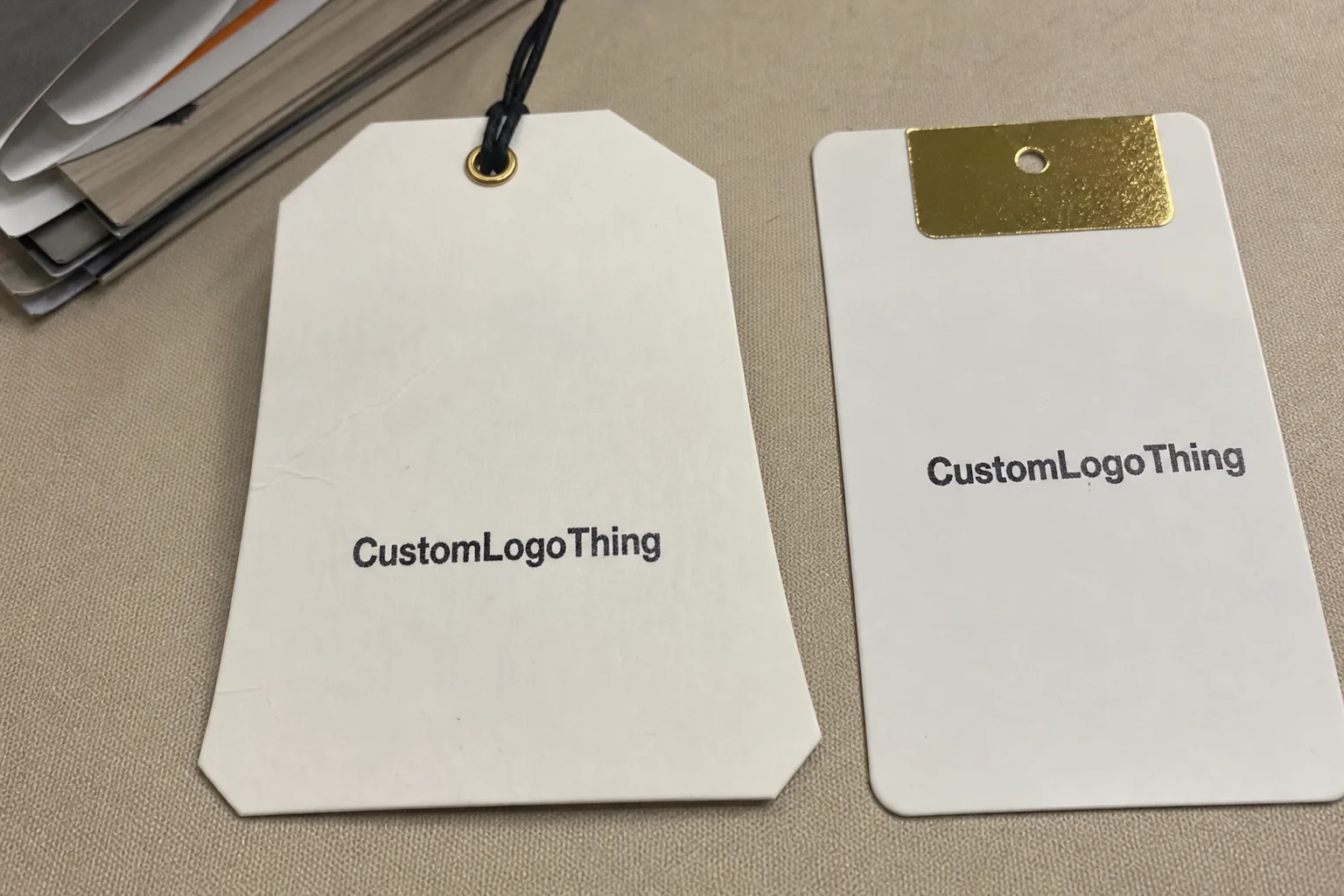
Most apparel buyers do not inspect a tag like a printer does. They hold it, glance at it, and make a quick judgment about the brand behind it. That is why printed label tags matter. They signal paper weight, color fidelity, edge quality, hole placement, and whether the branding feels intentional or added at the end.
For clothing brands, private label programs, boutiques, and promo goods, these tags identify the brand, support pricing and SKU control, add product information, and help the item sit neatly on a rack or folded display. They also pull together the rest of the package, especially if the garment uses a simple sewn-in label and the outer presentation needs more visual polish.
There is a real difference between a tag that looks printed and one that looks designed. Heavy ink coverage can make a color block feel premium, but if the stock buckles or the edges fuzz during trimming, that premium feeling disappears. Stock choice and print method matter because the artwork is only half the product.
A tag that looks cheap on the rack is usually a spec problem, not a design problem.
The useful lens is simple: decide what information the tag needs to carry, how much handling it will take, and how much brand presence it should create before the garment reaches the customer. The answer is rarely more decoration. It is usually better structure, clearer hierarchy, and fewer avoidable compromises.
How the Printing Process Works from File to Finished Tag
The production path usually starts with artwork setup and proofing. The designer sends final files, the printer checks resolution, bleed, safe zones, and die lines, then a proof confirms that layout, typography, and color placement make sense at actual size. If the tag includes barcode data, variable pricing, or SKU text, that information gets checked here too.
From there, the print method depends on quantity and finish. Digital printing is often the best choice for shorter runs, quick changes, or full-color artwork with many variables. Offset printing usually makes more sense at higher quantities where sharp detail and consistent color matter. Screen printing can work for bold spot-color jobs, while flexographic methods are common in high-volume packaging and label applications. The best method is the one that fits the run size, artwork style, and target cost.
Substrate choice affects everything downstream. Coated stocks hold bright images and crisp contrast, but some papers reflect more light than buyers expect. Uncoated stocks feel softer and more natural, though fine type can lose edge sharpness if the ink spreads. Synthetic materials add tear resistance and moisture protection, which matters if the tags will be handled often in warehouse or retail environments. For broader material and converting principles, resources from The Association for Packaging and Processing Technologies are useful because the same fundamentals apply to tag production.
Finishing is where the tag starts to feel complete. Matte or gloss coating changes the visual temperature of the piece. Varnish can help protect printed areas. Rounded corners reduce dog-earing. Hole punching and stringing affect how the tag hangs on a garment, and poor placement can make good artwork look off-center. Good printing is only half the job; the other half is building a tag that survives packing, shipping, and customer handling.
Cost, Pricing, MOQ, and What Changes the Quote
Pricing for printed label tags usually comes down to six things: quantity, size, print colors, stock, finish, and any custom cutting or attachment work. A small, single-color tag on standard cardstock is much easier to price than a multi-layer piece with foil, lamination, and custom stringing. Buyers often compare quotes only on unit price, but setup and finishing can change landed cost more than they expect.
Minimum order quantity, or MOQ, exists because setup time has to be spread across the run. A short run can be perfectly workable, but the per-unit price will usually be higher. As a rough market pattern, simple digital tags might land around $0.35-$0.85 per unit in smaller quantities, while larger offset runs with straightforward construction may drop closer to $0.12-$0.28 per unit. Specialty materials, foil, embossing, soft-touch coating, or custom shapes can move those numbers higher. Those are not fixed prices, just practical ranges that reflect how production behaves.
| Print Option | Best Fit | Typical MOQ | Relative Unit Cost | Notes |
|---|---|---|---|---|
| Digital | Short runs, frequent artwork changes, variable data | Low to moderate | Higher on small orders | Fast to set up, good for color-rich designs |
| Offset | Mid to high volumes, crisp text, consistent color | Moderate to high | Lower as quantity rises | Setup takes longer, but unit economics improve quickly |
| Screen | Bold spot colors, simple graphics | Moderate | Moderate | Strong ink coverage, limited for complex imagery |
| Specialty finish | Premium apparel, gift packaging, boutique presentation | Varies | Highest | Foil, emboss, soft-touch, or custom shapes add cost fast |
Freight, proofs, and rework also affect total cost. A quote that looks inexpensive can become expensive once shipping, split cartons, or rush handling are added. If the tag is part of a premium line or a product that will be handled heavily, a slightly better stock or clearer print may protect the brand better than the lowest bid ever could. On the sustainability side, if you need certified paper, look for FSC options rather than assuming any paper claim is enough.
Process and Turnaround: From Approval to Delivery
Turnaround starts before production does. The fastest orders are the ones where the buyer sends final artwork, exact dimensions, quantity, hole placement, stock preference, and ship-to details in one clean package. If the artwork still needs cleanup, the proof stage slows down. If the supplier has to ask basic questions about size or barcode placement, the clock keeps moving.
Proof approval is the main gate. That is where spelling errors, off-center logos, incorrect color breaks, and barcode issues should be caught. It is also where Buyers Should Check the piece at actual size, not just on a monitor. A layout that looks balanced on screen can feel cramped once printed, especially if the tag has a lot of small text or a dense back side.
Typical turnaround depends on complexity and plant load. Simple printed label tags can often move in roughly 10 to 15 business days after proof approval, while more finished or custom-shaped orders can take longer. Rush work is possible in some cases, but only if the proof is approved quickly and the finish list is not overloaded. If a project needs to hit a launch date, plan the tag order around the product calendar instead of forcing it into the last week.
For shipment planning, it helps to think in terms of the full box chain. Tags are small, but if they are part of a larger retail pack, carton timing and damage resistance matter. Distribution testing concepts from ISTA are useful here because they remind buyers to think about vibration, compression, and handling, not just the print output.
A good schedule is straightforward: file review, proof, approval, print, finish, pack, freight booking. The weak point is usually proof approval. Move that step quickly and accurately, and the rest of the schedule gets easier to manage.
Key Spec Choices That Affect Readability and Shelf Appeal
Readability starts with typography. Small type needs enough contrast and enough breathing room to stay legible under store lighting and on a crowded rack. Thin fonts are elegant on a design proof and risky on a tag. In practice, a slightly heavier weight performs better, especially if the tag includes legal copy, SKU text, or pricing. Black text on white stock is still the easiest path for clarity, but a well-printed dark field with white type can work if the ink lays down cleanly.
Size matters too. A tag that is too small can feel cramped and force the buyer to compress information, which hurts clarity. A tag that is too large can feel awkward on a light garment or overpower the product. The right dimensions depend on how much information must fit and how the item is displayed.
Paper versus synthetic is another practical decision. Paper stocks are economical and familiar, but synthetic materials offer better tear resistance and moisture tolerance. If the tag will sit in transit for a long time, get handled often, or be attached to products that may sweat, crease, or rub against other items, a synthetic or coated construction may hold up better. That does not mean paper is wrong; it just means the environment should guide the choice.
Color use can either sharpen the message or clutter the surface. Spot colors keep things controlled. Full-color imagery can be effective for lifestyle brands, but it should have a reason to exist. If the tag becomes a tiny brochure, the brand signal weakens. The best tags usually say less than the first version of the artwork wanted to say.
Finish details carry more weight than most buyers expect. Hole placement changes how the tag hangs. Rounded corners reduce wear. String length affects presentation. A soft-touch finish can feel expensive, but only if the stock and print quality support it. If you need a tag to feel polished without becoming fussy, keep the spec disciplined and let the material do the heavy lifting.
Common Mistakes When Ordering Printed Label Tags
The biggest mistake is designing for the screen instead of the shelf. On a monitor, delicate lines and small copy can look clean. Under real retail lighting, with movement, glare, and distance, those same choices can disappear. If the logo has hairline detail or the secondary text is tiny, ask whether the customer will actually read it from arm’s length. If the answer is no, simplify.
Another common problem is ignoring dielines, bleed, and safe zones. A logo placed too close to the edge can get clipped. A hole punched too near a text block can make the whole tag look off. These are basic issues, but they are the ones that create avoidable reprints. The proof should always be reviewed at actual size, and the back side should be checked just as carefully as the front.
Matching stock to product category matters more than many buyers think. A thick, rigid tag can look excellent on premium outerwear, but it can feel oversized on a lightweight tee or children’s item. A thin stock can be fine for entry-level merch, yet look underbuilt on a high-ticket garment. The tag should support the price point, not fight it.
There is also the trap of chasing the lowest unit price without looking at landed cost. Freight, proof corrections, packaging changes, and reprints can erase any savings fast. If the brand has multiple collections, inconsistent tag standards can create another issue: the line starts to look visually disconnected. Hang tags, care labels, and outer packaging should feel like they belong to the same family.
Finally, do not assume the same spec will work forever. A program that moved through a holiday capsule with no issues may need a different stock or finish for spring product, a heavier garment, or a different retail channel. Packaging should evolve with the line, not stay frozen because the previous order happened to work.
What to Do Before You Place the Next Order
Before you ask for a quote, assemble a short spec sheet. Include quantity, dimensions, print colors, stock preference, finish, attachment method, ship date, destination, and budget range. That one page saves time because it forces the key decisions out into the open. It also makes supplier quotes easier to compare because everyone is pricing the same thing.
Then gather the artwork in final form. Confirm whether the tag needs variable data, such as SKU fields, pricing, or compliance text, and decide whether that information is static or changes by batch. If the order includes a barcode, make sure the format is readable and the quiet zone is respected.
Ask for a proof review that checks spelling, logo placement, barcode readability, hole position, and overall balance. If possible, review the proof at the size the tag will actually print. That is the easiest way to catch proportion problems before they become inventory problems. A good supplier should be comfortable walking through those details with you.
Match the spec to the product line, not just the sample. A tag for a premium knit sweater should not automatically be copied onto a lightweight basics line. The product, the channel, and the price point all shape the right construction. That is where buyers get more value from printed label tags than from simply ordering the cheapest version available.
The simplest rule is also the most useful: make the order easy to print, easy to approve, and strong enough to survive the way the product will actually move through packing, shipping, and retail handling.
Frequently Asked Questions
What are printed label tags used for in clothing packaging?
They identify the brand and product while also carrying sizing, pricing, care, or SKU information. They also help a garment look finished and retail-ready before it reaches the customer.
How do printed label tags differ from woven labels?
Printed label tags are separate paper or synthetic tags attached to the garment, while woven labels are sewn into the product. Tags are better for branding, pricing, and removable retail information; woven labels are better for permanent identification.
What affects the price of printed label tags the most?
Quantity, size, print method, stock choice, finishing, and any custom die-cutting are the biggest cost drivers. Small orders usually have a higher unit cost because setup is spread over fewer pieces.
How long does production usually take for printed label tags?
Timeline depends on proof approval speed, quantity, finish complexity, and current production load. Fast approvals and simple specs move faster than highly finished or custom-shaped orders.
What should I check before approving printed label tags?
Confirm spelling, logo placement, colors, hole position, bleed, and any barcode or SKU readability. Review the proof at actual size whenever possible so layout problems are easier to catch before production.