Buyer Fit Snapshot
| Best fit | Printed Mailer Boxes Cost Per Unit projects where brand print, material claims, artwork control, MOQ, and repeat-order consistency need to be specified before quoting. |
|---|---|
| Quote inputs | Share finished size, material target, print colors, finish, packing count, annual reorder estimate, ship-to region, and any compliance wording. |
| Proofing check | Approve dieline scale, logo placement, barcode or warning zones, color tolerance, closure strength, and carton packing before bulk production. |
| Main risk | Vague material claims, crowded artwork, missing packing details, or unclear freight terms can make a low unit price expensive after revisions. |
Fast answer: Printed Mailer Boxes Cost Per Unit: Pricing Breakdown should be specified like a repeatable production item. The safest quote records material, print method, finish, artwork proof, packing count, and reorder notes in one written spec.
Production checks before approval
Compare the actual filled-product size with the drawing, then confirm tolerance on folds, seals, hang holes, label areas, and retail display edges. Reserve space for logos, QR codes, warning copy, and material claims before decorative graphics fill the panel.
Quote comparison points
Review material grade, print process, finish, sampling route, tooling charges, carton quantity, and freight assumptions side by side. A quote is only useful when the supplier can repeat the same color, closure quality, and packing count on the next order.
Printed Mailer Boxes Cost Per Unit: Pricing Breakdown - if you are buying custom mailers, the price is never just "a box price." Printed mailer boxes cost per unit changes the moment size, board grade, artwork coverage, finish, or order quantity changes. That is normal, even if it is a little annoying the first time you run into it. Packaging buyers who skip those variables often end up comparing two quotes that are not even the same product.
Most brands begin with a rough size idea and a logo file. That is not enough. Printed mailer boxes cost per unit is built from the real specification, not a mood board. A box that looks a little smaller on paper can still create more board waste, change the die layout, shift freight cube, and trigger a different production setup. You are not paying for cardboard alone. You are paying for material, print, setup, finishing, packing, and the mistakes that come from guessing instead of measuring.
From a packaging buyer's point of view, the right question is not "What is the cheapest mailer?" The better question is "What spec gives me the lowest total landed cost without hurting the product or making the brand look cheap?" That is where printed mailer boxes cost per unit becomes useful. It shows which line item is moving, which one is fixed, and which one is just dressing up the quote.
Printed Mailer Boxes Cost Per Unit: What Moves the Price First
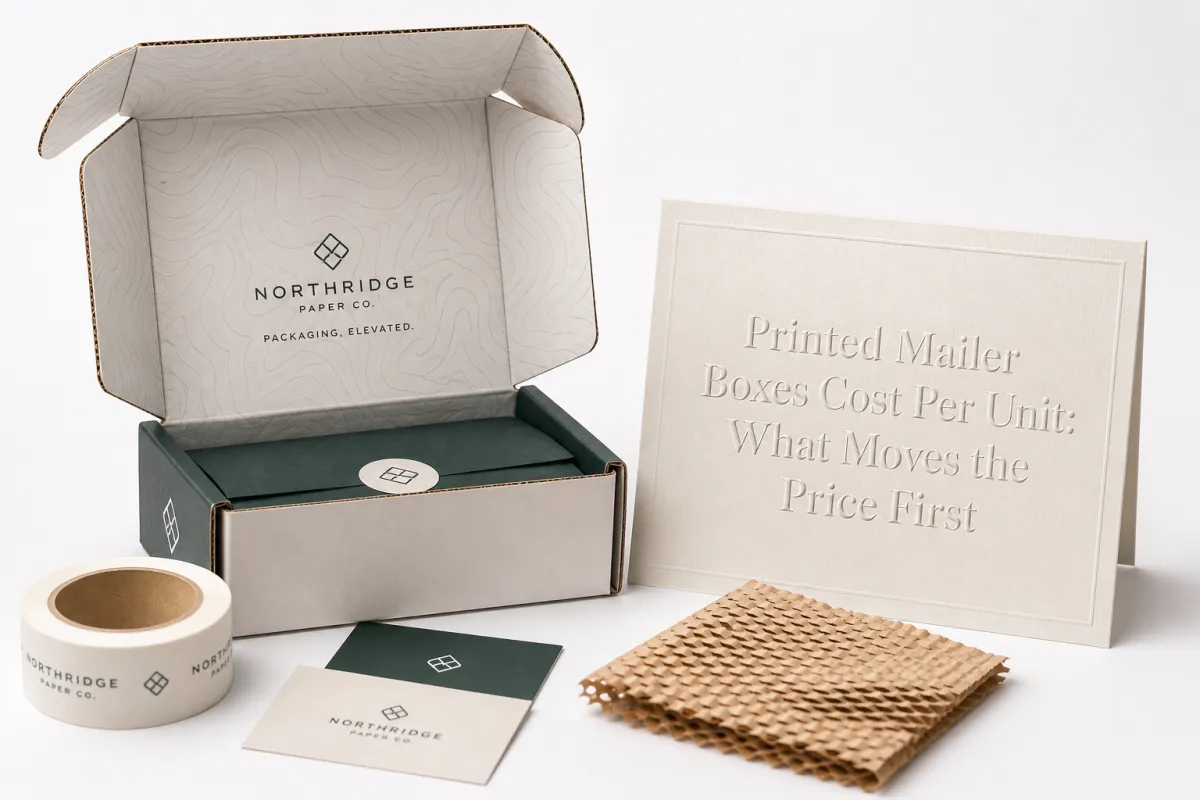
Printed mailer boxes cost per unit starts with size. A fraction of an inch matters more than most people expect. Change the length, width, or depth, and the board layout may no longer nest efficiently on the sheet. That means more waste, less output per run, and a higher unit cost. Freight cube can shift too, which changes shipping cost. A small adjustment can create three separate cost increases at once.
Board grade is the next driver. A light e-commerce mailer for apparel does not need the same crush resistance as a bottle set, candle kit, or beauty box with inserts. Standard corrugated mailers often use E-flute or B-flute, while heavier or more protective builds may move to stronger board structures. Better board costs more. So does overbuilding. Buyers ask for a premium feel, then wonder why printed mailer boxes cost per unit climbed. Thicker board is not free, and it is not a cosmetic upgrade that disappears in production.
Print coverage is another major lever. A simple one-color logo on the top panel costs less than full-bleed artwork across every face. More ink, more coverage, more setup, more attention during production. Digital print can help lower quantities launch without a huge upfront barrier, while flexographic print can be more efficient at scale. The catch is plain enough: the cheapest print method is not always the cheapest order. If the artwork is complex or the quantity is low, setup charges can dominate the quote.
Finish changes both perception and price. Matte, gloss, aqueous coating, and soft-touch each affect the final feel, but not in the same way. Aqueous coating can protect print and improve scuff resistance without turning the box into a luxury project. Soft-touch feels richer in hand, though it adds cost and usually makes sense only when the box is doing real presentation work. Buyers who want a clean quote should ask how each finish changes printed mailer boxes cost per unit rather than assuming every upgrade is a small add-on.
The cheapest-looking option is not always the cheapest order. A lower price per box can hide freight penalties, higher damage rates, or a stronger need for replacement inventory. If the box collapses in transit, the savings disappear fast. That is why printed mailer boxes cost per unit should always be read alongside product protection, shipping method, and expected handling.
I have seen buyers save a few cents on the box and then lose far more on damaged returns or repacks. That kind of math gets expensive in a hurry. The quote might look tidy on paper, but the real cost shows up after the boxes start moving through a parcel network.
Printed Mailer Boxes Cost Per Unit: Product Details Buyers Miss
Printed mailer boxes cost per unit also depends on the style of mailer. A roll-end front tuck box uses board efficiently and gives a clean presentation, which is why it is common for retail-ready shipments and subscription products. A literature mailer or literature-style corrugated mailer can offer different closure behavior or stacking performance. The structure itself changes material use, die complexity, and finishing time. Same logo. Different box. Different cost.
Buyers often overlook closure details. Dust flaps, interlocking tabs, and tuck strength matter more than most design decks admit. If the mailer will move through parcel networks, the closure has to survive vibration, compression, and repeated handling. If it is mostly a shelf presentation box, the same closure may be overkill. That is one reason printed mailer boxes cost per unit can vary even when the outer size looks identical. The structure is doing different work.
Inside printing is another decision that changes the quote. One-color inside ink is often enough for a clean branded reveal. Full inside graphics cost more and are only worth it when the unboxing moment justifies the spend. I would rather see a buyer spend extra money on board quality than on decorative ink that never protects the product. That is not the glamorous answer, but it is the one that keeps returns down and margins healthier. In practice, printed mailer boxes cost per unit should reflect real use, not just brand wish list items.
Finish options also have practical value beyond appearance. Matte can hide scuffs better. Gloss can pop under retail lighting. Soft-touch feels premium but tends to show handling marks in the wrong conditions unless the coating and print are well matched. Aqueous coating is the workhorse choice for many mailers because it gives a cleaner surface without the same cost lift as specialty laminations. The point is not to guess; the point is to line up function with budget so printed mailer boxes cost per unit stays where it should.
Two more details get missed often. First, whether the box ships flat or pre-assembled changes packing labor and freight volume. Second, whether inserts or partitions are needed can change both unit price and assembly time. If your product slides around, rattles, or scratches during transit, the "cheap" box turns expensive very quickly. If you are comparing options, use the same spec every time and ask how each version changes printed mailer boxes cost per unit before you accept a quote.
Specifications That Lock In Strength, Print, and Fit
Before asking for pricing, collect the core spec. Printed mailer boxes cost per unit becomes far more accurate when the supplier has internal dimensions, board thickness, flute type, print sides, and the shipping format. If you only send the outside size, the quote may look fast, but it will not be trustworthy. Measure the product first, then add the clearance needed for cushioning, inserts, and hand packing.
Product weight matters. A light T-shirt box and a fragile glass item are not the same project, even if the footprint looks similar. A heavier item may need stronger crush resistance, a tighter board spec, or a different closure geometry. That changes material use and often changes setup as well. Plainly put, better protection raises printed mailer boxes cost per unit, but the alternative may be breakage, chargebacks, or a damaged brand impression.
The tradeoff between presentation and structure is real. A thicker board can feel more premium in hand and protect the contents better, but it also increases material cost and shipping weight. If the product is going through parcel carriers, that extra weight can hit the freight bill too. If the product is going straight to retail shelves, presentation may matter more. There is no universal answer. There is only the spec that fits the channel. That is why a responsible quote for printed mailer boxes cost per unit always asks what the box is supposed to do after it leaves the plant.
Inserts and cutouts deserve their own conversation. A simple die-cut insert can stabilize a product beautifully, but it also adds tooling, assembly, and sometimes higher board usage. Partitions help with multi-pack orders, sample kits, and gift sets, yet they make packing slower. If the box includes nested components, the quoted printed mailer boxes cost per unit should reflect that extra labor, not hide it.
For buyers who need a broader packaging mix, it helps to compare this format with other Custom Packaging Products and, when the order needs simpler shipping pouches instead of rigid presentation boxes, with Custom Poly Mailers. A smart packaging program is not one box type. It is the right structure for the right job. That keeps printed mailer boxes cost per unit from being inflated by features you do not actually need.
Two standards are useful here. For transit performance, many suppliers reference parcel testing approaches tied to ISTA protocols. For responsible sourcing, FSC certification is a practical signal that the board is coming from managed forests and controlled supply chains. Not every order needs every credential, but Buyers Should Know what they are paying for. If a quote mentions testing or certification, ask how it changes printed mailer boxes cost per unit and whether that cost is actually relevant to your product.
I usually tell teams to separate "nice to have" from "must survive shipping." That split keeps the spec honest. Otherwise, the box gets loaded up with extras that look good in a meeting and do almost nothing in transit.
Printed Mailer Boxes Cost Per Unit, MOQ, and Quote Logic
Printed mailer boxes cost per unit is heavily shaped by MOQ. Minimum order quantity is not a random number a supplier throws at you for fun. It exists because setup costs do not shrink just because the run is small. Plates, die cutting, press setup, make-ready waste, and packing all need to be paid for. When quantity is low, those fixed costs get spread across fewer boxes, so the unit cost rises. That is basic math, not supplier attitude.
Here is a simple way to think about the pricing ladder. Sample runs and prototypes are the most expensive per piece because they absorb the full force of setup charges. Low-volume launch orders improve the unit price, but they still carry a premium. Mid-size replenishment runs usually land in the sweet spot for many brands. Larger production batches bring clearer bulk pricing, lower cost per piece, and better efficiency across the line. That pattern holds for most printed mailer boxes cost per unit calculations, though exact numbers still depend on size and finish.
| Order band | Typical unit price range | What drives the price | Best use case |
|---|---|---|---|
| Prototype / sample | $1.50 - $4.00 per unit | Full setup charges, one-off production, minimal run efficiency | Fit checks, artwork review, pre-launch approval |
| Low volume launch | $0.85 - $2.10 per unit | MOQ pressure, partial setup recovery, moderate print coverage | Small product drops, test launches, early ecommerce runs |
| Mid-volume production | $0.42 - $1.10 per unit | Better material efficiency, lower setup impact, steadier press time | Repeat orders, seasonal programs, steady replenishment |
| High volume bulk pricing | $0.22 - $0.75 per unit | Stronger run efficiency, lower cost per piece, less waste per unit | Established brands, larger inventory buys, retail rollout |
Those ranges are not a promise. They are a reality check. A compact apparel mailer with simple one-color print will price differently from a large, full-bleed mailer with coating and inserts. Freight also matters. A quote that ignores delivery to your warehouse is not a landed cost; it is a headline number. The better approach is to ask for pricing that includes tooling fees, setup charges, and freight so you can compare apples to apples. That is the only sane way to judge printed mailer boxes cost per unit.
If the quote looks cheap, check the board spec and freight line first. Most surprises hide there, not in the pretty PDF.
Good quote logic starts with accurate inputs. Exact size. Exact quantity. Print sides. Finish. Delivery location. Target ship date. Product weight if available. If any of those are fuzzy, the supplier will protect themselves with a wider price band. A vague request for printed mailer boxes cost per unit usually gets you a vague answer. A precise brief gets you a real one.
One more thing: a lower MOQ can help with testing, but it may not be the smartest long-term plan. If the box is going to be a repeat seller, it can be cheaper to place a slightly larger order, lower the unit price, and avoid multiple small reorders. That tradeoff is where many buying decisions live. Shorter cash outlay today versus lower printed mailer boxes cost per unit over the full program. Sometimes the cheapest move is the one that feels a bit boring up front.
Process, Timeline, and Lead Time From File to Freight
The production path is straightforward, but only if the files are clean. Printed mailer boxes cost per unit does not exist in isolation from lead time. First comes briefing and spec confirmation. Then the dieline is checked. Artwork is set up. Proofs are reviewed. Only after approval does production begin. After that come printing, finishing, packing, and dispatch. Every step matters because a delay in one place can make the whole order late.
Most time gets lost in the same few places. Missing artwork specs are a classic problem. Late proof changes are another. So is a buyer who approves size by email, then changes the product dimension after the dieline has already been built. That kind of back-and-forth pushes production back and usually nudges printed mailer boxes cost per unit upward because the supplier has to spend more time on revisions or remake tools.
For a basic custom mailer with standard print and no unusual finishes, a practical lead time is often around 12-15 business days after proof approval. More complex jobs, special coatings, inserts, or tight schedules can stretch longer. Rush work is possible sometimes, but it usually costs more. If the order needs a physical sample before mass production, add time for sampling and approval. That delay is often worth it when the item is fragile, expensive, or being shipped retail-ready. A small amount of caution can save a lot of rework, and rework is the silent tax on printed mailer boxes cost per unit.
Shipping and receiving matter more than buyers think. If your inventory window is narrow, you need to know when the boxes leave the plant and when they hit your dock. If you are launching a new SKU, late packaging can hold up photography, fulfillment, or retail placement. I always tell buyers to give the packaging schedule the same respect they give the product schedule. The box is part of the launch, not a footnote. That mindset keeps printed mailer boxes cost per unit aligned with actual business timing.
There is also a practical reason to sample. A one-off sample lets you check fit, crush behavior, closure strength, and print legibility before you commit to volume. If the box has to survive parcel handling, a transit-style test based on ISTA methods is worth discussing. If the finish or sourced board matters to your brand story, ask for the certification details before approval. Nobody wants to discover a structural problem after 8,000 pieces are already printed. That is an expensive lesson, and it usually starts with someone assuming printed mailer boxes cost per unit was the only number that mattered.
Why Choose Us for Printed Mailer Boxes
Printed mailer boxes cost per unit should come with a clear explanation, not a vague promise and a nice smile. Custom Logo Things focuses on practical packaging decisions: clean specs, honest quote structure, and fewer surprises during approval. If a buyer needs a box that looks good and behaves properly in transit, the quote has to reflect actual use. That means we look at size, board choice, print coverage, finish, and shipping before talking about price.
Strong packaging guidance matters because many buyers overspend by accident. They ask for a premium finish when a cleaner print treatment would do the job. They choose heavier board than the product needs. They approve extra inside graphics that add cost but do not improve protection. Good support catches those issues early. That is how printed mailer boxes cost per unit stays under control without turning the box into a compromise.
We also know that communication affects cost. If a dieline is wrong, proof cycles multiply. If the artwork file is unclear, production slows down. If the buyer wants a box to do five jobs at once, the spec starts to drift. Clear feedback avoids reprints and unnecessary setup charges. That is not glamorous, but it is exactly how a packaging program stays profitable. A clean approval process is often the cheapest part of printed mailer boxes cost per unit.
For buyers who need packaging across several formats, it helps to work with a team that can keep the logic consistent across product lines. A subscription brand may need printed mailers for one program and Custom Poly Mailers for another. A retail brand may pair presentation mailers with cartons or inserts from Custom Packaging Products. The point is consistency. If the spec is managed well, the pricing conversation gets easier and printed mailer boxes cost per unit becomes a predictable part of the budget instead of a surprise line item.
We are also realistic about volume. Some buyers are launching. Others are reordering at scale. Both matter. A startup does not need the same buying playbook as a brand moving pallets every month. The right answer is not always the biggest run. It is the run that fits the forecast, storage space, and sales cycle. That is the kind of advice that keeps printed mailer boxes cost per unit tied to business reality instead of wishful thinking.
And if a project needs a hard answer rather than a polite maybe, that is fine too. A good packaging quote should tell you where the cost sits, what can be trimmed, and what should stay put. No mystery, no fluff, just a box spec that matches the job.
Next Steps to Get an Accurate Unit Price
If you want a fast quote, send the real spec. Printed mailer boxes cost per unit becomes much easier to pin down when you provide internal dimensions, quantity, artwork file, finish preference, board preference, and destination ZIP code or country. If you know product weight, include that too. If you have a deadline, say it plainly. Guessing saves no one time.
- Internal dimensions of the product or target box
- Quantity needed for the first run and any repeat run estimate
- Artwork file or at least a clear mockup
- Print coverage details: outside only, inside only, or both
- Board preference, flute type, or any required strength target
- Finish preference: matte, gloss, aqueous, or soft-touch
- Delivery location and target ship date
If the item is unusual, fragile, or retail-ready, ask for a sample first. That is the conservative move, and it is usually the smart one. A sample can expose fit issues, print placement problems, or closure weakness before you spend money on volume. The sample cost may make printed mailer boxes cost per unit look higher in the short term, but it often protects the bigger order from avoidable waste.
It also helps to request two quote scenarios. One lean version. One upgraded version. Maybe the lean version uses simpler print and standard coating. Maybe the premium version adds inside print or a softer finish. Seeing both side by side shows where printed mailer boxes cost per unit actually moves. More often than not, the biggest difference comes from print coverage, board grade, and order quantity rather than the logo itself.
Use printed mailer boxes cost per unit as the benchmark when reviewing any proposal. If the quote does not show the spec, the quantity, the setup charges, and the freight clearly, it is not a clean proposal. Match the box to the product, match the quantity to the forecast, and match the delivery plan to the launch. That is how you keep the price honest and avoid paying for cardboard theater.
What is the average printed mailer box unit price for a small order?
Small orders usually carry the highest unit cost because setup is spread over fewer boxes. The exact number depends on size, board, print coverage, and whether you need coating or inserts. A real quote needs your finished dimensions and quantity, not a rough guess. For many small runs, printed mailer boxes cost per unit ends up noticeably higher than buyers expect, which is why sample pricing and launch pricing should be treated separately.
How does MOQ affect printed mailer boxes cost per unit?
Lower MOQ almost always means a higher unit price. That is normal: the press setup, die cutting, and finishing costs do not shrink just because the run is smaller. Once volume rises, the price per box usually drops in clearer steps. In practice, printed mailer boxes cost per unit improves as you spread fixed setup charges across more units.
Do full-color graphics raise the price more than one-color printing?
Usually yes, especially when the design covers most of the outer surface. Coverage, ink density, and the chosen print method matter as much as color count. A simple design can still look premium without pushing the quote as hard. When comparing options, ask exactly how artwork coverage changes printed mailer boxes cost per unit so you are not guessing based on color alone.
What details should I send to get a fast quote?
Send internal dimensions, quantity, artwork, finish preference, and product weight if you know it. Add delivery location and deadline so the supplier can include freight and lead time correctly. A dieline or sample image helps avoid back-and-forth. The more accurate the spec, the cleaner the printed mailer boxes cost per unit estimate will be.
How long does it take to produce custom printed mailer boxes?
Timeline depends on proof approval, production load, and whether you need a sample first. Simple jobs move faster than complex boxes with special coatings or inserts. The cleanest way to protect your schedule is to approve artwork and specs early. That keeps printed mailer boxes cost per unit from being distorted by rush handling and last-minute changes.
Bottom line: printed mailer boxes cost per unit is not one number, and anybody pretending otherwise is selling you a shortcut. Size, board, print coverage, finish, MOQ, setup charges, and freight all shape the final answer. Give the supplier the real spec, compare the landed cost, and choose the box that protects the product while still looking like it belongs in your brand. That is the benchmark that matters, and that is how you judge printed mailer boxes cost per unit without getting fooled by a pretty headline price. If you need one practical rule to keep in mind, make it this: start with the product, not the box, and the pricing usually settles into place a lot faster.

