Buyer Fit Snapshot
| Best fit | printed matte lamination boxes for premium branding for packaging buyers comparing material specs, print proof, MOQ, unit cost, freight, and repeat-order risk where brand print, material, artwork control, and repeat-order consistency matter. |
|---|---|
| Quote inputs | Share finished size, material target, print colors, finish, packing count, annual reorder estimate, and delivery region. |
| Proofing check | Approve dieline scale, logo placement, barcode or warning zones, color tolerance, and any recyclable or compostable wording before bulk production. |
| Main risk | Vague material claims, crowded artwork, or missing packing details can create delays even when the unit price looks attractive. |
Fast answer: Printed Matte Lamination Boxes for Premium Branding should be specified like a repeatable production item. The safest quote includes material, print method, finish, artwork proof, carton packing, and reorder notes in one written spec.
What to confirm before approving the packaging proof
Check the product dimensions against the actual filled item, not only the sales mockup. Ask for tolerance on folds, seals, hang holes, label areas, and retail display edges. If the package carries a logo, QR code, warning copy, or legal claim, reserve that space before decorative graphics fill the panel.
How to compare quotes without losing quality
Compare board or film grade, print process, finish, sampling route, tooling charges, carton quantity, and freight assumptions side by side. A lower quote is only useful if the supplier can repeat the same color, closure quality, and packing count on the next order.
Two cartons can come off the same press and land in two very different places in a buyer’s head. One feels forgettable. The other feels considered. That gap is where printed matte lamination boxes earn their keep. They soften the surface, kill the glare, and make the package look like somebody gave a damn before sending it into the world.
Custom Logo Things treats finish choices like part of the product, not decoration tacked on by committee after the fact. Good. That is how it should be. Matte lamination changes how a box reads under retail lights, how it survives handling, and how fast a customer decides the package feels premium or cheap. printed matte lamination boxes sit right in that awkward little space between branding and production, which is exactly why they matter.
What Printed Matte Lamination Boxes Actually Change
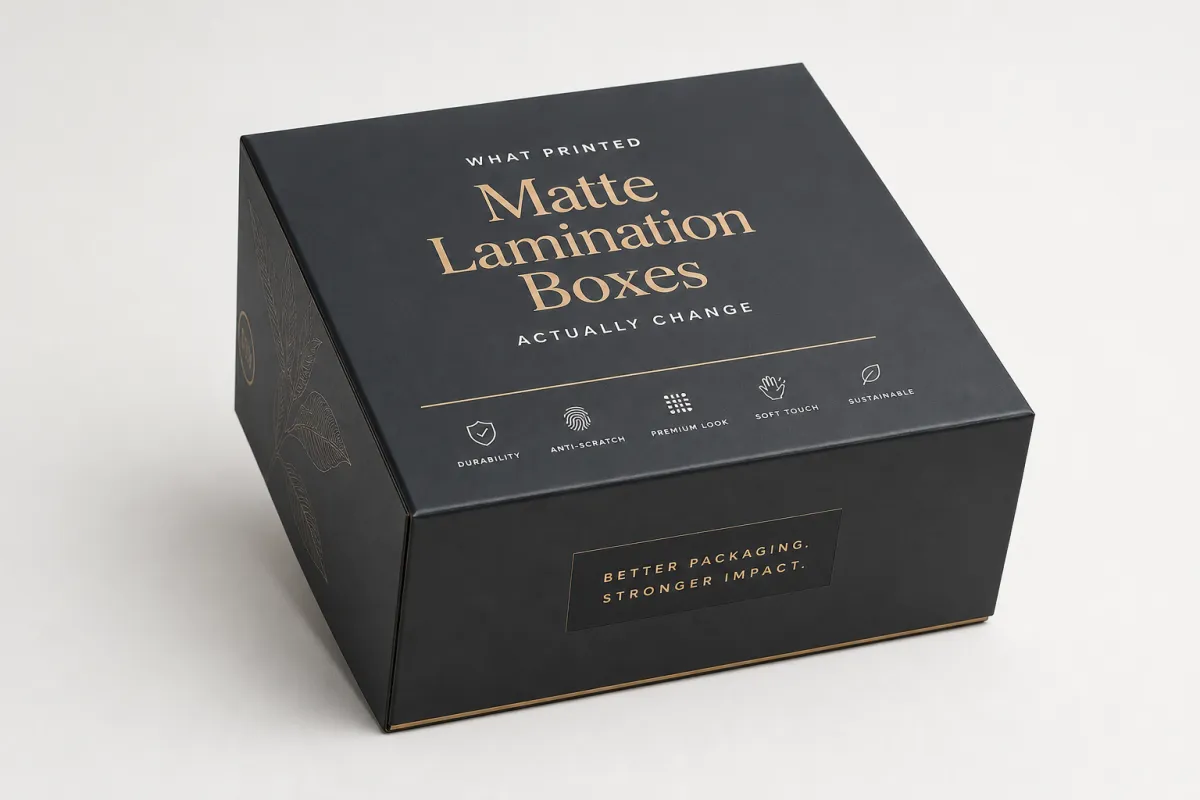
Put the same carton under a bright shelf light in gloss and in matte. The gloss version throws reflections everywhere and starts fighting the product for attention. The matte version behaves differently. It settles down. Color looks deeper. Type looks cleaner. The box stops shouting and starts looking expensive without trying too hard. That is the whole point of printed matte lamination boxes.
The process is straightforward enough to explain without packaging jargon taking over. The box is printed first. Then a matte laminate is applied over the printed sheet. That outer layer changes the sheen, the tactile feel, and the way the ink is perceived. Gloss reflects more light. Matte diffuses it. The eye gets less glare and more information. The hand gets less slip and more substance. For a lot of brands, printed matte lamination boxes feel more deliberate the moment they leave the pressroom.
Readability improves, too. A matte surface cuts reflections, which helps logos, ingredient copy, and product names stay legible under ugly store lighting. That sounds minor until you remember how people shop. They scan. They compare. They pick up one box, then another, then walk away because the shelf is a mess. If the finish is fighting the light, the box loses. printed matte lamination boxes give the message a cleaner shot at that first glance.
Gloss still has a job. Some products need sparkle. Some need color punch. Some need the louder shelf presence that gloss naturally gives. Matte is better for restraint, quiet luxury, cleaner beauty branding, and modern packaging that does not beg for attention. Neither finish is universally correct. The right choice depends on the category, the price point, and the story the package needs to tell. That is why experienced buyers treat printed matte lamination boxes as both a visual decision and a manufacturing decision.
A matte box rarely wins by being loud. It wins by making the product look more controlled, more expensive, and more intentional than the material cost suggests.
If your team is still deciding between finishes, look at the whole carton system, not just the surface. Board selection, structure, and print treatment all affect the final result. A weak board stays weak, even in matte. For buyers comparing options, the smarter starting point is often the broader lineup of Custom Packaging Products rather than the finish by itself.
How Printed Matte Lamination Boxes Are Made
The production flow for printed matte lamination boxes looks simple on a spec sheet. In practice, every step leaves fingerprints on the final box. It usually starts with dielines and artwork prep. Once the structure is locked, the design is laid out to match the panel sizes, bleed, and fold allowances. The sheet is printed, typically in CMYK, with spot colors added when brand standards demand tighter color control. Then the laminate goes on. Then die cutting, creasing, folding, and assembly follow.
The matte film or sheet is applied after printing under heat and pressure. That layer does more than flatten the shine. It protects the print from light abrasion, handling marks, and fingerprints. On a carton that gets stacked, shipped, and touched by everyone from warehouse staff to retail associates, that protection matters. A box that starts crisp should not look tired before it reaches a customer. In that sense, printed matte lamination boxes are not just finished boxes. They are packed with a little more defense built in.
Board choice changes the outcome more than most buyers expect. Folding carton board, SBS, and coated stocks all react differently under matte lamination. A smooth, well-calendered sheet usually gives a cleaner finish. A rougher sheet can show texture through the laminate, which can look premium in some luxury categories and distracting in others. Ask for a sample on the exact board grade you plan to run. A random substitute proves very little. That matters even more for printed matte lamination boxes that rely on sharp type and fine line work.
Matte and soft-touch are related, but they are not twins. Standard matte lowers shine and gives the surface a flatter appearance. Soft-touch adds a velvety feel that many high-end cosmetics and gift boxes use because people like touching things that feel expensive. Naturally. Soft-touch costs more and can behave differently in handling and shipping. If the brief calls for elegance without drama, standard matte usually does the job. If the brief wants tactile theater, soft-touch may be worth the added cost. Both can be used on printed matte lamination boxes, but they do different work.
Durability testing should stay in the conversation. Transit standards such as ISTA help teams check whether the structure and finish can survive compression, vibration, and drop conditions. Lamination helps. It does not fix bad engineering. A nice box still needs the right board thickness, the right glue pattern, and the right die-cut tolerances.
Printed Matte Lamination Boxes: Key Design Factors
Designing printed matte lamination boxes starts with a useful question: what happens to the artwork once the shine is gone? Usually, everything gets calmer. Blues look richer. Black reads deeper. Neutral colors start feeling more architectural. Busy layouts, on the other hand, can go flat fast because matte removes some of the sparkle that helps crowded designs hide their own chaos. The layout needs room to breathe. Otherwise the whole thing starts looking like it was squeezed through a bad meeting.
Typography deserves extra attention. Thin type, especially reversed out of dark backgrounds, can lose crispness if the layout is packed too tightly or the file quality is weak. Matte does not ruin good typography. It exposes lazy typography. Logos with tight letter spacing, small legal copy, or subtle brand marks should be tested under print conditions before a full run of printed matte lamination boxes gets approved. What looks sharp on a screen can soften once the laminate is on it.
Structure matters just as much as graphics. A two-piece rigid box, a tuck-end carton, and a sleeve all create different visual rhythms. A larger front panel gives matte more room to carry the design. A smaller carton may need stronger hierarchy, more contrast, or a finish accent such as foil stamping or spot UV. Those details should support the finish instead of crowding it. Done well, a box uses lamination as part of the story structure. That is where printed matte lamination boxes stop being ordinary.
The product category changes the design rules. Beauty and skincare usually want softness, white space, and a restrained palette. Electronics need clarity and precision. Apparel can sit somewhere in the middle, especially for gift sets or subscription kits. A premium tea brand may lean into quiet natural tones. A luxury candle brand might prefer darker matte panels with a small emboss and a foil detail. Same finish. Different personality. That is packaging for you.
Proofing is where a lot of teams get careless. Digital mockups are useful, but they lie by omission. They do not show how matte changes the actual color, surface reflectivity, or handling. A physical sample does. It also shows how the box behaves in a warehouse, in a studio, and under rough retail lighting. For printed matte lamination boxes, that sample often saves everyone from a very expensive lesson. I have seen more than one “great” design fall apart on paper because nobody checked it on the actual stock. Kinda embarrassing, honestly.
Good matte packaging does not lean on effects to feel premium. It leans on proportion, print discipline, and a finish that knows when to stay quiet.
If the packaging program needs a broader sustainability story, sourcing belongs in the conversation too. FSC-certified paper can strengthen the claim, as long as the documentation is real and the sourcing is accurate. Brands that care about certified paper can review guidance from the FSC and then decide how the finish fits the larger material plan. One pretty box does not cover for sloppy sourcing.
What Printed Matte Lamination Boxes Cost and Why
Pricing for printed matte lamination boxes usually comes down to five things: board grade, box size, print coverage, quantity, and finishing complexity. Shipping weight can matter too, especially on bigger cartons or longer freight lanes. A small change in board thickness may look harmless on paper, then turn into a cost shift in packing density, transit performance, and freight charges. Quotes need the full structure, not just a finish request scribbled in the corner.
As a rough range, a standard matte lamination on a mid-volume folding carton may add about $0.03-$0.08 per unit on runs around 5,000 pieces, depending on sheet size and coverage. Soft-touch usually costs more. Spot UV over matte can add another layer of expense because it needs extra setup and tighter register control. If the project includes embossing or foil stamping, the total climbs fast. For printed matte lamination boxes, the base number often looks modest until the finishing stack gets built out.
Small runs work differently. Setup charges do not shrink just because the order is smaller. That means a 500-unit run can carry a much higher per-unit rate than a 5,000-unit run, even if the box design never changes. People who compare only the unit price usually miss the shape of the cost curve. The quote can still be fair. The economics are just being driven by fixed work: plates, die creation, press setup, lamination setup, and finishing setup. For printed matte lamination boxes, volume matters more than people want it to.
| Finish Option | Visual Effect | Typical Use | Approx. Added Cost at Mid-Volume |
|---|---|---|---|
| Standard matte lamination | Low sheen, soft contrast, clean print surface | Beauty, wellness, apparel, gift packaging | $0.03-$0.08 per unit |
| Soft-touch matte | Velvety feel, deeper tactile premium cue | Luxury gifts, cosmetics, high-end retail | $0.05-$0.12 per unit |
| Matte with spot UV | Contrast between flat surface and gloss highlights | Logos, patterns, special retail moments | $0.06-$0.15 per unit |
| Matte with foil stamping | Metallic accent against muted background | Premium launches, limited editions | $0.07-$0.18 per unit |
That table gives a starting point, not a promise. The real quote changes with the box style, board thickness, ink coverage, and how much of the sheet is actually being printed. A plain white carton with a small logo behaves differently from a full-coverage box with heavy ink on both sides. A simple tuck box is not the same animal as a Custom Rigid Setup. printed matte lamination boxes get priced by the whole production system, not by one finish line in a purchase order.
Good buyers ask for a line-item breakdown. It shows how much is going into board, print, lamination, die cutting, glue, inserts, and freight. That level of detail makes it easier to compare proposals without guessing where the money went. It also helps teams decide whether a premium finish actually pays back. If the carton is tied to a retail launch, the investment can make sense through better shelf presence and fewer damage claims. If the product margin is thin, a simpler build may be the smarter call. Either way, the quote should tell the full story of printed matte lamination boxes.
Printed Matte Lamination Boxes: Process and Timeline
A realistic timeline for printed matte lamination boxes starts with dielines and artwork approval. Once the structure is locked, prepress checks the bleed, panel alignment, barcodes, and small text. If the project needs a custom insert, a changed closure, or special print effects, those choices should be settled before plates or dies are ordered. A lot of schedule trouble comes from moving targets. Packaging teams love moving targets right up until they miss a ship date.
From approved proof to finished cartons, a simple run may take 12-15 business days. More complex projects can stretch to 18-25 business days, especially if they include multiple proof rounds, specialty coatings, or imported materials. Freight adds its own clock. Ground shipping may be predictable. Cross-country or international transit is not. Build that time into the plan and treat it like real time, not wishful thinking. For printed matte lamination boxes, the calendar is part of the spec.
Color approval can slow things down too. A buyer may sign off on a digital proof in a hurry, then ask for a press proof, then want one more tweak after the first physical sample lands on the desk. That is normal. It is also why launch planning needs breathing room. If the boxes support a seasonal drop, a retailer meeting, or a subscription ship date, the packaging deadline should move earlier, not sit five minutes from disaster. Nobody wants finished printed matte lamination boxes stacked in a warehouse while the product has already launched.
Approvals need to be locked before the press line starts. That includes dimensions, artwork, finish choice, and any extras such as embossing, foil stamping, or spot UV. Once production begins, changes get expensive fast. A revision that looks tiny on a screen can trigger new plates, a new die cut, or a full rerun of the printed sheet. Solid project control avoids that waste and keeps the job from becoming a case study in avoidable pain.
A practical way to plan is to work backward from the ship date and leave one extra checkpoint for sampling. That gives the team room to fix one surprise without blowing up the whole schedule. The most reliable printed matte lamination boxes projects are the ones that treat timing risk as normal, because it is.
Common Mistakes With Printed Matte Lamination Boxes
The first mistake is assuming matte works for every brand story. It does not. Some products need gloss because they depend on sparkle, color punch, or a louder shelf presence. Others need contrast from metallic ink or a reflective accent. If the product is playful or youthful, a flat matte carton can feel too restrained. printed matte lamination boxes work best when the brand wants composure, not noise.
The second mistake is expecting the finish to rescue weak artwork. It will not. Thin type, low-contrast logos, and crowded layouts tend to suffer more under matte because the surface removes visual drama instead of adding it. If the design is already cluttered, the box can look less expensive rather than more. The better move is to simplify hierarchy, strengthen contrast, and keep the key message large enough to read in natural store lighting. Plenty of disappointing printed matte lamination boxes start as crowded designs, not bad finishes.
Third, some buyers under-spec the board. A beautiful finish on flimsy material still fails in transit, fulfillment, or retail handling. That matters even more for heavier products like candles, supplements in glass, or electronics accessories with inserts. The board needs to support the closure, the fill weight, and the handling it will face. If the carton bows, scuffs, or crushes, the matte layer cannot hide it. Strong printed matte lamination boxes begin with the right substrate.
Fourth, skipping samples is a bad habit. A screen mockup cannot show how matte behaves under warm retail lighting or how it shifts a dark brand color. A physical sample can. It also reveals whether a logo sits too close to a fold or whether a detail gets dulled by the finish. Serious packaging teams ask for at least one sample round before committing to volume. That sample is cheaper than a warehouse full of wrong printed matte lamination boxes.
Fifth, piling on premium effects without a strategy wastes money. Foil stamping, embossing, spot UV, and custom inserts all have a place. Each one needs a job. If the box already communicates value through structure and print discipline, extra effects can muddy the message. There is a difference between purposeful finish work and decoration for its own sake. Buyers who keep that distinction in mind usually get better results from printed matte lamination boxes.
The packaging world has a habit of rewarding restraint. That does not mean boring. It means every choice needs a reason to exist. A matte carton with a strong board, clean graphics, and one well-placed accent often beats a louder design with five competing effects. That judgment is what separates effective printed matte lamination boxes from merely expensive ones.
Expert Tips and Next Steps for Printed Matte Lamination Boxes
Start with a sample board or a short run. That is the easiest way to see how printed matte lamination boxes look and feel once real materials meet real light. A sample also shows whether the matte level is too flat, too warm, or too dull for the product category. Skincare often does better with a subtle finish. A luxury gift box may need a deeper matte with foil stamping to create the right contrast. Different goals. Different answers.
Match the finish to the price point. A wellness brand selling a modestly priced product does not need the same tactile treatment as a high-end candle line or a premium beauty set. That does not mean the lower-priced item should look cheap. It means the finish should support the economics. printed matte lamination boxes should fit the margin structure and the customer expectation, not mimic a category with a different price ladder.
Ask for a written quote breakdown. A useful estimate should separate print, board, lamination, die cutting, glue, inserts, and freight so you can see where the money is going. That makes it easier to compare vendors and decide whether extras like spot UV, embossing, or foil stamping are worth it. It also helps if the team has to defend the budget internally. Clear numbers make approval less painful, which is a rare gift. printed matte lamination boxes are easier to sign off on when the math is visible.
One practical way to move forward is to work through the project in this order:
- Confirm final box dimensions and product weight.
- Lock artwork and dielines before prepress.
- Choose the board stock and matte finish level.
- Request a sample or proof on the actual material.
- Set the production window with freight buffer built in.
That sequence cuts rework and keeps the brand team and packaging team pointed in the same direction. The best printed matte lamination boxes do more than look polished. They protect the product, support the sale, and communicate value without making a scene. That is the kind of packaging that earns its cost in perception, shelf presence, and fewer production surprises.
For brands comparing structural options before they finalize finish, the smartest move is to review the whole packaging system and pick the build that fits the product, the budget, and the launch calendar. printed matte lamination boxes can be understated or dramatic, but they work best when print, board, and finish are planned together instead of stitched together later like a rescue mission.
If you need the cleanest path forward, use this rule: lock the structure, test the stock, approve a physical sample, then price the run. Do that in order and you will avoid most of the ugly surprises that turn a simple packaging job into a headache nobody asked for.
Are printed matte lamination boxes better than gloss for premium brands?
Matte usually reads as quieter and more refined, while gloss reads brighter and more reflective. For many premium brands, printed matte lamination boxes feel more controlled and mature, especially in categories like skincare, wellness, apparel, and gifting. Gloss still makes sense if the brand wants sparkle, stronger color pop, or a more energetic retail presence.
How durable are printed matte lamination boxes in shipping?
The laminate adds a protective layer that helps resist scuffs, fingerprints, and light abrasion. Durability still depends on board thickness, box structure, and how the product sits inside the carton. For heavier items, ask for a stronger board grade and test transit samples before committing to full production of printed matte lamination boxes.
What affects the price of printed matte lamination boxes most?
Quantity, board choice, print coverage, and finishing options usually drive the biggest price changes. Small runs often cost more per unit because setup gets spread across fewer boxes. Special effects like foil stamping, embossing, spot UV, or custom inserts can raise the total quickly on printed matte lamination boxes.
How long does it take to produce printed matte lamination boxes?
The timeline depends on artwork approval, sample checks, production complexity, and freight. Simple projects can move in roughly 12-15 business days after proof approval, while more complex custom builds may need 18-25 business days or more. Build in extra buffer if the boxes support a launch or retail deadline, because printed matte lamination boxes are easier to manage when the schedule is realistic.
Can printed matte lamination boxes be customized for different products?
Yes. Box size, structure, artwork, inserts, and finishing can all be tailored to the product. Many brands use the same matte system across multiple SKUs while changing graphics and dimensions, which keeps the line consistent without making every carton look identical. The key is to keep printed matte lamination boxes aligned with the product’s price point and the customer’s expectations.


