Buyer Fit Snapshot
| Best fit | Printed Pallet Sleeves with Logo projects where brand print, material claims, artwork control, MOQ, and repeat-order consistency need to be specified before quoting. |
|---|---|
| Quote inputs | Share finished size, material target, print colors, finish, packing count, annual reorder estimate, ship-to region, and any compliance wording. |
| Proofing check | Approve dieline scale, logo placement, barcode or warning zones, color tolerance, closure strength, and carton packing before bulk production. |
| Main risk | Vague material claims, crowded artwork, missing packing details, or unclear freight terms can make a low unit price expensive after revisions. |
Fast answer: Printed Pallet Sleeves with Logo: Material, Print, Proofing, and Reorder Risk should be specified like a repeatable production item. The safest quote records material, print method, finish, artwork proof, packing count, and reorder notes in one written spec.
Production checks before approval
Compare the actual filled-product size with the drawing, then confirm tolerance on folds, seals, hang holes, label areas, and retail display edges. Reserve space for logos, QR codes, warning copy, and material claims before decorative graphics fill the panel.
Quote comparison points
Review material grade, print process, finish, sampling route, tooling charges, carton quantity, and freight assumptions side by side. A quote is only useful when the supplier can repeat the same color, closure quality, and packing count on the next order.
A pallet can roll into a dock looking like anonymous freight, all stretch wrap and barcodes and nobody quite sure what is what, until Printed Pallet Sleeves with logo give the load a clear identity that can be read in a glance. That change might seem modest on paper, but on a busy receiving floor it can mean faster sorting, cleaner retail presentation, fewer misroutes, and less time spent hunting for the one pallet that got parked in the wrong lane.
From the packaging side of the warehouse, I think of printed pallet sleeves with logo as a meeting point between logistics and presentation, and that balance is exactly why they get used in so many different programs. They do more than carry a brand mark. They can identify product families, call out handling notes, help crews separate mixed shipments, and make a stacked pallet look planned rather than improvised.
Printed Pallet Sleeves With Logo: What They Are
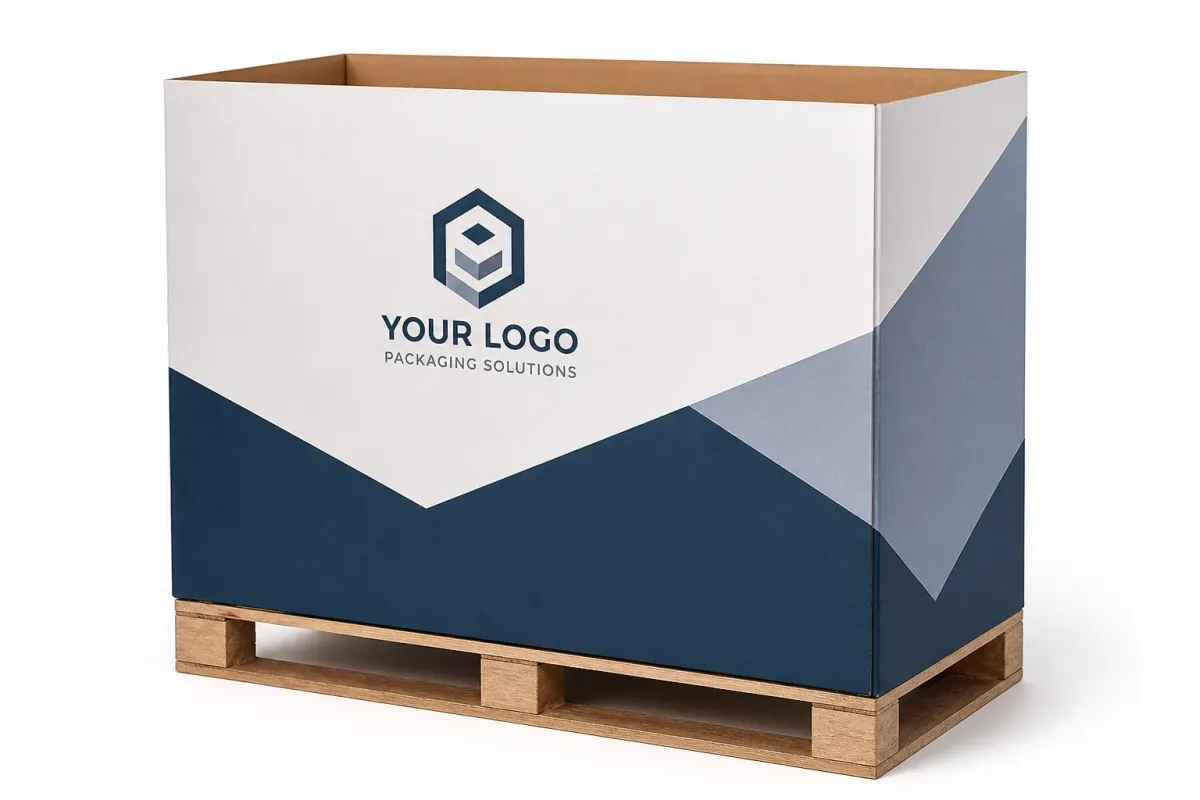
At the simplest level, printed pallet sleeves with logo are printed corrugated or paperboard wraps that fit around a palletized load. They are usually die-cut and scored so they fold around one visible face or around the full perimeter of the stack, then stay aligned while the pallet moves through staging, transport, and receiving. The construction can be lightweight paperboard for display-heavy programs or a stronger corrugated build for tougher distribution lanes, and the right choice depends on the pallet, not just the artwork.
On a warehouse floor, a plain stretch-wrapped pallet often looks like every other pallet in the building. Once printed pallet sleeves with logo are added, that same load becomes easier to identify, easier to route, and easier to present to the end customer. Club-store programs use them because the front panel of the pallet can function like a billboard. Seasonal promotions use them because the graphics can turn a bulk shipment into a branded fixture. Replenishment programs use them because speed matters and people need to know what they are grabbing under pressure.
The value runs deeper than decoration. A sleeve can carry product IDs, SKU families, destination notes, pallet counts, barcode zones, and handling symbols in one visible place. That matters in a distribution center where one mislabeled pallet can create a long trail of rework. It also matters at retail receiving, where the right graphic can help a store team move the load to the correct department before the truck is fully unloaded. In other words, the sleeve is doing real work, not just dressing up freight.
Printed pallet sleeves with logo sit in a useful middle layer of packaging. They are not a full shipper case, and they are not just a label either. Buyers often compare them with pallet displays, pallet skirts, corrugated toppers, and other retail-ready packaging pieces. When the load identity needs to be visible from several feet away, a sleeve is often the cleanest answer.
A sleeve should handle two jobs at once: make the load easier to understand and make the load easier to handle. If it only looks good in a mockup, it has missed half the brief.
For buyers planning printed pallet sleeves with logo, the first question is rarely “Can we print it?” The better question is “What has to happen to this pallet after the sleeve is on it?” That answer drives everything else, from board grade to cut style to the amount of ink coverage that makes sense. I know that sounds simple, but it is the part people skip when they are trying to move fast, and it is usually where the trouble starts.
How Printed Pallet Sleeves With Logo Work on the Floor
On the floor, printed pallet sleeves with logo work because they are designed around the real sequence of pallet handling. The sleeve is produced as a scored blank, folded into shape, and applied once the load is stacked. Depending on the design, it may cover a single face, three sides, or the full perimeter. It needs to sit square on the pallet so the graphics stay aligned and the edges do not curl into the stack path or interfere with the wrap.
Most programs use the sleeve together with stretch wrap, corner boards, top caps, and the pallet itself. That combination matters. The sleeve carries the branding and the visible instructions, while the other components protect the unit load from movement, crush, and top damage. If the pallet will be handled by forklift several times, the design needs to tolerate normal bumps and vibration without tearing loose or folding under the load.
Strong printed pallet sleeves with logo usually include some mix of logo, product family name, SKU or item code, pallet count, handling symbols, and a barcode area. In some distribution systems, the graphics stay simple and bold because the goal is fast recognition from the dock. In others, the sleeve becomes a retail-facing surface, so the panel can carry stronger visuals, campaign copy, and a cleaner brand block. The trick is to avoid clutter that fights with scanning, stacking, or visibility from the aisle.
The floor-level advantage shows up fast: a person can often identify a load from several feet away without walking up to read a small label. That saves seconds on every move, and seconds matter when a warehouse stages hundreds of pallets a day. I have seen operations lose time not because the freight was complicated, but because the pallet identity was visually weak. Printed pallet sleeves with logo solve that by making the most important load information obvious at a glance.
They also help with sorting. A receiving team can separate a promotion from routine replenishment. A store can see whether a load belongs in produce, seasonal, or general merchandise. A cross-dock operation can route freight faster because the graphic language is already doing part of the work. That is why printed pallet sleeves with logo are often treated as a process tool, not only a branding piece.
If the program needs validation, I prefer testing tied to a recognized method rather than a vague “it held up fine” claim. The ISTA test framework is a useful reference point for distribution trials, and if the board is being sourced with a sustainability requirement, FSC certification can matter for procurement without changing the sleeve’s basic function. Those two considerations often show up on serious pallet programs, especially where the load has to travel through multiple touchpoints before it reaches the shelf.
One practical detail people miss is visibility under real lighting. A sleeve that looks crisp in a design proof can read softer under sodium dock lights or against reflective film. That is not a design failure so much as a production reality, and it is one reason I always push for a real pallet check before a full release.
Cost, Pricing, and Quote Factors for Printed Pallet Sleeves
Pricing for printed pallet sleeves with logo depends on the structure, the graphics, and the size of the run. The biggest drivers are sleeve dimensions, board grade, number of print colors, ink coverage, finishing, and total quantity ordered. A larger run spreads setup costs over more units, while a short run carries more labor and press setup per sleeve. That is why a buyer asking for a few hundred pieces often sees a very different unit price than a buyer ordering several thousand.
As a rough planning range, a simple sleeve with modest print coverage on a mid-size order can land in a fairly different cost band than a full-panel branded sleeve with heavy ink coverage, tight registration, or special finishing. A buyer might see something like $0.45-$1.10 per unit on a larger standard run, while smaller custom quantities can be notably higher. Those are planning numbers, not promises, because pallet footprint, print area, and structural demands can push the quote up or down quickly.
MOQ, or minimum order quantity, affects printed pallet sleeves with logo more than many first-time buyers expect. If the supplier has to make a new die, set up new plates, and proof a one-off layout, the overhead lands on a small order. If the same design repeats across multiple product families, the economics improve. In many cases, it is smarter to standardize a few sleeve sizes instead of designing a different format for every single SKU. That gets you out of a mess later, and frankly it saves a lot of back-and-forth.
There are also hidden costs that do not always show up in the first conversation. Freight can be meaningful because the sleeves are bulky. Artwork revisions can slow the job if the dieline is not approved cleanly. Proofing takes time, especially if the team wants color matching or a physical sample before release. Storage may matter if the job is produced in one lot and consumed over several months. If you are budgeting printed pallet sleeves with logo, include all of that instead of only looking at the print price.
| Order Type | Typical Use | Indicative Unit Cost | Main Cost Driver |
|---|---|---|---|
| Short-run custom | Promotions, pilots, limited launches | $0.90-$1.75 | Setup spread across fewer units |
| Mid-volume standard | Recurring warehouse and retail programs | $0.45-$1.10 | Board grade, print coverage, quantity tier |
| High-volume repeat | Stable replenishment or club-store packaging | $0.25-$0.65 | Efficiency, repeat tooling, simplified graphics |
That table is only a planning tool, but it shows the pattern clearly. More coverage, more complexity, and lower quantity usually mean more expensive printed pallet sleeves with logo. Simpler branding, repeat tooling, and larger quantities usually mean better unit economics. If the application is highly visible and tied to retail presentation, many buyers decide the extra spend is justified because the sleeve becomes part of the customer-facing brand experience.
Before asking for a quote, gather the pallet footprint, stack height, load weight, artwork files, delivery window, and any special handling needs. A complete brief leads to a cleaner quote and fewer change orders. In my experience, the best printed pallet sleeves with logo projects are the ones where the buyer has already thought through how the sleeve will fit the load, how many units are needed per month, and what level of brand finish is actually worth paying for.
If a vendor gives you a number without asking about pallet height, wrap method, or storage conditions, treat that as an estimate rather than a finished spec. The quote may still be useful, but it should not be the final word until the real use case is clear.
Process and Timeline: From Artwork to Production
The production path for printed pallet sleeves with logo usually follows a clear sequence: discovery, measurement, structural design, artwork setup, proof review, approval, production, finishing, and shipment. It sounds straightforward on paper. In practice, the timeline usually depends on how quickly the team can lock the dimensions and how many revisions the artwork needs before everyone signs off.
The longest step is often not the press run itself. It is usually the proof stage. If the logo file is low resolution, if the barcode needs to move, or if the sleeve has to be resized after the first dieline review, time disappears fast. I have also seen projects slow down because the pallet height was estimated instead of measured, which sounds small until the sleeve arrives and the top edge fights with the wrap line or the corner boards.
For standard printed pallet sleeves with logo, turnaround can be fairly predictable once the dimensions and artwork are stable. A clean, repeat order may move through the shop in about 12-15 business days after proof approval, depending on plant workload and finishing. Highly customized sleeves, especially those that need a sample first, can take longer. If the print has strong coverage, multiple colors, or special structural cuts, build in more time rather than less.
A clean artwork handoff saves days. Send the final logo files in vector format if possible, confirm the exact copy, and mark where barcodes or handling notes must sit. If there is a need for product family color coding, specify that early so the design team can build the layout around it. Once the proof is approved, avoid reopening the design unless something truly important changed. Every late revision creates a ripple through production planning for printed pallet sleeves with logo.
Lead time is also tied to sampling. A pilot run or flat sample may be worthwhile if the sleeve is going onto a new pallet size, a taller stack, or a load that will be stored in a cold room. That extra step can prevent an expensive mistake later. I have seen people skip samples to save a few days, then lose a week fixing fit issues after the first delivery. That is not a good trade.
For companies with recurring demand, it helps to set a master spec sheet for printed pallet sleeves with logo. Include the board grade, dieline version, artwork version, barcode format, pallet footprint, and release approval chain. That way, each reprint starts from a known standard instead of a fresh debate. The more disciplined the spec process, the less likely the project is to drift.
One more practical point: if the job will be reprinted every quarter or tied to seasonal resets, keep a clean archive of approved files. The hour saved on file hunting is small, but the bigger win is consistency. A pallet sleeve that changes size or copy every cycle can create avoidable friction for warehouse teams and store teams alike.
Key Factors That Affect Fit, Strength, and Print Quality
Fit starts with the pallet footprint and stack height. If printed pallet sleeves with logo are too loose, they can shift during handling, which makes the branding look crooked and can expose the load edges. If they are too tight, the crew may struggle to install them, and installation friction is a real labor issue on a busy dock. A sleeve should be sized to the actual load, not guessed from a catalog.
Load weight and stacking pressure matter just as much. A lighter promotional pallet does not need the same board strength as a dense, high-stack unit load. Many buyers talk about print first and structure second, but the load only cares about structure. Depending on the application, 32 ECT single-wall board may be enough for lighter programs, while heavier or taller loads may need 44 ECT or another stronger construction. That choice depends on how the pallet is handled, stacked, and stored.
Moisture is another silent problem. Corrugated material changes character in humid docks, chilled rooms, or damp trailer environments. If the pallet is leaving a dry warehouse and entering a cooler retail chain, ask how long the sleeve needs to hold its shape under real conditions. Printed pallet sleeves with logo that look beautiful in a dry pre-production room can disappoint if nobody asks how the load behaves in a cold chain or a humid cross-dock.
Print quality is not only about color. It is about contrast, line weight, panel size, and where the logo lands on the sleeve. Thin strokes can disappear from a distance. Low-contrast colors can look weak under warehouse lighting. If the sleeve has a barcode, make sure the quiet zone is protected and the print does not crowd the scan area. The graphics should read fast from a few feet away, because that is how the dock actually works.
Compatibility with stretch film, labels, and handling icons matters too. A sleeve should support the rest of the packout, not fight it. If the stretch wrap is part of the protection strategy, the print should remain visible through the film or above the wrap line. If labels are still needed for internal routing or compliance, reserve clean spaces for them. Good printed pallet sleeves with logo are designed as part of the full load system, not as a one-off decoration.
Standardization helps more than many teams expect. If several products share the same pallet dimensions, one sleeve family may serve all of them with minor artwork changes. That can simplify inventory and reduce ordering mistakes. In a real operation, simplicity is a form of strength, and it often pays better than over-customizing every pallet size.
There is also a print-side reality that buyers sometimes underestimate: large solid ink areas can show banding or scuffing more readily than lighter layouts, especially if the sleeves are handled before the ink is fully cured. A good supplier should explain what the finish can and cannot do, and that honest explanation is part of trust, not a sign of weakness.
Step-by-Step Guide to Ordering Printed Pallet Sleeves With Logo
If you are ordering printed pallet sleeves with logo for the first time, start with the load itself. Measure the pallet footprint, the maximum load height, any overhang, and whether the sleeve needs to fit a standard pallet or a custom footprint. A few minutes with a tape measure beats a week of back-and-forth after the proof comes in.
- Measure the load - Record the pallet size, stack height, and whether the load is squared up or irregular.
- Define the job - Decide whether the sleeve is mainly for branding, retail presentation, shipping identification, or all three.
- Pick the structure - Match board grade and sleeve style to the weight and handling pattern.
- Prepare artwork - Send logo files, exact copy, barcode details, and any handling icons.
- Review the proof - Confirm dimensions, color placement, scan zones, and fold lines before approval.
- Run a pilot - Test fit and handling on a real load before scaling to the full order.
The first decision is always priority. Some printed pallet sleeves with logo are made to elevate retail presentation, so the surface area becomes a brand panel. Others are designed to help a warehouse identify product faster, so the graphics stay clean, bold, and highly functional. A few programs need both. That is fine, but the layout should still choose one main message instead of trying to say everything at once.
Next comes material and print approach. A sleeve for a high-value display pallet may justify a smoother face sheet, stronger color treatment, and a more refined finish. A sleeve for a back-of-house shipping lane may need stronger board and simpler graphics. The important thing is to match the spec to the actual use. Printed pallet sleeves with logo are most successful when the design reflects how the pallet will really move.
Artwork should be built with breathing room. A logo jammed into a tight corner looks rushed. A barcode squeezed into a decorative panel can become unreadable. Handling symbols need to be legible, not tucked away as an afterthought. I often tell buyers to think of the sleeve as a communication panel first and a graphic object second. That mindset keeps the print layout practical.
After the proof, ask for one last functional check. Does the barcode scan? Is the logo visible from the aisle? Is the copy readable through normal warehouse lighting? Does the fold line cut through any key element? Do the printed pallet sleeves with logo still make sense if the pallet is filmed or pushed under a top cap? Those are the questions that prevent expensive surprises.
Once production starts, build in a receiving check at the dock. The team should confirm fit, board condition, print placement, and scanability on the first cartons or sleeves that arrive. If the first few pieces look right, the full lot usually behaves. If something looks off, stop early and correct it before the entire run goes into circulation. That is the safest way to introduce printed pallet sleeves with logo into a live operation.
If the program is meant to repeat, lock the approval chain before the first run ships. A clear owner for artwork, a clear owner for receiving checks, and a clear owner for reorders can spare everybody a lot of confusion later.
Common Mistakes, Expert Tips, and Next Steps
The most common mistake with printed pallet sleeves with logo is ordering from a guess instead of an actual measurement. People estimate pallet height, assume the load will stay square, and forget that the product may settle after wrapping. That is how sleeves end up loose, twisted, or awkward to install. A tape measure and a photo of the actual load save more money than most people realize.
Another mistake is overcrowding the layout. Buyers often want the logo, a slogan, a barcode, a handling note, a product family name, a color band, and sometimes a seasonal graphic all on one panel. The result looks busy and reads poorly. Strong printed pallet sleeves with logo usually keep the message simple, use high contrast, and give the eye a clear path from brand to product ID to handling information.
Moisture and storage conditions are easy to overlook. If the sleeve will sit in a humid dock, a chilled room, or a trailer for hours before delivery, the board and finish should be chosen for that environment. A sleeve that looks great during the proof and then softens in real use creates rework, extra labor, and complaints from the receiving team. That is not a print problem alone; it is a system problem.
My strongest practical tip is to design around forklift visibility and dock handling. Keep the most important information in the area that a driver or picker can see quickly. Standardize sleeve sizes across similar product families where possible, because repeatability helps both inventory control and production planning. Test the sleeve on an actual load, not just a cardboard stand-in, before you approve the full rollout of printed pallet sleeves with logo.
Here is a simple rollout sequence that works well in the real world:
- Audit current pallet sizes and load weights.
- Collect final logo files, copy, and barcode requirements.
- Request pricing in at least two or three quantity tiers.
- Approve a proof only after the dimensions and scan zones are confirmed.
- Run one pilot and inspect the first live load at the dock.
If the pilot goes well, scale the program with confidence. If something feels off, fix the structure or the graphics before the next release. That measured approach is usually better than trying to force a one-size-fits-all sleeve into a messy operation. Well-designed printed pallet sleeves with logo can simplify the warehouse, but only if the process is treated with the same care as the print.
My last piece of advice is simple: do not let the sleeve become an afterthought. Treat it as a functional package component with a branding job, a handling job, and a communication job. That is where the value sits. If you get the measurements right, keep the graphics disciplined, and Choose the Right board for the lane, printed pallet sleeves with logo can do a lot more than dress up a pallet; they can make the entire flow cleaner.
For teams planning the next buy, the smartest move is to lock the pallet specs, gather artwork files in usable format, compare volume pricing, request a proof, and validate one live pallet before scaling. That sequence keeps the project grounded in reality, which is exactly where printed pallet sleeves with logo perform best.
Once those pieces are in place, the decision gets a lot easier: choose the sleeve that fits the load, prints cleanly, survives the lane it is traveling through, and tells the right story the moment it reaches the dock.
FAQ
What are printed pallet sleeves with logo used for in shipping and logistics?
They wrap and identify palletized loads so teams can spot the right shipment quickly. They also add branding, handling notes, and product information without changing the pallet itself. In practice, printed pallet sleeves with logo are especially useful in retail distribution, club-store programs, and high-volume warehouse lanes where fast recognition saves labor and reduces sorting errors.
How much do printed pallet sleeves with logo usually cost?
Pricing depends on size, board grade, print coverage, quantity, and structural complexity. Short runs and highly customized designs usually cost more per sleeve than larger repeat orders. Freight, proofing, and revision cycles can also affect the final quote, so it helps to send full pallet details before asking for a price on printed pallet sleeves with logo.
How long is the process for printed pallet sleeves with logo?
The timeline depends on artwork readiness, proof approval, material availability, and the production queue. Projects move faster when measurements, copy, and logo files are finalized before quoting. Plan extra time if the sleeve needs sampling, tight color matching, or multiple revision rounds, since printed pallet sleeves with logo often slow down at the proof stage, not on the press.
What information should I send for a quote on printed pallet sleeves with logo?
Send pallet dimensions, load height, product weight, quantity, delivery location, and desired print coverage. Include logo files, copy, barcode needs, and any handling or compliance instructions. If the sleeve must work with stretch wrap or special storage conditions, mention that up front so the quote for printed pallet sleeves with logo reflects the real use case.
Can printed pallet sleeves with logo replace labels or stretch wrap?
Usually they complement the rest of the packaging system rather than replacing everything. The sleeve handles branding and identification, while labels and stretch wrap may still be needed for compliance and load security. The best setup depends on how the pallet moves through your warehouse and customer network, so printed pallet sleeves with logo should be designed as part of the full load strategy.
What makes one sleeve spec better than another?
The better spec is the one that fits the actual load, survives the handling lane, and stays readable under real warehouse conditions. A prettier mockup is not enough if the sleeve tears, shifts, or hides the scan zone. Good printed pallet sleeves with logo are judged by function first and appearance second, even if both matter.


