Buyer Fit Snapshot
| Best fit | Printed Rigid Carton Packaging Order projects where brand print, material claims, artwork control, MOQ, and repeat-order consistency need to be specified before quoting. |
|---|---|
| Quote inputs | Share finished size, material target, print colors, finish, packing count, annual reorder estimate, ship-to region, and any compliance wording. |
| Proofing check | Approve dieline scale, logo placement, barcode or warning zones, color tolerance, closure strength, and carton packing before bulk production. |
| Main risk | Vague material claims, crowded artwork, missing packing details, or unclear freight terms can make a low unit price expensive after revisions. |
Fast answer: Printed Rigid Carton Packaging Order: Board, Finish, Dieline, and Unit Cost should be specified like a repeatable production item. The safest quote records material, print method, finish, artwork proof, packing count, and reorder notes in one written spec.
Production checks before approval
Compare the actual filled-product size with the drawing, then confirm tolerance on folds, seals, hang holes, label areas, and retail display edges. Reserve space for logos, QR codes, warning copy, and material claims before decorative graphics fill the panel.
Quote comparison points
Review material grade, print process, finish, sampling route, tooling charges, carton quantity, and freight assumptions side by side. A quote is only useful when the supplier can repeat the same color, closure quality, and packing count on the next order.
Printed Rigid Carton Packaging Order: Buyer's Guide
A printed rigid carton packaging order can change the way a product is judged before a shopper even gets a hand on it. In beauty, gifting, and electronics, the carton often does more to raise perceived value than a new logo, a larger ad budget, or a brighter display ever could. That is why a printed rigid carton packaging order deserves attention before the first sales report points to a problem.
From a packaging buyer's point of view, this is not decoration for decoration's sake. It is product packaging that communicates weight, care, and credibility in a matter of seconds. One carton can make the same item feel ordinary. Another can make it feel worth opening, keeping, and paying more for.
Many teams wait until the launch is already close. The product gets finished, the ship date is fixed, and packaging becomes the last item on the list. By then, the carton has to fit around the schedule instead of helping the product succeed. A better printed rigid carton packaging order starts earlier, because structure, finish, and insert design all shape the final result.
For buyers comparing Custom Printed Boxes, the real question is not whether rigid packaging looks polished. It is whether the box design can tell the brand story, protect the product, and still make sense at the quantities being ordered. That balance is where the decision gets real, and it is where a lot of programs either save money or burn it.
I have reviewed enough samples over the years to know that the first physical carton usually settles arguments that went on for weeks in email. A screen can make a box look gorgeous. A sample tells the truth about thickness, seam placement, and whether the closure feels reassuring or kinda flimsy.
"A premium carton should earn its shelf space before it earns its shipping label."
Why a Printed Rigid Carton Packaging Order Changes Shelf Perception
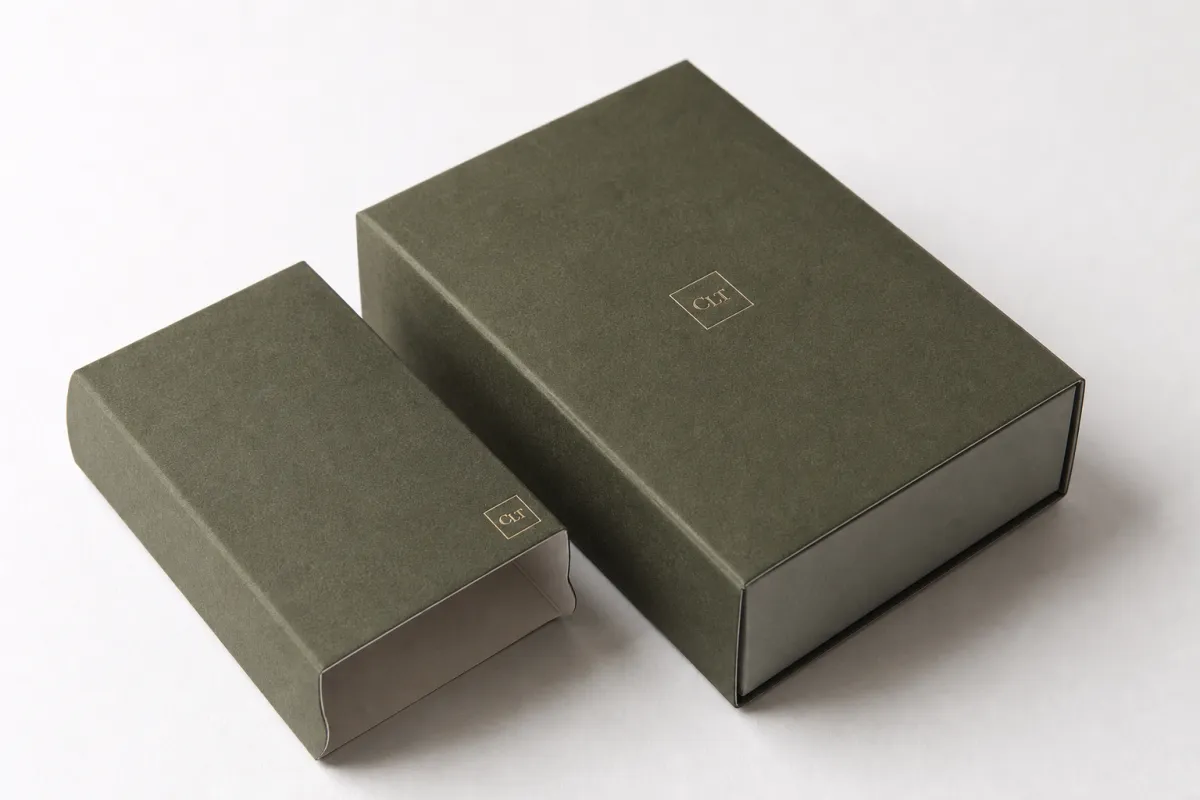
A printed rigid carton packaging order changes shelf perception because shoppers read structure as quality. A thick, wrapped carton feels deliberate. It has body. It opens with a firm response instead of folding away. That physical experience sends a message before anyone studies the copy on the front panel.
That effect shows up fast in categories where buyers compare products in a hurry: gift sets, prestige beauty, candles, watches, headphones, and other electronics accessories. The product itself may be excellent, yet if the box feels thin or generic, perceived value drops. A printed rigid carton packaging order can correct that mismatch faster than a graphic-only redesign.
Shoppers do not need to know the board grade or the lamination type to feel the difference between a carton that seems dense and one that seems flimsy. The hand tells the story before the eye does. Package branding matters for that reason. The box is often the first tactile proof that the brand means what it says.
The practical side matters too. Rigid cartons help protect fragile items by limiting movement and reducing crush risk, especially when the insert is sized correctly. The same structure that improves presentation can also reduce damage in handling. For a printed rigid carton packaging order, that combination is part of the value: stronger display and stronger protection in one build.
Buyers often ask whether the added spend is justified. The answer usually depends on what the product is trying to do. If the item competes on margin, gifting, or visual appeal, rigid packaging can be a better use of budget than another round of broad advertising. A stronger carton can support a higher price point, improve conversion at retail, and reduce the amount of explanation needed after the customer picks it up.
If the current package is flattening the brand story, that is the signal to revisit the structure now. Markets rarely wait for a perfect calendar window. A printed rigid carton packaging order is worth evaluating when the product needs a more premium frame, not after it has already struggled to stand out.
There is also a trust factor here that gets overlooked. A box that opens cleanly, closes with intention, and keeps the item centered tells the buyer the brand cared enough to think through the details. That kind of care is not decorative; it is part of the product experience.
Printed Rigid Carton Packaging Order: Product Details That Matter
A rigid carton is a pre-formed box built from thick greyboard or chipboard, usually wrapped in printed paper or specialty stock. A folding carton ships flat and uses lighter paperboard. That difference changes the feel in hand, the strength of the package, freight behavior, and the way the product reads on a shelf. For a printed rigid carton packaging order, the structure is part of the brand, not just the container around it.
The common formats are easy to recognize once the language becomes familiar. A lift-off lid is clean and classic. A magnetic closure feels more gift-like and controlled. Drawer boxes create a reveal moment that works well for jewelry, small electronics, and prestige kits. Book-style packaging opens like a presentation case, which makes it a strong fit for launches where the unboxing matters as much as the product.
- Lift-off lid - Simple, elegant, and efficient for sets that need a premium but not overly complex presentation.
- Magnetic closure - Best when the printed rigid carton packaging order needs a refined opening experience and repeat handling.
- Drawer box - Useful for products that benefit from a layered reveal and a snug inner tray.
- Book-style box - Strong choice for brand stories, limited editions, and presentation-heavy retail packaging.
The details inside the box matter just as much as the outside. Board thickness usually falls between 1.5 mm and 3 mm, depending on size and load. The wrap paper can be coated art paper, specialty paper, textured stock, or a printed sheet with soft-touch lamination. Even a small shift here can move the perception from practical to luxury without changing the product inside.
Finishing options deserve careful planning. Foil stamping can highlight a logo or product name. Embossing adds depth that catches both light and touch. Spot UV creates contrast, but only if the artwork leaves enough breathing room for it to work. Soft-touch lamination gives a velvety surface that many buyers associate with higher-end retail packaging, though it can mute brightness a little. That is not a flaw; it is a trade-off that should be built into the proofing process.
The insert deserves the same level of attention. Paperboard inserts are economical and easy to print. EVA foam offers tight protection for heavier items. Molded pulp supports sustainability goals and holds the product well if the cavity is engineered correctly. Flocked trays feel upscale, but they usually make sense in lower-volume or gift-oriented programs. For a printed rigid carton packaging order, the insert should stop movement without forcing the product into the box.
Dimension planning is more important than many teams expect. The internal size needs enough room for the product, but not so much that the item rattles. The opening experience should also feel clean. If the lid binds or the drawer catches, the whole impression weakens. Packaging design for rigid cartons is part engineering, part merchandising, and part restraint.
If the structure is still undecided, review the options early. The Custom Packaging Products page is a useful starting point for teams comparing presentation, protection, and budget before they move a printed rigid carton packaging order into sampling.
Specifications for a Printed Rigid Carton Packaging Order
The fastest way to slow down a printed rigid carton packaging order is to leave the specification vague. Strong projects start with measurable inputs: internal dimensions, board grade, wrap paper, print method, color count, and finish. Each one affects cost, schedule, and the chance of a clean first sample.
Here is the core specification list buyers should lock early:
- Internal dimensions - The usable inside size should be based on the actual product, not the nominal retail size.
- Board grade - Common ranges include 1.5 mm, 2 mm, and 2.5 mm greyboard, with thicker board for larger or heavier items.
- Wrap paper - Decide whether the outer wrap is coated art paper, texture paper, specialty stock, or another branded surface.
- Print method - Offset printing is the standard for most premium runs, while digital sampling can speed up approvals.
- Color count - Full color, spot color, and Pantone matching each affect the proofing process.
- Finish selection - Soft-touch, matte, gloss, foil, emboss, deboss, and spot UV all influence final appearance.
- Insert style - Paperboard, foam, molded pulp, or mixed-material trays should be specified with the product shape in mind.
Exact measurements reduce rework. If the product shifts even 2 or 3 millimeters too much, the insert may need to be rebuilt. That means another proof, another approval, and a delay that could have been avoided at the start. A printed rigid carton packaging order becomes easier to manage once the dieline is built around real samples instead of estimates.
One habit saves time: measure the product with calipers and a ruler, then confirm the widest, tallest, and deepest points separately. Do not rely on label size or retail display size. Caps, closures, accessories, and irregular edges can all change the fit. With a rigid box, tolerance matters because the insert cavity is less forgiving than a loose folding carton.
Artwork readiness is another place where good projects move faster. Files should include bleed, safe zones, and clear barcode placement. For premium boxes, the printer usually wants vector artwork or high-resolution files at the correct scale. Fonts should be outlined or packaged properly, and all images should be sharp enough for the print method selected. If the brand uses Pantone colors, call them out directly so there is no guessing during proofing.
For shipping and durability, ask whether the carton needs testing beyond shelf display. If the box will move through parcel networks, transit testing aligned with ISTA methods is worth discussing, and a plan based on ASTM D4169 may also be appropriate. For paper sourcing claims, confirm whether the wrap or board is certified through FSC or backed by equivalent documentation. Buyers do not need every certificate on day one, but they do need clarity before the printed rigid carton packaging order is released.
A useful rule helps keep decisions clean: every specification should answer one of three questions. Does it fit? Does it protect? Does it sell? If it does none of those, it probably belongs in a revision note rather than the production order.
When a spec sheet is built carefully, the quotation process gets a lot less messy. That is usually where the calm begins, and the back-and-forth drops off.
"A five-minute measurement check can save a five-day revision cycle."
Printed Rigid Carton Packaging Order Pricing, MOQ, and Quote Inputs
Pricing for a printed rigid carton packaging order depends on a chain of decisions, not a single number. Box size, board thickness, paper choice, finish level, insert design, and order quantity all move the final unit cost. Buyers who understand those drivers usually get better quotes and fewer surprises.
MOQ matters because setup costs are spread across every carton. At 500 units, tooling, print setup, and labor are divided over a small base. At 3,000 or 5,000 units, the same work is spread more efficiently, so the unit price usually falls. That does not mean the biggest run is always the best move. Storage, cash flow, and launch timing still matter.
For a standard printed rigid carton packaging order with a paper wrap and a simple insert, short runs often land around $1.90-$4.50 per unit at 500 pieces, depending on size and finish. At 3,000 pieces, that same box can often land closer to $0.95-$2.20 per unit. Add foil, embossing, specialty paper, or a more complex magnetic structure, and the range climbs quickly. These figures are directional, not fixed quotes, but they give buyers a realistic starting point.
| Box Style | Typical MOQ | Indicative Unit Price | Best Use | Cost Drivers |
|---|---|---|---|---|
| Lift-off lid rigid box | 500-1,000 pcs | $1.90-$4.20 | Gift sets, beauty, small accessories | Paper stock, board thickness, simple foil or matte finish |
| Drawer rigid box | 1,000-3,000 pcs | $2.40-$5.80 | Jewelry, candles, premium kits | Inner tray fit, ribbon pull, extra assembly time |
| Magnetic closure box | 1,000-5,000 pcs | $3.10-$7.50 | Prestige retail packaging, launches, electronics | Magnet placement, tighter tolerances, heavier board |
| Book-style presentation box | 2,000-5,000 pcs | $3.60-$8.50 | Limited editions, brand storytelling, PR kits | Complex structure, premium wrap, insert engineering |
The quote inputs buyers should send are straightforward, but they need to be complete. A supplier can only price accurately if the request includes exact dimensions, target quantity, product weight, finish requests, artwork files, insertion needs, and delivery location. If any of those are missing, the first quote is usually a placeholder rather than a usable number.
It also helps to state the launch objective. Is the carton for retail shelves, ecommerce shipping, influencer kits, or a seasonal gift line? The answer changes the build. A box that only sits on a shelf can behave differently from one that has to survive courier handling. That is one reason a low quote sometimes turns expensive later: the carton was priced for appearance, not for function.
When you compare offers, do not stop at the lowest line item. Check whether the quote includes internal trays, proofing rounds, material upgrades, and assembly. Ask what happens if the color drifts slightly or the die needs a second pass. A quote that is 10% lower on paper can become more expensive if it adds two weeks of delay or removes the finishing details that made the carton worth ordering in the first place.
For repeat launches, seasonal programs, or multi-SKU lines, ask about Wholesale Programs. That is often the easiest route for keeping a printed rigid carton packaging order financially steady across multiple runs.
If you are comparing several vendors, keep one thing in mind: a quote that looks tidy on paper is not always the quote that behaves best in production. Ask how often the supplier handles the exact structure you want, and whether they can explain where the cost comes from without hand-waving.
Printed Rigid Carton Packaging Order Process and Timeline
A printed rigid carton packaging order usually follows a predictable path, but only if the buyer keeps approvals moving. The best projects move through inquiry, spec review, quote approval, dieline confirmation, sample or proof stage, production, inspection, and shipment without revisiting the same decisions three times.
- Inquiry and brief - Send product dimensions, quantity, carton style, finish ideas, and delivery timing.
- Spec review - The supplier checks board thickness, insert style, and print feasibility.
- Quotation - Pricing is issued based on the approved structure and the expected level of decoration.
- Dieline confirmation - The structure is checked against the product size, opening direction, and insert fit.
- Sample or proof - A white sample, digital proof, or finished sample is reviewed for fit and appearance.
- Production - Printing, mounting, cutting, wrapping, and assembly are completed.
- Inspection and shipment - Cartons are checked for alignment, finish, and quantity before dispatch.
Lead time depends on how complete the information is at the start. A straightforward printed rigid carton packaging order with final artwork and no structural changes often takes 12-18 business days after proof approval. If the design includes foil, embossing, a complex magnetic flap, or a custom insert that needs extra fit checks, the schedule can extend to 15-25 business days or more. Freight sits outside that window.
The biggest bottlenecks are rarely mysterious. Missing artwork files cause delays. Color corrections eat time. Insert changes create a new fit review. Late approval on the structural sample can stall a run that was otherwise ready to move. In almost every case, the printed rigid carton packaging order slows down where the buyer hesitates, not where the machine runs.
That is why buffer time matters. If the product launch is tied to a retailer ship date, a trade show, or a seasonal window, build in extra time for sample review and freight booking. A supplier can print a box quickly, but if the team needs two approval cycles and a last-minute graphic update, the calendar gets tight very fast.
For ecommerce programs, think about transit testing as part of the schedule, not as a side task. A carton that looks perfect on a desk can still fail if the insert allows movement during parcel distribution. Packaging teams that work with branded packaging usually plan the structure first and the decoration second. The order matters.
I have seen more than one launch slip simply because the sample phase was treated like a checkbox instead of a decision point. That step is where fit, finish, and handling should be proven before money gets locked into the full run.
If you need a quick place to confirm approval steps or shipping questions before release, the FAQ is a practical reference point while the printed rigid carton packaging order is still in motion.
Why Choose Us for a Printed Rigid Carton Packaging Order
At Custom Logo Things, the goal is not to push every client into the same carton spec. A printed rigid carton packaging order should reflect the product, the brand, and the way the box will be handled after it leaves production. That sounds simple, yet it is where many packaging programs go wrong. They buy a box that looks premium on a screen and then find out it feels awkward in hand, ships poorly, or pushes the budget too far.
What buyers usually value most is consistency. Print should register cleanly across the whole run. Corners should stay square. The finish should match the proof. The insert should hold the product without wobble. Those are not glamorous details, but they determine whether the final carton supports the brand or quietly works against it. A printed rigid carton packaging order is only as good as its least controlled step.
That is why quality control matters at several points, not just at the end. The board should be checked for thickness consistency. The wrap should be aligned so the seams land where they belong. The magnet, lid, or drawer should open without drag. The insert fit should be tested with actual product units, not just a mock size. Those checks sound basic because they are basic, and basic is what prevents expensive mistakes.
Service value is easier to measure than people think. Faster responses on artwork reduce idle time. Clear pricing reduces back-and-forth. Fewer revision cycles keep the production line moving. Better support for repeat orders matters even more, because many carton programs are not one-off purchases; they are ongoing packaging systems that need predictable output across seasons and SKUs.
That is also why the conversation should stay close to the business goal. If the goal is retail display, the box needs shelf presence. If the goal is gifting, the opening sequence matters. If the goal is ecommerce, the carton needs to survive handling without losing its look. A strong printed rigid carton packaging order supports all three, but the spec has to be written for the right job.
For buyers comparing options, the internal links below can help organize the next step:
- Custom Packaging Products for format comparison and structure selection.
- Wholesale Programs for recurring lines and higher-volume planning.
- FAQ for sample approval, artwork, and shipping basics.
"A premium box is only premium if it arrives square, clean, and on time."
That is the standard we try to keep in view on every printed rigid carton packaging order: practical specs, clear communication, and a box that does the job without drama. Nothing fancy for the sake of it, just a carton that does what it promised to do.
Next Steps for Your Printed Rigid Carton Packaging Order
The next move should be simple: gather the product, the measurements, and the brand assets before asking for a quote. A printed rigid carton packaging order becomes much easier to price and produce when the supplier can see the real item, not just a rough description.
- Collect the product sample - Include the physical item if possible, because shape and weight affect the insert and board choice.
- Confirm dimensions - Measure width, depth, height, and any protruding parts separately.
- Decide the structure - Choose lift-off, magnetic, drawer, or book-style before revising decoration.
- Set the finish level - Decide whether the carton needs soft-touch, foil, embossing, spot UV, or a simpler print treatment.
- Send artwork early - Provide files, logo versions, and any Pantone references before proofing starts.
- Ask for the proof schedule - Clear approval windows keep the printed rigid carton packaging order from losing time in review.
If you are still comparing carton structures, start with the value level of the product and work backward. A mass-market accessory does not need the same structure as a limited-edition gift set. Likewise, a luxury fragrance set does not belong in a carton that feels thin or underbuilt. The best packaging design matches the retail story without spending money where the customer will never notice it.
One useful habit is to compare quotes on total impact, not just on unit price. Ask what the box includes, what the proofing process looks like, how long production will take, and whether the supplier has experience with the exact structure you want. A printed rigid carton packaging order should be approved with the same discipline as any other production purchase: check the spec, compare the options, and do not rush the sample gate.
If the launch date is fixed, reverse-plan from the ship date. Leave time for proofing, sample approval, production, inspection, and transit. That approach reduces last-minute pressure and gives the team room to correct small issues before they become expensive ones.
Done well, a printed rigid carton packaging order gives you more than a box. It gives you stronger shelf presence, a cleaner unboxing moment, and a more predictable production path. If you are ready to move forward, confirm the specs, compare the quotes, approve the sample, and send the printed rigid carton packaging order into production with no guesswork.
What do I need to request a printed rigid carton packaging order quote?
Start with product dimensions, target quantity, and carton style so the supplier can size the structure correctly. Add artwork files, finish requests, insert needs, and shipping destination to avoid a second round of revisions. If you only have a sample unit, send that and ask for the quote to be built from the actual product.
How does MOQ affect printed rigid carton packaging order pricing?
Lower quantities usually raise the unit price because setup and tooling costs are spread across fewer cartons. Higher MOQs often reduce cost per box, but only if storage, cash flow, and launch timing can support the larger run. Ask where the pricing breakpoints begin so you can compare total spend, not just the cheapest unit number.
What is a realistic lead time for a printed rigid carton packaging order?
Lead time depends on whether artwork, samples, and structural approval are ready when the order is placed. Simple projects can move in a few weeks, while complex finishes, custom inserts, or color corrections add time. Build buffer time for proofing and freight so the cartons arrive before the launch date.
Can I approve a sample before full production starts?
Yes, and that is usually the safest way to check dimensions, closure strength, insert fit, and print appearance. Ask whether the sample is a white mockup, a digital proof, or a finished production sample, because each serves a different purpose. Treat sample approval as a real checkpoint, not a formality.
Which finishes work best for a premium printed rigid carton packaging order?
Soft-touch lamination, foil stamping, embossing, and spot UV are common choices when the goal is a high-end feel. The right finish depends on the product category, brand tone, and how the box will be handled in retail or ecommerce. Balance visual impact with durability so the carton still looks clean after shipping and shelf handling.
What is the biggest mistake buyers make with rigid cartons?
The most common mistake is approving the artwork before the structure is fully settled. That usually leads to a rushed dieline, a loose insert, or a closure that feels slightly off in the hand. A cleaner path is to lock the product fit first, then decorate the carton around it.

