Buyer Fit Snapshot
| Best fit | Printed Shipping Labels for Cartons projects where brand print, material claims, artwork control, MOQ, and repeat-order consistency need to be specified before quoting. |
|---|---|
| Quote inputs | Share finished size, material target, print colors, finish, packing count, annual reorder estimate, ship-to region, and any compliance wording. |
| Proofing check | Approve dieline scale, logo placement, barcode or warning zones, color tolerance, closure strength, and carton packing before bulk production. |
| Main risk | Vague material claims, crowded artwork, missing packing details, or unclear freight terms can make a low unit price expensive after revisions. |
Fast answer: Printed Shipping Labels for Cartons: Material, Adhesive, Artwork, and MOQ should be specified like a repeatable production item. The safest quote records material, print method, finish, artwork proof, packing count, and reorder notes in one written spec.
Production checks before approval
Compare the actual filled-product size with the drawing, then confirm tolerance on folds, seals, hang holes, label areas, and retail display edges. Reserve space for logos, QR codes, warning copy, and material claims before decorative graphics fill the panel.
Quote comparison points
Review material grade, print process, finish, sampling route, tooling charges, carton quantity, and freight assumptions side by side. A quote is only useful when the supplier can repeat the same color, closure quality, and packing count on the next order.
Printed Shipping Labels for Cartons: Setup, Cost, Tips
One bad scan can jam up an entire dock door. That is the ugly truth behind printed shipping labels for cartons. The box might be packed well, taped tight, and built to survive a rough ride. If the label smears, lifts, or lands under glare, the shipment still goes sideways.
From a packaging buyer’s angle, carton labels are not decoration. They are a control point. printed shipping labels for cartons steer routing, tracking, compliance, and the pace of order fulfillment. A clean label system cuts relabeling, lowers mis-sorts, and keeps ecommerce shipping from turning into a mess. A weak one does the opposite. More manual work. More delays. More freight pain. The irritating part is that these labels look simple until you start counting the moving pieces: stock, adhesive, print method, carton surface, handling, temperature, and whatever the box runs into after it leaves the line.
That is the real conversation. Not just design. The question is whether printed shipping labels for cartons hold up after vibration, humidity, abrasion, stacking pressure, and the usual warehouse abuse. Get the spec right and the label disappears into the workflow. That is the goal. Not attention. Reliability.
What Printed Shipping Labels for Cartons Actually Do
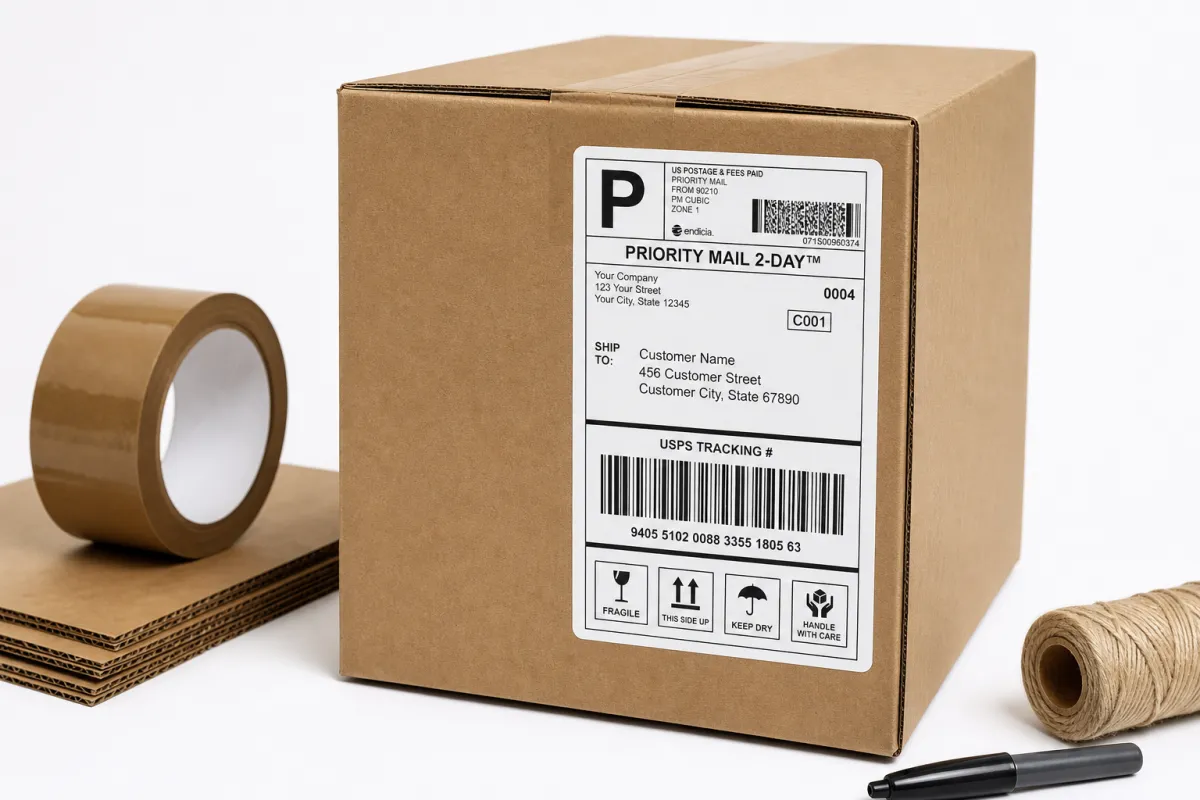
Picture a carton leaving the pack station. The box gets sealed, printed shipping labels for cartons go on, and the shipment heads to the dock. A carrier scans it. A sortation system reads it again. A warehouse or delivery team uses the same data to move it where it belongs. The carton is the container. The label is the instruction set.
In plain terms, printed shipping labels for cartons are pre-printed or custom-printed identifiers placed on shipping cartons for routing, tracking, compliance, inventory control, and brand presentation. Some are bare-bones. Others carry barcodes, serial numbers, handling symbols, destination fields, and logo treatment. The point is the same either way: replace handwriting, replace random stickers, and stop relying on whatever the night shift felt like doing.
The payoff shows up fast on a busy line. Teams applying printed shipping labels for cartons move faster because they are not writing destinations by hand or printing one-off labels for every order. Scan rates improve because the barcode, text, and quiet zone stay consistent. Brand teams also get a carton that looks intentional instead of slapped together five minutes before pickup.
Most buyers miss one blunt detail: the carton label is usually the smallest piece of the shipment, but it carries the information that can wreck the whole move. A box can be strong, well-packed, and neatly taped. A bad label still derails delivery. Ecommerce networks run on fast optical reads. They do not care how pretty the packaging looked in the mockup.
A label that looks fine on a desk can fail after one rough pass through the warehouse. The problem is usually not the artwork. It is the material, adhesive, and placement.
printed shipping labels for cartons should be planned with the rest of the transit packaging. Not treated like a separate print job that someone remembers later. The label has to survive the same conditions the carton does: friction, compression, moisture, and temperature swings. If the label is weak, the whole pack-out feels weak.
- Identification: carton labels tell warehouse staff, carriers, and customers what the package is and where it belongs.
- Routing: printed shipping labels for cartons support pick-to-ship workflows and carrier sortation.
- Compliance: handling marks, serial numbers, and regulated data can live on the label face.
- Branding: a clean label makes the shipment look deliberate instead of improvised.
Think of it this way: the box protects the product. The label protects the shipment’s information. One handles damage. The other handles direction.
How Printed Shipping Labels for Cartons Work
The workflow behind printed shipping labels for cartons starts with artwork setup. That means confirming dimensions, deciding whether a barcode is needed, and sorting out which fields stay fixed and which change with each order. If cartons are serialized or routed by order number, the variable data has to be mapped before anything goes to press.
Then comes barcode generation and proofing. A barcode may look like a few black bars, but it is a precision piece of the label. Quiet zones, bar width, contrast, and placement all matter. Pack too much into the layout, or shove the code too close to an edge, and scanners start failing. The goal is not design flair. It is machine readability. Many teams test samples in the actual warehouse scanner environment before they sign off, which is the smart move because office lighting lies.
After proof approval, production starts. The three main print methods used for printed shipping labels for cartons are digital printing, flexographic printing, and thermal transfer. Each one fits a different buying pattern.
Digital printing
Digital production works well for shorter runs, multiple SKUs, and variable data. No plates. Less setup. Faster artwork changes. For printed shipping labels for cartons that change with seasons, promotions, or routing rules, digital usually keeps the workflow moving. Unit cost can climb at very high volume, so the economics matter.
Flexographic printing
Flexographic printing fits higher volumes and stable artwork. Once the plates are made and the press is dialed in, the per-label cost often drops in a way buyers can feel. For repeat printed shipping labels for cartons that do not change every week, flexo is often the practical choice. It likes repetition. So does accounting.
Thermal transfer
Thermal transfer is common for on-demand labeling inside warehouses. It prints through a ribbon onto label stock, which gives strong barcode clarity and decent resistance in many jobs. It is not always the best choice for fully branded labels, but it can be very useful for printed shipping labels for cartons that need variable information at the point of pack.
| Print method | Best fit | Typical setup profile | Typical unit cost behavior | Watch-outs |
|---|---|---|---|---|
| Digital | Short runs, multiple versions, variable data | Low to moderate setup, fast artwork changes | Often higher than flexo at scale; commonly around $0.08-$0.28 per label depending on size and coverage | Can be less economical on very large repeat orders |
| Flexographic | Long runs, stable artwork, repeat carton programs | Plate and press setup required | Lower per-label cost at volume; often around $0.04-$0.12 per label for large repeats | Artwork changes add time and cost |
| Thermal transfer | Warehouse-printed labels, serialized carton data | Low setup, equipment-dependent | Good for on-demand use; stock and ribbon economics vary widely | Not ideal for every brand-forward application |
That table hides the bigger point: printed shipping labels for cartons are not just a print decision. They are a workflow decision. A format that works for a contract packer with stable output can be a lousy fit for an ecommerce operation that changes promotions, bundles, or routing every week.
Labels also come in different structures. Some operations use a single label for direct-to-consumer shipments. Others use master carton labels for case-packed goods moving through distribution. Some use multi-panel layouts with routing fields, handling marks, and serial data separated into zones. The structure should match how the carton actually moves, not how the PDF looks on a laptop.
Scannability testing closes the loop. Teams should check contrast, barcode size, quiet zones, and placement on the carton face under realistic lighting. A label that scans perfectly under office light can still fail near a dock with glare, worn corrugate, or shrink wrap bouncing reflections everywhere. The best printed shipping labels for cartons are tested in the real environment, not just blessed from a screen.
Key Factors That Affect Performance and Durability
If a label goes on a clean, dry carton and ships out within hours, the spec can stay fairly simple. If the same label has to survive humidity, cold storage, or rough handling in transit packaging, the spec changes fast. That is why printed shipping labels for cartons need to match the carton surface and shipping environment, not somebody’s habit.
Material matters more than most buyers expect
Paper is the most common and often the most economical choice for printed shipping labels for cartons that move quickly through dry environments. It prints cleanly, reads well, and usually keeps costs contained. Once the label faces rubbing, moisture, or long dwell times, paper starts to look tired fast.
Polypropylene and polyester hold up better. They resist moisture, abrasion, and in some cases temperature swings better than plain paper. For cartons that may sit in refrigeration, damp dock areas, or longer transit windows, synthetic stocks often make more sense. The trade-off is price, and sometimes a slightly different print look. Buyers need to decide what matters more: appearance or punishment resistance.
Recycled-fiber cartons add another wrinkle. Rougher board can reduce adhesion, especially on dusty surfaces or low-energy corrugate. That does not mean printed shipping labels for cartons will fail on recycled board. It means adhesive choice and application pressure matter more than they do on a smooth fresh carton.
Adhesive selection can make or break the job
The adhesive does invisible work. Standard permanent adhesive handles a lot of carton programs just fine, but cold-chain, recycled board, rough-surface corrugate, and humid storage may need a different tack level or a freezer-grade adhesive. A label can look fine while one corner starts lifting. The scanner notices before the eye does.
For printed shipping labels for cartons, adhesive choice should follow the carton’s actual life cycle. If the carton is packed, palletized, staged, and shipped in a narrow window, one adhesive profile may be enough. If the carton sits in a warehouse, hangs around a dock, and then takes a longer carrier route, the adhesive needs more margin.
Size, placement, and scan geometry
Label size should be dictated by the flat area on the carton face. Too small, and the barcode, human-readable text, and handling symbols feel cramped. Too large, and the label folds over an edge, crosses a seam, or gets in the way of tape. In practice, the best printed shipping labels for cartons are large enough to scan quickly but small enough to stay on one flat panel.
Placement matters just as much. A label on a corrugate seam can peel early. A label near an edge may catch on stretch wrap or conveyor hardware. A label under a strap can become unreadable. Even the angle of the carton as it enters the scanner field can affect performance. In high-volume order fulfillment, those details matter more than an extra 10% of print coverage.
Dimensional weight belongs in the same conversation. A carton that is oversized for its contents may cost more to ship, and a big face can tempt teams to over-label. Bad idea. printed shipping labels for cartons should be sized to the data they need to carry, not to the box dimensions alone.
Print quality still has to do real work
Resolution, ink or toner durability, and contrast determine whether the label reads well after handling. Barcodes need enough darkness to scan consistently, but not so much spread that the bars blur together. Small type has to stay legible after rubbing against other shipping materials or the edge of tape. If the label includes logos or color blocks, those elements should never weaken barcode contrast.
There is a practical tradeoff here. A nice-looking label that sacrifices machine readability is a bad label. A purely functional label that looks accidental is a missed branding opportunity. The better printed shipping labels for cartons do both jobs. They read cleanly and still look like they belong to the brand.
For teams that want a standards-based lens, the wider packaging industry often looks to groups such as ISTA for distribution testing and FSC for responsible fiber sourcing when paper materials are part of the spec. Those references do not replace a carton-specific trial, but they give buyers a common language for judging the label and the board together.
I have seen too many programs approve the first sample that looks acceptable, then act surprised when the first few hundred cartons fail in the lane. A controlled test on the real board, under the real conditions, costs less than the cleanup. That is not glamorous, but it beats explaining a pallet of peel-back labels to operations.
printed shipping labels for cartons also need to be checked against the rest of the pack-out. If the label is fine but the carton surface is dusty, the tape pattern is awkward, or the box quality varies by batch, the label still suffers. Packaging choices stack.
Printed Shipping Labels for Cartons: Cost and Pricing Factors
Price is usually the first question, but it should not be the only one. The cost of printed shipping labels for cartons depends on size, stock, adhesive, color count, finishing, order volume, and whether the label carries variable data. A plain one-color carton label ordered in bulk can be very different from a branded version with serialized data and specialty adhesive.
Scale changes the math. A short-run order may look expensive because setup costs are spread across fewer units. Once volume increases, the same printed shipping labels for cartons can drop sharply on a per-piece basis. That is why quotes should be checked at 1,000, 5,000, and 25,000 pieces, not just one quantity that flatters the spreadsheet.
The table below gives a practical comparison of cost behavior. These are not universal prices. Supplier, artwork, and material choices change the math. Still, the ranges are useful when you are planning a budget.
| Option | Typical use | Setup cost profile | Approximate unit price behavior | Main value |
|---|---|---|---|---|
| Simple paper labels | Dry, short-hold cartons | Low | Often the least expensive, sometimes under $0.05-$0.10 at higher quantities | Good for basic printed shipping labels for cartons with minimal exposure |
| Branded digital labels | Multiple SKUs, seasonal runs | Moderate | Often around $0.08-$0.28 depending on size, color, and data handling | Flexible artwork and faster changes |
| Flexo labels | High-volume repeat orders | Higher upfront, lower at scale | Commonly around $0.04-$0.12 per label at volume | Strong economics for repeat printed shipping labels for cartons |
| Synthetic labels | Moisture, abrasion, cold-chain | Moderate to higher | Often priced above paper because of stock and adhesive performance | Better durability in tough transit packaging |
Hidden costs show up fast. Artwork revisions add days and money. Proof cycles drag when barcode fields are still changing. Rush production usually carries a premium. If the shipment needs freezer storage, rough corrugate, or a long dwell time, the label spec may need a more expensive stock or adhesive. That is still cheaper than relabeling pallets by hand.
The honest comparison is total cost, not unit cost alone. A label that is $0.03 cheaper but causes a 2% error rate may end up costing more once labor, reprints, and late shipments are counted. That is especially true in ecommerce shipping, where a few bad scans can ripple into customer service headaches and refund pressure.
Here is the budgeting lens I use for printed shipping labels for cartons:
- Label unit cost: stock, ink, adhesive, finishing, and any variable data handling.
- Application labor: manual placement time, printer upkeep, and pack-line interruptions.
- Waste rate: spoiled labels, misprints, damaged cartons, and rework.
- Replacement risk: the cost of a label failure after cartons leave the dock.
That fourth line is the one people ignore. A relabel in the warehouse is annoying. A relabel in transit is a delayed order, a missed delivery window, or a chargeback. printed shipping labels for cartons should be budgeted as a control system, not as a sticker purchase.
If you are pricing a broader packaging update, it helps to compare carton labels alongside Custom Labels & Tags, Custom Packaging Products, and the carton itself through Custom Shipping Boxes. That side-by-side view often reveals where the real spend sits, especially in packed ecommerce shipping programs.
Step-by-Step Process and Timeline for Carton Labels
Good printed shipping labels for cartons do not happen by accident. They move through a fairly predictable sequence, and the timeline gets easier to manage when the buyer brings the right inputs early.
- Gather the brief: carton size, label location, barcode content, routing rules, storage conditions, and target quantity.
- Prepare artwork: logo files, text fields, handling icons, regulatory notes, and any variable data structure.
- Build the proof: verify that the layout fits the carton face and that the barcode remains readable at the intended size.
- Approve production: confirm stock, adhesive, finish, and any serialization or version control details.
- Print and finish: labels are produced, cut, stacked, wound, or sheeted depending on the application method.
- Ship and stage: the labels arrive at the warehouse or co-packer before the pack line needs them.
For many standard jobs, once artwork is approved, printed shipping labels for cartons can move through production in about 5 to 10 business days. If the spec includes specialty adhesive, custom stock, serialized data, or multiple proof rounds, 10 to 15 business days is a safer planning window. Very complex programs can take longer, especially when several teams need sign-off.
The buyer should know what has to be ready before ordering. The most useful inputs are usually:
- Carton dimensions and the flat panel available for the label.
- Barcode data, routing rules, and any human-readable copy.
- The shipping environment: dry storage, chilled storage, high humidity, long dwell time, or rough sortation.
- Quantity forecast and reorder cadence.
- Whether the label needs to match a branded box, a plain carton, or mixed shipping materials across different SKUs.
That last point matters more than it sounds. A label spec built for one carton line may fail on another if the board finish, tape layout, or application point changes. If your operation uses different carton styles for different product families, printed shipping labels for cartons should be tested across each one, not just the nicest box in the stack.
There is also a handoff problem between operations and procurement. The label may be approved in a spreadsheet, but the packing team is the one that has to live with it. I would rather see a plain spec sheet that locks in size, stock, adhesive, barcode rules, and application area than a vague approval email nobody can find later.
That spec sheet should be boring. That is a compliment. It should tell everyone exactly how printed shipping labels for cartons are supposed to behave. If the label has to be reordered by a different buyer six months from now, the rules should still be there.
A useful planning timeline looks like this:
- Day 1-2: gather artwork, carton specs, and barcode fields.
- Day 3-4: review proof and test placement on the actual carton face.
- Day 5-10: production for straightforward printed shipping labels for cartons.
- Day 10-15: more realistic for custom stock, special adhesive, or serialized data.
- After delivery: stage labels near the line and confirm the pack team knows the application standard.
That last step sounds dull. It saves a lot of trouble. Labels stored too far from the line slow pack-out. Labels without clear application instructions lead to crooked placement, seam overlap, and wasted cartons. A disciplined handoff turns the label into a process asset instead of an interruption.
Common Mistakes When Ordering Printed Shipping Labels
The most common mistake with printed shipping labels for cartons is also the easiest to avoid: choosing a label size that does not fit the actual carton face. A label that crowds the barcode or spills over a crease may look fine in a mockup, but on the line it creates trouble. Scan reliability drops, and the team wastes time repositioning labels or rejecting boxes.
Material mismatch comes next. Paper labels on a cold, humid shipment may peel at the corners. A low-tack adhesive on rough corrugate may fail before the carton reaches the carrier hub. A synthetic stock costs more upfront, but if the shipment faces abrasion, moisture, or a longer route, that extra spend is easier to justify. printed shipping labels for cartons need to match the handling reality, not the fantasy version of it.
Another mistake is under-specifying barcode rules. If the barcode size, quiet zone, or contrast target is vague, the printer may technically meet the brief and still create a label that scans badly in a real warehouse. Testing on the actual carton surface matters. Testing under warehouse lighting matters too.
If you do not test the label on the carton, you are testing the artwork, not the shipment.
Inventory planning fails in quieter ways. Teams order too few labels and scramble mid-run. They approve old artwork and never retire the obsolete version. They forget to plan for reorders, so a promotion, a new customer channel, or an added SKU breaks the supply plan. With printed shipping labels for cartons, those mistakes usually show up as labor waste before they show up as a budget line.
There is a downstream effect too. Poorly ordered labels can trigger missed scans, re-routing, chargebacks, and late deliveries. They can even make package protection look worse than it is, because a damaged or detached label can make a sound carton appear mishandled. That kind of signal problem can distort carrier claims and customer service reporting.
Here are the mistakes I would keep at the top of the avoid list:
- Wrong size: the label is too big, too small, or forced over a seam.
- Wrong stock: the material cannot handle humidity, abrasion, or time in transit.
- Wrong adhesive: the label lifts on recycled board or cold surfaces.
- Weak proofing: the barcode is not tested on the actual carton.
- Poor planning: no reorder schedule, no backup art, and no version control for printed shipping labels for cartons.
One more mistake is forgetting the human side of the process. The pack line has to apply these labels quickly and consistently. If the label is awkward to peel, hard to align, or impossible to place without slowing the line, the format needs another look. The right label makes work easier, not harder.
Expert Tips and Next Steps for Better Carton Labeling
The best advice I can give is blunt: test printed shipping labels for cartons on real cartons Before You Buy a full run. Not on a sample sheet. Not on a desk. On the actual board, with the actual tape pattern, under the actual warehouse light. A quick rub test, a drop test, and a scan test usually tell you more than a polished proof ever will.
Build a label spec sheet and make it the source of truth. Lock in size, stock, adhesive, barcode rules, human-readable content, and placement. If your operation uses multiple carton styles, include each one. If the label has to coordinate with branded boxes or other packaging components, write that down too. No improvising later. That is how mistakes sneak in.
It also helps to put packaging, operations, and fulfillment in the same room. The people designing printed shipping labels for cartons are not always the people applying them or scanning them. A 20-minute review with the pack line supervisor can save hours of cleanup later. That matters most in order fulfillment environments where speed and consistency matter more than pretty graphics.
Compare total cost, not just unit price. A label that saves a few cents but fails under humidity, slows the line, or needs manual correction is not the cheaper choice. Think about the whole system: stock, adhesive, artwork, labor, waste, and replacement risk. That view is more honest. It also leads to better decisions.
If you are standardizing shipping programs across multiple product types, it can make sense to coordinate printed shipping labels for cartons with the rest of your packaging. A label spec that fits your Custom Shipping Boxes and matches broader Custom Packaging Products usually creates fewer surprises at the dock. If you also need other printed brand elements, pairing the project with Custom Labels & Tags keeps the visual system tighter.
Here are the next moves I would make:
- Audit your current carton labels for peeling, smudging, slow scans, and application errors.
- Identify the most common condition your labels face: dry storage, humidity, cold chain, long transit, or rough handling.
- Request sample proofs of printed shipping labels for cartons and test them on the real board.
- Write a reorder plan so the next purchase is not rushed.
- Document the final spec so every future run matches the same standard.
For most teams, the smartest upgrade is not a flashy redesign. It is a label that survives the dock, scans the first time, and keeps moving without drama. Done well, printed shipping labels for cartons quietly improve package protection, reduce exceptions, and make ecommerce shipping easier to run at scale. That is the whole point, really.
FAQ
What are printed shipping labels for cartons used for?
They identify the carton for carriers, warehouse teams, and customers. They also help with routing, tracking, inventory control, and compliance, and they can support branding while reducing manual labeling errors. In a busy dock environment, printed shipping labels for cartons often do more work than the carton graphics themselves.
Which material works best for printed shipping labels for cartons?
Paper works well for dry, short-hold shipments with light handling. Polypropylene or polyester is a better fit for moisture, abrasion, or longer transit. The carton surface and storage conditions should decide the final choice, because printed shipping labels for cartons only perform well when the stock matches the environment.
How do I know what size printed shipping labels for cartons should be?
Measure the flat label area on the carton face, then leave enough room for the barcode and quiet zone. The label should be large enough to scan quickly, but not so large that it folds over an edge or crosses a seam. Before approving production, test printed shipping labels for cartons on the actual carton.
Are printed shipping labels for cartons expensive?
Cost depends on size, material, adhesive, quantity, and whether variable data is needed. Higher volumes usually reduce the per-label price, but setup and artwork can add to the total. The cheapest label is not always the lowest-cost option if printed shipping labels for cartons fail in transit or create rework.
How fast can printed shipping labels for cartons be produced?
Simple jobs can move quickly once artwork and data are approved. Custom materials, specialty adhesives, or serialized labels usually add time. The fastest way to shorten the timeline is to have specs, quantities, and barcode data ready before you request printed shipping labels for cartons.


