Buyer Fit Snapshot
| Best fit | Printed Stretch Wrap Labels projects where brand print, material claims, artwork control, MOQ, and repeat-order consistency need to be specified before quoting. |
|---|---|
| Quote inputs | Share finished size, material target, print colors, finish, packing count, annual reorder estimate, ship-to region, and any compliance wording. |
| Proofing check | Approve dieline scale, logo placement, barcode or warning zones, color tolerance, closure strength, and carton packing before bulk production. |
| Main risk | Vague material claims, crowded artwork, missing packing details, or unclear freight terms can make a low unit price expensive after revisions. |
Fast answer: Printed Stretch Wrap Labels: Costs, Uses, and Timing should be specified like a repeatable production item. The safest quote records material, print method, finish, artwork proof, packing count, and reorder notes in one written spec.
Production checks before approval
Compare the actual filled-product size with the drawing, then confirm tolerance on folds, seals, hang holes, label areas, and retail display edges. Reserve space for logos, QR codes, warning copy, and material claims before decorative graphics fill the panel.
Quote comparison points
Review material grade, print process, finish, sampling route, tooling charges, carton quantity, and freight assumptions side by side. A quote is only useful when the supplier can repeat the same color, closure quality, and packing count on the next order.
Printed Stretch Wrap Labels: Costs, Uses, and Timing
A pallet is often the first branded surface a buyer sees. That is why printed stretch wrap labels matter more than most teams admit, especially when the cartons are plain and the load has to speak for itself from twenty feet away. If the pallet face is doing the work of brand, compliance, and identification all at once, the label needs to survive the dock, the wrap cycle, and the truck ride without falling apart or looking embarrassing.
Printed Stretch Wrap Labels: What They Are and Why They Matter
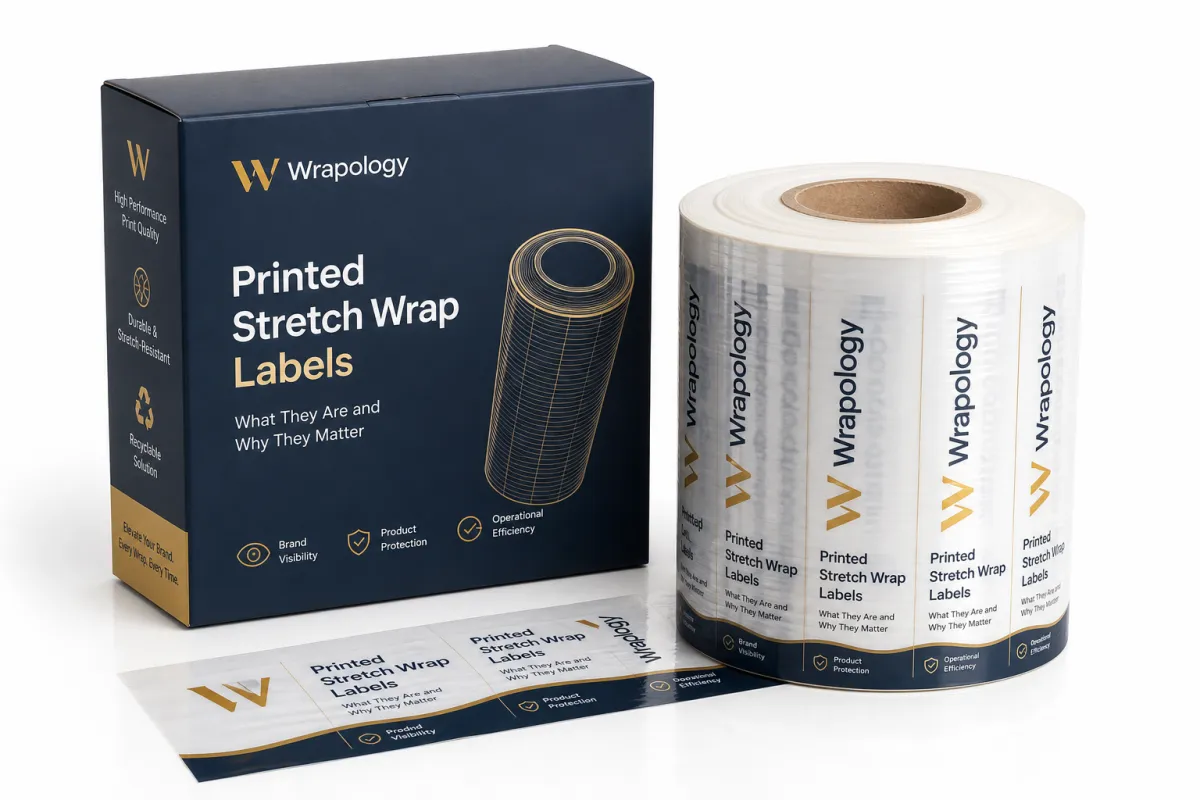
Printed stretch wrap labels are branded, scannable graphics built for palletized loads. They are not random stickers slapped onto film because somebody wanted a logo visible somewhere. They can carry a logo, SKU, handling instructions, lot data, compliance copy, or a barcode panel, and they are meant to work with the wrap and the warehouse flow instead of fighting both.
The idea is simple. The execution is usually where people get sloppy.
From a packaging buyer's point of view, printed stretch wrap labels solve a very practical problem: a pallet can look like a mess of brown cartons, white film, and forklift scuffs unless one visible face is doing the heavy lifting. A clean graphic panel turns the load into something recognizable at a glance. That helps on receiving docks, in cross-docks, in warehouse clubs, and in operations that deal with mixed SKUs and fast changeovers.
They also cut visual clutter. If a team is using separate pallet labels, loose signs, and marker notes scribbled on random corners, the result is chaos wearing a lanyard. printed stretch wrap labels can consolidate that information into one visible area so operators do not have to hunt across the pallet for basic facts like destination, product family, or scan code.
They are not magic. printed stretch wrap labels do not fix unstable loads, weak wrap tension, or sloppy warehouse labeling habits. They are not a substitute for load containment, and they are not a shortcut around the boring parts of shipping that keep freight from arriving crushed, torn, or rejected. They are one piece of a larger system, and the system still has to work.
They fit best for distributors, co-packers, warehouse clubs, fulfillment centers, and seasonal or high-mix operations where the label design changes often but the pallet still needs to move fast. If your operation runs many SKUs, a visible branded face on the load can save time and reduce mistakes. If your products already use strong carton graphics, you may still want Custom Labels & Tags for the unit level and printed stretch wrap labels for the pallet level. Different jobs. Different surfaces. Same need for clarity.
"If the pallet face cannot survive the dock, it does not matter how nice the proof looked on a laptop."
That line is cruder than a brand deck, but it is closer to reality. printed stretch wrap labels are judged in motion: by the wrap machine, by the dock crew, by the scanner, and by whatever rough handling the carrier decides to call normal.
How Printed Stretch Wrap Labels Work on the Line
printed stretch wrap labels usually start with artwork built for a specific panel size and a specific application method. That can mean a pre-printed label stock, a compatible film panel, or a printed area added during the wrapping workflow. The job is not just "print it and stick it." The job is making sure the graphic stays readable while the pallet flexes, shifts, and gets handled like freight instead of a display stand.
There are three common application points: before wrapping, during wrapping, and after wrapping. Before wrapping works well when the operator wants a clean label panel positioned on the load face before film goes on. During wrapping can help when the machine is configured to place or capture the graphic as part of the cycle. After wrapping is usually the simplest for manual lines, but it depends on adhesion and on how much the film surface moves once the load is under tension.
The key decision is visibility versus durability. printed stretch wrap labels need a clean panel that stays visible, but they also need to flex with the wrap without cracking, curling, or riding up at the edges. If the label fights the film, the label loses. That is not theory. It is what happens on a warehouse floor when the adhesive is too weak or the graphic is too stiff for the application method.
Barcode placement matters just as much as the artwork. A high-contrast code with enough quiet zone around it scans faster and causes fewer headaches. Put the code in the wrong part of the panel and you get stretched bars, glare, or a code that looks fine in prepress and useless in the scanner lane. For printed stretch wrap labels, a barcode should sit in the most stable part of the design, away from corners, film stress points, and areas that get folded by the wrap pattern.
Warehouse conditions are the ugly part of the spec. Dust on the floor, condensation from cold storage, humidity near dock doors, pallet corner abrasion, and vibration during transit can all affect how well printed stretch wrap labels stay readable. A label that holds up in a clean sample room may fail fast in a refrigerated dispatch area. I have seen a gorgeous proof turn into a smudged, curling mess once it hit a cold dock. Pretty on the screen. Useless in real life. That is why a real pallet test beats a polished mockup every time.
If the operation uses machine wrap, talk through roll direction, placement timing, and the amount of panel exposure the machine leaves behind. If the operation is hand-wrapped, ask how much variation the team allows from pallet to pallet. The best printed stretch wrap labels setup is the one the line can repeat without needing luck from the operator.
For buyers who need a benchmark on handling and transit abuse, ISTA has testing guidance that is far more useful than guesswork. You do not need a lab coat to appreciate that vibration, drop, and compression all matter. You just need one ruined shipment to remember it.
Printed Stretch Wrap Labels Pricing: What Drives the Cost
printed stretch wrap labels pricing follows the same stubborn math that governs most custom packaging: size, quantity, ink coverage, substrate choice, finishing, and how many different SKUs you need to keep alive. Add custom setup, revision cycles, or compliance copy, and the quote changes fast. Anyone promising one magic price without asking those questions is either guessing or selling disappointment.
The biggest trap is low volume. A small run looks expensive because setup costs are spread across fewer labels. A larger run usually drops the unit price hard because the press, plate, or file prep cost gets diluted. That is why buyers should always ask for tiered pricing. Without tiers, you are not comparing options. You are staring at one number and pretending it means something.
Here is a practical pricing view for printed stretch wrap labels. These are typical ranges, not promises, because artwork coverage and application method can push the number up or down.
| Option | Best For | Typical Unit Price at 1,000 | Typical Unit Price at 5,000 | Typical Unit Price at 10,000 | Notes |
|---|---|---|---|---|---|
| Simple one-color panel | Basic pallet ID, internal logistics, lean branding | $0.32-$0.55 | $0.12-$0.22 | $0.08-$0.16 | Lowest setup burden; clean typography matters more than flashy art. |
| Full-color branded panel | Retail-facing loads, promotional pallets, stronger shelf appeal | $0.55-$1.10 | $0.18-$0.38 | $0.10-$0.26 | More ink coverage and tighter print control usually increase cost. |
| Compliance-heavy multi-SKU version | Lots of copy, lot data, traceability, multiple pallet destinations | $0.70-$1.40 | $0.24-$0.45 | $0.12-$0.32 | Variable data and version management add time and proofing risk. |
Those numbers make more sense if you compare them to the old workaround: generic stretch wrap plus a separate label applied later by hand. On paper, that can look cheaper. In the warehouse, not always. Labor adds up. Mislabel risk adds up. Rework adds up. If a pallet gets wrapped, then relabeled, then touched again because somebody placed the label on the wrong face, the real cost of the "cheap" method gets ugly fast.
printed stretch wrap labels can also save money by reducing damage and rejected pallets. That is harder to model, which is why many buyers ignore it until the first failure shows up in the receiving report. A damaged pallet that gets refused, repalletized, or audited twice is no bargain. Neither is a barcode that scans badly enough to slow down every case handling step downstream.
Ask for quote tiers at 1,000, 5,000, and 10,000 units. That gives you a real break-even picture. If the 5,000-unit price drops only a little, maybe the design is setup-heavy or the artwork is too complex. If it drops sharply, you may have room to plan ahead and save money without stuffing your inventory room with dead stock.
If you are already comparing pallet-level branding to carton-level labeling, it can help to line up the specification with Custom Labels & Tags. The more consistent the information system is across layers, the fewer mistakes the warehouse makes. That is the sort of boring efficiency that actually pays the bills.
One more thing buyers forget: revisions cost money. Rebuilding art, changing barcode data, swapping SKUs, or chasing approval comments can burn more time than the print run itself. With printed stretch wrap labels, clean inputs save real budget.
Choosing Specs and Timeline for Printed Stretch Wrap Labels
The right spec for printed stretch wrap labels depends on how the load is built, how it moves, and where it lives before it ships. A hand-wrapped pallet in a dry warehouse does not need the same construction as a machine-wrapped load staging in a cold dock zone. Treating those as the same job is how projects get delayed and shipments get messy.
Start with dimensions. How large is the visible panel? Where does the label need to sit so it stays readable on three sides, not just one? If the graphic is too wide, it can fold over the pallet edge or distort around the film. If it is too small, it disappears once the wrap tension pulls everything tight. The sweet spot is usually the biggest flat or nearly flat face the pallet can give you without crossing the corners.
Then look at material thickness and adhesive behavior. Thicker materials can give the artwork more body, but they are not always the best fit for a stretch-heavy surface. In a real warehouse, adhesion has to survive dust, moisture, temperature swings, and rough handling. If the pallet goes into cold storage or sits near a wet dock, the adhesive choice matters more than the color palette. Fashion is not the point here.
For jobs with cold chain exposure, moisture, or abrasion, the spec should be tested on the actual pallet face. A real pallet tells you more than a catalog does. If the application includes paper components or sustainable sourcing claims, buyers may want FSC documentation for the relevant material stream; that starts with the standards at fsc.org. Sustainability claims are useful only if they are traceable. Otherwise they are just marketing wallpaper.
Lead time follows a fairly predictable path for printed stretch wrap labels. Artwork intake usually happens first. Then proofing. Then revisions. Then final approval. Then production scheduling, printing, finishing, packing, and freight. Simple repeat jobs can move quickly, especially if the art is already locked and the file format is clean. New jobs with multiple SKUs, special coatings, or messy approvals take longer because every extra version adds another chance for delay.
Typical timing breaks down like this:
- Artwork intake and file check: 1-2 business days if the files are clean, longer if somebody sends a logo in a blurry screenshot.
- Proofing and revisions: 2-5 business days for a straightforward job, longer if barcode data or compliance copy keeps changing.
- Production after approval: often 7-12 business days for a new run, faster for reorders.
- Total first-order timing: commonly 12-15 business days from proof approval, sometimes more if you need specialty materials or multiple versions.
Simple reorders usually run faster because the settings are already dialed in. That is one reason it pays to document the final spec well. If the production file lives in someone's inbox instead of a shared system, the next reorder becomes a scavenger hunt. Nobody enjoys that, least of all the person trying to keep a truck from leaving empty.
For buyers who want a benchmark on process quality, a packaging supplier should be able to explain how their printed stretch wrap labels job maps to handling and transit realities, not just print quality. A good proof is not enough. A good process is what keeps the proof from becoming a problem.
Step-by-Step Ordering Process That Prevents Delays
Ordering printed stretch wrap labels gets a lot easier when the buyer treats it like a production project, not a casual print request. The companies that move fastest usually do the boring prep first. The ones that stall tend to send half the information, then act surprised when proofing drags on. The machine does not care about optimism. It cares about data.
- Define the load. Share pallet size, wrap method, label placement, scan requirements, and whether the pallet face has enough flat area for a large graphic. If the load is unstable, fix the load before worrying about the art. A pretty label on a failing pallet is still a failing pallet.
- Package the artwork properly. Send logo files, copy, barcode data, color references, and compliance text in one clean packet. If you need printed stretch wrap labels across several SKUs, list the differences clearly. The most expensive mistake is usually the one made because version control was casual.
- Review a proof on a real pallet face. Not just on a screen. Screens lie in flattering ways. A proof can look great at 100 percent zoom and fail spectacularly on a stretched load. Check text size, barcode placement, contrast, and how the design sits relative to pallet edges.
- Run a pilot before a full rollout. Test one SKU, one warehouse lane, or one region first. That tells you whether the printed stretch wrap labels hold up under real handling and whether the scan rate is acceptable. If the pilot fails, fix it before you multiply the mistake across the network.
- Lock the reorder rules. Write down the approved size, finish, adhesive, barcode rules, and art owner. Decide who can change the file and who signs off on revisions. That turns the next order into a repeatable system instead of a fresh argument.
If your operation also needs unit-level labels, set up the pallet workflow and carton workflow together. That is where Custom Labels & Tags can keep the visual system consistent across the supply chain. Consistency is not glamorous. It does, however, reduce mistakes.
One practical tip: request a sample or short pilot run before you commit to the full order. That is especially smart if the label will travel across multiple facilities, or if you plan to use it in seasonal shifts where warehouse conditions change. printed stretch wrap labels are one of those products where a ten-minute check on a loaded pallet can save a ten-thousand-dollar headache later.
Keep the approval chain short. Every extra approver adds delay. Every "one more tweak" risks a fresh proof. If the barcode, copy, and brand owner are not aligned before production starts, expect the schedule to slip. That is not a supplier problem. That is process drift wearing a nice shirt.
Common Mistakes With Printed Stretch Wrap Labels
Most failures with printed stretch wrap labels are not technical disasters. They are planning mistakes. That is the annoying part. The fix is often simple, but only if somebody catches the issue before the pallets leave the building.
- Oversized graphics: A design that looks strong on screen can fold around corners, wrinkle under the wrap, or disappear on a pallet edge. Keep the panel inside the usable face.
- Weak barcode contrast: Pale ink on a glossy or busy background causes scanner problems. High contrast wins. It is not subtle, but it works.
- Wrong material choice: Cheap construction may hold on a dry day and fail in cold storage, high humidity, or rough transit. The lowest quote is not always the lowest cost.
- No real mockup: If nobody checks the label on an actual pallet, placement errors show up after the run, which is the worst possible time.
- One design for too many products: A generic panel used across too many items creates mix-ups. It slows warehouse staff down because they have to read more carefully than the process deserves.
printed stretch wrap labels also suffer when teams ignore wrap tension. If the wrap is too loose, the panel can shift. If the wrap is too aggressive, the graphic can distort or the edges can lift. That is why the label spec and the wrap spec should be reviewed together. A label vendor who ignores the wrapping method is missing half the story.
Another common miss is barcode placement inside the stretch-heavy zone. That is how a code that looked perfect in approval ends up failing on the floor. Keep the code on the most stable part of the panel, with enough margin around it, and verify it after the load is fully wrapped. Not after it is still sitting on the staging cart. After the real wrap.
Do not ignore the dock environment either. Wet floors, cold air, dust, and pallet damage all affect the result. printed stretch wrap labels are only as good as the roughest place they have to survive. That is the honest test, and it is usually the one people skip.
"A bad pallet label does not stay local. It spreads into receiving, inventory, and customer service."
That is why the cheapest spec often becomes the most expensive problem. A few cents saved per unit can turn into delays, repicks, relabeling, or a rejected load. No one posts that on a sales sheet, for obvious reasons.
Expert Tips and Next Steps for a Smart First Order
The smartest first order for printed stretch wrap labels is the one that proves the concept without betting the whole warehouse on a guess. Start small. Measure the results. Then scale only after the load, the scan, and the application method all behave the way they should.
My practical starting point is simple: pick one pilot SKU and one warehouse lane. That gives you a controlled test for application speed, visual impact, and barcode performance. If the load is stable, the film behaves, and the scanner reads cleanly, you have something usable. If not, you know exactly where the problem lives instead of arguing with six different departments.
Ask for price tiers across multiple order sizes. Do not accept only one quote. You need to see where the break point sits between low-volume convenience and better unit economics. For printed stretch wrap labels, the difference between 1,000 and 5,000 units can be big enough to change the sourcing decision entirely.
Keep a one-page spec sheet. Nothing fancy. Just the essentials:
- Label dimensions and placement rules
- Material and finish
- Barcode content and contrast requirements
- Hand-wrap or machine-wrap application method
- Approval owner and revision history
- Reorder trigger and lead-time target
That sheet becomes gold the second someone asks for a reorder or a version change. Without it, printed stretch wrap labels can turn into a recurring fire drill every season. With it, the next run is a repeat. Repeats are profitable. Chaos is not.
Test the label after handling, not just after application. Move the pallet. Scan it. Check the corners. Look for lift, rub, or distortion. If the pallet will be staged in a cold room, test in a cold room. If it will sit near a wet dock, test there too. Real-world testing is cheaper than real-world failure.
Lock the process now. Approve the artwork. Run the sample. Verify the lane. Set the reorder trigger. That is how printed stretch wrap labels stop being a one-off headache and start acting like a repeatable packaging system.
From a buyer's point of view, the best result is boring. The pallet is visible. The code scans. The wrap holds. The warehouse does not complain. That is the win. If your first order of printed stretch wrap labels gets you there, you have done the job right.
FAQ
What are printed stretch wrap labels used for?
They identify pallet loads while also carrying brand graphics, handling cues, or compliance copy. They work best when you want one visible surface to do the job of several smaller labels. They are useful for shipping, warehousing, co-packing, and retail distribution.
How do printed stretch wrap labels differ from pallet stickers?
Pallet stickers are usually small, separate labels; printed stretch wrap labels are designed to work with the wrap itself or with the wrapping workflow. Stretch wrap formats usually give you a bigger visible panel and stronger brand presence. They also need to flex, scan, and hold up under pallet movement instead of sitting on a flat carton face.
What affects the price of printed stretch wrap labels most?
The biggest drivers are size, quantity, ink coverage, material choice, and setup complexity. Special finishes, multiple versions, and custom barcode requirements add cost fast. Small runs usually cost more per unit because setup is spread over fewer labels.
How long does a printed stretch wrap labels order usually take?
Simple reorders move faster than first-time jobs because artwork and production settings are already locked. New artwork, revisions, proofs, and specialty materials usually add time before press-ready approval. Build in extra buffer if you need multiple SKUs, rush shipping, or cross-facility rollout.
Can printed stretch wrap labels handle cold storage or wet docks?
Yes, but only if you specify the right substrate and adhesive for the temperature and moisture conditions. Cold storage, condensation, and rough handling all change how well the label sticks and stays readable. Always test on a real pallet in the actual environment before you commit to a full run.
If you need printed stretch wrap labels that actually survive a warehouse, not just a proof file, lock the pallet dimensions, wrap method, barcode, and test conditions before you request quotes. That one page of inputs saves time, money, and a whole lot of kinda avoidable drama.


