Buyer Fit Snapshot
| Best fit | Printed Tissue Paper with Cmyk projects where brand print, material claims, artwork control, MOQ, and repeat-order consistency need to be specified before quoting. |
|---|---|
| Quote inputs | Share finished size, material target, print colors, finish, packing count, annual reorder estimate, ship-to region, and any compliance wording. |
| Proofing check | Approve dieline scale, logo placement, barcode or warning zones, color tolerance, closure strength, and carton packing before bulk production. |
| Main risk | Vague material claims, crowded artwork, missing packing details, or unclear freight terms can make a low unit price expensive after revisions. |
Fast answer: Printed Tissue Paper with Cmyk: Material, Print, Proofing, and Reorder Risk should be specified like a repeatable production item. The safest quote records material, print method, finish, artwork proof, packing count, and reorder notes in one written spec.
Production checks before approval
Compare the actual filled-product size with the drawing, then confirm tolerance on folds, seals, hang holes, label areas, and retail display edges. Reserve space for logos, QR codes, warning copy, and material claims before decorative graphics fill the panel.
Quote comparison points
Review material grade, print process, finish, sampling route, tooling charges, carton quantity, and freight assumptions side by side. A quote is only useful when the supplier can repeat the same color, closure quality, and packing count on the next order.
Printed Tissue Paper with CMYK looks simple from a distance: send artwork, approve a proof, wait for the cartons to arrive, and unwrap a stack of branded sheets that make the package feel deliberate instead of generic. The reality is more temperamental. Light passes through the sheet. Fibers absorb ink. Color softens. A file that looks sharp on a monitor can land on the press with softer edges, and that shift catches first-time buyers off guard.
That softness is not a flaw. It is the material speaking. Printed Tissue Paper with CMYK shows up in e-commerce, retail wrapping, apparel mailers, cosmetic boxes, and gift packaging because it adds perceived value without changing the carton or the mailer itself. In a warehouse, I have seen a plain pack look finished after one sheet of printed tissue, and I have also seen the wrong tissue make an otherwise clean pack feel muddy and overworked. The gap between those two outcomes is bigger than most procurement teams expect.
Most buyers begin with color and end up learning about paper weight, opacity, print method, and minimum order quantity. Printed tissue paper with CMYK also has a habit of looking inexpensive at the quote stage and expensive once setup, freight, and remake risk enter the picture. Treat it like a packaging specification, not a decorative extra.
A screen can promise saturation that tissue cannot hold. The winning order respects the substrate first and the PDF second.
That is the practical lens. Printed tissue paper with CMYK is a sourcing decision with creative consequences, and the better you understand the process, the easier it is to balance color, cost, and turnaround. The first touch matters in packaging. Tissue is often the first thing a customer feels after opening a parcel, which gives this thin sheet a job far larger than its thickness suggests.
Why printed tissue paper with CMYK looks simple but isn't
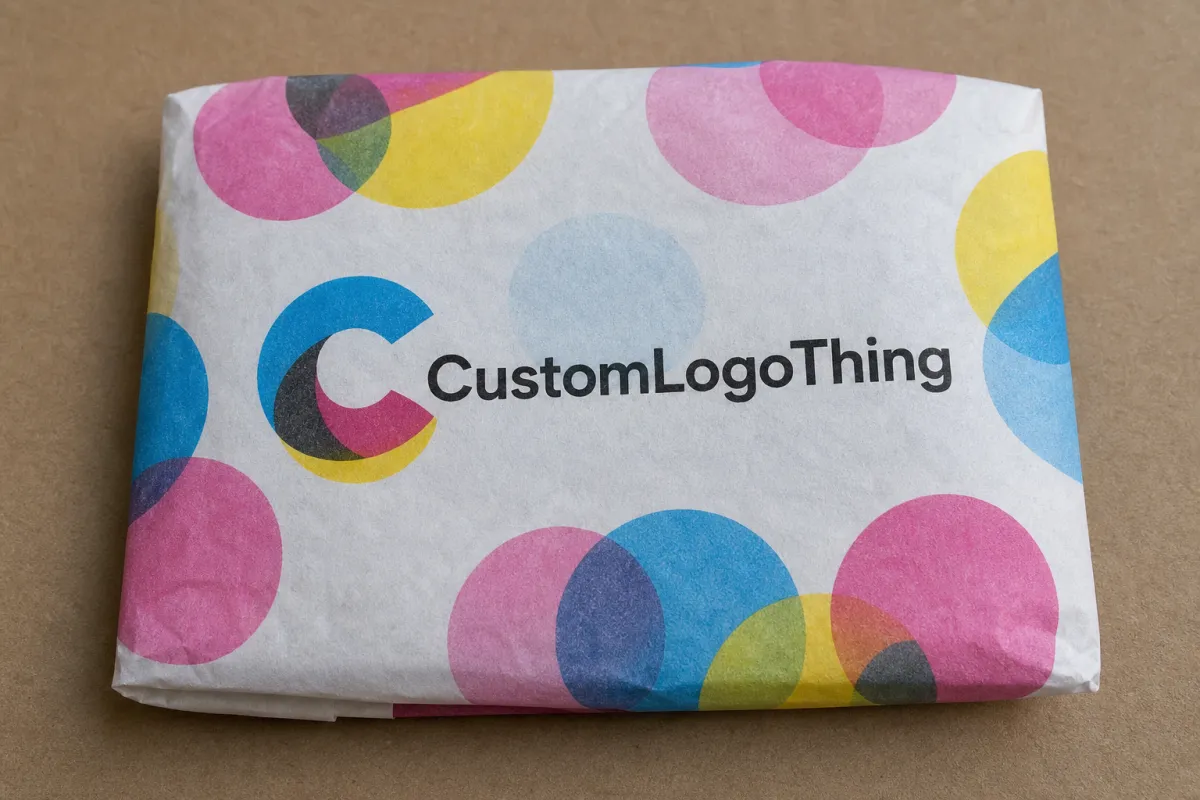
Printed tissue paper with CMYK sits in a strange middle ground. It is low-cost compared with rigid packaging upgrades, yet it changes the customer experience almost immediately. A plain white wrap says, "We shipped your order." A printed wrap says, "We planned the handoff." That small shift explains why so many brands ask for tissue once they see what it can do. The catch: printed tissue paper with CMYK is not a billboard. It is a translucent, absorbent sheet with its own limits and quirks.
Most branded tissue runs around 17-22 gsm, although some suppliers offer heavier stock when the goal is a less fragile feel. That range matters. Lighter tissue carries print with a softer look, while heavier tissue can hold ink a little more evenly and usually costs more to make and ship. Printed tissue paper with CMYK also picks up the tone of the base sheet. Bright white, natural white, and cream all shift the final read. A brand blue that looks crisp on bright white can turn subdued on a warm base before the press even starts.
Opacity changes the result too. CMYK builds color from four process inks, but tissue is not coated art paper. It absorbs differently, so tonal density changes and small details blur faster than many buyers expect. Fine gradients, delicate lines, and pale brand colors may look elegant on-screen and weak on the sheet. Printed tissue paper with CMYK usually performs best when the artwork is built for the material instead of copied from a full-coverage label or box design.
For a packaging buyer, the appeal is obvious: low unit cost, quick visual impact, and a fast lift in presentation. The tradeoff shows up just as fast. You are asking a thin substrate to carry brand work that a rigid carton would handle more easily. Clean artwork helps. Clear color expectations help more. A supplier who prints tissue every week is worth far more than a generic paper vendor who happens to take the job. Printed tissue paper with CMYK is simple to order only after you learn what the sheet can and cannot do.
In one line: the material is modest, the effect is not. That is why printed tissue paper with CMYK keeps appearing in apparel mailers, cosmetics packs, boutique retail bags, and gift boxes. It is one of the cheapest places to add a premium cue, and one of the easiest places to create disappointment if the spec is loose.
Printed tissue paper with CMYK: the production process
The production flow starts before the press. Artwork review comes first. A supplier usually checks file size, repeat pattern, bleed, safe area, and color build. Next comes color separation, where the artwork is split into cyan, magenta, yellow, and black print channels or plates. That is the core of printed tissue paper with CMYK: the printer mixes process inks on press to approximate the final image instead of laying down a dedicated spot color.
Proofing follows, and this is the step many buyers underestimate. A proof on coated stock is not a tissue proof. A digital mock-up is even less predictive. A careful proof stage may include a laser sample, a digital sample with annotations, or a press proof on the actual substrate if the order is color-sensitive. Printed tissue paper with CMYK often needs that extra attention because tissue absorbs ink quickly, which can darken mid-tones and soften tiny details. I have watched a neutral gray pattern drift warmer on tissue simply because the paper base was slightly cream-colored; nothing was wrong with the file, but the material changed the result.
After approval, the press team sets ink density, registration, and repeat length. Offset printing, digital printing, and flexographic printing diverge here in practice. Offset printing usually gives finer detail and smoother tonal transitions, which helps with logos and pattern work. Flexographic printing can suit repeat patterns and simpler coverage, especially when the supplier works with thin paper every day. Digital printing is often more useful for sampling and short runs, though not every shop uses it for final tissue production. For a clean reference on packaging language and substrates, packaging.org is a useful starting point: packaging.org.
Drying and curing come next. Tissue uses less ink than heavier paper stock, but the sheet still needs careful handling so the print does not smear or transfer. After that, the paper is cut, counted, bundled, and packed. In finishing terms, that means more than decoration. The final stack has to be square, clean, and easy to ship without wrinkles or crush marks. Printed tissue paper with CMYK can lose polish fast if finishing and packing are careless.
One detail buyers rarely ask about: ink density can be adjusted during production if the printer sees the tissue drinking too much color. That is normal. It is also why the first approved visual on a computer should never be treated as a promise carved in stone. Printed tissue paper with CMYK is controlled, but the substrate gets the final vote.
Printed tissue paper with CMYK cost, pricing, and MOQ factors
Price for printed tissue paper with CMYK usually comes down to five things: sheet size, order quantity, print coverage, paper grade, and how much custom handling the job needs. A small repeat logo on a standard sheet is cheaper than a full-bleed pattern with tight color expectations. A simple one-color look is easier than a dense four-color illustration. Add special packing, extra proofing, or split shipments, and the quote changes again.
For rough planning, small custom runs often land around $0.18-$0.35 per sheet, while larger lots can fall to roughly $0.07-$0.16 per sheet depending on size and coverage. That spread is not marketing polish. It reflects setup economics. Printed tissue paper with CMYK carries real prepress and press costs, and those costs get spread across the run. Order 3,000 sheets instead of 30,000, and the setup burden sits much heavier on each unit.
MOQ is where buyers feel that math most clearly. Some suppliers quote by ream, some by case, and some by press run. A ream-based quote can look tidy while still hiding the actual sheet count. If you are comparing printed tissue paper with CMYK suppliers, ask what the minimum really means: is it a print-ready quantity, a packed case, or a production threshold that already includes spoilage allowance?
Hidden costs matter too. Freight can be significant because tissue is bulky for its value. Rush fees can turn a decent quote into an awkward one. Rework risk matters if the artwork is not production-ready, because a supplier that has to correct files or remake a job will usually price that uncertainty into the quote. Printed tissue paper with CMYK is rarely expensive in absolute terms, but it becomes inefficient fast when the order is underplanned.
| Order profile | Typical MOQ | Unit price range | Proofing and setup | Best fit |
|---|---|---|---|---|
| Test run | 3,000-5,000 sheets | $0.18-$0.35 | More time per sheet; proof fees are common | New artwork, brand launch, color-sensitive projects |
| Standard production | 10,000-20,000 sheets | $0.10-$0.20 | Setup spread across a larger run | Regular packaging programs and seasonal sales |
| Repeat or replenishment | 30,000+ sheets | $0.07-$0.16 | Lower setup burden if specs stay fixed | Brands with steady monthly usage |
That table hides a useful lesson: the cheapest printed tissue paper with CMYK quote is not always the best buying decision. A slightly higher unit price can still be the lower total cost if it avoids color disputes, last-minute freight, or a rejected run. From a procurement angle, repeat consistency deserves as much attention as launch pricing.
There is also a quality-cost link people miss. Higher ink coverage can make the sheet feel stiffer and look less airy, which changes the premium effect some brands are chasing. If the visual system depends on a soft luxury impression, the cheapest version of printed tissue paper with CMYK may be the wrong version for the job.
How to plan the process and timeline for printed tissue paper with CMYK
A clean timeline starts with good inputs. Before you request a quote, gather the sheet dimensions, desired quantity, artwork files, target ship date, and whether the order needs folding or flat packing. Printed tissue paper with CMYK moves faster when the supplier sees a complete brief. Missing dimensions or a logo trapped in a low-resolution JPEG will slow the job immediately.
Typical lead times vary, but a realistic first order often looks like this: one to three business days for quote and artwork review, two to four business days for proofing, seven to twelve business days for production after approval, and a few more days for freight depending on distance. Printed tissue paper with CMYK can move faster than that, though speed usually means fewer proof options and more pressure on color control. That speed has a cost.
Build buffer time into the first order. The reason is plain. Printed tissue paper with CMYK often needs at least one proof round, and the first round often reveals something useful: the repeat might be too small, the logo too faint, or the base shade too warm. Catching that before press time is a win. Catching it after production is a bill.
Separate artwork approval from production approval. Let the supplier check the file, then send a proof, then wait for final sign-off. That keeps layout confirmation from being mistaken for on-press color agreement. If exact brand standards matter, ask how the supplier handles print verification and what tolerance they allow for repeat orders. Printed tissue paper with CMYK is easier to reorder when the spec is documented properly the first time.
Rush work changes the economics. A tighter schedule can mean overtime, fewer press options, or a narrower color window. If the order is tied to a launch date, that tradeoff may be fine. If it is part of a recurring packaging program, a rushed first run can create a color mismatch that lingers into replenishment. The better move is usually to protect the proof stage and compress the rest only if the calendar forces it.
Common mistakes when ordering branded tissue paper
The most common mistake is treating monitor color like print color. That assumption causes trouble quickly, especially with pale brand hues and subtle gradients. Printed tissue paper with CMYK is affected by translucency, paper tone, and absorption, so the screen version is only a reference. It is not the finish line.
Artwork mistakes come next. Low-resolution logos, missing bleed, hairline strokes, and elements placed too close to the edge can all fail on tissue. A 0.25 pt line may look neat on a screen and vanish on absorbent stock. Printed tissue paper with CMYK usually rewards bolder shapes and clearer repeat spacing. If a design depends on tiny type, it is already fighting the substrate.
Another common miss is ignoring the base color. Bright white, natural white, and off-white do not behave the same. The wrong base can mute a cool gray, yellow a pale blue, or flatten contrast enough that the print feels tired. Printed tissue paper with CMYK is especially sensitive here because the paper itself contributes to the appearance more than many buyers expect.
Ink load creates another problem. Heavy coverage can make the sheet feel less elegant, even when the design looks richer in a proof. That tradeoff matters in luxury and gift packaging, where the goal is to suggest lightness and care. A dense four-color background may be technically impressive and visually too heavy. Printed tissue paper with CMYK works best when the artwork respects what tissue is meant to do: frame the product, not overpower it.
Finally, the cheapest quote can become the most expensive order if the run is inconsistent or needs a remake. A few cents saved per sheet disappears fast when color drift forces reapproval or a launch slips. I would rather see a buyer pay a little more for repeatability than chase the lowest number and spend the next month explaining why the boxes do not match. Printed tissue paper with CMYK is a low-cost item, but brand trust is not low-cost.
Expert tips to improve color, cost, and packaging impact
Start with artwork that suits the material. Bold logos, larger repeats, and clear contrast usually print better on tissue than fine decorative detail. If the goal is brand recognition, printed tissue paper with CMYK should make the mark easy to read at a glance, not make the customer hunt for it. Think visual accent, not poster.
Ask for a sample or press proof whenever exact color matters. That matters even more for logos with strict brand rules or products that ship in multiples, because buyers often spot inconsistency before the brand team does. Printed tissue paper with CMYK is not the place to gamble on "close enough" if the packaging program already depends on a polished look. A physical sample also shows how the sheet folds, wrinkles, and stacks, which a flat mock-up cannot reveal.
If budget is tight, simplify the coverage. A repeat pattern with lighter ink density can look cleaner and cost less than a full-surface image that tries to say too much. Less ink is not always less effective. In many cases, it feels more refined. Printed tissue paper with CMYK can look premium when the design is restrained and the print stays consistent.
Think like a packaging strategist, not just a designer. The wrap should support the rest of the system: mailer, insert card, label, tape, and product presentation. If those pieces are already doing a lot of visual work, the tissue should not compete with them. Printed tissue paper with CMYK works best when it ties the pack together rather than becoming the loudest thing in the box.
Sourcing questions matter as much as design choices. Ask whether the supplier keeps a repeat file on record, how they handle reorders, and whether they can hold the same paper spec for future jobs. If sustainability claims matter to your brand, check the paper trail too. FSC guidance is clear on labeling and chain-of-custody expectations, and the details are available at fsc.org. Printed tissue paper with CMYK can support a clean brand story, but only if the certification claim is accurate.
One more tactical point: compare suppliers on proof policy, not just quote price. A vendor that includes one careful proof round and preserves repeat settings may save more than a slightly cheaper shop that treats each reorder like a fresh experiment. That matters most when a brand is scaling fast and printed tissue paper with CMYK is becoming part of a fixed packaging program.
Next steps for sourcing printed tissue paper with CMYK
The fastest path to a good order is preparation. Before you send a request, gather the sheet size, quantity, artwork files, paper preference, target delivery date, and any packing needs such as flat packing or carton labels. Printed tissue paper with CMYK becomes much easier to price when the supplier does not have to guess at the basics.
Ask three direct questions early: What is the MOQ? What is the realistic lead time after proof approval? How is color approved before production starts? Those questions cut through vague sales language and reveal how the supplier actually works. Printed tissue paper with CMYK is not difficult, but it rewards clarity.
When quotes come back, compare more than price. Look at proof policy, freight terms, packing method, remake rules, and whether the supplier can hold the same specs for a repeat run. If your brand is new to tissue packaging, start with a test run, confirm the visual result, then scale once the print and cost structure make sense. Printed tissue paper with CMYK should fit the packaging strategy, not force the strategy to fit the order.
If you are buying through Custom Logo Things, the same logic applies: treat the sheet as a branded packaging component with real production variables, not a simple add-on. The best orders happen when artwork, budget, and timing line up before the PO is issued. That is the practical advantage of planning printed tissue paper with CMYK carefully instead of fixing problems after the run is already on press.
The takeaway is direct. Printed tissue paper with CMYK can add polish, recognition, and perceived value at a relatively low cost, but only when the substrate, artwork, proofing, and MOQ are aligned from the start. Get those pieces right, and printed tissue paper with CMYK becomes one of the smartest small packaging investments a brand can make.
How much does printed tissue paper with CMYK usually cost?
Pricing depends on sheet size, quantity, ink coverage, paper grade, and whether the order includes custom packing or freight. Small runs of printed tissue paper with CMYK usually cost more per sheet because setup and proofing are spread across fewer units. Ask for a quote that separates unit price, setup, shipping, and rush charges so you can compare suppliers fairly.
What file type is best for printed tissue paper with CMYK artwork?
Vector files are usually best for logos and repeat patterns because they stay crisp at scale. PDF, AI, and EPS files are commonly preferred, with fonts outlined or embedded to avoid font substitution. For printed tissue paper with CMYK, include final dimensions, bleed, and a clear color reference before you send the file for review.
How long is the turnaround for printed tissue paper with CMYK orders?
Turnaround depends on proofing speed, paper availability, order size, and shipping distance. First-time printed tissue paper with CMYK orders often take longer because the supplier may need extra time for artwork review and color approval. If you need a rush job, ask whether the faster schedule changes cost or reduces proof options.
Can printed tissue paper with CMYK match Pantone colors exactly?
Usually not. CMYK builds color from process inks, not a dedicated spot color, and tissue translucency shifts the final look. Close matches are possible, but printed tissue paper with CMYK will rarely behave like a coated sample card. If color precision is critical, request a physical proof and ask how the supplier handles expectations.
What MOQ should I expect for printed tissue paper with CMYK?
MOQ varies by supplier and production method, but tissue orders are often priced by ream, case, or press run. Lower MOQs are useful for testing, although they usually carry a higher unit cost. If you expect to reorder, ask whether the supplier can keep the same specs for future printed tissue paper with CMYK runs.


