Buyer Fit Snapshot
| Best fit | Printed Tissue Paper Wholesale projects where brand print, material claims, artwork control, MOQ, and repeat-order consistency need to be specified before quoting. |
|---|---|
| Quote inputs | Share finished size, material target, print colors, finish, packing count, annual reorder estimate, ship-to region, and any compliance wording. |
| Proofing check | Approve dieline scale, logo placement, barcode or warning zones, color tolerance, closure strength, and carton packing before bulk production. |
| Main risk | Vague material claims, crowded artwork, missing packing details, or unclear freight terms can make a low unit price expensive after revisions. |
Fast answer: Printed Tissue Paper Wholesale: Specs, Pricing & Lead Times should be specified like a repeatable production item. The safest quote records material, print method, finish, artwork proof, packing count, and reorder notes in one written spec.
Production checks before approval
Compare the actual filled-product size with the drawing, then confirm tolerance on folds, seals, hang holes, label areas, and retail display edges. Reserve space for logos, QR codes, warning copy, and material claims before decorative graphics fill the panel.
Quote comparison points
Review material grade, print process, finish, sampling route, tooling charges, carton quantity, and freight assumptions side by side. A quote is only useful when the supplier can repeat the same color, closure quality, and packing count on the next order.
Printed Tissue Paper wholesale sounds like a small purchasing decision until the math starts talking back. A retail pack looks cheap on a shelf, but the per-sheet cost, the inconsistent sizing, and the “whatever color we could find” problem can quietly inflate packaging expense once orders start shipping every week. For an e-commerce brand, boutique, or subscription box program, printed Tissue Paper Wholesale usually makes more sense because it turns a disposable packing layer into a repeatable brand cue without adding much weight or freight cost.
I have watched brands spend far more fixing packaging inconsistency than they ever planned to spend on the paper itself. One batch is slightly undersized, the next is a different white, and suddenly the packing team is folding and refolding tissue just to make the box look intentional. That kind of friction is small on paper, then very not small in real life. Printed Tissue Paper wholesale reduces that drift. It gives the team one spec to follow, one look to approve, and one repeatable material to reorder.
The commercial logic is straightforward. The visual payoff is real too. A repeating logo, a fixed sheet size, and the same paper tone across every carton make an order feel designed rather than improvised. Customers notice that, even if they would never say it out loud. They may not name the difference, but they feel it. Buy tissue in random retail quantities and the result is usually the same story: mismatched stock, waste, and too many minutes spent trying to make a low-budget material look premium.
“The expensive part is rarely the paper itself. The expensive part is the inconsistency.”
Why Printed Tissue Paper Wholesale Beats Retail
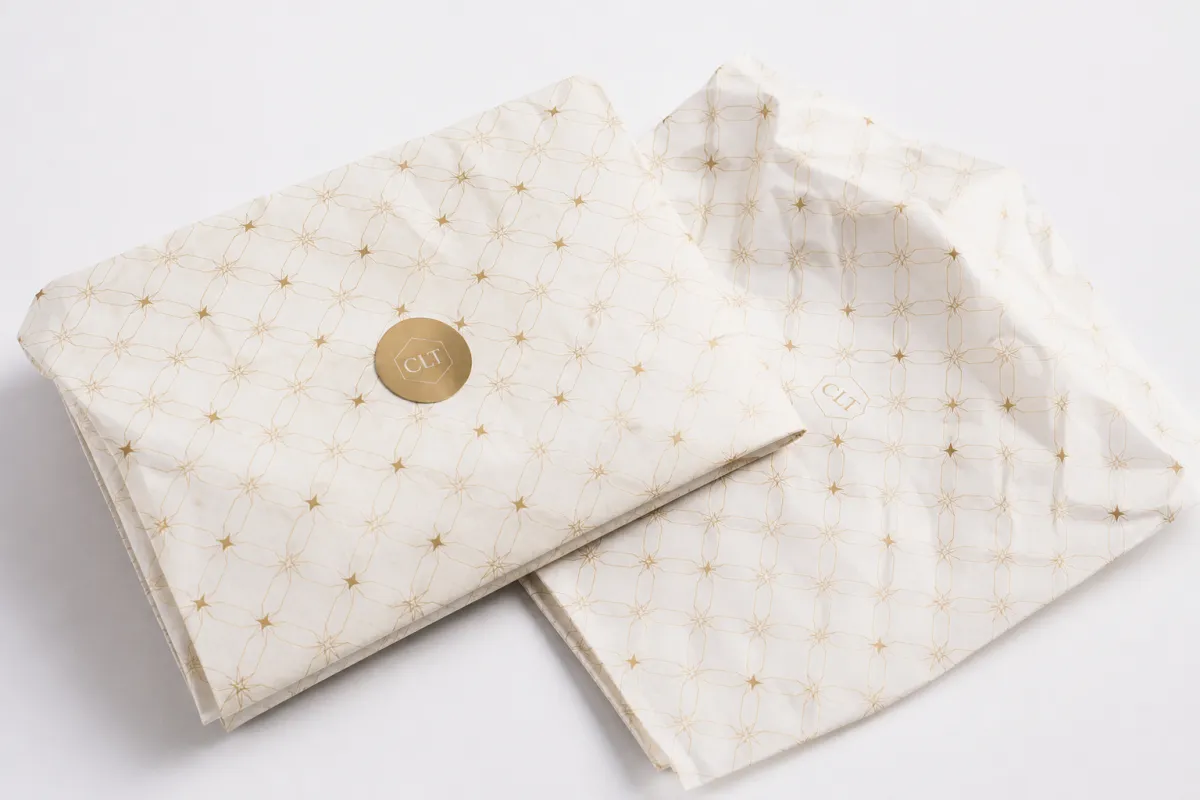
The first mistake many buyers make is treating tissue paper as if every sheet were interchangeable. It is not. A craft project can survive retail packs. A brand shipping 1,000 or 10,000 parcels cannot. Printed Tissue Paper wholesale cuts unit cost, but the bigger win is control: less scrambling to restock, fewer size mismatches, and no guessing whether the same stock will even exist next month. That predictability matters more than people think.
Consistency matters just as much as cost. A gift set in October and a basic apparel order in November can use the same sheet size, the same print repeat, and the same visual tone. That kind of continuity matters for e-commerce brands, boutiques, gift companies, and subscription boxes because packaging stops being an afterthought and starts doing part of the selling. I’ve seen a plain product feel far more expensive simply because the tissue matched the carton and the insert card without fighting for attention.
Freight behaves better than buyers expect, too. Tissue is light, yes, but that is only half the story. Printed tissue paper wholesale usually arrives in formats that are easier to warehouse, easier to count, and easier to pull during fulfillment. Less wasted carton space. Less rework. Fewer emergency retail purchases that quietly eat margin one small order at a time. That’s the kind of line item that makes finance people grin, even if they won’t use the word “grin.”
The commercial reality is plain: a few dozen sheets can come from retail without much pain. Repeated runs change the math. Printed tissue paper wholesale gives buyers control over details that shape the finished package, including repeat spacing, print density, and exact dimensions. No guesswork. No “close enough.”
The logic is similar to the move from generic mailers to custom cartons. Once order volume steadies, packaging stops acting like a supply-store errand and starts functioning like part of the operating system. Brands already sourcing through a Wholesale Programs page usually understand that this is the kind of item that belongs there.
Best fit buyers usually include:
- E-commerce brands that want a branded unboxing layer in every parcel
- Boutiques and gift shops that need a cleaner retail presentation
- Subscription boxes that rely on the same insert format month after month
- Seasonal brands that want holiday print runs without overbuying retail stock
- Promotional packaging teams that need consistent color and print placement
The strongest wholesale buyers think in cycles, not isolated orders. They place one run, document the spec, and stop burning time on short-term fixes. That is the quiet advantage of printed tissue paper wholesale.
Printed Tissue Paper Wholesale Product Details That Matter
Good printed tissue paper wholesale orders begin with the basics: sheet size, paper weight, print coverage, and the way the design repeats. Those four choices decide whether the tissue feels premium, flimsy, wasteful, or awkward in the box. Ignore them and the sample may look lovely while the packing line fights the material.
Sheet size comes first. Common sizes often land around 20 x 30 inches, 15 x 20 inches, or a custom dimension matched to the product and carton size. Smaller sheets can work for jewelry, cosmetics, and folded inserts. Larger sheets fit apparel, gift boxes, and Fragile Items That need more wrap coverage. There is no universal winner. There is only the size that fits the product without forcing extra folds. If a team is trying to stuff oversized tissue into a tiny box, the whole thing starts looking a little silly.
Paper weight shifts both feel and performance. Lighter tissue, often in the 17gsm to 22gsm range, drapes well and folds easily. Heavier stock, often around 22gsm to 30gsm, feels sturdier and resists tearing during packing and shipping. Sharp edges and multi-item boxes usually benefit from the heavier side. If the goal is a soft reveal, lighter tissue can look better. That tradeoff is where most of the judgment lives.
Print coverage is where appearance and price diverge. A centered logo repeat on a white sheet is simple and usually cost-efficient. A multi-color scattered pattern asks for more setup and more ink. Full-bleed coverage can look striking, but it also demands more planning and usually more budget. Buyers of printed tissue paper wholesale should not confuse “more print” with “better print.” A restrained two-color repeat often reads as more polished than a crowded full-sheet design.
The finish is usually matte. That is not a compromise; it is part of the material’s character. Tissue paper is supposed to feel soft and natural, not glossy or synthetic. Recyclable stock or acid-free tissue should be requested early, because those details affect sourcing and can matter for fragile products, archival pieces, or high-end gift presentation. For sustainability claims, check the actual paper spec instead of assuming every tissue sheet is interchangeable. The EPA offers general packaging and waste guidance at epa.gov, and that baseline is worth reviewing before making environmental claims that need support.
Ink choice matters too. Soy-based and water-based inks are common, depending on the supplier and print method. The right ink depends on coverage, color count, and how much rub resistance the brand needs. If the tissue sits inside a box and does not rub against rough products, standard print performance is often enough. If the product ships with a lot of movement, ask how the print handles scuffing before approving the run. That one question can save a headache later.
Common print styles buyers request
- Single-color logo repeat for clean, low-noise branding
- Two-color repeat pattern for stronger shelf presence
- Full-bleed branding for premium presentation and larger budgets
- Edge-to-edge patterns for gift wrapping and retail display
- Custom message prints for seasonal campaigns or limited drops
Practical uses are easy to map. Wrap fragile items. Separate SKUs inside a shipping carton. Add a branded reveal when the customer opens the package. Use it as a light dust barrier for apparel. None of that is theatrical, and that is exactly the point. Printed tissue paper wholesale keeps showing up in stable packaging programs because it solves ordinary packing problems while making the box look deliberate.
A useful rule: the more jobs the tissue has to perform, the more carefully the stock weight and print placement should be defined. A weak sheet can pull down an otherwise strong package. A properly specified sheet does the opposite.
Printed Tissue Paper Wholesale Specs, Materials, and File Setup
Before asking for a quote, lock in the spec. Buyers skip that step all the time, then wonder why pricing feels vague. Printed tissue paper wholesale orders become easier to price, proof, and produce once the supplier has exact sheet dimensions, sheet count, tissue weight, ink colors, print repeat, and packing format. Without those details, an estimate is closer to a guess than a quote.
Dimensions come first. The supplier needs to know whether the project uses standard sizes or custom cut sheets. Quantity follows. Then the print method and color count. A one-color logo is a different job than a four-color art print. After that, define the packing format: flat-packed reams, loose sheets, or another arrangement that fits storage and fulfillment.
Artwork setup deserves more attention than most brands give it. Vector files are preferred because they keep edges sharp at different sizes and repeat intervals. AI, EPS, and print-ready PDF files are usually the safest formats. Raster artwork can work if it is high resolution and clean. If the file looks fuzzy on screen, the press will not rescue it. Color-sensitive jobs should include a clear Pantone reference. “Close enough” is not a spec, and frankly it never was.
Repeat patterns need explicit spacing instructions. If the logo should appear every 4 inches, say that. If the pattern should scatter with non-uniform spacing, say that too. Placement affects both the final appearance and the cost. Centered logos are usually simpler. Dense edge-to-edge branding requires more planning and can increase ink usage. Printed tissue paper wholesale is one of those products where a small shift in layout can alter the quote in a visible way.
Normal production tolerances apply. Small color shifts between batches, slight registration movement, and sheet-to-sheet variation are part of paper production. That is not sloppiness. It is the nature of the material. Buyers who expect every sheet to behave like a digital mockup usually end up disappointed. A sample or proof prevents a lot of that pain before the full run begins.
Sample approval matters even more if the tissue must sit alongside cartons, bags, or labels. Packaging systems work best when the color family stays coherent. A warm white box and a cold bright white tissue sheet can clash the moment the customer opens the parcel. A specific brand red should be approved before production starts. Printed tissue paper wholesale runs are easier to correct before the batch is made than after it lands.
Handling format is another detail that becomes a warehouse issue later. Flat-packed sheets are easier to store, easier to count, and easier to pull during fulfillment. Loose or bulky formats may save a little prep time, but they can create clutter in the packing area. If the team already manages labels, inserts, and cartons, keep the tissue format simple.
Ask how the supplier packages the tissue for shipping. Moisture protection, carton strength, and edge protection matter. Tissue that arrives bent or damp is not a bargain. Standards from groups like ISTA help frame transit risk in a practical way, which is useful if freight damage is supposed to be “someone else’s problem.”
| Option | Typical Use | Cost Level | Notes |
|---|---|---|---|
| Single-color repeat | Retail orders, apparel, gift wrap | Lower | Clean look, usually easiest to price |
| Two-color repeat | Brand-forward packaging | Mid | Better visual impact, more setup detail |
| Full-bleed print | Premium unboxing, seasonal campaigns | Higher | More ink, more planning, stronger visual punch |
| Custom size + custom pattern | Special product lines | Variable | Best fit when the box and product dimensions are fixed |
Printed Tissue Paper Wholesale Pricing & MOQ
Pricing is where buyers either get a sensible deal or step into a trap. Printed tissue paper wholesale costs depend on quantity, sheet size, ink count, print coverage, paper grade, packing format, and freight. That is the real list. A low unit price without setup or shipping is just a headline, not a quote.
For many programs, a practical MOQ sits around 1,000 to 5,000 sheets per design, though the floor changes with size and print complexity. Larger runs usually drop the unit cost quickly. That is how paper production behaves. Setup costs spread across more sheets, so the per-sheet number becomes kinder as quantity climbs. A brand testing a new look can start lower. A brand with steady replenishment usually pays more by ordering too little.
Cost bands tend to track the print spec. A simple one-color repeat in a moderate quantity usually sits in a lower range, while a dense multi-color design or full-bleed print moves up. At 1,000 sheets, the per-sheet cost can feel high. At 5,000 or 10,000 sheets, the math often improves enough to justify the storage. Printed tissue paper wholesale buyers should compare a few volume tiers before locking the order.
Common cost drivers include:
- Sheet dimensions and total paper area
- Paper weight and finish requirements
- Number of print colors
- Coverage area and repeat complexity
- Proofing and setup labor
- Packing format and carton requirements
- Shipping method and destination
Quote structure matters as much as the unit price. A proper quote should show setup, proofing, production, packing, and freight. If the only number on the page is a low per-sheet figure, ask what is missing. Special packaging, split shipments, and rush handling can turn a cheap-looking order into an expensive lesson. Packaging quotes have a way of exposing optimism.
Many buyers compare these ranges:
- 1,000 sheets: useful for a test run or seasonal launch, but usually the least efficient on a per-sheet basis
- 3,000 to 5,000 sheets: a common sweet spot for small and mid-sized brands with regular order flow
- 10,000 sheets and up: better unit economics, but only smart if the design and inventory plan are stable
Landeds cost matters too. That includes the print price plus freight, packaging, duties if relevant, and any storage handling at arrival. The cheapest printed tissue paper wholesale quote can become the most expensive order once shipping is added. Buyers who compare landed cost instead of only the headline price usually make better calls. That is not theory. That is margin protection.
For many brands, the real question is not whether tissue is affordable. The real question is how much presentation the spend buys. If the order improves perceived value, protects the product, and keeps fulfillment efficient, the spend usually makes sense. If it is decorative clutter, skip it.
Printed Tissue Paper Wholesale Process and Timeline
The order process should not feel mysterious. It usually runs in a straight line: inquiry, quote, artwork review, proof approval, production, packing, and shipping. That is the full chain. Printed tissue paper wholesale orders move faster when each stage is clean and approvals happen on time. The hard part is not the paperwork. The hard part is the delay created by indecision.
A normal timeline often allows a few days for quoting and proofing, especially if the design is simple and the buyer responds quickly. Production commonly takes around 10 to 25 business days depending on size, color count, print coverage, and factory workload. That range is realistic. Complex artwork, unusual dimensions, or a busy production calendar can push it longer. Buyers planning a launch should treat that window as a real constraint, not a loose suggestion.
Delays usually come from the same places: unclear artwork, late color changes after the proof is issued, custom sizing that needs extra prepress work, or buyers who take days to answer a simple proof question. None of that sounds dramatic, but it compounds fast. Printed tissue paper wholesale works best when the artwork is ready before the clock starts.
Transit time is separate from production time, and the two get mixed up constantly. Domestic freight may move quickly. Ocean freight is a different animal entirely. Warehouse consolidation adds more time. If the packaging arrives late, the printer is not always the culprit. Shipping plans matter too. Build a buffer into launch schedules so one missing approval does not hold up the entire release.
Brands that package in cycles should forecast the next order before the current one runs low. Nothing slows a launch faster than waiting for a reprint because the box design changed and nobody flagged the tissue until the warehouse was already short. Printed tissue paper wholesale belongs in the replenishment plan, not in the emergency pile.
Simple timeline breakdown:
- Send logo, dimensions, quantity, and target delivery date
- Review quote and confirm cost, MOQ, and shipping terms
- Approve artwork proof or request one round of revisions
- Release production once the proof is signed off
- Inspect packing details, then ship and receive
The cleaner the process, the fewer surprises. That sounds obvious because it is. In packaging, obvious is valuable.
Why Choose Us for Printed Tissue Paper Wholesale
Buyers usually want three things: clear pricing, steady quality, and no nonsense. Reasonable ask. A strong printed tissue paper wholesale program should earn trust on exactly those points. The value is not just that tissue can be printed. The value sits in tighter spec control, fewer surprises during production, and a process that does not waste a team’s time with vague answers.
Direct factory control helps because it cuts down on translation loss between the order sheet and the actual run. When the dimensions, repeat, paper weight, and packing format are documented correctly, repeat orders become much easier. A buyer should not have to rebuild the project every time. A proper spec sheet makes the second order feel like a reprint, not a new assignment.
Quality control matters more than the material’s simplicity suggests. Tissue still needs inspection. Print clarity matters. Sheet consistency matters. Carton packing matters. If the order ships in rough shape, the savings disappear fast. A credible printed tissue paper wholesale partner should be able to explain how the paper is checked before packing and how cartons are protected during transit.
There is value in working with someone who can answer practical packaging questions instead of just collecting an order. Should the sheet be larger? Should the repeat be denser? Is the extra color worth the cost? Those are packaging questions, not sales questions. A good supplier should explain the tradeoffs in plain language. That saves time and helps avoid mistakes that do not announce themselves until the boxes are already on the dock.
For repeat buyers, predictability is the best part. Once the artwork is approved and the spec is locked, the next run becomes much simpler. Packaging should not become a recurring fire drill. Printed tissue paper wholesale works best as a stable part of the packaging stack, not as a quarterly design experiment.
What good service looks like:
- Clear quote language with setup, production, and freight broken out
- Proofs that show repeat placement and color treatment
- Practical advice on paper weight and sheet size
- Packaging inspection before shipment
- Repeat-order documentation so future runs stay consistent
That is the whole game. Fewer surprises. Fewer reworks. Better odds that the paper approved is the paper that arrives. If you want to compare packaging options more broadly, our Wholesale Programs page is the place to start.
I also prefer suppliers who say the quiet part out loud. A lower unit price may come with a longer lead time. A thicker sheet may cost more, but it can reduce waste because it holds shape better. The cheapest option is not always the smartest one. Strange, I know.
Next Steps for Printed Tissue Paper Wholesale Orders
If you want a clean order, gather the basics before asking for a quote. Send the logo file, preferred colors, target sheet size, quantity, ship-to address, and needed delivery date. If the paper weight or print repeat is already known, include that too. The more precise the brief, the less time gets burned on back-and-forth.
If brand color matters, ask for a sample or printed proof before full production. That is normal caution, not overcaution. A small proof step costs far less than reprinting a full batch because the red came out dull or the logo repeat feels cramped. Printed tissue paper wholesale should fit the packaging system rather than fight it.
It also helps to compare at least two landed-cost quotes. One quote can look cheaper on paper and end up worse after freight. Another may cost more at the unit level but save money on shipping or packing. Full landed cost gives a clearer picture than chasing the lowest headline number.
Prepare this before you request pricing:
- Logo file in vector format if possible
- Exact sheet dimensions or a target product fit
- Preferred ink color or Pantone reference
- Estimated quantity and reorder forecast
- Delivery deadline and receiving location
Then confirm the MOQ, review the proof, and book the slot. That is how printed tissue paper wholesale stays efficient instead of turning into a rush order with extra fees attached. If the packaging calendar is already tight, do not wait until the warehouse is empty. That move almost always costs more than it should.
Printed tissue paper wholesale works best when the buyer treats it as a planned packaging purchase, not a last-minute accessory. Get the spec right. Approve the proof. Check the landed cost. Then place the run while there is still time to fix mistakes before they reach the dock.
FAQ
What is the usual MOQ for printed tissue paper wholesale orders?
Most wholesale programs start around 1,000 to 5,000 sheets per design, though the exact floor changes with size, color count, and print coverage. Higher quantities usually lower the unit cost quickly, so it makes sense to price several volume tiers before choosing the final run. If a brand needs a smaller test order, ask whether the supplier can offer a sample run or a limited production batch. A small run can be useful, but the economics are often a little rough.
How long does printed tissue paper wholesale production usually take?
A normal timeline allows a few days for quoting and proof approval, then roughly 10 to 25 business days for production. Custom colors, complex artwork, and busy factory schedules can stretch the lead time, so buyers should not leave the order until the last minute. Freight time is separate from production time, so the delivery window depends on whether the order ships domestically or by international freight. If the launch date is fixed, build in a buffer instead of hoping for luck.
Can printed tissue paper wholesale match my brand colors?
Yes, many suppliers can work from Pantone references or approved artwork, but buyers should expect minor variation between paper runs. Color matching is strongest when the artwork is clean, the reference is specific, and the proof is reviewed before production starts. For color-critical packaging, it is smart to request a physical sample or printed proof before confirming the full order. That extra step is boring in the best possible way.
What file format should I send for printed tissue paper wholesale artwork?
Vector files are best, especially AI, EPS, or PDF files with outlined fonts and clean logo shapes. High-resolution files can work for simple designs, but low-quality images usually create soft edges and weak print results. Include exact dimensions, repeat pattern notes, and Pantone references so the production team does not have to guess. Guessing is where good packaging projects go sideways.
How is printed tissue paper wholesale packed and shipped?
Most tissue is flat-packed in sheets or reams to protect the print and keep storage simple for warehouse teams. Packaging should prevent creasing, moisture damage, and edge wear during transit, especially on longer freight routes. For larger orders, confirm carton counts, palletization, and delivery terms before approving the quote so logistics do not become a surprise. A clean ship method can save just as much grief as a good print spec.


