Food Apparel Labels Carry More Than a Logo
A customer picks up a bakery tote, a barista ties on an apron, or a restaurant manager hands out new staff caps before a busy service. That small label on the seam, hem, neck, pocket, or bag edge gets touched, washed, pulled, folded, and judged more often than most buyers expect. For food brands, the label is not decoration alone; it is part of how the garment feels, wears, and represents the business after repeated use.
Buyers asking for a printed woven labels Quote for Food usually need clear answers before they can approve production: How durable is the label? Will the color stay close to the brand standard? Can the text be read after washing? What minimum order makes sense? How long will the order take once artwork is approved?
A well-specified woven label can outlast many surface-printed garment decorations because the logo is formed with dyed threads, not only ink sitting on top of fabric. That advantage still depends on the details. Material, thread density, fold style, cut method, backing, printed copy, and sewing placement all affect the finished result.
Food apparel also takes real abuse. Aprons go through repeated wash cycles. Chef coats rub at the neckline, sleeves, and placket. Branded T-shirts may be sold as retail merch, then worn weekly by loyal customers. Tote bags get dragged through markets, delivery runs, counters, storage rooms, and car trunks.
The label has to look polished without becoming uncomfortable or impractical. A sauce brand selling caps at pop-ups may want a crisp exterior woven patch. A café group ordering employee shirts may need a soft neck label that does not scratch. A bakery with retail aprons may prefer a folded hem tag that looks intentional but does not overpower the garment.
Custom Logo Things helps turn those choices into quote-ready production specs: artwork, dimensions, fold, materials, quantity, timeline, finishing, and intended use. Clear specs save time because they remove guessing before the order moves into proofing and production.
Production rule: a label is only premium if it works on the garment, survives the wash plan, and can be repeated cleanly on the next order.
Product Details for Printed Woven Clothing Labels
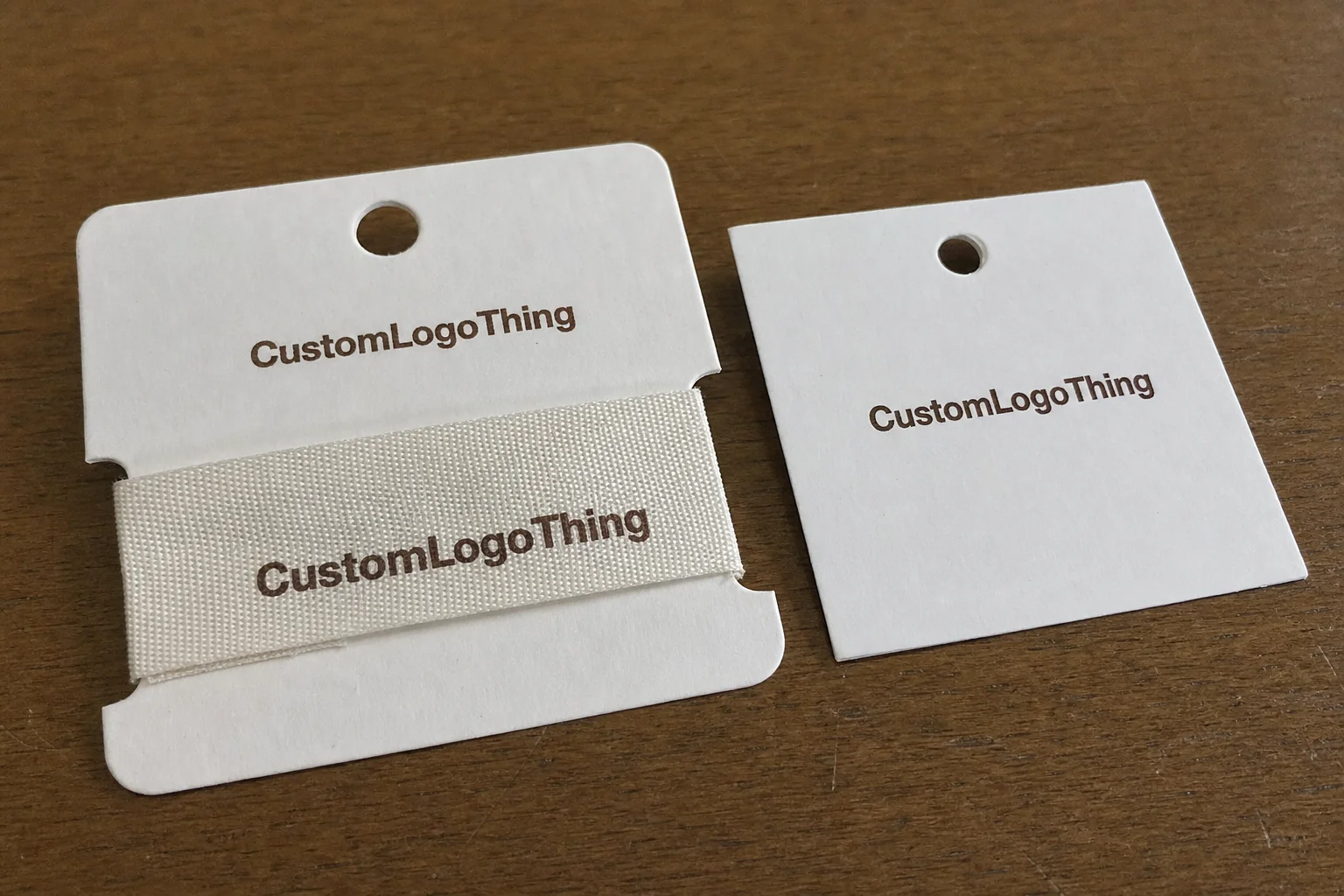
Printed Woven Labels combine two decoration methods. The main artwork is created with interlaced threads, usually polyester, while printed details can be added for copy or graphics that are too fine, variable, or detailed to weave cleanly. Think of the woven portion as the durable branded base and the printed portion as the fine-detail layer.
Food brands use these labels in predictable places. Neck labels work well for branded T-shirts, sweatshirts, and retail apparel. Side seam labels add a subtle brand mark without crowding the chest print. Hem tags give uniforms and staff shirts a finished look. Folded labels can be sewn into apron pockets, waist seams, chef coat plackets, or reusable bag edges. Exterior logo labels, including thicker woven bases, are common on caps, canvas totes, workwear-style overshirts, and heavier aprons.
Construction determines how the label sits after sewing. A straight cut label lays flat and is often used as an exterior patch. An end fold tucks the left and right ends under for a cleaner sew-down. A center fold is common for necklines, hems, and side seams where the fold is captured in stitching. A Manhattan fold combines a center fold with tucked ends for a very clean collar application. A loop fold works well for hanging or seam labels, while a mitre fold creates angled ends often used on sleeves, hems, and premium trim placements.
Most food apparel programs use damask woven polyester because it holds clean edges better than lower-density weaves. Satin-style woven materials feel smoother against skin, which matters for neck labels and chef wear. Thicker woven bases can be a good fit for heritage food brands, butcher shops, breweries, coffee roasters, workwear-inspired merch, and canvas bags, but they can feel bulky in a lightweight T-shirt collar.
Printing becomes useful when the label needs small care text, bilingual copy, QR codes, small-batch variants, promotion marks, franchise identifiers, or other details that would blur if woven. A good quote separates woven elements from printed elements because each process affects cost, proofing, tolerance, and durability differently.
If you already know the label placement and garment type, Custom Logo Things can help shape the request through the Custom Labels & Tags product category. The best quote does not start with the logo alone. It starts with where the label will go, what it will touch, and how the garment will be used.
Specs That Affect Label Look, Feel, and Wash Life
A logo file helps, but it is not enough to quote accurately. Cost and performance come from the full specification: size, fold, thread count, backing, printed coverage, edge finish, and attachment method. A 1-inch center fold neck label is a different product from a 2.5-inch end fold apron patch, even if both carry the same logo.
Before requesting pricing, confirm as many of these details as possible:
- Finished label dimensions: width and height after folding, usually stated in inches or millimeters.
- Fold style: straight cut, end fold, center fold, Manhattan fold, loop fold, or mitre fold.
- Base material: damask polyester, satin-style woven material, or heavier woven base.
- Thread colors: often 2 to 6 colors for efficient production, depending on artwork complexity.
- Printed colors: especially for care instructions, QR codes, small text, or batch identifiers.
- Edge finish: heat cut, ultrasonic cut, woven edge, or folded edge depending on comfort and placement.
- Backing option: sew-on, iron-on, adhesive backing, or heat-seal backing if suitable for the garment.
- Placement: collar, side seam, hem, sleeve, pocket, apron strap, bag edge, or cap panel.
- Garment fabric: cotton jersey, poly-cotton twill, canvas, denim, chef coat fabric, or performance knit.
Color needs a practical conversation. Woven threads can often be matched closely to Pantone references, but thread has texture and reflects light differently than ink on coated paper or color on a screen. A black-and-cream café logo may look warmer in thread than in a PDF proof. A bright sauce brand orange may need the closest available thread match rather than a mathematically exact color.
Artwork should be vector whenever possible: AI, EPS, SVG, or press-quality PDF. Small serif text, thin lines under about 0.3 mm, and tight negative spaces may need adjustment before weaving. Simplifying a mark is not a downgrade if it makes the label cleaner, more readable, and easier to repeat on future orders.
QR codes deserve extra care. A code that scans at 1 inch on paper may fail on textured fabric if the quiet zone is too tight, the contrast is weak, or the print shifts slightly during production. If a QR code is required, the final scanned size, print area, contrast, and registration tolerance should be reviewed before approval.
Laundering is one of the biggest practical concerns for food service. Aprons, chef coats, and uniforms may see warmer water, more frequent washing, and more mechanical agitation than casual retail shirts. Strong wash resistance usually calls for polyester woven material, stable edges, and a fold style that keeps raw edges away from the wearer’s skin. For heavy-use garments, fewer fragile details and a little more breathing room in the artwork usually perform better.
Compliance-adjacent copy should be handled carefully. If care instructions, fiber content, country-of-origin information, or retailer-required language must appear on the label, the buyer should supply the exact approved wording. Custom Logo Things can place it, size it, and quote it, but legal and regulatory language should come from the brand, garment supplier, retailer, or compliance advisor. For broader packaging and sustainability reference points, organizations such as the Forest Stewardship Council can be useful if the program also includes paper tags or certified packaging materials.
| Label Option | Best Food Brand Use | Typical Strength | Watch Point |
|---|---|---|---|
| Damask woven polyester | T-shirts, aprons, retail apparel, chef coats | Crisp logo detail and good wash life | Very tiny text may still need printing |
| Satin-style woven label | Neck labels and comfort-sensitive placements | Smooth hand feel against skin | Can look less textured than heritage branding wants |
| Thicker woven base | Caps, workwear, canvas totes, apron patches | Substantial retail appearance | May be too bulky for lightweight garments |
| Printed detail on woven base | QR codes, care copy, bilingual text, variants | Better readability for fine information | Print durability must match laundering expectations |
Printed Woven Labels Quote for Food: Cost, MOQ, and Unit Price
Pricing gets clearer once the label is treated like a manufactured trim component rather than a loose decoration idea. A useful quote should show what drives the price, where the minimum order quantity sits, and how unit cost changes as volume increases.
The main cost factors are straightforward: order quantity, finished size, fold type, woven thread colors, printed details, backing, cutting method, packaging requirements, and shipping destination. A larger label uses more material and loom time. More colors can add complexity. A Manhattan fold takes more finishing labor than a straight cut label. QR code printing requires added setup and proof review. Individual bagging, bundle labels, or special packing instructions can also add handling cost.
MOQ depends on the exact construction. Smaller trial runs may be possible, especially for simpler labels, but better unit pricing usually appears once setup, loom programming, cutting, folding, and inspection are spread across more pieces. For many custom woven label projects, buyers start comparing around a few hundred pieces, then review stronger unit economics at 1,000, 2,500, 5,000, or 10,000 pieces. These are planning brackets, not universal rules.
As a practical example, a 1.25-inch center fold neck label for T-shirts may quote very differently from a 2.75-inch end fold apron label with six thread colors and printed bilingual care text. A simple small woven label in a few colors can land far lower per unit at bulk volume than a larger folded label with printed QR details, special backing, and rush freight.
Low unit price can be a trap. Buyers sometimes shave pennies by approving a label that is too small for the logo, too stiff for the garment, or too light for repeated laundering. A scratchy neck label or curling apron patch costs more in complaints and reduced wear than the small savings gained during production.
For an accurate quote, send the following:
- Logo or artwork file, preferably vector
- Finished label dimensions
- Quantity needed, with possible reorder volume
- Fold type, or placement photos if you are unsure
- Garment type and fabric, such as apron twill, cotton jersey, or canvas tote
- Any printed copy, QR code, care text, or franchise identifier
- Target delivery date and shipping location
- Whether a physical sample or pre-production approval is required
Ask for two or three quantity breaks. A food startup might compare 500 labels for launch, 2,500 for the first reorder, and 5,000 for seasonal merch. A restaurant group might compare one location’s uniforms against a full rollout. The quote then becomes a planning tool, not just a price.
| Quantity Bracket | Typical Buyer Scenario | Pricing Behavior | Best Use |
|---|---|---|---|
| Small trial run | New café merch or first apron test | Higher unit cost due to setup spread over fewer labels | Testing size, placement, and brand fit |
| Mid-size order | Restaurant team uniforms or retail T-shirt launch | Better unit cost with practical inventory control | Launch programs and local rollouts |
| Bulk production | Multi-location uniform refresh or wholesale merch | Lowest unit cost in most standard specs | Reorders, franchise programs, and planned replenishment |
Process and Timeline From Artwork to Finished Labels
A clean process protects the buyer and the production team. The normal order flow is simple: submit artwork and specs, review the quote, confirm the layout, approve the digital proof, produce a physical sample if requested, begin bulk weaving and printing, finish edges and folds, inspect, pack, and ship.
Timelines vary. Artwork readiness, proof approval speed, sample requirements, quantity, finishing complexity, and shipping method all influence the schedule. A straightforward woven neck label with approved vector art can move faster than a folded label requiring QR testing, printed care copy, and physical sample approval. Many standard custom label projects are planned in business-day blocks because loom setup, weaving, finishing, and inspection each need time.
Send vector artwork early. Confirm label placement with the garment maker or decorator before approving the proof. If labels are being sewn into aprons, ask whether the sewing team wants end fold, center fold, or straight cut. If labels are going onto caps, confirm whether they will be sewn flat, heat applied, or attached before final cap assembly. Those details affect both construction and pricing.
A sample adds time, but it can prevent expensive mistakes. If the label must match an existing uniform line, franchise standard, or retail product already on shelves, a physical pre-production sample is often worth the extra step. Digital proofs are useful for layout, but they do not fully show thread texture, edge feel, stiffness, or how a label behaves on curved fabric.
Common delays are predictable: low-resolution logo files, missing fold instructions, unapproved care copy, late color changes, and rush requests that require freight changes. Another frequent issue is copy being revised after loom programming or print setup starts. Even a small wording change can interrupt the schedule if it affects line breaks, print plates, QR testing, or label dimensions.
The sales process should feel organized and calm. Good production work is not about pressure. It is about removing guesswork before material is woven, printed, cut, folded, counted, and packed.
- Submit: artwork, quantity, size, fold, placement, and target date.
- Quote: confirm cost, MOQ, timeline, and any sampling needs.
- Proof: review dimensions, colors, fold marks, and printed details.
- Sample: optional, but useful for matching existing programs.
- Produce: weave, print, cut, fold, inspect, pack, and ship.
Quality Checks That Matter for Food Brand Apparel
Quality control is not a final glance at a finished label. It starts with practical spec review and production-aware artwork feedback. A focused custom label manufacturer should flag a logo that is too detailed for the requested size, a fold style that does not fit the garment placement, or printed detail that needs more contrast before release.
On the production side, the inspection points are specific. Edge consistency matters because rough or uneven edges can irritate skin or look cheap on retail goods. Fold accuracy matters because a center fold that drifts by even a small amount can sit crooked in a neck seam. Thread clarity matters because small brand marks can fill in if the weave is too dense or the artwork is not simplified properly.
Print registration matters too. If QR codes, small care copy, or bilingual text are printed over a woven base, the print must land where the proof shows it. Color consistency should be checked across the order, especially on logos with strong brand colors. Backing adhesion, where applicable, should be reviewed for the intended attachment method. Count verification sounds basic, but it becomes critical when a sewing contractor is waiting for 2,500 labels and receives fewer than expected.
Food-brand applications create different quality priorities. Staff uniforms need comfort and wash resistance. Retail merch needs a polished finish that supports the selling price of the garment. Promotional apparel needs a label that does not make the item feel disposable. A nice T-shirt with a scratchy neck label gets worn less. A sturdy apron with a curling patch looks tired too soon.
Technical guidance can also save money. Not every program needs six thread colors, a large folded construction, or a specialty backing. Sometimes a 2-color damask label at the correct size looks cleaner than a crowded full-color attempt. Sometimes printed detail on a woven base is the right answer. Sometimes the best recommendation is to make the label slightly larger so the logo can be woven properly instead of forcing unreadable detail into a tiny space.
Custom Logo Things supports custom branding across apparel and packaging, which helps food companies keep labels, tags, stickers, and packaging presentation aligned. If your apparel label is part of a broader rollout, it may make sense to compare hang tags, product labels, and branded packaging during the same planning stage. Testing and transport expectations for broader packaging programs can be informed by groups such as ISTA, especially where shipping performance and distribution handling matter.
Buyers should expect clear specs, realistic timelines, organized proofing, and help catching production issues before they turn into finished inventory. That is how good custom manufacturing stays predictable.
What to Prepare Before Pricing
Before asking for pricing, gather the details that make the quote accurate. Start with the logo file, then choose the label placement, estimate the quantity, select the fold style if you know it, note the garment type, and define the delivery deadline. If care text, origin copy, QR codes, or retailer standards apply, prepare that copy before proofing begins.
Take one garment and mark the label location with tape or a temporary tag. It sounds simple because it is. A 1-inch label may look perfect in a PDF and too small on a heavy apron pocket. A 2.5-inch exterior label may look strong on a canvas tote and oversized on a lightweight T-shirt hem. Physical placement checks prevent many avoidable revisions.
Prepare brand colors with Pantone references if available, but allow for the natural difference between thread and ink. Share washing expectations plainly: home wash, commercial laundry, warm wash, hot wash, tumble dry, or low-heat drying. If the garment supplier has sewing requirements, include those too.
Ask for launch, reorder, and bulk quantity breaks. Purchasing teams can compare total cost and unit cost without restarting the process. If you are matching a previous label program, send clear photos of the front, back, fold, edge, and placement, plus a ruler in the image if possible. Photos help identify fold style, texture, edge finish, and approximate size.
If you are ready to move from rough idea to production pricing, send your details through Contact Us. With artwork, quantity, fold, size, garment use, and timeline ready, Custom Logo Things can prepare a Printed Woven Labels Quote for Food apparel with fewer revisions and a cleaner path to production.
FAQs
What do I need to get a woven label quote for food brand apparel?
Send your logo or artwork file, preferred label size, fold style, quantity, garment type, label placement, target delivery date, and any required text such as care or origin copy. Vector artwork is best because it allows the production team to review line thickness, text size, and color separation more accurately. If you are unsure about fold or size, provide photos of the garment and mark where the label will be sewn.
Are printed woven labels durable enough for restaurant uniforms and aprons?
Yes, when the material, fold, and print method are matched to the wash cycle and garment use. Uniforms and aprons should be quoted with wash resistance, comfort, and edge finish in mind, especially if they will be laundered frequently. For high-use food service garments, polyester woven bases, stable edges, and sensible artwork sizing usually perform better than labels overloaded with tiny detail.
How does MOQ affect the price of custom woven labels for food merchandise?
Higher quantities usually lower the unit cost because setup, loom programming, proofing, cutting, and finishing are spread across more labels. A small test order may be smart for a new merch launch, but a larger replenishment order often gives better value. Ask for multiple quantity breaks so you can compare a launch order against a larger reorder before approving production.
Can small text, QR codes, or care details be included on food apparel labels?
Small text and QR codes may be printed on a woven base when weaving alone cannot hold enough detail. The artwork should be reviewed for minimum readable size, contrast, print registration, and scannability before approval. For QR codes, the final label size and quiet zone around the code are especially important.
How long does production take after approving a custom woven label quote?
Timeline depends on artwork readiness, proof approval, sampling, order quantity, finishing details, and shipping method. The fastest orders are usually those with vector artwork, confirmed dimensions, approved copy, and no late revisions after proofing. If a physical sample is required, plan extra time because the sample must be produced, shipped, reviewed, and approved before bulk production begins.