Private Label Buyer Apparel Poly bags wholesale order planning gets expensive when the spec is loose. A bag that is too large wastes film and carton space. A bag that is too small slows pack-out, creases the fold, or splits at the seal. For buyers, the goal is simple: protect the garment, keep the line moving, and avoid packaging choices that add cost without adding value.
Poly bags remain the standard for folded tees, hoodies, socks, and multipacks because they are light, predictable, and easy to build into landed cost. They do not need to be fancy to work. The right bag disappears into the workflow and leaves the garment looking clean at opening.
The best apparel bag is the one that fits the product, supports the channel, and does not create extra handling.
Why Apparel Buyers Still Use Poly Bags at Scale
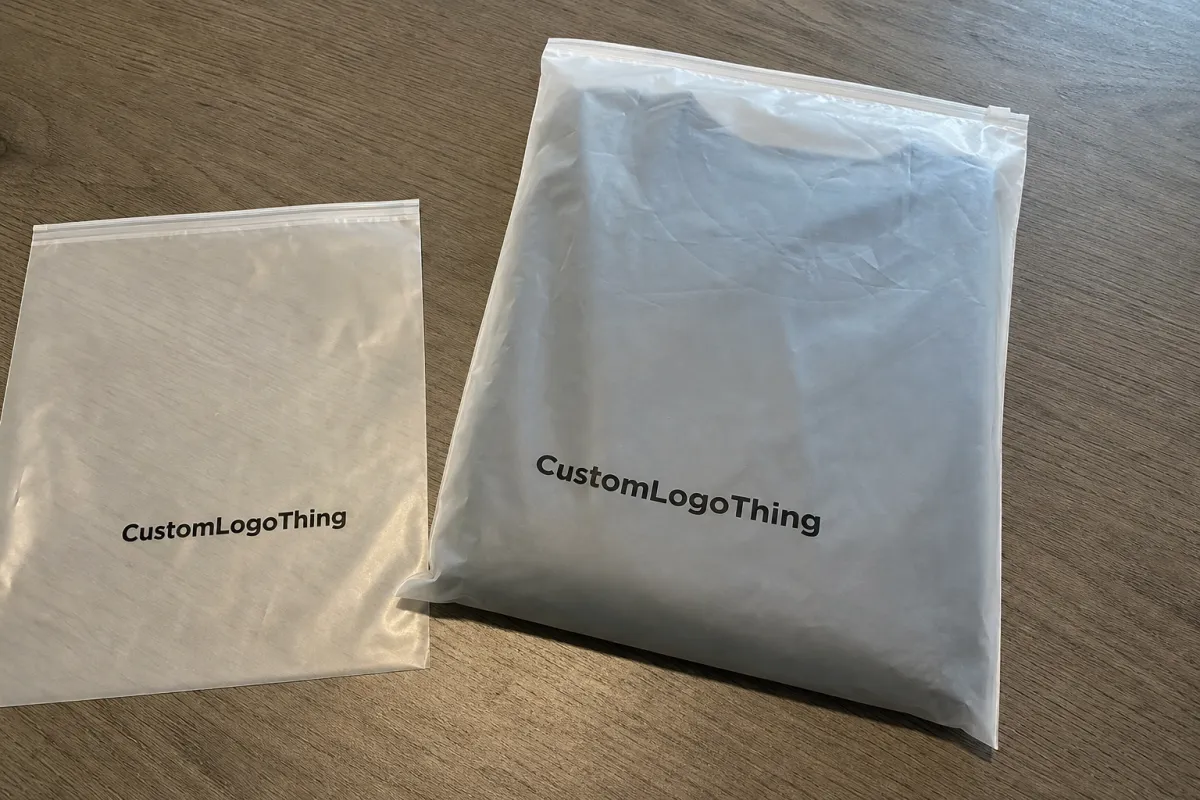
For high-volume apparel, poly bags win on simplicity. They are light, compact, and easy to count, store, and ship. A clear bag can protect the garment, keep the fold neat, and reduce wasted space in the carton. That matters when thousands of units move through the same warehouse process.
Buyers also value consistency. A folded shirt in a poly bag behaves the same way across shifts, sites, and seasons. That makes pack-out faster and reduces training issues. Less empty space usually means better freight efficiency, which matters more once the order reaches scale.
The biggest mistake is overbuilding the spec. Thicker film, oversized dimensions, extra colors, and decorative touches all raise cost. They may sound safer in a meeting, but they rarely solve the actual problem. A light tee does not usually need heavy-gauge film. It needs the right fit and a seal that holds.
That is the practical center of Private Label Buyer Apparel Poly bags wholesale order planning: match the package to the garment and the channel. A bulk basics program can usually use a clean flat bag. Retail presentation may require size marks, a barcode panel, or warning text. E-commerce may justify a resealable closure if the product is opened and handled more than once.
Material choice deserves a fast check. Clear LDPE and LLDPE are common because they balance flexibility, clarity, and sealability. Co-extruded films help when a buyer wants better tear resistance without moving to a much heavier gauge. If the garment has metal trims, rough embroidery, or dense prints, test the film against snag risk rather than choosing by appearance alone.
Bag Styles and Print Options That Fit the Garment
There is no single best poly bag for apparel. Flat bags, gusseted bags, resealable bags, header bags, and suffocation-warning bags solve different problems. The right choice depends on the garment, the channel, and how the unit is handled after packing.
| Bag Style | Best For | Typical Tradeoff | Buyer Note |
|---|---|---|---|
| Flat poly bag | Tees, socks, lightweight basics | Lowest cost, simplest pack-out | Best when folds are consistent and the product is thin |
| Gusseted bag | Hoodies, sweaters, thicker knits | Uses more film and takes more space | Useful when the garment needs extra depth without forcing compression |
| Resealable bag | DTC packs, premium basics, sample programs | Higher unit cost and slower closing step | Worth it when the end customer opens and closes the bag repeatedly |
| Header bag | Hanging display and peg merchandising | More material and more setup | Useful when retail presentation depends on a visible hanging point |
| Suffocation-warning bag | Marketplace and retail compliance needs | Print space is partly committed | Confirm wording and placement before the proof is approved |
Closure style matters just as much as the bag shape. Open-top flat bags are fast for folded tees and bulk basics. A resealable strip slows the line a little, but it helps when the garment may be inspected, returned to the bag, or shipped in a premium format. Header bags make sense when the product has to sit on a hook or in a tray without collapsing.
Printing should support the warehouse first and the brand second. A one-color logo is often enough. In many programs, a clear size mark, barcode panel, SKU code, or warning text is more useful than decorative art. If the bag is part of a larger packaging system, keep the print area uncluttered so the line can identify the unit at a glance.
Finish changes the look more than most buyers expect. Clear film shows the garment and works for most wholesale and retail uses. Frosted or tinted film can hide shadows and reduce the look of overpacked folds. Gloss gives stronger contrast under retail lighting. Matte and frosted surfaces hide scuffs better. None of these is automatically better; the channel decides.
Specs That Control Fit, Protection, and Reorder Accuracy
Bag size should be based on the folded garment, not on hanger size or a generic chart. Measure the product the way it will actually ship, then add enough clearance for loading and a clean seal. For many tees, that means roughly 11 x 14 to 12 x 15 inches. Hoodies usually need more room, often around 13 x 18 or 14 x 20 inches, depending on the fold and trim.
Film gauge is the next decision point. Light tees often work in 1.2 to 1.5 mil film. Midweight basics usually fit better in the 1.5 to 2.0 mil range. Heavier knits, multipacks, and products that face more abuse in transit may need 2.0 to 3.0 mil for tear resistance and puncture protection. More thickness is not always better; too much stiffness can make loading harder and the final pack bulkier.
The seal also affects performance. Bottom seal, side seal, venting, perforation, and hole placement all change how the bag behaves during packing and on the shelf. A bottom seal is common for a straightforward retail look. Side seals can fit certain production methods better. Venting helps bulky garments settle flat. Perforation is useful only if the end user needs easier opening.
For buyer accuracy, proofing is where expensive mistakes are still cheap. Check artwork safe zones, barcode placement, size callouts, warning text, and the orientation of the bag when packed. Lock width and length tolerances before production starts, because a half-inch shift on a narrow fold can spoil the final appearance. If the bag has to survive parcel shipping, ask whether the packed unit should be tested against transport methods such as ISTA.
- Measure the folded garment, not the hanger size.
- Check width and length tolerances before approval.
- Reserve enough panel space for barcode and size markings.
- Confirm warning text, orientation, and print position together.
- Test the fit on an actual folded sample, not only on paper dimensions.
File prep also affects reorder accuracy. If the bag, carton, and shipping label use different style rules, the warehouse ends up reconciling details that should have matched from the start. Good packaging files reduce that churn. A supplier who asks for the fold method, label placement, and carton mark before quoting is helping prevent rework later.
For customer-facing wording, keep disposal or recycling claims accurate and local. Neutral references such as the EPA recycling guidance can help teams avoid blanket statements that are hard to defend.
Private Label Buyer Apparel Poly Bags Wholesale Order Planning: Pricing, MOQ, and Unit Cost Levers to Watch
MOQ is usually driven by setup, print prep, and production efficiency. The quote changes most often with bag size, film gauge, number of print colors, closure style, and order volume. If one of those changes after proof approval, price changes with it.
The ranges below are planning markers, not promises. Resin pricing, freight, and print coverage can move a quote quickly, but the pattern is usually stable enough to help buyers compare options.
| Option | Typical MOQ | Usual Unit Cost Range | Best Use |
|---|---|---|---|
| Flat clear bag, 1-color print | 5,000 to 10,000 pcs | $0.12 to $0.22 | Tees, socks, and lightweight basics |
| Gusseted bag, 1-2 color print | 5,000 to 10,000 pcs | $0.18 to $0.30 | Hoodies, sweaters, and thicker knits |
| Resealable bag with branding | 3,000 to 5,000 pcs | $0.22 to $0.40 | DTC packs, premium basics, repeat handling |
| Header or hanging bag | 5,000 pcs and up | $0.20 to $0.35 | Retail display and peg-hook presentation |
Those figures shift with repeat-run status, print coverage, and whether the job is a first run or a reorder. A complicated first order can cost more than a straightforward repeat at the same quantity. What should raise a flag is a quote that ignores setup, sampling, or freight. Missing costs do not disappear; they show up later.
Landed cost matters more than factory price. Freight, duties, tooling, approval samples, and reprint risk belong in the same calculation. A bag that is $0.02 cheaper at the factory can be more expensive overall if the dimensions are off and the pack line has to slow down or rework units.
There are easy places to save without weakening the package. Standard dimensions usually cost less than custom ones. One or two print colors are simpler than a full graphic. Reusing an approved layout across similar SKUs shortens the reorder path and keeps approval cleaner. Those choices are practical, not flashy, but they help forecast total cost better.
The lowest factory quote is not the lowest program cost if the bag size or print setup makes every other step harder.
Production Steps, Lead Time, and Approval Milestones
A clean order follows a clean sequence: spec intake, artwork review, proof or sample, approval, production, inspection, and shipping. If the brief is complete, the job is predictable. If the files are incomplete, delays move to a later stage where they cost more.
For a standard printed apparel bag, a realistic timeline often looks like this: one to two business days for spec review, one to three days for artwork and dieline adjustments, two to five days for proofing or sampling, seven to fifteen business days for production after approval, and shipping time on top. Reorders usually move faster because the spec is already approved.
The fastest way to lose time is to change dimensions after the proof is aligned. The next fastest is to send artwork that ignores warning space or the barcode panel. Another common delay comes from approving the bag while leaving the carton mark unresolved. None of these issues is complicated; they are just expensive when discovered late.
Buyers can speed the process by approving the dieline, the copy, and the shipping marks together. That reduces the chance that the printed bag and outer label will contradict each other. If the bag is part of a larger apparel rollout, the packaging schedule should sit beside the product launch schedule, not off to the side.
Ask for transit expectations before production if the bagged units are going through parcel channels. Drop risk, compression, and repeated handling are not the same as warehouse storage. A bag that looks good on a table can still perform poorly once it is stacked, shipped, and repacked. The goal is not to overengineer the packaging. It is to understand the stress it will actually face.
For buyers comparing formats, a broader packaging catalog can help separate what belongs in the bag spec from what belongs in the outer pack. A product overview such as Custom Packaging Products can be useful for that comparison when one apparel line needs more than one package type.
What Repeat Orders Depend On
Repeat orders happen when the first run was clean, the proof matched the final product, and the production notes were specific enough to reuse. Good apparel bag planning should remove friction from the next reorder, not create a new decision tree each time the buyer needs more inventory.
From the buyer side, the strongest signs of a reliable spec are simple: the printed panel is where it should be, the gauge feels consistent, the fold fits without squeezing, and the carton count matches the paperwork. That consistency matters more than decorative features. It also prevents waste from overbuying or correcting a bad assumption.
Keep a short reorder record so the next quote stays accurate:
- Save the folded garment measurements used for the approved bag.
- Keep the artwork files, warning copy, and size marks in the same version set.
- Record the approved film gauge and material type for future runs.
- Note the carton mark, pack count, and shipping destination together.
- Flag any compliance requirements that changed after the first order.
If a reorder needs a different size or print panel, treat it as a new spec rather than a casual edit. Small changes can force new tooling assumptions, new proofs, or a different film layout. That is especially true when the bag serves more than one channel. Wholesale, retail, and direct-to-consumer shipments often want different levels of closure, label space, and compliance language.
For the next quote to be useful, the most helpful inputs are straightforward: folded garment dimensions, target quantity, print colors, compliance notes, and destination. That is enough to build a serious estimate instead of a loose guess. If the program also needs other packaging formats, keep those requests separate so the apparel bag spec stays readable and the approval chain stays short.
FAQ
What do I need for a private label apparel poly bags wholesale quote?
Send folded garment dimensions, target quantity, print colors, and whether the bag needs warning text or barcode space. Include the shipping destination and any retail requirements so the quote reflects landed cost, not just unit price.
How do I choose the right bag size for private label apparel?
Measure the folded product the way it will ship, then add enough clearance for loading and sealing. Do not size from hanger dimensions or size labels; the packed fold is what matters.
What drives private label apparel poly bags wholesale pricing the most?
The biggest drivers are size, film gauge, print complexity, order volume, and closure type. Freight, tooling, and reprint risk can matter just as much as the bag price if the spec is not tight.
How long does a wholesale order usually take from proof to delivery?
Simple repeat jobs move faster than custom first runs because artwork and sizing are already approved. Production time depends on volume and print complexity, then shipping time depends on the service level you choose.
Can I reorder the same apparel poly bags without restarting the process?
Yes, if the bag size, artwork, and material stay the same, reorders should move much faster. Keep approved files, specs, and carton marks on hand so the next order does not begin from scratch.


