Private Label Buyer Apparel Poly Bags Material Spec guide sounds technical until a bag that looked perfect on screen arrives too stiff, too loose, or too weak for the folding line. Then the cost shows up in relabeling, damaged garments, and a second shipment. From a packaging buyer's point of view, the mistake is usually not the artwork. It is the film, the seal, or the fit.
A 0.25 mil swing on a 2.0 mil spec is a 12.5% change. That seems minor until the bag starts to split at the seal, scuff a soft hand feel, or run short in a carton count because the film behaves differently on the line. If the same program also uses corrugated cardboard shippers, kraft paper inserts, or hanging tags, the bag spec has to sit beside those decisions, not behind them.
There is a simple way to think about it: a bag spec is closer to shoe size than to style. The artwork may sell the package, but the dimensions and material decide whether the package actually works. Buyers who catch that early usually avoid the expensive kind of correction, the one that comes after the first freight bill.
"The proof passed, but the folded hoodie still did not sit flat." That kind of problem usually traces back to bag gauge, width, or closure design, not the logo.
For private label teams, the purchase is broader than a film quote. It touches garment fold method, retail presentation, warehouse handling, and how fast receiving can move. A bag that works for a standard tee can be the wrong call for a heavyweight knit or a bundled three-pack. The buyer who checks those variables early is usually the one who avoids repacking labor later.
Private label buyer apparel poly bags: why a 0.25 mil miss costs more than print
Most apparel bag problems start with a mismatch between what the product needs and what the quote assumes. A printed logo can be perfect, yet the film may be too soft for stacked cartons, too slick for automated feeding, or too narrow for the folded garment profile. In practice, the material spec does more to protect the order than a second round of artwork comments ever will.
That is why Private Label Buyer apparel poly bags should be treated as a packaging spec, not a commodity line item. The bag has to work at three levels at once: appearance, protection, and handling. If the seal fails, the garment can pick up dust or snag during transit. If the film is too thin, it wrinkles and looks tired under retail lighting. If the fit is too generous, the product shifts inside the bag and the shelf presentation loses the squared look buyers expect.
The hidden cost is rework. A team may approve a proof in one day and spend two more weeks correcting a production issue that was never visible in the artwork. The second run is the expensive part. Every relabel, repack, and reship cuts into margin. That is why the first decision should be the physical spec, not the graphic layout.
Think about garment type the way a production manager does. Lightweight tees can tolerate a simpler flat bag. Heavy fleece and outerwear need more puncture resistance and more room at the side gusset. Retail folding and e-commerce bundling are not the same job either. A program built for folded shelf display may not hold up when the same package is thrown into a mixed fulfillment stream with corrugated cardboard cartons and rougher warehouse handling.
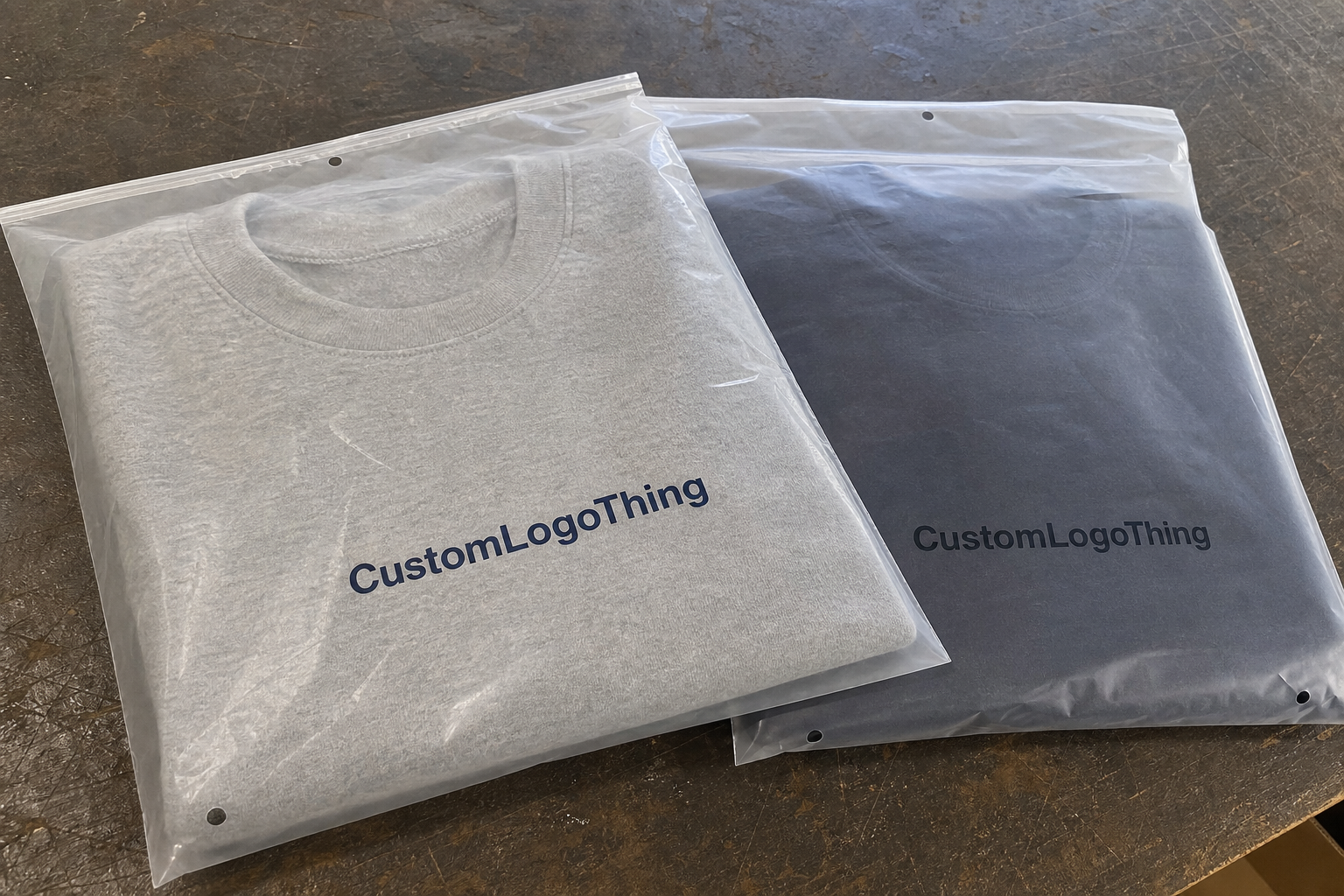
There is also a presentation issue that many buyers underprice. Clear, glossy film shows product well, but it will also magnify any off-center fold or trapped air. Semi-clear film softens the look, which can help on a busy apparel wall, but it can dull the garment color if the haze is too high. Small shifts matter more than people expect because apparel packaging is visual first and protective second.
One more practical comparison: a 10,000-unit order that runs at the wrong gauge often costs more than a slightly pricier quote with the correct gauge. The reason is simple. Waste hides in labor, not material. If the pack-out team has to fight the bag, the unit price stops being the real price.
Bag formats and product details that fit folded apparel
Not every bag style serves the same buyer objective. Flat poly bags are still the workhorse for tees, underwear, and folded basics because they stack well and are easy to pack by hand. Side-seal bags give a cleaner edge and can look sharper on a table display. Gusseted bags solve the volume problem for knitwear, sweatshirts, and bulkier sets. Wicketed bags matter when packing speed is the priority, while resealable zipper bags make sense for returnable packs, bundled sets, or products that need repeated opening.
Hanging-pack formats deserve their own scrutiny. Once a bag needs a hang hole, tear notch, or vent hole, the production logic changes. The design must support peg hook display without tearing, and the vent pattern must let trapped air escape without turning the bag into a weak point. Perforation helps with multipacks or inner packs, but it should be positioned so the finished unit still looks deliberate on the shelf.
Product details also influence merchandising. A logo printed too high can disappear once the garment is folded. A size mark that sits too low can get blocked by a carton lip. Adhesive closures are useful for quick line speed, but they can leave residue if the adhesive is too aggressive or the storage climate is hot. If the bag is being paired with Custom Labels & Tags, the artwork and the size callout should be designed together so the whole package reads as one system.
Clear film versus semi-clear film is not just a visual choice. Clear film gives the most product visibility and usually helps when the garment itself is part of the sell. Semi-clear film gives a slightly softer presentation and can hide minor fold imperfections. Gloss versus matte matters too. Gloss reads brighter and cleaner. Matte reads more premium, but it can mute print contrast unless the artwork is tuned correctly.
Fit is the quiet variable that decides whether the bag looks intentional or sloppy. A tighter fit often improves shelf appearance because the garment sits flatter and moves less during transport. Too tight is just as bad, though, because it can scuff screen prints, crush embellishments, or stress seams. The right answer is a measured fit around the folded garment, not a guessed bag width.
For buyers managing several SKUs, the easiest mistake is mixing fold methods. A tee folded to one board size may fit a 9 x 12 bag cleanly, while the same width fails once the neckline is folded differently for a retail wall. The bag spec should follow the fold spec, not the other way around.
Material specifications that control clarity, seal strength, and damage risk
The core spec fields are simple on paper and surprisingly easy to blur in a quote. Buyers should lock down resin type, film gauge, bag width, bag length, seal profile, slip characteristics, and any recycled-content requirement. If any of those drift, the bag can still arrive on time and still be wrong.
LDPE is the common starting point for apparel because it gives a soft hand, good clarity, and broad use across retail folding. LLDPE blends tend to offer better puncture resistance and a little more toughness, which helps with heavier garments and tighter freight stacking. Recycled-content options can work well when the spec is controlled, but they need closer review because clarity, thickness consistency, and seal behavior may vary more than they do in virgin film. Not all recycled materials behave alike, and that is where buyers get surprised.
The question is not only what the material is called. It is what it does. Haze, gloss, tensile strength, seal integrity, puncture resistance, and thickness tolerance matter more in practice than a nominal mil number by itself. A bag that measures 2.0 mil on the quote but wanders in production will behave differently from one held to a tight tolerance band. Ask for the actual tolerance and the test method. A supplier who can speak clearly about seal checks, tensile testing, and thickness control is usually easier to work with than one who only repeats the resin name.
For buyers who need a standards reference, seal-strength checks should map to something like ASTM F88-style testing, while film tensile performance can be compared against ASTM D882. Transit and distribution expectations often follow ISTA procedures, especially when the product ships through mixed carton networks. If the program also includes paper components, confirm whether cartons or inserts are FSC certified before you print the claim on the package. Claims and certifications should match the paperwork, not the sales pitch.
There is one more point that keeps showing up in approvals: suffocation warnings and retail labeling. A bag can have the right film and the wrong copy placement, and that still delays launch. Barcode location, warning text size, and any retailer-specific packaging rule should be approved before mass production starts. If a brand also uses biodegradable packaging language elsewhere in the line, do not let that term leak into a poly bag spec unless the material and certification actually support it.
Thickness alone is not enough to judge performance. A well-made 1.75 mil film can outlast a poorly controlled 2.0 mil run if the co-extrusion is stable and the seal line is consistent. Buyers sometimes chase a heavier number because it sounds safer. In practice, consistency beats bravado.
| Material option | Best fit | What to verify | Typical unit cost at 5,000 pcs |
|---|---|---|---|
| LDPE | Tees, basics, clean retail presentation | Clarity, gauge consistency, seal edge | $0.05-$0.09 |
| LLDPE blend | Knits, hoodies, heavier folded apparel | Puncture resistance, slip, scuff control | $0.06-$0.11 |
| Recycled-content blend | Programs with recycled materials targets | Haze, print hold, seal repeatability | $0.07-$0.13 |
| Specialty or zipper film | Premium retail, returns, reusable packs | Closure strength, fit, assembly speed | $0.12-$0.24 |
Those numbers are directional, not a promise. Size, print coverage, film source, and packing configuration can move the quote quickly. Still, the table makes one thing obvious: the cheapest-looking film is not always the cheapest bag once you account for rejects, rework, or a failed presentation standard.
What to lock in before you request quotes
A useful spec sheet is not long. It is complete. The buyer should be able to send one file and avoid a round of interpretive questions from three different suppliers. That usually means the garment type, folded dimensions, target bag size, film gauge, material type, closure style, print copy, warning text, carton count, pallet count, and delivery window are all written down before the RFQ goes out.
Add the handling environment too. A bag going into a climate-controlled store backroom has different demands than a bag that will move through a mixed e-commerce warehouse. Static, scuffing, and cartoning pressures can all change the correct spec. If the garment has embellishment, embroidery, foil print, or a raised heat transfer, call that out. Those details matter because a soft film that works on a plain tee can leave marks on decorated apparel.
It also helps to define the acceptable range for fit. A 1/4 inch difference in width sounds small on paper; in a tightly folded pack, it can decide whether the garment sits flat or buckles at the seam. Buyers who standardize the fold board across similar styles usually get better repeatability and fewer surprises in receiving.
There is a reason the best sourcing teams obsess over the boring fields. Artwork can be adjusted. A wrong bag width is harder to forgive. Once the cartons are on the dock, the spec is no longer theoretical.
Pricing, MOQ, and unit cost drivers for apparel poly bag orders
Price is built from pieces, and every piece is visible if you know where to look. Resin cost, film gauge, bag dimensions, closure style, print colors, tooling, and carton configuration all move the unit cost. Freight matters too, especially if the bags are packed in dense corrugated cardboard shippers that push pallet weight up fast.
The MOQ question is usually less mysterious than buyers think. A lower quantity raises the per-unit cost because setup, print, and changeover are spread across fewer bags. A higher run often lowers the piece price, but only if the spec stays stable. If the buyer keeps changing the width or the warning text, the savings disappear before production starts.
At a practical level, many custom apparel poly bag orders land in the following pattern: plain clear bags at lower volumes can sit around $0.05-$0.10 each, while one-color printed bags often move into the $0.09-$0.16 range, and more complex print or specialty closures can run higher. That is why a sourcing team should compare quotes using the same bag size, the same film, and the same print count on every line item. A quote that looks lower may simply be quoting a lighter spec.
A clean quote request should include exact garment type, folded dimensions, bag width and length, film gauge, closure style, print copy, warning text, carton pack count, ship date, and destination. If the product is part of a wider packaging refresh, it can be worth bundling the order with Custom Packaging Products rather than splitting artwork reviews across three vendors. DTC programs are different; if the same SKU needs ship-ready protection, compare the bag against Custom Poly Mailers before assuming one format can cover both retail and fulfillment.
There are a few savings levers that do not weaken the spec:
- Standardize widths across similar garments so one die can serve multiple SKUs.
- Reduce print colors if the logo system allows it.
- Cut duplicate bag styles and keep one spec for the majority of the line.
- Align order quantity with the supplier's production run so changeovers are not wasted.
The cheapest way to buy bags is not to chase the lowest quote. It is to remove ambiguity. Once the supplier is comparing the same film, the same dimensions, and the same print setup, the pricing conversation becomes honest.
One hidden driver is packing configuration. If a supplier packs 1,000 per carton and another packs 2,000, the per-unit freight exposure changes even when the material cost looks similar. That difference matters on large programs, especially when orders move by the pallet rather than by the case.
Process, timeline, and production steps from quote to shipment
A good run usually follows a predictable path: RFQ, spec confirmation, artwork review, sample approval, production scheduling, quality checks, packing, and freight booking. That sequence sounds simple because it is simple. The problems show up when one step is rushed or skipped.
Artwork is a common delay point, but not the only one. Late changes to bag size, missing compliance copy, and back-and-forth over film gauge can all push the schedule. If the supplier has to re-quote after the buyer changes the bag style, the whole timeline resets. That is why the first approval should include the physical dimensions, not only the design file.
Lead time depends on what is actually being made. Stock film with simple print can move faster. Custom film, multiple colors, or tightly managed retail approvals take longer. In many programs, a straightforward order may ship roughly 12-15 business days after proof approval, while a more complex run can stretch longer depending on material availability and inspection requirements. That range is normal. The mistake is assuming every quote should behave the same way.
Ask for proof photos, written signoff, and at least one checkpoint before mass production. If the run is sensitive, request sample cartons so the receiving team can see how the bags will arrive on the dock. For buyers managing a large apparel line, the receiving question matters as much as the print question. A bag that arrives in the wrong carton count, with weak pallet wrap or crushed edges, still costs time even if the film itself is right.
Warehouse handling should not be an afterthought. Outer packaging often changes the outcome. A neat bag packed into tidy corrugated cardboard cartons is easier to count, store, and issue. Kraft paper dividers may help with mixed SKU packs. If the packaging program uses recycled materials or post-consumer waste claims anywhere else in the line, keep the bag spec aligned with those documents so the whole package reads consistently to the buyer and to compliance.
Inspection should be more than a box tick. A real check looks at seal line integrity, print registration, edge trimming, and carton labeling. A supplier can pass a visual inspection and still have gauge variation that shows up only when the warehouse opens the first master carton. That is why the best programs include both a sample approval and an arrival check.
Supplier controls and next steps to order with confidence
Supplier controls are what separate a decent quote from a dependable run. Incoming resin checks, in-process thickness verification, seal testing, and final carton audits reduce rejects before the goods leave the plant. You do not need a supplier to sound impressive. You need one that can repeat the same result twice.
Price matters, but response speed and spec discipline tell you more. If a supplier answers with a clear drawing, a named gauge, and a realistic lead time, that is a positive sign. If they keep saying yes without asking about garment dimensions or folding method, expect trouble later. The best vendors translate a retail requirement into a stable production spec, then hold that line through the run.
Before you approve an order, send the garment dimensions, target bag count, print file, warning text, required MOQ, and delivery deadline. If the packaging system also needs labels, line cards, or hang tags, lock that artwork at the same time so the visual system stays consistent. Good production planning is mostly about removing surprise.
Here is the shortest path to a safe order:
- Request a sample and compare it against the written spec.
- Check width, length, gauge, seal, print placement, and warning copy.
- Confirm carton count, pallet condition, and ship window in writing.
- Approve the final art only after every field matches.
- Release the production order only when sourcing and receiving are aligned.
That sequence protects margin better than a small price concession. If you are building private label programs at scale, keep the physical spec in front of the art file and the freight booking behind it. That is the discipline that keeps a private label buyer apparel poly Bags Material Spec guide useful after the quote is signed, not just before it.
What film thickness works best for private label apparel poly bags?
Lightweight tees and folded basics often start with a thinner gauge, while heavier knits, hoodies, and e-commerce packs usually need more puncture resistance. Ask the supplier for the actual tolerance range, not just the nominal mil number, because small shifts can change seal behavior and clarity.
How do MOQ and unit cost change on custom apparel poly bags?
A higher MOQ usually lowers unit cost because setup, printing, and changeover expenses are spread across more bags. Print colors, bag size, and custom film choices can raise MOQ or price, so compare quotes using the same spec on every line item.
Which material is best for clear garment presentation bags?
LDPE or a blended film is commonly used when a soft hand and clear presentation both matter. If shelf appearance is the priority, ask for haze, gloss, and seal-strength data so you can compare options with the same standard.
What is the normal lead time for private label apparel poly bags?
Lead time depends on whether the job uses stock film, custom film, or printed copy that requires proof approval. The fastest orders are the ones with locked artwork, exact dimensions, and no late-stage spec changes.
What should I check before approving a shipment of apparel poly bags?
Verify width, length, gauge, print placement, and warning copy against the approved spec sheet. Check carton counts, pallet condition, and seal integrity so the shipment can move straight into packing without rework.