Buyer Fit Snapshot
| Best fit | Recyclable Mailer Sleeves Bulk projects where brand print, material claims, artwork control, MOQ, and repeat-order consistency need to be specified before quoting. |
|---|---|
| Quote inputs | Share finished size, material target, print colors, finish, packing count, annual reorder estimate, ship-to region, and any compliance wording. |
| Proofing check | Approve dieline scale, logo placement, barcode or warning zones, color tolerance, closure strength, and carton packing before bulk production. |
| Main risk | Vague material claims, crowded artwork, missing packing details, or unclear freight terms can make a low unit price expensive after revisions. |
Fast answer: Recyclable Mailer Sleeves Bulk: Specs, Pricing, Timing should be specified like a repeatable production item. The safest quote records material, print method, finish, artwork proof, packing count, and reorder notes in one written spec.
Production checks before approval
Compare the actual filled-product size with the drawing, then confirm tolerance on folds, seals, hang holes, label areas, and retail display edges. Reserve space for logos, QR codes, warning copy, and material claims before decorative graphics fill the panel.
Quote comparison points
Review material grade, print process, finish, sampling route, tooling charges, carton quantity, and freight assumptions side by side. A quote is only useful when the supplier can repeat the same color, closure quality, and packing count on the next order.
Most teams do not bleed margin on the product itself. They lose it in oversized packaging, clumsy packouts, and the kind of damage that shows up after a customer has already opened the parcel. Charming, right? That is why recyclable mailer sleeves bulk deserves a hard look for flat goods that need clean presentation, quick packing, and a paper-based structure that can usually go into common recycling streams. Apparel, printed inserts, folded paper goods, and slim mail-order items all benefit from a format that does not waste space or make the pack job harder than it needs to be.
The phrase recyclable mailer sleeves bulk sounds like a commodity buy. It is not. It is a spec decision. Size, caliper, closure, finish, print area, and carton pack all shape how the sleeve performs on the line and how it feels in the customer’s hands. Buy it casually, and you pay for rework, oversize freight, or a package that looks cheap the second it leaves the warehouse. Buy it with the right details, and the sleeve packs fast, protects the contents, and supports your recycling message without turning the job into a science project.
Custom Logo Things fits best in that middle ground between practical and polished. If you are comparing a custom paper sleeve with other light-duty formats, think about fit, handling speed, and end-of-life recycling first. Unit price matters, sure. So does the cost of fighting your own packaging every day. I have seen teams spend more in labor on a bad sleeve than they saved on the material quote. That is not a win.
Recyclable mailer sleeves bulk: the practical case for switching
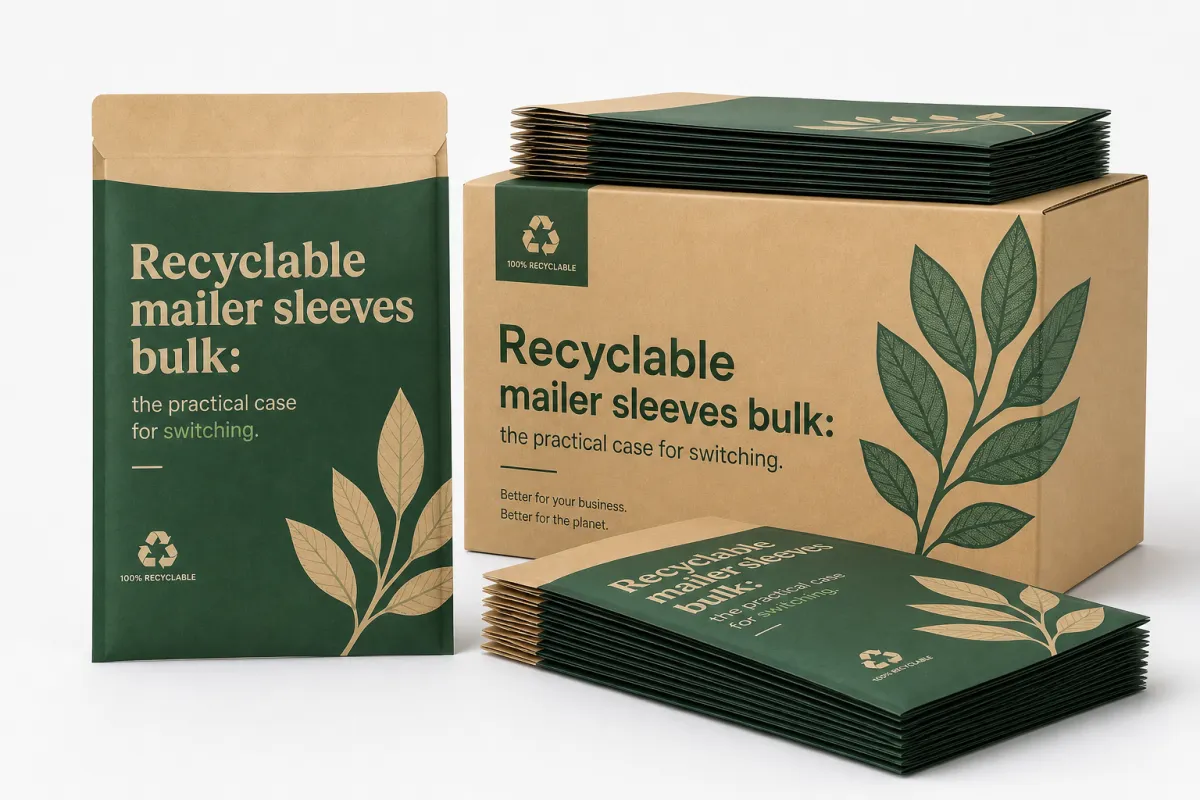
There is a real shop-floor reason to consider recyclable mailer sleeves bulk: many packing teams are still shipping too much air, then paying again to fix scuffing, crushing, or sloppy presentation after the box is opened. A sleeve is not magic. It is a controlled paper package for flat or lightly padded goods, and that is exactly why it works. It keeps the product aligned, gives the outside a clean finish, and removes the need for extra inserts in more cases than people expect.
For apparel, especially folded tees, socks, scarves, and lightweight accessories, recyclable mailer sleeves bulk gives you a tidy outer pack that does not hog shelf space or force heavy corrugated where it is not needed. The same logic applies to printed inserts, flat promotional kits, stationery, small catalogs, and similar items. If the shipment is flat, compact, and not crush-sensitive, a sleeve can be the better production choice. Less waste. Faster packing. Better consistency at unboxing. Not a bad trade.
The business case is simple enough to survive a whiteboard. Fewer mixed materials means less sorting at the end of use. Smaller pack sizes mean better carton utilization on inbound storage and outbound freight. A sleeve usually uses less raw material than a box-plus-fill system, especially for low-profile items. In practical terms, recyclable mailer sleeves bulk can cut down the number of separate SKUs in your packaging room and make reordering less annoying, which is useful if your team is already juggling labels, cartons, inserts, and outer shipping formats.
That said, this is not a universal fix. A sleeve is right for some products and wrong for others. Sharp corners, heavy point loads, liquid risk, and awkward thickness variation all call for testing. Flat goods are a different story. For those, recyclable mailer sleeves bulk often lands in the sweet spot where presentation, speed, and sustainability meet without forcing a premium structure the product does not need.
- Best fit categories: folded apparel, printed inserts, slim accessories, flat paper goods, and promotional kits.
- Operational gains: fewer pack components, less void fill, faster hand packing, and simpler storage.
- Customer value: cleaner opening experience and a paper-based package that is easier to sort after use.
If the package is flat, the presentation matters, and the product does not need crush protection, a well-spec'd paper sleeve can beat a heavier format on both cost and handling time.
One useful way to think about recyclable mailer sleeves bulk is this: it replaces overpacking with control. You are not buying in bulk because volume looks impressive on a spreadsheet. You are buying a repeatable structure that can run thousands of times with the same result. That repeatability is what makes a sleeve worth specifying carefully.
Recyclable mailer sleeves bulk: materials, fit, and construction
The material behind recyclable mailer sleeves bulk matters more than most buyers expect. A paper-based sleeve can be built from recycled paperboard, kraft-lined board, or a paper structure with a light protective finish, but the construction should match the product and the handling path. A sample that looks fine in the office can buckle, scuff, or spring open too easily if the board is too light or the fold geometry is sloppy. The right build gives you enough stiffness to protect the contents while still loading easily at a packing table.
Inside dimensions deserve real attention. Buyers often ask for a sleeve by outside width, then wonder why the item is too tight or rattles around inside. For recyclable mailer sleeves bulk, the useful spec starts with the product size, then adds the actual insertion clearance needed for the pack line. A folded garment may need room for a collar, hem, or thicker fold. A flat booklet may need only a small tolerance. Too tight, and loading slows down. Too loose, and the package loses its crisp profile.
Closure style changes performance too. Tuck ends are familiar and easy to explain to a warehouse team. Friction-fit closures can move quickly in manual packouts. Adhesive strips help lock the sleeve after insertion, but the adhesive choice should be reviewed carefully if recyclability is a priority. Wrap-around formats are another option for presentations that need a sleeve-like shell around a flat item. In recyclable mailer sleeves bulk, every closure choice affects line speed, opening behavior, and how cleanly the package separates at the end of use.
Surface finish is another practical call. Uncoated paper is usually the cleanest route for recyclability and gives a natural look many brands like. A light aqueous coating can improve scuff resistance without turning the piece into a plastic-heavy structure. Print can stay restrained and useful, or it can take over the panel area if the brand wants more visual punch. The point is to keep the structure paper-led. For most recyclable mailer sleeves bulk orders, a simple surface with controlled print coverage is the safest balance of appearance and end-of-life handling.
From a protection standpoint, sleeves are best viewed as presentation plus light containment, not as crush boxes for dense or fragile goods. They work well for flat products that need edge protection, surface protection, or a clean retail-style look. They are not the answer for breakables that shift, liquids that can leak, or products under serious stacking pressure. That is not a flaw. It is just the right tool for the job.
For buyers comparing materials, these are the main categories that usually come up in recyclable mailer sleeves bulk discussions:
- Recycled paperboard: good stiffness, clean print surface, and strong fit control for flat goods.
- Kraft-lined construction: natural appearance, useful for brands that want a plain-paper look.
- Paper-based coated sleeves: better scuff resistance, while the finish stays simple enough for recycling-focused programs.
- Custom die-cut paper sleeves: useful for unusual profiles, inserts, or presentation-heavy packs.
Packaging buyers often ask whether a sleeve can support a formal sustainability claim. The honest answer is yes, but only if the claim matches the structure and the recycling stream available to the end user. For fiber-based packaging and material sourcing guidance, useful references include the EPA recycling resources and the Forest Stewardship Council. For transport and packaging testing, the ISTA standards are worth reviewing if the shipment needs validation beyond a basic carton test.
That is the practical reason recyclable mailer sleeves bulk is a specification purchase. A sleeve is only as good as the board, the fold, the closure, and the fit. Get those four things right, and the format does its job quietly. Get them wrong, and the whole line feels slower than it should.
Specifications to confirm before you order
Before you place recyclable mailer sleeves bulk, lock down the details that decide whether the run is smooth or irritating. The most important spec is the internal dimension, because that governs fit. After that comes material thickness, product weight, print coverage, carton pack, and the way the sleeve will be loaded in real production. Buyers skip one of these fields all the time and then discover the quoted structure is technically correct but annoying in daily use. That usually costs more than taking ten extra minutes during specification.
Here is the short list I would verify before production on recyclable mailer sleeves bulk:
- Internal size: the exact flat product dimensions plus enough insertion clearance for efficient loading.
- Material thickness: enough stiffness to protect edges without making folding or closing difficult.
- Target product weight: useful for deciding whether the sleeve needs extra board strength.
- Print coverage: one-color logo, full-panel branding, barcode space, or instruction text.
- Carton configuration: sleeves per master carton, carton dimensions, and pallet stacking preference.
Tolerances matter more than many first-time buyers realize. If a sleeve must run through a packing table quickly, fold consistency needs to be tight enough that workers are not forcing every unit. If it will be inserted by a semi-automated process, the opening geometry has to repeat cleanly. In recyclable mailer sleeves bulk, the difference between sloppy tolerance and controlled tolerance is often the difference between a clean production day and a room full of tiny delays.
Testing should be functional, not theoretical. Ask whether the sleeve holds the item flat, whether the edges are protected, whether the panel stays aligned after handling, and whether the structure survives normal parcel motion without splitting or warping. If the package is for retail presentation, the test should include opening appearance too. A sleeve can be technically fine and still feel wrong if the flap is awkward or the graphic placement hides the product badly.
Branding details are not just decoration. They affect the converting job and the final spec. A single-color logo with a blank info zone is easier than a full-wrap print with multiple panel breaks. Barcode placement matters if the package needs scan-ready identification. Recycling icons or disposal instructions should be placed where the recipient will actually see them. For recyclable mailer sleeves bulk, the artboard layout is part of package engineering, not an afterthought.
Ask for a sample or dieline review before you commit to full production. A dieline shows the fold and cut logic; a sample proves whether the product loads properly and closes the way you expect. That step can save an entire bulk run from an avoidable mismatch. For custom packaging, a few minutes spent confirming the actual geometry beats a long explanation after a rushed approval.
One more practical note: if your product sits near the edge of the size range, do not force a near-fit just to use a standard sleeve. With recyclable mailer sleeves bulk, a custom dieline often packs faster than a compromise size because the line team is not fighting the pack every time they load a unit. Good packaging should feel easy in the hand and honest on the spec sheet.
Pricing, MOQ, and what changes your unit cost
Pricing for recyclable mailer sleeves bulk is driven by a handful of variables buyers can actually control. Material grade is the first one. Size comes next, because larger sleeves use more board per unit and often require different converting efficiency. Print coverage, finishing, and total volume round out the core cost drivers. If the design uses a simple uncoated board with light print, the price usually stays friendlier than a fully wrapped sleeve with a lot of decoration and multiple finishing passes.
Bulk volume helps because setup costs get spread across more units. That is true in most converting jobs. A 2,500-piece run may look convenient, but the per-unit price usually improves a lot at 5,000, 10,000, or more, especially once the die, print setup, and handling are amortized. For recyclable mailer sleeves bulk, the most efficient order size is often the one that fits monthly or quarterly demand without leaving dead inventory sitting in storage.
Minimum order quantity can be set by sheet usage, printing setup, or converting efficiency. Some suppliers need a minimum based on press time. Others price by board utilization. Some do both. That is why a useful quote request should include dimensions, artwork, quantity, and delivery timing. If you ask for recyclable mailer sleeves bulk without those details, the number you get back may be too broad to help with real planning.
There are hidden costs worth watching. Special die cuts can raise tooling or prep. Tight tolerances may increase setup time. Rush schedules can shift labor and freight. Split shipments can inflate landed cost because cartons are no longer moving in one clean lot. Custom inserts, if needed, should be priced separately so the sleeve cost stays honest. None of these are deal breakers. They just need to be visible before approval.
To make pricing easier to compare, use a spec sheet that includes finished size, sleeve style, print coverage, board preference, and destination. That lets the quote reflect the actual converting job rather than a rough guess. For recyclable mailer sleeves bulk, clarity up front usually shortens the sales cycle and gives you a steadier production plan.
| Option | Best for | Typical unit cost at 5,000 | Recycling note |
|---|---|---|---|
| Uncoated kraft paper sleeve | Folded apparel, inserts, flat mailers | $0.18-$0.26 | Usually the simplest path for paper recycling |
| Recycled paperboard sleeve | Printed goods and presentation packs | $0.22-$0.34 | Good route if the structure stays paper-only |
| Printed sleeve with light aqueous coating | Retail display and scuff-prone handling | $0.28-$0.42 | May still be recyclable depending on local program rules |
| Custom die-cut sleeve with special closure | Unusual shapes or tighter presentation requirements | $0.30-$0.50+ | Recyclability depends on adhesive and finish choices |
Those ranges are not promises. They are planning numbers. Final cost depends on board availability, print count, finishing, and whether the order is moving on a standard schedule or under a rush window. For most buyers, recyclable mailer sleeves bulk becomes attractive when the sleeve replaces a heavier pack system and the line savings offset any modest difference in material price.
If you are comparing options, think about the pack as a whole. A sleeve that lowers the need for void fill, stickers, or secondary wrap may cost a little more per unit than a bare-bones format, but still reduce total packaging spend. That is the right way to look at recyclable mailer sleeves bulk: not as a standalone box price, but as a complete packing workflow.
Production process and timeline for bulk orders
A clean production run for recyclable mailer sleeves bulk usually moves through a predictable path: inquiry, spec review, quote, proofing, sample approval if needed, production, finishing, carton packing, and shipping. None of those steps is exotic, but each one can slow down if the buyer is not ready. The smoothest orders are the ones where the artwork is final, the size is unambiguous, and the closure style is already agreed before the first proof is issued.
Delays usually show up in the same places. Artwork may be incomplete. Measurements may be based on a product that is still changing. The team may decide halfway through proofing that they want a different closure or a different print panel. In recyclable mailer sleeves bulk, those changes ripple into the die, the layout, and sometimes the material choice. Small changes look harmless on a screen; in converting, they can alter production speed and cost.
Lead time depends on material availability, print complexity, and current capacity. A simple unprinted run can move faster than a custom printed sleeve with multiple panels and tighter art alignment. If the sleeve must support a launch date or a seasonal shipment, confirm the production window before approving the final spec. I would rather see a buyer build a realistic schedule than rush the job and pay for freight they did not need.
A strong prepress handoff saves time. Final artwork files should be properly sized. The dieline should be approved. Color targets should be clear. Carton pack requirements should be listed so the warehouse receives the product in a usable format. That matters even more for recyclable mailer sleeves bulk, because large runs magnify small mistakes. A one-off error becomes a thousand-piece problem very quickly if nobody catches it before the plates or dies are locked.
Practical timeline planning usually looks like this:
- Spec and quote: 1-3 business days if the information is complete.
- Proof review: 1-2 rounds for most straightforward jobs.
- Sample or dieline approval: varies, but worth the time for custom structures.
- Production: often 12-15 business days after approval for standard runs, longer if print or finishing is complex.
- Freight: depends on destination and whether the order ships by parcel, LTL, or full pallet.
For buyers coordinating a launch, the freight plan deserves the same attention as the sleeve spec. If the warehouse needs staged delivery, say so early. If the order must arrive on a specific dock schedule, document it before approval. Recyclable mailer sleeves bulk works best when production and logistics are treated as one system, not separate conversations.
Why choose us for recyclable mailer sleeves bulk
Custom Logo Things is a strong fit for recyclable mailer sleeves bulk because the conversation starts with the structure, not just the artwork. That matters. A pretty sleeve that loads badly is still a bad sleeve. A practical sleeve with a clean logo, the right fit, and repeatable packing performance does more for the buyer over time than a flashy structure that causes headaches on the line. Good packaging suppliers do not just print. They help you choose a format that works in production and still looks right after the customer opens it.
Process discipline is a big part of that. Accurate measurements, clear proofs, consistent carton counts, and realistic freight expectations keep the job on track. With recyclable mailer sleeves bulk, those details are not paperwork noise. They are the difference between a package that runs smoothly and one that causes small but expensive interruptions every shift. Reliable bulk supply comes from controlled manufacturing and careful spec management, not vague promises with a nice logo on top.
There is also value in practical sustainability guidance. A paper-based sleeve should be chosen because it fits the product, supports the brand, and fits the recycling goal. Not because it sounds better in a sales deck. That difference matters. Buyers get better results when they match the structure to the actual item instead of forcing a heavy package into a flat-item problem. For a broader packaging mix, you may also want to compare your sleeve program with Custom Poly Mailers for items that need moisture resistance, or review our Wholesale Programs if you are standardizing packaging across multiple product lines.
Another advantage is plain communication. A buyer should know what is being quoted, what is being approved, and what ships. That sounds basic, yet it is where many packaging projects get messy. For recyclable mailer sleeves bulk, confidence comes from knowing the sleeve dimensions, board choice, print plan, and carton format before the first production sheet is cut. When those details line up, the run feels orderly from the start.
Here is the kind of control that matters most:
- Fit control: the sleeve matches the product, not just the spec sheet.
- Print control: branding lands where it should, with clean panel alignment.
- Pack control: cartons and pallet counts suit the warehouse workflow.
- Supply control: the bulk run supports reorders without constant redesign.
That is why recyclable mailer sleeves bulk should be treated as a packaging program, not a one-time print order. Once the format is right, it can be repeated with fewer surprises, and that is where the savings really show up.
Next steps for ordering recyclable mailer sleeves bulk
Before you request pricing on recyclable mailer sleeves bulk, gather three things: product dimensions, target quantity, and any print or branding needs. Those details are enough to start a real quote instead of a placeholder. If the item is borderline in thickness, include a sample or at least a photo with measurements. That saves time and avoids a near-fit that looks fine on paper but fights you at the packing table.
Then decide how the sleeve will be used. Manual packing, semi-automated insertion, and retail presentation all push the spec in different directions. Manual loading may favor a wider opening or an easier tuck. Semi-automated use needs steadier tolerances. Retail presentation may justify a cleaner print layout or a better surface finish. In recyclable mailer sleeves bulk, the end use should shape the structure from the start.
It also helps to ask for a sample, a dieline, or a side-by-side quote comparison before you approve full production. That is the easiest way to verify fit and landed cost at the same time. The approval checklist should cover final artwork, material choice, carton pack, shipping date, and reorder trigger. If those pieces are documented, the first run usually goes much more smoothly than a loose verbal agreement.
For buyers managing volume, one final point matters: do not wait until the last minute to align freight and production. A good recyclable mailer sleeves bulk order is as much about timing as it is about structure. Once the measurements are locked and the approval is clean, moving from estimate to production becomes a straightforward process instead of a scramble.
The move That Actually Works is simple: measure the product flat, approve the dieline against a real sample, and size the first run to your reorder rhythm. Do that, and the sleeve stops being packaging theater and starts being a real operating choice. That is the takeaway.
Frequently Asked Questions
What sizes are available for recyclable mailer sleeves bulk orders?
Sizes are usually built around the flat product you are shipping, so inside dimensions matter more than outside measurements. A good spec includes product thickness, insertion clearance, and whether the sleeve needs to hold a single item or a stacked set. If your item sits between standard sizes, a custom dieline is often the better choice because it preserves packing speed and avoids the friction that comes with forcing a near-fit.
Are recyclable mailer sleeves bulk orders actually recyclable everywhere?
Recyclability depends on the material structure and the local recycling program, so the base substrate should be selected with care. Paper-based sleeves are generally easier to route into common recycling streams than mixed-material packs. Heavy coatings, plastic windows, or hard-to-separate adhesives can reduce recyclability, which is why those choices should be reviewed before production rather than after the order is already approved.
What affects the price of recyclable mailer sleeves bulk the most?
The biggest cost drivers are material grade, custom size, print coverage, finishing, and order volume. Special die cuts, tight tolerances, and rush schedules can also raise the unit price. A full quote should include artwork, dimensions, and quantity so the pricing reflects the real converting job instead of a rough guess based on a generic sleeve.
How long does a bulk order usually take to produce?
Timeline depends on proof approval, material availability, print complexity, and current production load. Simple unprinted orders usually move faster than custom printed or highly tailored sleeves. The quickest way to avoid delays is to approve the dieline and artwork in one pass with final measurements, because back-and-forth changes are what usually slow the run.
Do recyclable mailer sleeves bulk orders work for fragile products?
They work best for flat or lightly Fragile Items That need presentation and surface protection, not heavy crush resistance. If the product can shift, bend, or crease easily, the sleeve may need a tighter fit, a protective insert, or a different pack style. A sample test is the safest way to confirm protection before placing a full run.
For teams that want dependable protection, clean presentation, and a paper-based package that makes sense in actual production, recyclable mailer sleeves bulk is a practical choice worth specifying carefully. Get the size right, keep the construction honest, and confirm the timing before approval, and the format will do what good packaging should do: protect the product, support the brand, and keep the packing line moving.


