Buyer Fit Snapshot
| Best fit | Recyclable Poly Mailers with Logo projects where brand print, material claims, artwork control, MOQ, and repeat-order consistency need to be specified before quoting. |
|---|---|
| Quote inputs | Share finished size, material target, print colors, finish, packing count, annual reorder estimate, ship-to region, and any compliance wording. |
| Proofing check | Approve dieline scale, logo placement, barcode or warning zones, color tolerance, closure strength, and carton packing before bulk production. |
| Main risk | Vague material claims, crowded artwork, missing packing details, or unclear freight terms can make a low unit price expensive after revisions. |
Fast answer: Recyclable Poly Mailers with Logo: Film, Print, MOQ, and Carton Packing should be specified like a repeatable production item. The safest quote records material, print method, finish, artwork proof, packing count, and reorder notes in one written spec.
Production checks before approval
Compare the actual filled-product size with the drawing, then confirm tolerance on folds, seals, hang holes, label areas, and retail display edges. Reserve space for logos, QR codes, warning copy, and material claims before decorative graphics fill the panel.
Quote comparison points
Review material grade, print process, finish, sampling route, tooling charges, carton quantity, and freight assumptions side by side. A quote is only useful when the supplier can repeat the same color, closure quality, and packing count on the next order.
For many brands, Recyclable Poly Mailers with logo solve a packaging problem that looks simple from a distance and far more technical up close. They cut shipping weight, take up less warehouse space than cartons, and give customers a branded first impression before the package is even opened. Yet the real decision is not whether the logo looks good. It is whether the film, seal, adhesive, ink system, and recycling claim can all survive scrutiny. In procurement reviews I have sat through, the fastest approvals usually came from teams that treated recyclable poly mailers with logo as a material specification first and a branding exercise second.
The order of decisions matters more than most people expect. A mailer can look polished on the outside and still be a weak sustainability claim on the inside. In practice, Recyclable Poly Mailers with logo are usually made from polyethylene film, printed with custom artwork, and selected for apparel, retail, and e-commerce shipments where low weight and presentation both matter. The better versions do three jobs at once: they protect against dust and moisture, move through packing stations quickly, and make the shipment feel deliberate rather than improvised.
There is a useful test I have seen packaging teams use again and again: is the bag easy to pack, easy to recognize, and easy to explain? If the answer is no on any one of those points, the package starts creating friction. If the recycling language is vague, the print looks muddy, or the size is wrong for the product, the mailer stops being an asset and becomes a recurring annoyance. The businesses that ask for the exact resin, film thickness, print method, and recovery pathway before approving artwork tend to avoid the expensive version of trial and error.
What Are Recyclable Poly Mailers With Logo?
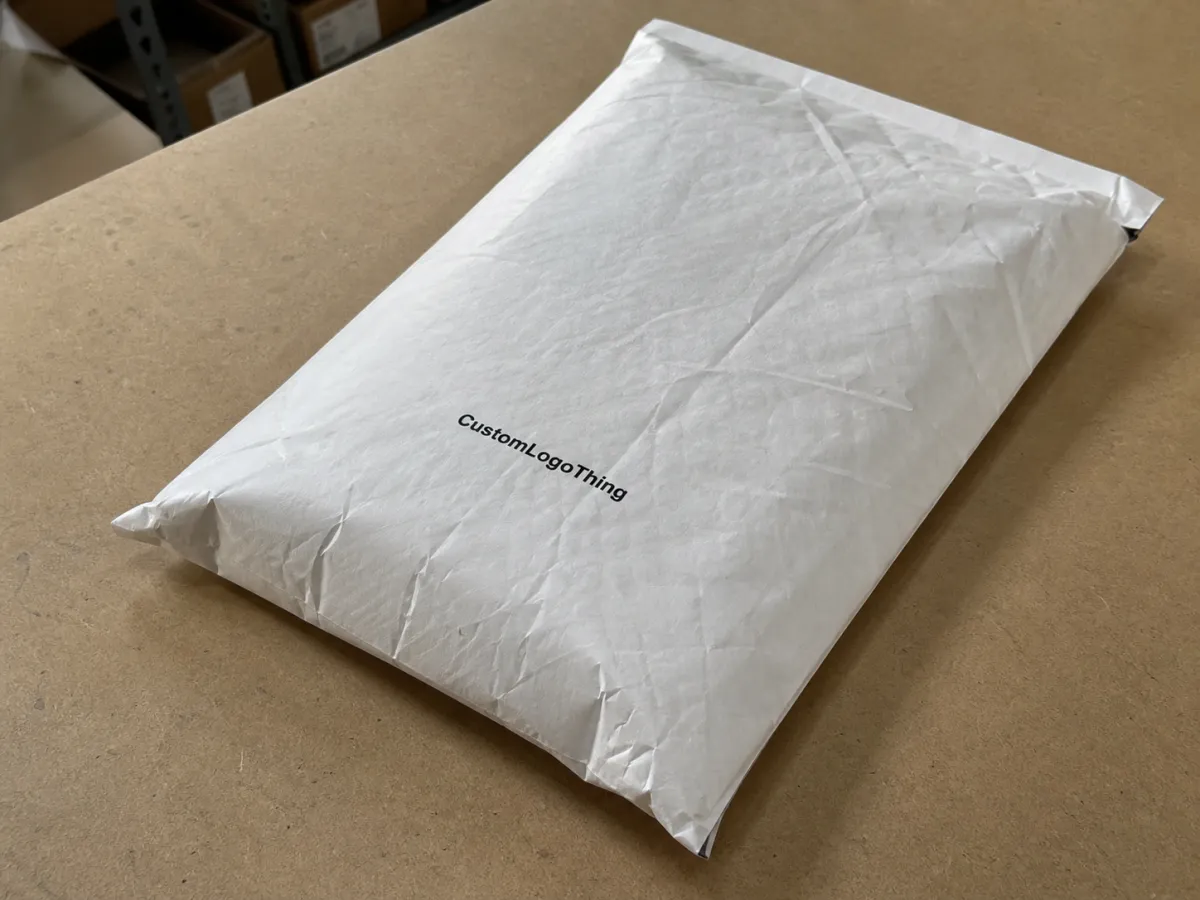
Recyclable poly mailers with logo are lightweight shipping bags made from a recyclable polyethylene-based structure and customized with branding, product information, or a simple mark that makes the parcel look finished on arrival. They are common in apparel, soft goods, books, accessories, and other products that do not need the crush protection of corrugated board. Because the logo is printed directly on the film, the brand lives on the shipping package itself instead of being added later with a label or insert.
One detail many first-time buyers miss: recyclable does not mean universally recyclable in every location. A mailer may be designed for polyethylene recovery streams, but acceptance still depends on the exact structure and the local collection rules. That makes specification important. A mono-material PE build is easier to defend than a mixed-layer bag, and a simple film with minimal additives is easier to explain honestly than a composite with too many moving parts. That distinction may sound minor in a meeting; it becomes very real once a sustainability team asks for documentation.
Brands often prefer recyclable poly mailers with logo because they are compact in storage, light in transit, and straightforward to customize. Compared with a box, a mailer takes up less shelf space, tends to pack faster, and can reduce dimensional weight on certain shipments. For a business shipping hundreds or thousands of orders a week, those differences compound quickly. The customer also sees the package as soon as it lands on the doorstep, and that moment carries more influence than it first appears.
My own view is simple: the strongest buyers treat recyclable poly mailers with logo as a system, not as a printed sleeve with a brand mark. The film, seal, closure flap, artwork, and recycling claim need to support each other. If one piece is off, credibility erodes. That is why the exact resin type, thickness, print method, and recovery pathway should be confirmed before the order is placed.
The other thing worth saying early is that recyclable poly mailers with logo are not one standard product. Some are thin and efficient for soft apparel. Others are heavier gauge for sharper edges or more load stress. Some use a single peel-and-seal strip. Others add a second adhesive line for returns. The right choice depends on packing flow, item shape, and the amount of abuse the shipment will see between the warehouse and the destination.
The real buyer question is not “Can the logo be printed?” It is “Will the logo print cleanly, will the mailer survive shipping, and can the recycling language stand up to scrutiny?” If those three answers are clear, the rest of the decision gets much easier.
How Recyclable Poly Mailers With Logo Work in Shipping
The structure behind recyclable poly mailers with logo is usually kept simple for a reason. A thin film body, side or bottom seals, and a closure flap with a peel-and-seal adhesive strip do most of the work. Some versions add a tear strip for easier opening. Others include a second adhesive line so the package can be reused for returns, which matters for apparel brands with frequent exchanges. A focused structure usually means a lighter bag and a cleaner claim.
Printing on recyclable poly mailers with logo is commonly handled through flexographic, gravure, or digital methods, depending on volume and artwork complexity. Flexo is often the workhorse for larger runs because it handles repeated artwork efficiently and keeps unit cost under control. Digital can make more sense for shorter runs or designs that change often. Either way, the artwork needs enough contrast, proper bleed, and sensible type size so the logo lands crisply on film rather than looking soft or uneven.
The job of recyclable poly mailers with logo is practical before it is aesthetic. They protect against dust, moisture, and light abrasion while keeping package weight low. They do not offer the crush protection of corrugated cartons, and they are not meant to. For clothing, soft goods, and many non-fragile items, the point is efficient shipping paired with a branded delivery moment. That is why they show up so often in fulfillment operations where speed and presentation need to coexist.
A truly recyclable structure usually depends on a mono-material build and low contamination from incompatible layers. When the film, adhesive, and print system are chosen well, recyclable poly mailers with logo fit polyethylene recovery pathways more naturally than mixed-material packaging. That still does not guarantee acceptance in every municipality, but it does make the claim more defensible and simpler for a sustainability team to review.
Production behavior matters too. Logo placement, logo size, and color count influence proofing, setup, and consistency across the run. A broad saturated print panel behaves differently from a small one-color mark, especially on colored film. At scale, recyclable poly mailers with logo can expose tiny artwork choices in surprisingly large ways: drying time, inspection rates, and line speed all move when the print spec changes. I have seen a single change from two colors to four color spots ripple through a schedule more than the original buyers expected.
For brands that want the rest of the shipping system to pull in the same direction, it helps to look at the full packaging mix. If the same order also includes inserts, labels, branded cartons, or seasonal packaging, compare the mailer decision against your broader product line through Custom Packaging Products and Custom Poly Mailers. That is often where the real efficiency gain shows up, not in a single line item.
For recycling basics and packaging disposal guidance, the EPA’s consumer recycling resources are a reliable starting point, while ISTA testing standards help frame how packages behave under transit stress. You can review those at EPA recycling information and ISTA.
Key Factors for Recyclable Poly Mailers With Logo
Material grade is the first thing I would inspect in recyclable poly mailers with logo. The base resin affects puncture resistance, seam strength, and the credibility of the recycling claim. Some buyers want post-consumer recycled content, which can support internal sustainability goals, but that choice still has to coexist with print quality and film performance. A bag that sounds eco-conscious but tears in transit is not a good trade.
Thickness matters a great deal. Thinner film uses less material and usually costs less, while heavier or sharper products demand more protection. A lightweight apparel tee can often ship well in a slimmer bag, while a belt buckle, a cosmetic kit with hard corners, or boxed goods with edges may need a stronger gauge. The best recyclable poly mailers with logo match the product instead of merely looking clean on a spec sheet.
Closure style is another decision with real operational consequences. A standard peel-and-seal strip works for many brands, but some want tamper evidence or a dual-seal return setup. That choice affects the customer experience, packing speed, and reverse logistics. If return rates are high, recyclable poly mailers with logo with a second adhesive strip can save time later. If returns are rare, the added feature may simply increase cost without much payoff.
Print coverage and color count have a direct relationship with both price and appearance. A one-color logo on white or natural film is usually efficient and easy to read. Heavy coverage, gradients, tiny type, and white ink all raise complexity. On colored film, white ink can make a logo stand out, but it also adds a step in production and can affect cure or drying conditions. With recyclable poly mailers with logo, the safest artwork is often the most legible artwork.
Size selection deserves more attention than it gets. A bag that is too small can stress the seams or force the packer to overstuff the contents. A bag that is too large wastes material and can make the parcel look sloppy. For recyclable poly mailers with logo, the best size is usually the one that lets the product slide in without fighting the flap, leaves enough room for closure, and still keeps the shipment compact enough for efficient transport.
These are the details that separate a decent order from a dependable one. A quick checklist helps:
- Product weight and shape - confirm the actual packed item, not just the catalog dimensions.
- Film structure - verify mono-material construction if recyclability is central to the claim.
- Seal style - choose standard closure or return-use closure based on the shipping flow.
- Artwork complexity - keep color count and ink coverage aligned with budget and print quality.
- Order volume - match the run size to your monthly or quarterly packing rhythm.
The strongest buyers of recyclable poly mailers with logo do not start with the lowest quote. They start with the product, the shipping environment, and the sustainability language they can actually support. Once those three pieces are clear, the rest of the specification becomes much easier to sharpen.
Recyclable Poly Mailers With Logo: Process and Timeline
The ordering process for recyclable poly mailers with logo usually begins with a spec sheet. That sheet should list product dimensions, average item weight, expected monthly volume, print colors, brand assets, and any sustainability requirement that matters to the project. If the vendor does not understand what you are shipping, they are guessing at the bag size. Guessing is expensive in packaging, even when the mistake looks small on paper.
Artwork and dieline review comes next. This is where a careful buyer checks logo placement, barcode placement if needed, bleed, safe areas, and the seal zones that should stay clear. It is also the point to confirm type size. Tiny legal copy, tiny recycling instructions, and tiny contact details tend to disappear on flexible film. With recyclable poly mailers with logo, what looks fine on a screen may become much smaller in the real world.
Sampling matters more than many teams expect. A proof on paper is useful, but a bag sample packed with the actual product tells a fuller story. You can see how the flap closes, whether the item shifts inside the mailer, whether the logo sits where the customer will see it, and whether the film feels too flimsy or too stiff. For recyclable poly mailers with logo, that sample stage often prevents rework later. It also exposes the subtle stuff that never shows up in a mockup, like static cling or a seal that feels slightly short.
The production sequence is straightforward once everything is approved. Files are prepared, plates or digital assets are set, film is converted, printing happens, the material is cured or dried, the film is slit and formed into bags, and the finished pieces are inspected before shipment. If you are ordering recyclable poly mailers with logo in a larger run, even a small artwork correction can affect that sequence, so it is worth slowing down at proof stage and speeding up the actual manufacturing stage.
Timeline depends on the order type. A reorder with approved files usually moves faster because the vendor already has the setup information. A first-time custom run usually takes longer because there is more review, more proofing, and more back-and-forth on brand details. In a normal production environment, simple custom orders may land in the 12-15 business day range after proof approval, while more complex jobs can run longer if the artwork needs revisions or the print spec is unusual. That timing is very common for recyclable poly mailers with logo.
Delays usually come from predictable places:
- Late artwork changes after proof approval.
- Missing logo files or low-resolution files.
- Confusion about the recycling claim or material structure.
- Sample revisions after a packing test exposes a fit problem.
- Size changes after procurement and operations were already aligned.
Lock the operational details before the decorative ones. That sounds almost too simple, yet packaging teams often reverse the sequence. With recyclable poly mailers with logo, the shipping fit and the material claim should be approved before anyone gets attached to a color proof.
“The cleanest custom mailer order is the one where the team tests the actual product, approves the proof carefully, and gives the printer one clear instruction set. Everything else is just noise.”
Recyclable Poly Mailers With Logo: Cost, Pricing, and MOQ
Pricing for recyclable poly mailers with logo depends on several variables at once, and the quote makes far more sense once you separate them. Bag size matters. Film thickness matters. Print coverage matters. Number of colors matters. Recycled content can matter. Artwork complexity matters. Volume matters too, because setup costs spread more efficiently on larger runs.
As a broad buying range, smaller custom runs of recyclable poly mailers with logo may land somewhere around $0.18-$0.35 per unit depending on size and print coverage, while larger volumes can often move into a more favorable range if the artwork is simple and the run is efficient. Those are not fixed numbers. A heavy gauge bag with full-coverage printing and a special closure will cost more than a straightforward one-color mailer, and freight can widen the gap faster than some buyers expect.
MOQ, or minimum order quantity, follows production reality. The printer has to prepare the job, and that setup cost gets distributed across the run. That is why recyclable poly mailers with logo tend to get cheaper per unit as order size grows. If you only need a few hundred pieces, the unit price can feel steep. If you need several thousand, the economics usually improve quickly.
It helps to separate one-time costs from recurring costs. One-time costs can include artwork setup, plate charges, proofing, and special color matching. Recurring costs include the bags themselves, freight, and any warehousing before use. Many buyers compare quotes on unit price alone, but recyclable poly mailers with logo should be judged on total landed cost, not just the sticker number on the bag.
| Option | Typical Strength | Brand Impact | Cost Profile | Best For |
|---|---|---|---|---|
| Plain stock mailers + labels | Good for basic apparel shipments | Moderate, depends on label quality | Lowest upfront cost, more labor | Low volume or frequent artwork changes |
| Recyclable poly mailers with logo | Good to very good, depending on gauge | Strong, direct branded presentation | Higher setup, lower labor per pack | Consistent shipments and repeat branding |
| Higher-gauge branded mailers | Very good for heavier items | Strong and premium-looking | Higher material cost | Products with sharp edges or more weight |
| Corrugated cartons | Best crush protection | Very strong unboxing structure | Higher material and freight cost | Fragile or rigid products |
The table shows the real tradeoff. Sometimes recyclable poly mailers with logo are the right answer. Sometimes a plain stock bag and label program is more practical. Sometimes a box still wins. Good packaging is not about forcing one solution everywhere; it is about matching the package to the shipment and the economics of the route.
Freight deserves a close look too. A pallet of recyclable poly mailers with logo ships efficiently because the bags are light and compact, yet the savings can disappear if you order the wrong size or sit on excess inventory for too long. Storage, cash flow, and reorder timing all matter. Order too little and you risk stockouts. Order too much and you tie up space and working capital.
From a buyer’s point of view, the best pricing question is not “What is the cheapest mailer?” It is “What is the most reliable package at the lowest total cost for the next six months of shipping?” That answer often points back to recyclable poly mailers with logo, but only if the size, spec, and volume line up.
Common Mistakes With Recyclable Poly Mailers With Logo
The first mistake is treating recyclable as a generic marketing word. If a bag uses mixed layers or incompatible components, the claim may be weak even when the outside looks fine. That is not just a branding issue. It becomes a trust issue. With recyclable poly mailers with logo, the material description should be plain, specific, and backed by the actual structure.
The second mistake is overdesigning the print. Too many colors, too much ink coverage, and tiny details can raise cost without strengthening the package. Busy art can make recyclable poly mailers with logo feel less polished because the print loses clarity on flexible film. A simple logo with strong contrast often works better than a crowded design with five messages competing for attention.
The third mistake is choosing the wrong size for the product. That sounds basic, but it happens constantly. A bag that is too small can split at the seam or make packing slow and awkward. A bag that is too large can create a loose, sloppy presentation and waste material. For recyclable poly mailers with logo, the correct size should support both the item and the packing line.
The fourth mistake is skipping real-world testing. A proof can look clean on a screen and still fail in the warehouse. Pack the actual product, seal the bag, stack a few units, shake them, drop-test them if appropriate, and look at the result. If the shipment feels weak or awkward, fix it before the run begins. That matters even more for recyclable poly mailers with logo, because the film itself is doing several jobs at once.
The fifth mistake is launching before the recycling story is verified. Many brands want to support a sustainability message, and that is fair, but the claim has to match the material and the recovery pathway. If the local program does not accept the mailer type, or if the structure is not truly mono-material, then the message needs to be narrowed. The safest path with recyclable poly mailers with logo is to keep the sustainability statement factual and supportable.
There is also a quieter operational mistake that shows up later: not coordinating storage and reorder planning. Custom printed bags often need a more careful reorder trigger than stock mailers do. Running out of recyclable poly mailers with logo can disrupt fulfillment fast, and rushed repeat orders usually cost more than planning replenishment in advance.
Expert Tips and Next Steps for Recyclable Poly Mailers With Logo
Start with a simple spec sheet. List product dimensions, average weight, closure preference, monthly volume, print colors, and any sustainability requirement the vendor needs to honor. That one document speeds up quoting and cuts down on back-and-forth. It also helps suppliers compare apples to apples when they prepare recyclable poly mailers with logo options.
Request samples and test them with the real product. Not a stand-in. Not a dummy load. The actual item. That is the best way to see whether the mailer fits well, seals properly, and looks good from the customer’s side of the transaction. For recyclable poly mailers with logo, the sample stage is where bad assumptions get caught before they become expensive mistakes.
Keep the artwork readable at speed. A logo that reads well on a conveyor, in a warehouse bin, and on a porch photo is usually stronger than one packed with fragile detail. High contrast helps. Clean typography helps. If you want a premium look, aim for crisp spacing and disciplined layout rather than piling on more color. The strongest recyclable poly mailers with logo usually feel intentional, not busy.
Coordinate purchasing, operations, and branding before the order is placed. If the team responsible for visual identity never talks to the team that packs the boxes, you can end up with a lovely design that is annoying to use. If operations never reviews the recycling claim, you can also end up with a package that does not match the story being told. The best recyclable poly mailers with logo are approved by both sides.
A simple decision flow works well:
- Confirm the product shape and packing method.
- Choose the right film thickness and closure style.
- Approve a clean, legible artwork layout.
- Test samples with real goods.
- Lock the production schedule and reorder point.
If you follow that sequence, recyclable poly mailers with logo become much easier to manage. You reduce waste, avoid unnecessary delays, and end up with a package that looks branded without trying too hard. That is usually the sweet spot for packaging: practical, credible, and repeatable.
The most actionable next step is also the least glamorous one: measure the packed product, confirm the film structure, and ask for a printed sample before you approve the artwork. That order matters. Once those three pieces line up, recyclable poly mailers with logo can support a cleaner operation and a more honest sustainability message at the same time.
FAQ
Are recyclable poly mailers with logo actually recyclable?
They can be, but the answer depends on the exact film structure, the closure system, and the local recycling program. A clean mono-material polyethylene mailer is usually easier to position honestly than a mixed-layer structure, yet you still need to verify the recovery pathway before making a broad claim. For recyclable poly mailers with logo, the safest practice is to match the spec to the actual collection stream rather than assume every curbside program accepts the same package.
What artwork works best on recyclable poly mailers with logo?
Simple, high-contrast artwork tends to print and read better than dense graphics with lots of tiny details. Large logo placement, limited colors, and clear typography usually give the strongest result, especially on flexible film that moves through high-speed packing. If your design needs fine lines, gradients, or white ink, ask for a proof so you can see how recyclable poly mailers with logo will actually look in production.
How long does a custom recyclable poly mailers with logo order take?
Timing depends on artwork readiness, proof approval, sampling, production scheduling, and freight distance. A reorder with approved files is often faster than a first-time custom run that needs setup and review. Build in extra time if you are changing size, testing a new structure, or waiting on internal brand approval. For recyclable poly mailers with logo, the slowest part is usually the decision-making, not the manufacturing.
How do I choose the right size recyclable poly mailer with logo?
Measure the finished product, not just the flat dimensions, and leave room for the item to slide in without stressing the seams. Consider thickness, closure type, and any inserts or returns workflow before selecting the final size. If you are between two sizes, test both with the real item and choose the one that seals securely without excess waste. That approach works well for recyclable poly mailers with logo because fit affects both protection and presentation.
How can I compare pricing for recyclable poly mailers with logo suppliers?
Compare unit price, MOQ, setup charges, freight, sample costs, and any extra fees for color matching or special print coverage. Ask for the exact material spec so you are comparing similar bags, not just similar-looking quotes. The cheapest quote is not always the best value if the mailer ships poorly, prints inconsistently, or misses your sustainability target. For recyclable poly mailers with logo, total landed cost and reliability usually matter more than the lowest line item.


