Buyer Fit Snapshot
| Best fit | Recycled Content Mailers for Print Shops projects where brand print, material claims, artwork control, MOQ, and repeat-order consistency need to be specified before quoting. |
|---|---|
| Quote inputs | Share finished size, material target, print colors, finish, packing count, annual reorder estimate, ship-to region, and any compliance wording. |
| Proofing check | Approve dieline scale, logo placement, barcode or warning zones, color tolerance, closure strength, and carton packing before bulk production. |
| Main risk | Vague material claims, crowded artwork, missing packing details, or unclear freight terms can make a low unit price expensive after revisions. |
Fast answer: Recycled Content Mailers for Print Shops: Film, Print, MOQ, and Carton Packing should be specified like a repeatable production item. The safest quote records material, print method, finish, artwork proof, packing count, and reorder notes in one written spec.
Production checks before approval
Compare the actual filled-product size with the drawing, then confirm tolerance on folds, seals, hang holes, label areas, and retail display edges. Reserve space for logos, QR codes, warning copy, and material claims before decorative graphics fill the panel.
Quote comparison points
Review material grade, print process, finish, sampling route, tooling charges, carton quantity, and freight assumptions side by side. A quote is only useful when the supplier can repeat the same color, closure quality, and packing count on the next order.
I still remember walking a binder-and-kitting room in Milwaukee on a wet Tuesday in March, where three pallet wraps sat near the dock, two cartons of virgin-poly mailers were stacked by a pallet jack, and a pile of press proofs was moving out the door with the urgency of a 4:30 p.m. UPS pickup. That scene has stayed with me because it explains why recycled content mailers for print shops deserve a serious look. A print team may want a cleaner sustainability story, yes, but they also need a mailer that can hold a 12 x 18 proof set, survive a 36-inch drop from a conveyor edge, and land on a buyer's desk without looking crushed. If the mailer misses any of those jobs, the recycled-content percentage is gonna stop being useful very quickly.
I've seen the same pressure in digital rooms in Austin and offset plants outside Cleveland: the owner wants less waste, the production lead wants fewer complaints, and the shipping desk wants a bag that seals fast at 4:45 p.m. when the FedEx truck is already backing into the bay. That last part matters more than the brochure copy ever does. Recycled content mailers for print shops sit right in the middle of that practical mess, so the buying decision needs to rest on film gauge, closure type, lead time, and real handling behavior instead of a polished sustainability pitch that sounds tidy in a meeting and falls apart on the floor.
My experience says print shops get better results when they treat recycled content mailers for print shops as a production tool first and a brand statement second. The right mailer protects flat samples, folded brochures, press checks, short-run merch kits, and stitched or perfect-bound sets without adding much packing friction at the bench. The wrong one turns into a daily nuisance, usually because somebody bought on price alone or assumed every recycled claim meant the same thing. Spoiler: it does not. I have seen more than one buyer discover that the cheapest option was only cheap right up until the first wave of damaged jobs started coming back through the door.
These mailers also need to fit the rhythm of a real shipping room, where a carton opener, a label printer, and a stack of inserts all compete for space on the same crowded table. The best choice usually feels ordinary in the best possible way: it opens cleanly, seals at a sensible speed, and holds together after a few hard touches from a dock cart or carrier scan. That sort of quiet reliability is kinda the whole point.
What Should Print Shops Look for in Recycled Content Mailers?
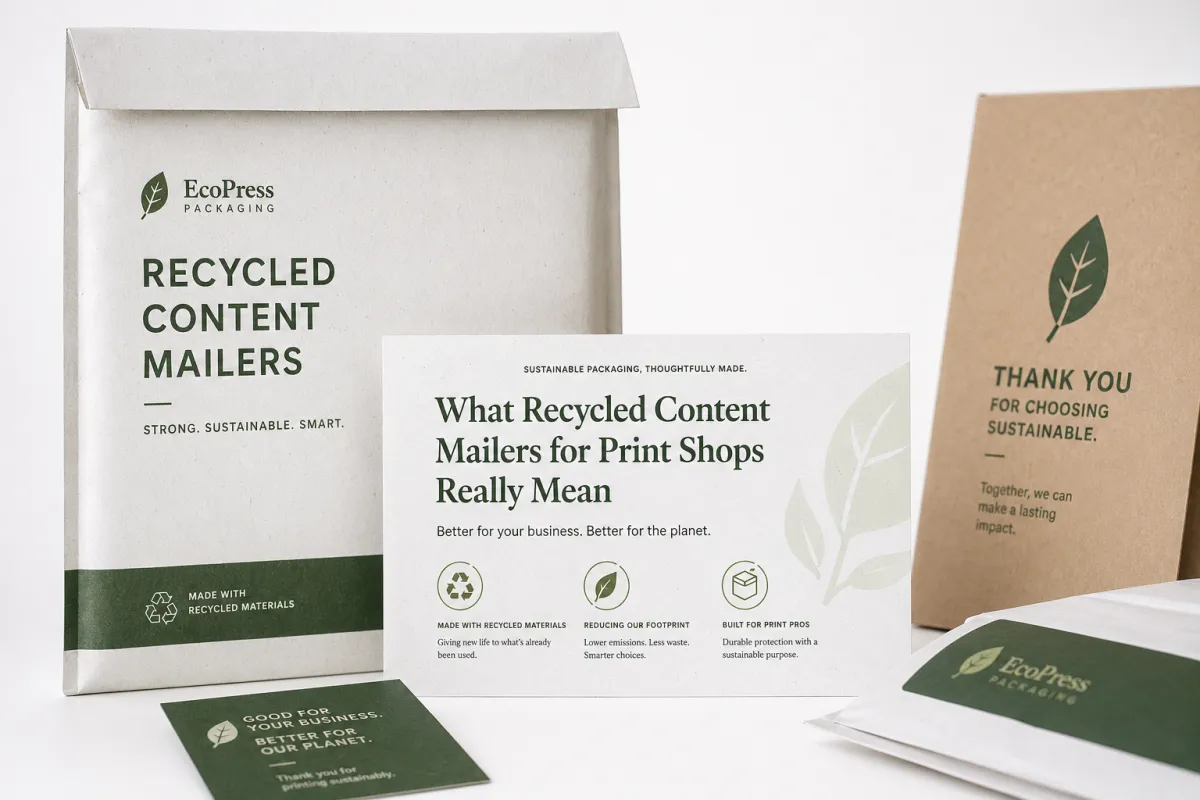
When I say recycled content mailers for print shops, I mean poly mailers made with resin that includes recovered plastic from prior use or from post-industrial scrap, then converted into a bag that can ship printed materials safely. Put simply, the film is not made from brand-new plastic only; part of it comes from resin that has already lived another life, been cleaned up, and gone back through processing in a plant in places like Dongguan, Guangdong, or Columbus, Ohio. For a print shop, that matters because the packaging itself can support a better environmental story without forcing a sacrifice in basic protection. I like that combination because it feels honest, and honesty has a way of making sales conversations a lot less awkward.
The two terms you will hear most often are PCR and PIR. Post-consumer recycled resin, or PCR, comes from material that was used by consumers, collected, sorted, and reprocessed; post-industrial recycled resin, or PIR, comes from factory scrap, trim, or production byproducts that never left the controlled manufacturing chain. I prefer suppliers who spell out the blend clearly, because these mailers are much easier to explain to a buyer when the source of the recycled content is documented instead of vague. If a rep starts waving their hands and saying "it's all recycled somehow," I usually start asking sharper questions, the kind that make a sales call go quiet for a second.
There was a job in Atlanta a few years back where a trade-show print buyer wanted a mailer for 250 sample kits, each one holding a folded sell sheet, a stitched spec book, and a small swatch packet. The buyer did not care whether the bag looked perfectly uniform; she cared that the kit arrived flat, dry, and undamaged, and that the packaging story matched the client's sustainability pledge. That is the real use case for recycled content mailers for print shops: protecting printed pieces while supporting the message around waste reduction, brand perception, and responsible sourcing. The packaging had to do the boring work well, which is usually the highest compliment you can give it.
One thing people get wrong is expecting recycled film to look like fresh clear poly. It often will not. The color may read slightly milky, gray, amber, or speckled, and the gloss level may shift from lot to lot depending on the recycled blend and the converter's process control, especially on runs from a plant in the Pacific Northwest or northern Mexico where feedstock changes week to week. I tell buyers to judge the bags by how well they hold seal integrity, resist punctures, and present the job, not by whether the film has the same showroom shine as virgin material. Frankly, chasing a perfect cosmetic finish on recycled film can be a waste of time and a great way to miss what actually matters.
That view lines up with the basics you will see from packaging organizations and recycling agencies. Industry guidance at packaging.org and the EPA's recycling guidance at epa.gov/recycle both point to a simple standard: materials choices should be judged by function, end use, and accurate claims, not by a slogan on the box. For recycled content mailers for print shops, that means performance and documentation need to travel together. I wish more people in procurement would circle that sentence in red ink and tape it to the monitor, because it would save everyone a lot of back-and-forth.
How Recycled Content Mailers for Print Shops Are Made
The manufacturing path for recycled content mailers for print shops starts with recovered resin that is sorted, washed, ground, melted, filtered, and pelletized into a usable feedstock. I watched a converter outside Shenzhen run this sequence in a plant where the floor was so clean you could have eaten off it, and I have seen similar lines in Monterrey and suburban Chicago. The quality difference between the sorted bales and the finished pellets was dramatic. Clean input streams and tighter filtration usually mean a more predictable bag once the shipment reaches your dock. Dirty input streams, on the other hand, tend to produce all the surprises nobody wants to explain on Monday morning.
From there, the pellets move into blown-film extrusion, where the resin is melted and pushed through a circular die to create a tube of film that is then cooled, collapsed, and wound. Thickness consistency gets made or lost here. If the film gauge wanders too much, one roll may feel fine while the next feels flimsy, and that inconsistency is exactly what makes these bags frustrating in a high-volume room where operators expect the same seal pressure and slide resistance every time. I have seen crews get suspicious of a whole shipment because one box of mailers felt different than the last one, and they were not being dramatic - they were trying to keep a production line from turning into a guessing game.
Seal strength, gusset formation, and closure style are also built into the converting stage, not added as an afterthought. A well-made mailer has side seams that hold under repeated flexing, a bottom seal that survives a drop test, and a closure That Actually Works at speed, whether that is a peel-and-seal strip or a tamper-evident flap. I have watched press crews lose half an hour because a weak adhesive strip opened on the packout table in a shop near Indianapolis, which is why I always tell buyers to ask how the seal is formed, not just what the bag is made from. The material story is nice, but the seal is what keeps the content from spilling onto the floor like a very expensive mistake.
Recycled content can also change the surface feel of the film, which affects slip, stackability, and whether labels hold cleanly. A slightly less slick surface can help if you are hand applying shipping labels, but it can also change the way mailers feed through a packing line if the team is used to glossy virgin poly. If you are comparing suppliers, request the resin origin, the recycled-content percentage, the bag gauge, and any data sheets that show tensile, tear, or puncture expectations. I like to see references to ASTM D882 for tensile properties and ISTA-style parcel handling tests when the application will face multiple carrier touches. That kind of paperwork is not exciting, but neither is repacking 300 kits because the film gave up at the wrong moment.
Most suppliers can show you the broad claim, but the better ones can show you the manufacturing story behind it. Ask whether the resin is PCR, PIR, or a blend; ask whether the film is single-layer or coextruded; ask whether the lot color is expected to vary because of recycled feedstock. You do not need a dissertation, but you do need enough information to compare options side by side instead of guessing from a sample bag that happened to look nice under warehouse lights. I have been fooled by nice lighting before, and it is annoying every single time.
Key Factors: Cost, Strength, and Print Compatibility
Cost is usually the first question, and for good reason. On a 5,000-piece order, I have seen stock recycled content mailers for print shops land at $0.15 to $0.27 per unit for common sizes like 9 x 12 or 10 x 13 when the bag is unprinted and the gauge is around 2.5 mil, while custom printed versions often move closer to $0.26 to $0.46 depending on film gauge, artwork, closure type, and whether the supplier is running the order in Vietnam, Illinois, or Tijuana. If you go heavier, say a 3 mil build for thicker mail packs or sample kits, the unit price can climb into the mid-$0.30s or higher. Those numbers are not universal, but they are a practical starting point for a serious quote conversation. If a quote comes in way outside that range, I start asking what is different and whether that difference actually helps the job.
The hidden cost is usually not the mailer itself. It is freight, damage, labor, and reorders. A bag that saves $0.04 on unit price but causes 2 percent more tears or takes 8 extra seconds to seal can cost more by the end of the month. I have seen procurement teams celebrate a low quote, then discover that the crew on the floor spent another 90 minutes a week correcting weak seals or repacking damaged proofs. That is why the right mailer should be judged on landed cost, not just the line item. Honestly, I think the line item is the least interesting part of the story once you factor in all the little delays that pile up.
| Option | Typical Quantity | Typical Price Per Unit | Best For | Watch-Out |
|---|---|---|---|---|
| Stock recycled-content mailer | 5,000 pieces | $0.15-$0.27 | Proofs, flat samples, light kits | Limited sizes and less branding control |
| Custom printed recycled-content mailer | 5,000 pieces | $0.26-$0.46 | Client-facing mailers and recurring programs | Proofing time and artwork setup |
| Heavier-gauge recycled-content mailer | 5,000 pieces | $0.34-$0.58 | Thicker books, boxed inserts, merch bundles | More material cost and possibly longer lead time |
Strength is the next filter. For recycled content mailers for print shops, I look at seam integrity, puncture resistance, tear propagation, and how the bag behaves when it is slightly overfilled. A 10 x 13 mailer that works beautifully for a 16-page folded brochure may fail miserably if you stuff it with a bound catalog, a rigid board sample, and a swatch card with sharp corners. The problem is often not the resin quality; it is choosing the wrong gauge for the contents. That mismatch causes more headaches than people expect, and the headaches always seem to land on the shipping desk instead of in the meeting where the wrong size was chosen.
Print compatibility deserves its own discussion because the mailer is often part of the brand experience. If you plan custom artwork, flexographic printing is usually the first place I look for film bags, especially for larger runs where a limited number of spot color plates can keep the setup cost under control. CMYK can work when the design needs more color range, but on recycled film, high-contrast spot color artwork often reads better than a delicate four-color image. Digital printing is more useful for labels, short-run personalization, and variable data, while offset printing usually belongs on the inserts, instruction cards, or outer cartons that ride inside the mailer. A common build I recommend for the internal collateral is a 350gsm C1S artboard insert with a matte aqueous coat, paired with a 14 pt uncoated instruction card if the customer wants the pack to feel sturdy without adding too much bulk. I know that sounds like a lot of process talk, but the process is what keeps the final package from looking like it was assembled in a hurry by a stressed-out intern with one eye on the clock.
If your brand depends on a premium feel, remember that print finishing matters too. A matte label, a soft-touch printed insert, or a clean uncoated instruction sheet can make the whole shipment feel more considered, even if the outer mailer has a naturally mottled recycled look. I have watched buyers react positively to a simple black-on-natural layout with one bold spot color, because the design matched the material rather than fighting it. That is usually a better move than trying to disguise recycled-content mailers as something they are not. Every time someone tries to make recycled film pretend it is luxury gloss poly, the result looks a bit fake, and nobody needs more fake in their packaging stack.
A simple comparison framework helps keep quotes honest. Ask every supplier for the same bag size, the same gauge, the same closure, the same recycled-content claim, and the same print method. Then compare three numbers side by side: unit price, freight to your dock, and expected damage or repack rate. When you do that, recycled content mailers for print shops become much easier to evaluate because you are looking at a matched spec instead of a loose assortment of sample bags and vague promises. That one exercise can save a week of back-and-forth and a whole lot of "can you send me the spec again?" emails.
Step-by-Step: Choosing Recycled Content Mailers for Print Shops
The best place to start is a real audit of what you are shipping. Are you sending folded flyers, trade-show sample packs, proof books, merch kits, or retail inserts? I ask this question every time because the contents drive the size, the gauge, and the closure style far more than the marketing story does. A 6 x 9 sleeve for stitched postcards is a different animal from a 12 x 15 mailer carrying a stitched lookbook with a 24-page offset printed insert, and recycled content mailers for print shops should be chosen for the actual load, not the most optimistic version of it. I have seen too many people size a bag based on the cleanest, flattest version of a kit and then act surprised when the finished version bulges like an overstuffed backpack.
Next, size the bag around the finished pack, not the flat insert alone. If the kit includes a folded brochure, a foam board sample, and a return card, you need room for the bulk created by folds, folds inside envelopes, and any tape or label buildup. I usually tell teams to leave enough extra room so the bag can close without stretching the film, because overstretching is where a lot of seal failures begin. That extra half-inch or inch can mean the difference between a clean packout and a line of bags that split at the seams, which is a painful lesson for anyone working with these mailers. If the person packing the orders has to wrestle the bag shut, the spec is already wrong.
Then define the sustainability story and the branding requirements in writing. Decide whether you want natural recycled film, a stated PCR percentage, custom printing, a white label area, or a simple one-color logo in black or dark green. If the client expects specific wording, write it down before the quote stage and make sure the supplier can support it. I have sat in too many buyer meetings where the sales team promised a claim the plant could not substantiate, and that is avoidable if you set the rules early for the packaging program. Nobody enjoys explaining to a client why the approved language vanished in transit between sales and production.
Samples matter more than polished presentations. Request two or three candidates, then fill them with real contents and run them through real handling: hand packing, label application, conveyor movement if you have one, a drop from waist height, and a day or two in a warm storeroom. I also like to put a sample on the loading dock and let it sit near the shipping area dust for a few hours, because real shipping zones are not climate-controlled showrooms. If the bag still seals, still reads clearly, and still looks presentable, you are close to a usable spec for recycled content mailers for print shops. If it fails after one afternoon in the dock area, better to learn that before 5,000 pieces are on the water or halfway through transit.
Finally, map your timeline backward from the ship date. If you need sample approval, proofing, first article inspection, and inbound receiving, build that into the schedule before you promise a customer launch date. A stock bag might arrive in 7 to 10 business days, while a custom printed run can take 12 to 15 business days from proof approval for a domestic converter in the Midwest, or 15 to 22 business days if the production line is in southern China and the order needs ocean freight. That planning window matters, especially when recycled content mailers for print shops are part of a monthly mailing cadence or a seasonal campaign that cannot slip. I have seen more than one good program stumble because someone assumed packaging could be ordered like printer toner - fast, easy, and always on the shelf. It is not that simple, and pretending otherwise only creates stress later.
Common Mistakes Print Shops Make With Recycled Mailers
The first mistake is buying only on price. I understand the temptation, especially when a procurement sheet shows a difference of $0.03 or $0.05 per unit. But the cheapest recycled content mailers for print shops often end up costing more if the film is too thin, the seams fail during packout, or the size is too loose and wastes time and filler. When I worked with a bindery in Nashville that was shipping show kits every week, they learned that a slightly heavier bag cut repacks enough to pay for itself within two reorder cycles. That was one of those lessons nobody forgets because it happened in the middle of a Friday rush, which is just rude if you ask me.
The second mistake is assuming every recycled-content claim means the same thing. One supplier may use a high PCR blend with obvious visual variation, another may use mostly PIR, and a third may blend the two in a way that behaves very differently on the line. None of those is automatically bad, but they are not interchangeable. If you do not ask for documentation, these mailers can look similar in the sample room and behave very differently in daily use. That is where the trouble starts, because a bag that sounds identical on paper can still feel entirely different once a crew starts packing it in volume.
Skipping sample testing is another classic error. A bag can look fine in a sales rep's hand and still fail once it sees a loaded packet with sharp corners, a glossy insert, and a pressure-sensitive label. I have watched bags crack at the fold line after a cold morning delivery, stick together in summer humidity, or scuff badly because the film surface had more grip than expected. That is why I keep repeating that these mailers need to earn their place with real materials, real handling, and real shipping conditions. One attractive sample does not prove anything except that the rep knows how to make a good first impression.
Storage is easy to ignore, but it can change everything. If a pallet sits near a sunny dock door, the film may relax; if it sits in a dusty warehouse corner, the surface can pick up enough debris to affect seals or labels; if it sits too long, operator confidence drops because nobody trusts the bag anymore. One client in Ohio had a perfect spec on paper and a miserable outcome in practice because the cartons were stored for six months above a pressroom heat source. That is not a problem with the packaging by itself, but it is a real-world factor that belongs in the process. Packaging does not live in a vacuum, even if the spec sheet acts like it does.
The last mistake is overpromising the sustainability language. If the supplier can support a 30 percent recycled-content claim and nothing more, do not write 50 percent on a customer-facing sheet and hope nobody asks. Ask for the product data sheet, keep it with the spec file, and be honest about what the packaging does and does not prove. Trust is easier to keep than to rebuild, and that is especially true when the bags are being used in front of eco-minded buyers who read labels carefully. If you have ever had to explain a claim that outran the documentation, you know how quickly a good conversation can turn into a long afternoon.
Expert Tips for Better Results With Recycled Content Mailers for Print Shops
Standardize a small set of sizes and you will feel the difference almost immediately. A pressroom that uses three or four core SKUs for most of its shipping has far less chaos than one buying a different bag for every job. I have seen a shop in Charlotte cut packout confusion by moving from eleven mailer sizes to four, and the improvement was not subtle. For recycled content mailers for print shops, fewer SKUs usually means better purchasing control, less shelf clutter, and fewer mistakes on busy shipping days. It also means fewer cartons opening on the floor while somebody tries to remember whether this is the 9 x 12 or the 10 x 13 for the blue folder job.
Keep the spec sheet close. I recommend attaching a product data sheet to the job file with the gauge, recycled-content percentage, seal type, size, print method, and preferred use case. That way, if someone covers for a colleague or if the buyer changes, the knowledge does not vanish. This kind of housekeeping sounds boring, but it prevents the kind of mis-order that can derail a week of fulfillment. It also makes recycled content mailers for print shops easier to reorder without redoing the entire selection process. There is a real comfort in knowing the next order will match the last one instead of becoming a scavenger hunt across email threads.
Design for visual variation instead of fighting it. Recycled film rarely looks identical from lot to lot, so use labels and artwork with enough contrast to stay readable even when the background shifts a little. Dark text on a lighter recycled surface often performs better than pale art on a cloudy bag, and a simple one-color logo can look stronger than a crowded design that depends on precise CMYK reproduction. I learned that lesson during a supplier negotiation in Kansas City where the converter showed me three adjacent lots of the same film, and each one looked a touch different under shop lights. The product was fine; the design had to respect the material. That is one of those moments that quietly changes how you spec packaging afterward.
Coordinate the mailer with the rest of the workflow. If your team uses offset printing for inserts, digital printing for versioned sheets, and flexographic printing for the bag itself, the artwork and pack plan should line up so nobody is waiting on the wrong component. The best packaging choices are often the ones that shave seconds off sealing, folding, or label placement rather than the ones with the lowest unit price. I have seen recycled content mailers for print shops save more labor through better sizing than through any price concession on the film. That is a little unglamorous, but so is cutting an hour of daily packout friction. Unsexy fixes are often the ones that keep a shop sane.
Use precise sustainability language. If the outer carton is FSC-certified, say that separately from the recycled-content film. If the mailer contains PCR and PIR, say that clearly instead of bundling it into a vague claim. When you tell the truth at a detailed level, customers trust the rest of the program more, and compliance risk drops. That is one of the reasons I keep recommending recycled content mailers for print shops to shops that want a cleaner story without drifting into sloppy marketing language. Specificity may not sound flashy, but it keeps people from arguing about what the packaging actually is.
If you are building a broader packaging mix, our Custom Packaging Products page is a useful place to compare related items, and our Custom Poly Mailers page helps when you want to see how standard and branded mailers fit into the same shipping plan. For many shops, that broader view makes the recycled choice easier to defend because it sits inside a complete packaging system rather than as a one-off purchase. I like that approach because packaging decisions rarely live alone; they tend to touch logistics, branding, and the occasional very annoyed shipping manager all at once.
Next Steps for Recycled Content Mailers for Print Shops
If you are ready to move forward, start with a short checklist: define the contents, set a size target, choose a gauge range, decide whether custom printing is needed, and estimate monthly volume. That is enough to get real quotes from serious suppliers without spending three weeks in vague email loops. Once that is on paper, recycled content mailers for print shops become a manageable sourcing project instead of an open-ended search for a perfect bag. A clear spec is a wonderful thing; it keeps everyone from improvising their way into a mess.
Then gather two or three samples and compare them side by side under the conditions that matter to you. Put printed inserts inside them, label them, stack them, seal them, and send a few through the exact shipping path they will see in production. Compare strength, appearance, sealing speed, and landed cost, not just the headline price on the quote. I have rarely seen the cheapest option win once a team measures the full workload behind recycled content mailers for print shops. The minute you count the extra labor and the occasional damaged piece, the "best price" story starts to wobble.
Assign ownership before the first order ships. One person should own the rollout, one should verify the sustainability claim, and one should confirm that the packaging fits the actual shipping workflow in the warehouse or bindery. That simple division of labor keeps the project from drifting, especially if the bags are part of a recurring client program. When the right people are involved early, recycled content mailers for print shops usually become a repeatable, low-drama part of daily operations instead of a constant exception. And low-drama in a print shop is not nothing - it is practically a luxury item.
The practical truth is simple: when the spec is clear, the samples are tested honestly, and the supplier can document the resin story, recycled content mailers for print shops can do a lot of quiet work for a print business. They protect flat goods, support a cleaner brand message, and fit into real production schedules without creating extra noise on the floor. The best move is to lock down one or two sizes, test them with your real kits, and choose the version that survives the dock, the labeler, and the carrier handoff without drama. That is the kind of packaging choice I like best, because it earns its place shipment after shipment. It does its job, stays out of the way, and does not need a parade to prove its value.
FAQ
Are recycled content mailers for print shops strong enough for daily shipping?
Yes, if the gauge, seam construction, and bag size match the actual contents instead of being chosen by unit price alone. I always tell print shops to test recycled content mailers for print shops with the real inserts, books, or kits they ship every day, then check for punctures, seal lift, and scuffing after a few handling cycles. A sample that looks good on a desk is not enough; it has to survive the warehouse, the dock, and the carrier handoff without acting offended by the workload.
What recycled content percentage should print shops look for in mailers?
There is no single best percentage, because the right target depends on strength, appearance, and cost. Ask whether the bag uses PCR, PIR, or a blend, and request documentation that explains the claim clearly. The best recycled content mailers for print shops are the ones you can explain honestly to a buyer and still trust in the warehouse. If the numbers are hard to explain, that usually means the spec is not finished yet.
Can recycled content mailers for print shops be custom printed?
Often yes. Flexographic printing is common for larger runs, especially when a simple spot color or two can carry the logo cleanly, while digital printing can work well for labels and short-run personalization. If you want recycled content mailers for print shops to carry strong branding, ask for a proof on the actual film before you approve production. I would not approve a bag just because the mockup looks pretty on a screen; the real film tells the truth much faster.
How long does it take to order recycled content mailers for a print shop?
Lead time depends on whether you are buying stock sizes or custom sizes, whether you need printing, and how much supplier capacity is available. Stock orders may ship in about 7 to 10 business days, while custom programs can take 12 to 15 business days from proof approval for domestic production, or 15 to 22 business days if the bags are made offshore and shipped by ocean freight. For recycled content mailers for print shops, I always build in sample review time so the main order does not get rushed. Rushing packaging tends to create the same kind of chaos as rushing a press check - nobody leaves happy.
Are recycled content mailers more expensive than standard poly mailers?
They can be slightly more expensive on a unit basis, but that is only part of the picture. Freight, damage rates, labor, and reorder consistency matter too. For many buyers, recycled content mailers for print shops end up making more sense when they reduce repacks, support a better brand story, and keep the shipping line moving without surprises. If you compare the full landed cost instead of stopping at the quote total, the answer often changes in a way that is pleasantly less dramatic than people expect.


