Buyer Fit Snapshot
| Best fit | Recycled Paper Pouches Supplier projects where brand print, material claims, artwork control, MOQ, and repeat-order consistency need to be specified before quoting. |
|---|---|
| Quote inputs | Share finished size, material target, print colors, finish, packing count, annual reorder estimate, ship-to region, and any compliance wording. |
| Proofing check | Approve dieline scale, logo placement, barcode or warning zones, color tolerance, closure strength, and carton packing before bulk production. |
| Main risk | Vague material claims, crowded artwork, missing packing details, or unclear freight terms can make a low unit price expensive after revisions. |
Fast answer: Recycled Paper Pouches Supplier: Film, Print, MOQ, and Carton Packing should be specified like a repeatable production item. The safest quote records material, print method, finish, artwork proof, packing count, and reorder notes in one written spec.
Production checks before approval
Compare the actual filled-product size with the drawing, then confirm tolerance on folds, seals, hang holes, label areas, and retail display edges. Reserve space for logos, QR codes, warning copy, and material claims before decorative graphics fill the panel.
Quote comparison points
Review material grade, print process, finish, sampling route, tooling charges, carton quantity, and freight assumptions side by side. A quote is only useful when the supplier can repeat the same color, closure quality, and packing count on the next order.
Recycled Paper Pouches Supplier: How to Choose Well
A recycled paper pouches supplier can hand you a pouch that looks clean, natural, and ready for the shelf. Fine. But the real test is boring in the best way: does it protect the product, run on the line, and still support the sustainability story you want to tell? In packaging, the easy-looking structures usually hide the most decisions. Fiber choice, barrier layers, seal strength, print build, and converting tolerances all have to work together like adults.
If you are comparing a recycled paper pouches supplier with a general pouch converter, the gap is rarely just material selection. It shows up in machine compatibility, shelf appearance, compliance, and end-of-life claims. That is why I treat recycled paper pouches as a technical packaging decision first and a branding decision second. Pretty is nice. Functional is better.
For Custom Logo Things, that distinction matters. A good supplier should explain where the recycled fiber comes from, how the pouch is converted, what protects the product, and which tradeoffs sit underneath the finished look. If they cannot do that, you are probably buying a story before you are buying a package. That usually ends the same way.
What a Recycled Paper Pouches Supplier Actually Delivers
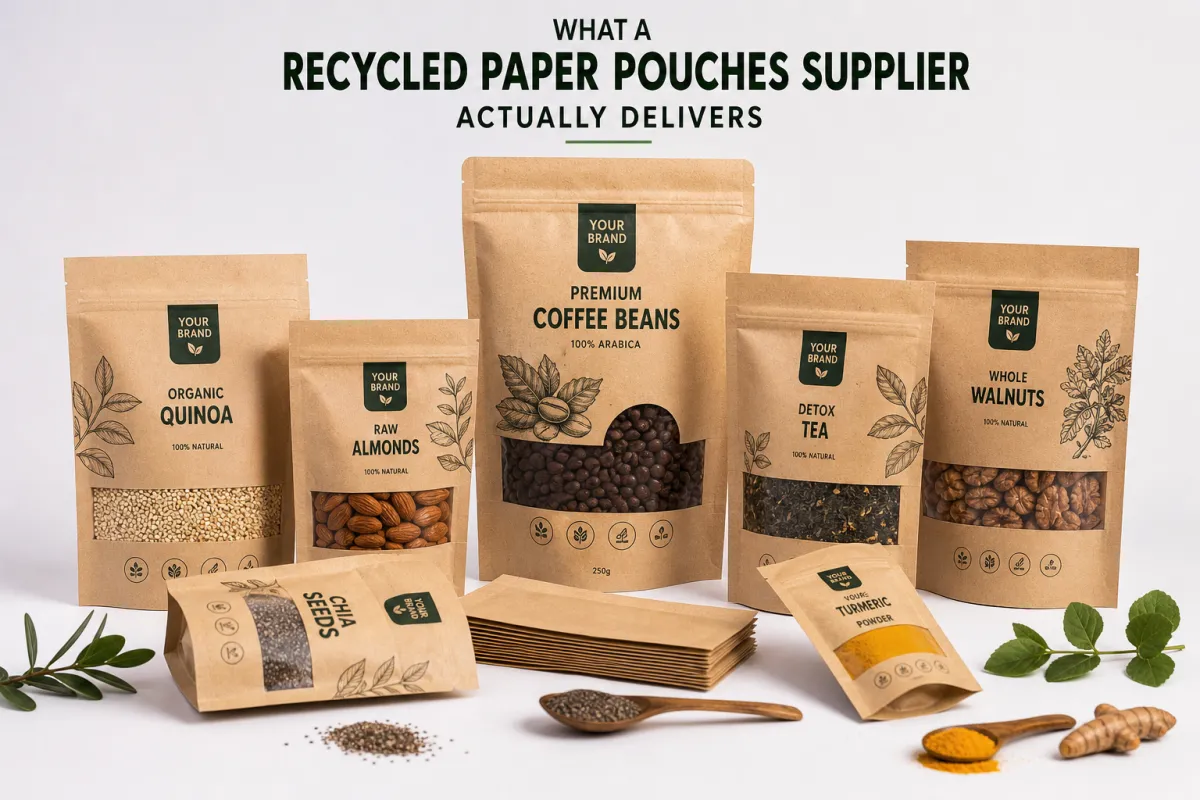
A recycled paper pouches supplier does more than sell a pouch with a kraft-looking face. The better suppliers build around the real use case. Dry snacks, coffee, tea, nutraceuticals, pet treats, powders, hardware, and promotional kits all ask different things from the package. A pouch that looks perfect on a mockup can still fail if the seal line is too narrow, the film layer is wrong, or the paper face curls after filling. Packaging likes to punish assumptions.
In packaging terms, recycled paper usually means fiber that includes post-consumer content, post-industrial content, or a blend of the two. Post-consumer fiber comes from recovered material that has already been used by consumers, while post-industrial fiber comes from manufacturing trim and other clean production scrap. A recycled paper pouches supplier may use either one depending on the target appearance, strength, cost, and availability. The label sounds simple. The supply chain is not.
That supplier role goes beyond the material callout. It usually includes board or web selection, converting, print coordination, adhesive and coating decisions, quality checks, and fit-for-use testing. A recycled paper pouches supplier that understands all of those steps can help you avoid the classic problem where the printed sample looks great in a photo but behaves badly in a real fill environment. Photos do not catch seal failures. Machines do.
Freshness and shelf presentation matter just as much as the sustainability message. If the product is sensitive to moisture, oxygen, aroma loss, or light, the pouch has to be built for that. If the brand wants a natural matte look, the supplier still has to preserve scuff resistance and seal reliability. Those tradeoffs are where an experienced recycled paper pouches supplier earns its keep, because the last thing anyone wants is a lovely pouch that gives up in transit.
From a buyer's point of view, the right partner should be able to speak plainly about product protection, lead times, and what is actually recyclable versus what is merely made with recycled fiber. That honesty matters because recycled content alone does not guarantee a better package. In practice, the best recycled paper pouches supplier is the one that can make the pouch perform, not just the one that can print a sustainability claim on it.
A pouch can look simple on shelf and still require a very specific fiber, barrier, and seal combination to work well in the real world.
One more reality check: a recycled paper pouches supplier may recommend a blended construction even when a buyer asks for "all paper." That is not automatically a red flag. Sometimes a thin barrier layer or a targeted coating is the difference between a pouch that protects the contents and one that creates waste through leaks, spoilage, or returns. Cute sustainability slogans do not replace physics.
I have seen projects stall because the buyer wanted the cleanest-looking paper face possible and the team skipped the ugly conversation about performance. Usually, that comes back as a packaging headache a month later. You can kind of guess how that ends.
How Recycled Paper Pouches Are Made
The production path starts long before the pouch itself exists. Recovered paper is collected, sorted, cleaned, and pulped. From there, the material may be de-inked, refined, screened, and formed into new sheets or rolls. The quality of that upstream work matters because recycled fibers can vary in strength, brightness, cleanliness, and consistency. A recycled paper pouches supplier that sources well will usually have more stable results from run to run. Garbage in, garbage out. Packaging has not escaped that rule.
Once the paper is converted into usable rollstock or sheet stock, the structure moves into pouch making. Depending on the format, the recycled paper pouches supplier may slit the web, laminate it with a barrier film, apply coatings, print the graphics, die-cut the shape, form the gussets, and seal the edges. For pre-made pouches, the process ends with closures such as zippers, tin ties, press-to-close features, or heat-sealed tops. For roll-fed structures, the pouch may be built on packaging equipment downstream.
That is where the technical details start to matter. If the pouch needs grease resistance, for example, the supplier may add a barrier coating that helps repel oils without making the structure brittle. If oxygen control matters, there may be an inner layer selected for low transmission. If the product has aroma to retain, the recycled paper pouches supplier may specify a better sealant layer and a tighter seal window. Small choices. Big consequences.
Print layers also get introduced somewhere in that build. Water-based, solvent-based, or UV-cured inks may be used depending on the press, the substrate, and the required finish. Adhesives, varnishes, and overprint coatings all affect appearance and performance. They also affect how the pouch behaves at end of life, which is why a recycled paper pouches supplier should be able to explain the complete material stack, not just the paper face. Otherwise, the sustainability claim is mostly a vibe.
There is a real difference between stock pouches and custom converting. Stock pouches are usually faster and cheaper because the supplier already has a standard structure, size, and closure combination ready to go. Custom converting makes sense when the fill weight, shelf shape, zipper style, or print requirements are specific enough that a standard pouch would create compromises. A good recycled paper pouches supplier will tell you which route fits the project instead of pushing the highest-margin option. Convenient for them is not the same as right for you.
Timeline expectations are often too optimistic on the buyer side. Even a straightforward recycled paper pouches supplier project can take time for artwork setup, proofing, sample revisions, and production scheduling. If the structure is custom, the first usable sample may arrive in 1 to 3 weeks, and full production may sit in the 3 to 6 week range after approval, depending on complexity, capacity, and freight. It is better to hear that up front than to discover it after launch dates are already fixed.
Key Factors That Affect Performance, Cost, and Sustainability
Buyers sometimes assume a higher recycled percentage automatically means a better package, but that is not how a recycled paper pouches supplier should frame the decision. Recycled content is only one variable. Strength, barrier, print quality, shelf stability, and actual end-of-life behavior all matter just as much. A pouch with 90% recycled fiber that fails in transit is not a sustainable outcome. It is just expensive disappointment.
The first technical question is barrier performance. Does the product need protection from moisture, grease, aroma, oxygen, or light? A dry protein powder has different needs from roasted coffee, and coffee has different needs from a cosmetic sachet or a spice blend. A recycled paper pouches supplier should be able to discuss moisture vapor transmission rate, oxygen transmission rate, grease resistance, and seal integrity in practical terms, not only as data-sheet jargon.
Compliance is another important checkpoint. If the pouch touches food, the inks, adhesives, coatings, and any liners must be appropriate for the market where the product will be sold. In some cases, that means asking for food-contact documentation under regional rules. In other cases, it means reviewing a declaration instead of taking a verbal assurance. A recycled paper pouches supplier that works across food, wellness, and consumer goods should already have a clean process for that paperwork. If they do not, that is your warning sign.
For readers who want a baseline on packaging standards, two useful references are the Sustainable Packaging Coalition at packaging.org and transit-testing guidance from the International Safe Transit Association at ista.org. Those organizations will not choose your pouch for you, but they give context for material claims and transport performance that a recycled paper pouches supplier should respect.
Size and format also change the economics. A stand-up pouch with a wide gusset, a zipper, and a reinforced tear notch costs more than a simple flat pouch because it uses more material and more converting time. Closure style matters too. A zipper improves consumer convenience, but it adds cost and can complicate sealing if the filling equipment is not tuned well. A recycled paper pouches supplier should break those costs out clearly so you can see what each feature is buying.
Print coverage and finish have a visible effect on price and on the final feel in hand. Heavy flood coats, metallic accents, soft-touch finishes, matte varnishes, and multiple spot colors all increase complexity. They can also interfere with recyclability claims if they create a mixed-material structure or a surface treatment that changes the disposal path. Honest recycled paper pouches supplier conversations should include that tradeoff instead of hiding behind the design mockup.
Here is the part that experienced buyers learn early: sustainability is not a single material switch. It is a set of choices, and each choice has a consequence. Better fiber sourcing may cost a little more. A stronger barrier may add a layer. A cleaner claim may require a narrower material stack. The best recycled paper pouches supplier helps you balance those decisions with enough detail to choose deliberately.
| Option | Typical Build | Approx. Unit Price | Typical Lead Time | Best Fit |
|---|---|---|---|---|
| Stock recycled paper pouch | Standard size, limited print, fixed closure | $0.18-$0.32 each at 5,000 units | 7-12 business days after approval | Fast launches, simpler dry goods |
| Semi-custom pouch | Standard base with custom print and selected features | $0.24-$0.45 each at 5,000 units | 12-20 business days after approval | Mid-volume retail programs |
| Fully custom pouch | Custom size, barrier, finish, and closure | $0.32-$0.70+ each at 5,000 units | 15-30 business days after approval | Specialty products, premium branding |
Those numbers are not promises. They move with paper grade, print coverage, order size, and raw material conditions. Still, the table gives a realistic frame for comparing a recycled paper pouches supplier against another without getting distracted by a single headline price. Cheap quotes love to omit the annoying parts.
One more practical point: sustainability claims should match the actual build. If a pouch uses recycled paper on the face but the hidden layers make it a mixed-material structure, the supplier should say that clearly. Trust goes downhill fast once a buyer feels the spec sheet was dressed up. Nobody wants that.
Recycled Paper Pouches Supplier Pricing and Lead Times
Pricing in this category is driven by a few repeatable factors, and the best recycled paper pouches supplier will tell you exactly which ones are affecting your quote. Material grade is usually the first driver. A stronger, cleaner, or more consistent recycled paper face costs more than a lower-grade alternative, especially if the project needs better print holdout or improved stiffness. Then there is the barrier build, which can add cost quickly if you need grease resistance, aroma retention, or stronger shelf life.
Order quantity changes everything. Low-volume runs carry more setup cost per unit because the press, cutter, die, and production planning still have to happen, whether you order 1,000 pouches or 50,000. A recycled paper pouches supplier may quote a sample or pilot run at a very different unit rate than a full production order, so buyers should look at the total landed cost rather than just the unit price. Freight, cartons, inner packaging, and inspection costs all belong in that conversation.
Another line item to watch is setup. Some suppliers separate plate charges, tooling charges, die charges, or color-matching fees from the unit price. Others roll some of those costs into the quote. Neither method is wrong, but it can make two quotes look closer than they really are. A careful recycled paper pouches supplier comparison should list out every one-time charge before anyone starts debating per-piece cost. Hidden fees are not a personality trait you want in packaging.
Lead time usually runs through a simple chain: intake, specification review, artwork or dieline confirmation, sample creation, revision, final approval, production scheduling, and shipment. If the artwork is already final and the structure is stock-based, the process can move fairly fast. If the pouch is custom, the timeline expands because every change has to be checked for fit, seal strength, and print alignment. A recycled paper pouches supplier that gives you a realistic timeline is worth more than one that only tells you what you want to hear.
Rush orders are rarely cheap. They compress production windows, increase the risk of mistakes, and may require premium freight or overtime. If your launch date is fixed, it is smarter to start the recycled paper pouches supplier conversation early and ask for both standard and expedited options. That gives you a way to compare cost against risk instead of forcing a late scramble.
Quote comparison gets much easier if you require every supplier to answer the same questions. What are the exact dimensions, including gusset and fill volume? How many print colors? What recycled content is documented? Is the pouch stock, semi-custom, or fully custom? What closure is included? Is the price FOB, delivered, or freight excluded? A recycled paper pouches supplier should have no issue answering those points in writing.
Here is a practical rule I use: if two quotes differ by more than a few percentage points, do not assume the cheaper one is the better deal until you compare the build line by line. Lower price can hide thinner paper, weaker barrier, smaller tolerances, or a stripped-down finish that may not survive your real production and distribution conditions. The invoice does not care about your assumptions.
How to Vet a Recycled Paper Pouches Supplier Step by Step
The easiest way to start is with a solid product brief. A recycled paper pouches supplier cannot quote intelligently if the brief only says "eco-friendly pouch." The brief should include fill weight, product sensitivity, shelf life target, storage temperature, whether the product is oily or aromatic, how the pouch will be filled, and whether the final package will sit on a shelf, hang on a peg, or ship in a case. Those details change the structure choice more than most buyers expect.
Next, ask for the build sheet. The recycled paper pouches supplier should be able to show the outer paper grade, the liner or barrier layer if there is one, the adhesive or lamination method, the closure style, and the finishing process. If the supplier is vague about material composition, that is a warning sign. A good answer does not have to be complicated, but it should be specific. "Trust us" is not a spec.
Samples deserve real testing, not just a quick visual check. I like to see seal strength, drop resistance, print durability, and machine compatibility assessed under actual filling conditions whenever possible. A pouch can look beautiful in a hand sample and still wrinkle, leak, or misfeed on production equipment. If the product is moisture sensitive, ask for any barrier data the supplier has. If shipping abuse is likely, run the sample through transit testing or a simplified version of it, with input from ISTA-style thinking rather than guesswork.
It is also smart to ask how the supplier handles variation. Fiber-based materials can shift slightly from lot to lot, and coatings or liners can change if a raw material is substituted. A reliable recycled paper pouches supplier should have tolerances, change-control practices, and continuity plans in place. If the answer is "we will let you know if anything changes," press for more detail. That answer sounds polite and still fails the actual question.
Below is a simple scorecard framework that makes comparisons easier:
- Material clarity: Can the recycled paper pouches supplier explain the build in plain language?
- Testing: Are there sample results, seal checks, or transit references?
- Compliance: Are food-contact or other regulatory claims documented?
- Responsiveness: Do questions get answered quickly and clearly?
- Continuity: What happens if a paper grade or coating source changes?
- Total cost: Does the quote include setup, freight, and packaging?
That scorecard works because it focuses on what a recycled paper pouches supplier can actually control. Service matters. So does process discipline. So does the ability to explain a tradeoff without turning it into a sales pitch. The fancy presentation is optional. The answers are not.
One more practical step: ask for a revision trail. If the supplier changes the dieline, seal area, barrier layer, or finish, you should know exactly which revision is current. Simple change control saves a surprising amount of money later, especially when a launch team has marketing, operations, and procurement all looking at different versions of the same pouch. That kind of mess is avoidable.
Common Mistakes When Choosing Recycled Paper Pouches
The biggest mistake is buying on the recycled claim alone. A recycled paper pouches supplier can offer a pouch with a strong sustainability story, but if the structure does not protect the product, the claim loses value fast. Leakage, spoilage, poor shelf presentation, and damaged goods create waste that no marketing copy can hide. "Eco-friendly" does not get a pass from physics.
Skipping trials is another common error. Buyers sometimes approve a pouch from artwork alone, then discover curling, seal failures, zipper issues, or line stoppages after production starts. A sample run costs far less than a full recall, a line shutdown, or a pallet of unusable inventory. A disciplined recycled paper pouches supplier should welcome testing because it lowers risk for everyone. If they seem nervous about samples, ask why.
Many teams also underestimate the hidden work around minimums, tooling, freight, and revisions. A quote that looks affordable on paper can become expensive once you add custom plates, shipping from the converter, carton requirements, or extra sample rounds. A recycled paper pouches supplier that is transparent about these add-ons is easier to work with than one that saves them for the last step. Surprise charges are not a badge of honor.
There is also a lot of confusion around recyclability and compostability. Not every paper pouch is equally recyclable, and not every pouch that contains recycled fiber is compostable. If the structure includes mixed materials, barrier laminations, or coatings that complicate recovery, the end-of-life claim must be stated carefully. A trustworthy recycled paper pouches supplier will not blur those lines just to make the pouch sound greener than it is.
Timing mistakes are just as damaging. Artwork approvals, inventory planning, and release checkpoints are easy to ignore when the design looks finished, but those steps determine whether production lands on time. If the brand waits too long to freeze the final build, even the best recycled paper pouches supplier can run into scheduling pressure. That is how rush charges show up, along with the usual regret.
A helpful way to think about it is this: a pouch failure is usually not one big failure. It is a chain of small misses. Slightly wrong barrier. Slightly weak seal. Slightly under-tested sample. Slightly vague spec sheet. By themselves, each one seems manageable. Together, they can turn a launch into a cleanup exercise.
Honestly, that is why the best recycled paper pouches supplier relationships feel a little slower at the start. There are more questions, more sample reviews, and more detail than a quick buying process would like. But that extra work usually saves time later, because it reduces rework, complaint handling, and emergency substitutions. Slow beats expensive. Almost every time.
Expert Tips and Next Steps for Your Recycled Paper Pouches Supplier Search
If you want cleaner quotes, ask for a one-page specification before you request pricing. A recycled paper pouches supplier should receive the same dimensions, closure style, print coverage, recycled content target, barrier need, and pack-out assumption every time. That way, you are comparing the same structure instead of comparing different interpretations of the same idea. Guessing is not a procurement strategy.
Start with the harshest version of the use case. If the pouch will sit in a humid warehouse, hold oily contents, or run at high speed on a filler, test those conditions first. A recycled paper pouches supplier can often make a nice-looking sample for easy conditions, but the hard conditions tell you whether the structure is really ready. Shelf appeal is nice. Survival is nicer.
Approve samples as close to production reality as possible. Bench tests are useful, but they are not the same as live filling, transport, and retail handling. If the pouch will be handled by a contract packer, involve that team early. If the product is sensitive to aroma or moisture, make sure the shelf-life expectations are clear before final release. A recycled paper pouches supplier that understands the whole chain will usually help you set those tests up properly.
I also recommend a short scorecard process: sample review, pilot order, then full rollout. That sequence keeps risk controlled and gives your team time to see how the pouch behaves after a few weeks in the market. A recycled paper pouches supplier that accepts that process is usually more confident in the build, which is a good sign. Confidence backed by testing is useful. Confidence backed by vibes is not.
For a final checklist, confirm these points before you release the order:
- Final dimensions and fill weight
- Exact recycled content claim and supporting documentation
- Barrier requirement and acceptable shelf life
- Artwork revision number and print colors
- Closure style and seal specification
- QA tolerances for seal, cut, and registration
- Reorder point and backup stock plan
That checklist sounds basic, but basic is where a lot of packaging projects fall apart. A strong recycled paper pouches supplier should welcome the discipline because it removes ambiguity. Ambiguity is expensive, and everyone knows it.
For a Custom Logo Things project, keep the conversation grounded in the actual build, not just the recycled paper headline. That is how you find a recycled paper pouches supplier that can deliver the right balance of shelf appeal, product protection, and credible sustainability. Clean design helps. Clean decisions matter more.
If you are still between two options, compare them on the same six points: material clarity, barrier fit, compliance, testing, lead time, and total landed cost. That single pass usually shows which supplier is solid and which one is just good at talking. Packaging is too expensive for guesswork.
Choosing with Confidence
Choosing a recycled paper pouches supplier is really about matching promise to performance. If the supplier can show you the fiber source, describe the barrier structure, discuss compliance, and walk you through realistic Pricing and Lead Times, you are on solid ground. If they cannot, the risk usually shows up later in complaints, delays, or a package that looks better in theory than it does in use.
The strongest programs are built on clear specs, honest testing, and steady communication. That is true whether you are launching a small seasonal run or building a larger retail line. A recycled paper pouches supplier that respects those basics will usually save time, reduce rework, and help the finished pouch do the job it was meant to do. Packaging is not glamorous. It just has to work.
For a Custom Logo Things project, keep the conversation grounded in the actual build, not just the recycled paper headline. That is how you find a recycled paper pouches supplier that can deliver the right balance of shelf appeal, product protection, and credible sustainability. Clean design helps. Clean decisions matter more.
The takeaway is simple: do not ask only whether a pouch contains recycled paper. Ask what the pouch is made of, how it performs, what it costs to run, and how the supplier proves the claim. If those answers are clear, you are probably dealing with the right partner. If they are fuzzy, keep looking.
What should I ask a recycled paper pouches supplier before requesting a quote?
Ask for the exact material build, recycled content level, barrier layer, closure style, and whether the pouch is stock or custom. Confirm minimum order quantity, sample availability, setup charges, and the lead time after artwork approval. If the pouch will hold food, request proof of food-contact suitability or the documentation that supports the claim. A vague answer at this stage usually stays vague later.
Are recycled paper pouches suitable for food packaging?
Yes, if the construction is designed for food contact and the barrier level matches the product's moisture, grease, or aroma needs. A recycled paper pouches supplier should be able to explain the inks, adhesives, coatings, and liner layers involved. Always test seal strength and shelf life with the actual product before you commit to a full run. Paper on its own is not a magic shield.
How do I compare pricing from different recycled paper pouches suppliers fairly?
Make sure every supplier is quoting the same dimensions, material build, print coverage, quantity, and closure type. Separate setup fees, tooling costs, freight, and sample charges from the unit price so the totals are truly comparable. Compare total landed cost, because a lower per-piece rate can hide expensive extras. The cheapest quote often gets creative in the margins.
What lead time should I expect for custom recycled paper pouches?
Lead time depends on whether the pouch is stock-based or fully custom, and custom artwork or tooling usually adds time. Expect additional time for sample approval, revisions, compliance checks, and production scheduling before shipment. Ask the recycled paper pouches supplier to quote both standard and expedited timelines so you can plan inventory realistically. A guess is not a schedule.
How can I tell whether a pouch is actually eco-friendly?
Review the fiber source, barrier structure, and end-of-life claim, because recycled paper alone does not tell the full story. Look for clear documentation on certifications, material composition, and any limits on recyclability or compostability. Judge the pouch by both sustainability and performance, since a package that fails in use creates waste of its own. Green claims are easy. Good packaging is harder.