Buyer Fit Snapshot
| Best fit | Corrugated Shipping Boxes MOQ projects where brand print, material claims, artwork control, MOQ, and repeat-order consistency need to be specified before quoting. |
|---|---|
| Quote inputs | Share finished size, material target, print colors, finish, packing count, annual reorder estimate, ship-to region, and any compliance wording. |
| Proofing check | Approve dieline scale, logo placement, barcode or warning zones, color tolerance, closure strength, and carton packing before bulk production. |
| Main risk | Vague material claims, crowded artwork, missing packing details, or unclear freight terms can make a low unit price expensive after revisions. |
Fast answer: Corrugated Shipping Boxes MOQ: Pricing and Lead Times should be specified like a repeatable production item. The safest quote records material, print method, finish, artwork proof, packing count, and reorder notes in one written spec.
Production checks before approval
Compare the actual filled-product size with the drawing, then confirm tolerance on folds, seals, hang holes, label areas, and retail display edges. Reserve space for logos, QR codes, warning copy, and material claims before decorative graphics fill the panel.
Quote comparison points
Review material grade, print process, finish, sampling route, tooling charges, carton quantity, and freight assumptions side by side. A quote is only useful when the supplier can repeat the same color, closure quality, and packing count on the next order.
Corrugated Shipping Boxes MOQ: What Buyers Miss First
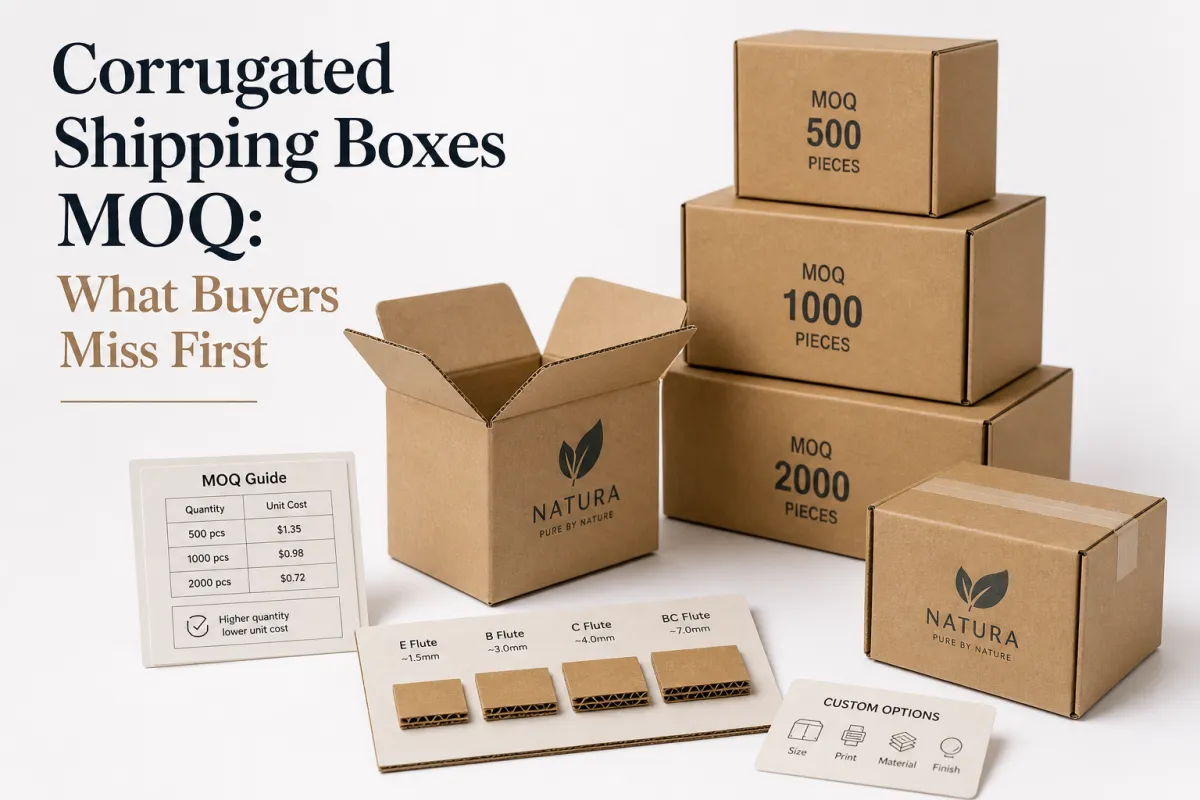
Most buyers treat Corrugated Shipping Boxes MOQ like a gatekeeper. Hit the number, get your boxes, move on. Nice idea. Packaging does not care about nice ideas. A low corrugated shipping boxes MOQ can look friendly on the quote sheet and still turn into a mess if the carton is too large, too heavy, or built for the wrong job. Then freight climbs, labor gets slower, and the “cheap” box starts acting expensive.
MOQ is rarely random. It usually comes from sheet yield, die-cut setup, print setup, glue patterns, and how efficiently the plant can run the job. If a box wastes board on the sheet, the supplier has less room to keep the run small. Add a custom die, special print, or a weird closure and the factory needs to spread setup cost across more units. That is why Corrugated Shipping Boxes MOQ is really a production question, not a magic number someone typed while half awake.
I see the same mistake over and over with smaller brands. They want a cleaner carton and a lower unit cost, which makes sense. Then they order the wrong size, or they undercount storage space, or they ask for a print spec that belongs on a much larger run. A few weeks later, there is a stack of boxes in the warehouse and everybody is pretending that stack was part of the plan. It was not. That is the part buyers do not see until they are already stuck with inventory.
Think of corrugated shipping boxes MOQ as a fit problem first and a volume problem second. The carton should protect the product, stack cleanly, move through fulfillment without drama, and avoid oversize charges that eat the margin. A box that fits the product well and ships efficiently usually wins, even if the minimum order is a little higher than the team hoped for. I know, not very romantic. Still true.
Low MOQ only looks cheap if the carton fits the product, stacks well, and does not trigger ugly freight math.
The better question is not “What is the smallest number you can make?” It is “What quantity gives me the right carton at a cost that still works after freight, storage, and labor?” That is the real conversation behind corrugated shipping boxes MOQ quotes.
Corrugated Shipping Boxes MOQ and Product Options
Box style changes the minimum because each style asks the factory to do something different. A regular slotted container, or RSC, is usually the easiest place to start. It is common, efficient, and easy to repeat. Mailer boxes are another ecommerce favorite because they open neatly and look good on arrival. Die-cut cartons give a tighter fit and a better unboxing feel, but that precision usually pushes corrugated shipping boxes MOQ higher. Heavy-duty corrugated shipping boxes, especially double-wall styles, can do the same because they use more board and often move through production more slowly.
Single-wall and double-wall are not just strength labels. They change the economics. Single-wall cartons usually cover lighter products, retail kits, and a lot of direct-to-consumer shipments. Double-wall construction makes more sense when the product is heavier, brittle, or stacked for long periods in transit packaging. More board means more material cost. More material cost usually means a higher MOQ threshold, especially if the box is custom sized. That part is not fancy. It is just math with cardboard.
Standard dimensions are easier to buy than highly custom dimensions. That sounds obvious, and still people miss it. Shift the length, width, or depth even a little and the sheet layout can change enough to reduce how many blanks fit per sheet. If a layout drops from ten-up to eight-up, the plant loses efficiency and the minimum can move up. That is one of the main reasons corrugated shipping boxes MOQ changes even when the box only grows a little.
Printing changes the order too. Unprinted stock boxes usually support the lowest MOQ because they skip extra setup work. One-color print stays manageable and still gives you branded packaging without a circus. Full-color outside print, inside print, or full bleed graphics add complexity. They can be worth it for presentation, sure. They are not free. Setup, press time, and proofing still show up somewhere. If you are comparing quotes, make sure the print method is identical before you decide which corrugated shipping boxes MOQ actually makes sense.
Add-ons matter. Inserts, partitions, glue tape, and specialty dielines all add structure and labor. A plain carton is fast. A custom box with a folded insert and a partition sized for glass bottles is a different animal. More features usually mean more engineering, more sampling, and a higher minimum order quantity. That is not a supplier being difficult. That is production reality doing its thing.
Here is the quickest way to sort the options:
- Regular slotted containers: good for shipping, storage, and simple branding.
- Mailer boxes: better for ecommerce presentation and unboxing.
- Die-cut cartons: best for precise fit and retail-style presentation.
- Double-wall cartons: better for weight, stacking, and extra package protection.
If you are still choosing between corrugated and lighter packaging, start with product weight and shipping method. For flat, light items, some brands split the order between corrugated cartons and Custom Poly Mailers. That is usually smarter than forcing one carton style to do every job. Trying to make one box solve everything is how people end up buying the wrong thing twice.
Corrugated Shipping Boxes MOQ Specifications That Affect Cost
Flute type is one of the first specs I check. E-flute is thinner and cleaner, so it shows up often in display-style boxes and lighter products. B-flute gives a good mix of strength and print surface. C-flute is thicker and offers more cushion for package protection. None of them is magically right in every case. The answer depends on product weight, shipping distance, and how the box will be handled in order fulfillment. Each flute changes sheet usage, board cost, and often corrugated shipping boxes MOQ.
Board grade matters just as much. You will see burst strength and Edge Crush Test, or ECT, thrown around. Burst strength measures puncture and rupture resistance. ECT matters more for stacking strength and warehouse compression. If the box will sit on a pallet, live in a fulfillment center, or travel through rough distribution channels, ECT deserves attention. Skip that detail and the cheapest carton may fail in transit packaging. That is not savings. That is a refund with extra steps.
Tolerance is another detail people love to wave away until the first sample is wrong. Tight inside dimensions can make the carton harder to manufacture consistently. Material thickness, board caliper, and folding allowance all affect the final fit. A 1/8 inch mismatch may sound tiny, but on a snug product kit it can force a redesign. That redesign can raise corrugated shipping boxes MOQ because the factory has to rerun samples, adjust the die, or rework the layout.
Structural upgrades change the minimum too. Reinforced bottoms, locking tabs, crash-lock bottoms, and double-wall builds all use more material or more labor. Some of those runs move slower, and slower production costs more. If you need heavy contents, do not under-spec the box just to chase a smaller MOQ. That shortcut usually comes back as breakage, returns, or damaged brand perception. None of those make finance happy.
For ecommerce shipping, I also check whether the carton matches carrier dimensional weight rules. A lightweight box that is too big can cost more to ship than a smaller, denser design. That is the part buyers miss. The carton itself looks cheap, but the shipping label quietly eats the margin. When corrugated shipping boxes MOQ is evaluated against dimensional weight, the best choice is often the one that trims dead air without crushing the product. Sometimes the smaller box is the smarter one, even if it feels a little less dramatic.
Industry standards help keep the conversation honest. For transit packaging testing, the International Safe Transit Association publishes useful test profiles at ista.org. For fiber sourcing, FSC certification at fsc.org is a solid starting point if certified paperboard matters to your brand. Those references do not pick the box for you, but they help you ask sharper questions before you lock in a corrugated shipping boxes MOQ.
If you need a quick rule of thumb, use this:
- E-flute for lighter items and stronger print presentation.
- B-flute for balanced strength and common ecommerce use.
- C-flute for more cushion and heavier shipments.
- Double-wall when stacking, weight, or rough handling becomes a real risk.
That is not fancy. It is practical packaging. Practical packaging usually wins, even if it does not sound exciting in a meeting.
Corrugated Shipping Boxes MOQ Pricing Breakdown
Pricing for corrugated shipping boxes MOQ comes from several pieces: unit price, setup charges, tooling, sample fees, freight, and any testing or structural engineering. People love to compare only the unit price. That is lazy. If one quote has a lower box price but higher freight or a bigger setup fee, the supposedly cheaper option can end up being the worst deal on the page.
The biggest cost lever is quantity. In general, larger corrugated shipping boxes MOQ runs lower the unit cost because setup gets spread across more cartons. That only helps if the buyer can actually move the inventory. If boxes sit in storage for six months, the cash tied up in them becomes its own cost. Smart packaging buying is not just about the lowest price per unit. It is about buying enough to get efficiency without clogging inventory. That balance is the whole trick.
Freight can distort quotes fast. A box that ships flat and nests efficiently is easier to move than a bulky structure with a wide footprint or awkward pallet pattern. A cheap unit price can turn into an expensive delivered cost if the cartons need multiple pallets, special handling, or poor stacking. That is why I always look at landed cost, not just manufacturing cost, when reviewing corrugated shipping boxes MOQ pricing.
Sample approval has real value. If the box is new, a prototype or sample catches the wrong size, wrong print, or wrong board spec before production starts. Some buyers skip that step to save time. They usually pay for it anyway. One bad run costs more than a sample and a corrected proof. Usually a lot more. I have never seen a skipped sample come back and save the day. Never.
A low quote only matters if the carton survives shipping, fits the product, and does not trigger ugly freight math.
| Order Size | Typical Box Style | Unit Price Range | Setup / Tooling | Freight Impact | Best Fit |
|---|---|---|---|---|---|
| 500 units | Plain RSC or simple mailer | $1.10-$2.40 | $80-$250 | High per unit unless palletized well | Launch tests, pilot programs, short-term need |
| 1,000 units | Single-wall custom size | $0.72-$1.65 | $150-$400 | Moderate | New SKU, small ecommerce shipping volume |
| 5,000 units | Printed single-wall or standard double-wall | $0.32-$0.78 | $250-$700 | Better pallet efficiency | Steady replenishment, stronger branding, better unit cost |
| 10,000+ units | Standardized spec with simple print | $0.24-$0.55 | $0-$150 | Lowest per unit when shipped efficiently | High-volume order fulfillment and repeat runs |
Those numbers are working ranges, not promises. Box size, board grade, print coverage, destination, and whether the carton is made domestically or offshore all move the math. A wide box with full-color graphics is not the same thing as a plain carton with one-color print. Still, the pattern is clear: once the corrugated shipping boxes MOQ gets larger, the unit price usually drops hard and then starts flattening out. That drop matters most for standard specs.
If you want a better comparison, ask for quotes at several quantities. Do not ask only for the minimum and the maximum. Ask for the step where the price starts to flatten. That is usually where corrugated shipping boxes MOQ gives the best balance between cash flow and production efficiency. Otherwise you are just collecting numbers for sport.
Corrugated Shipping Boxes MOQ Process and Timeline
The path from request to delivery is usually pretty direct if the buyer gives real information. Start with specs intake: box dimensions, product weight, print count, shipping destination, and target quantity tiers. The clearer the brief, the cleaner the quote. A vague request gets a vague answer, and vague answers waste time. That matters with corrugated shipping boxes MOQ, because the production path changes fast depending on whether the design is stock-style, custom printed, or structurally complex.
After the quote comes structural review or dieline confirmation. If the box is simple, that review may move quickly. If it is custom, the supplier may need to check score lines, closures, folding behavior, and print alignment. Then comes proof approval. That is where delays usually pile up. Artwork changes, logo corrections, and late size edits all eat days. Nothing glamorous. Just packaging doing packaging things.
Sampling is worth the time. A carton can look fine on a screen and fail on a real packing line because the product weighs more than expected or the insert does not lock the way it should. Sample testing should reflect actual use: ecommerce shipping, warehouse stacking, drop handling, or whatever the product will face. If the box is part of transit packaging, I want to know how it behaves before production, not after complaints start. That is one reason solid corrugated shipping boxes MOQ planning pays off.
Typical timelines vary by complexity. Stock-style cartons can move faster. Simple unprinted or lightly printed runs often finish in about 8 to 12 business days after approval, though the plant schedule still matters. Custom printed or die-cut boxes usually need more like 12 to 20 business days. If the structure is complex, the board is heavy, or the print coverage is demanding, give it more time. Offshore production can take longer, often 30 days or more once freight is included. None of that is shocking. It is just what the spec asks for.
What speeds the process up?
- Exact inside dimensions, not rough estimates.
- Product weight and any fragile components.
- Clear print count and artwork files.
- Confirmed shipping destination and pallet needs.
- Target quantity tiers for the corrugated shipping boxes MOQ quote.
What Slows It Down?
- Artwork sent in the wrong format.
- Last-minute changes to the box size.
- Unclear strength requirements.
- Waiting too long to approve the sample.
- Not planning reorder points before stock gets low.
That last one matters more than people think. If you run order fulfillment and your reorder plan is sloppy, the next carton purchase becomes a rush job. Rush jobs cost more. They also force bad decisions. Setting a reorder point before inventory gets thin keeps the next corrugated shipping boxes MOQ order calm instead of frantic. Nobody likes a fire drill over cardboard.
Why Choose Us for Corrugated Shipping Boxes MOQ
Good packaging sourcing should make the carton fit the product, the budget, and the schedule. That sounds obvious, yet plenty of suppliers still push buyers into a box spec that is too stiff, too big, or too expensive to ship. A better approach is simpler: keep the corrugated shipping boxes MOQ realistic, protect the product, and avoid loading the design with unnecessary freight weight or pointless extras.
Engineering support matters here. Right-sizing is not about squeezing the product into the smallest possible box. It is about choosing a board grade, flute type, and closure style that holds up in real use. A good spec cuts waste, keeps the package looking professional, and helps the order stay within a sensible MOQ. That is useful whether you ship cosmetics, supplements, apparel, or small hardware.
Consistency across repeat orders matters too. A lot of buyers get burned when the first run looks good and the second run comes back slightly different. Maybe the board changed. Maybe the print shifted. Maybe the dimensions are close but not quite. That kind of drift causes packing problems and quality complaints. If you are going to invest in corrugated shipping boxes MOQ, make the spec repeatable. Otherwise the savings disappear the moment the next run lands on the dock.
We keep sourcing flexible as well. Sometimes domestic production is the right answer because the timeline is tight and the customer needs speed. Sometimes a larger program can handle a longer lead time and benefit from offshore sourcing. There is no single lane that fits every buyer. The right lane depends on quantity, freight tolerance, and how quickly the cartons need to hit the packing line. That is the kind of planning that keeps a corrugated shipping boxes MOQ order from turning into expensive theater.
For buyers comparing other packout options, it helps to look across the whole packaging stack. A company may need corrugated cartons for one product line, while a lighter SKU works better in poly. That is why some teams use both Custom Packaging Products and Custom Shipping Boxes instead of forcing every item into the same structure. It is also why our FAQ page helps when you are sorting through basic ordering questions before asking for a quote.
Most buyers do not need hype. They need a straight answer, a clear proof, and a carton that does its job. That is the point of corrugated shipping boxes MOQ support that respects the numbers instead of hiding behind jargon.
Next Steps for Your Corrugated Shipping Boxes MOQ Order
If you want a clean quote, gather the right inputs before you ask for pricing. Start with exact box dimensions, product weight, and shipping method. Then add print requirements, target monthly usage, and any insert or partition needs. If the product is fragile, send photos or a sample unit. That cuts guesswork and lowers the odds of a bad fit. A smart corrugated shipping boxes MOQ order starts with real dimensions, not optimistic ones.
Here is the short checklist I would use:
- Measure the product and confirm inside dimensions.
- List the product weight and any breakable components.
- Decide whether you need unprinted, one-color print, or full-color print.
- Estimate monthly usage so the MOQ fits your inventory plan.
- Ask for pricing at several quantities, not just one.
- Request a sample or prototype before production approval.
Do not stop at price. Compare freight, setup, and the exact board spec. A quote that looks lower can still cost more once the cartons are on a truck. That happens constantly with corrugated shipping boxes MOQ because the delivered cost matters more than the headline number. If one supplier is cheaper but the carton is weaker or oversized, the savings disappear in damage claims and wasted freight.
Once you have the final spec, place the order, approve the proof quickly, and set a reorder reminder. The best packaging program is the one that does not rely on panic. When the next production run is planned early, the corrugated shipping boxes MOQ conversation gets easier, pricing gets cleaner, and the box actually supports the business instead of getting in the way. That is the practical takeaway: start with fit, then check landed cost, then decide whether the MOQ is actually acceptable.
Frequently Asked Questions
What is a typical corrugated shipping boxes MOQ for custom orders?
MOQ depends on box style, size, print, and board grade, but custom runs usually start higher than plain stock cartons. Simple unprinted boxes can often be produced in smaller quantities than printed or die-cut designs. Ask for quantity tiers so you can see where pricing becomes efficient without overbuying inventory. That is the cleanest way to judge corrugated shipping boxes MOQ without guessing.
Do corrugated shipping boxes MOQ requirements change with printing?
Yes. Printing adds setup work, proofing, and sometimes plate or press fees. Single-color branding is often easier to keep at a lower MOQ than full-coverage or multi-color artwork. If you only need branding on a small run, ask whether a simpler print method or stock box can meet the target. That keeps corrugated shipping boxes MOQ under control without making the box look cheap.
How do I lower the MOQ on corrugated shipping boxes without hurting quality?
Use standard sizes and proven board specs whenever possible. Limit custom inserts, specialty finishes, and complex printing unless they are truly necessary. Share accurate product dimensions and shipping needs so the supplier can avoid overengineering the carton. That is usually the fastest way to bring down corrugated shipping boxes MOQ while protecting the product.
How long does production usually take after approving a corrugated shipping boxes MOQ quote?
Plain cartons move faster than custom printed or structurally complex boxes. Sampling, artwork approval, and freight booking are the steps that usually affect timing the most. A complete spec sheet at the quoting stage is the easiest way to avoid delays. For many buyers, the real issue is not production time alone; it is the mix of corrugated shipping boxes MOQ, proof approval, and freight scheduling.
What should I compare when reviewing corrugated shipping boxes MOQ pricing?
Compare the exact box spec, not just the headline unit price. Check setup charges, freight, sampling, and whether the quote includes the same board strength and print method. A cheaper quote is not better if the box fails in transit or costs more to ship. That is the whole point of comparing corrugated shipping boxes MOQ quotes carefully instead of chasing the lowest number.
If you want the smarter version of this purchase, start with the real product dimensions, ask for spec-matched pricing, and compare landed cost instead of chasing a meaningless bargain. That is how corrugated shipping boxes MOQ stops being a hurdle and becomes a buying tool that actually helps your business.


