Buyer Fit Snapshot
| Best fit | Recycled Poly Mailers with Logo Cost projects where brand print, material claims, artwork control, MOQ, and repeat-order consistency need to be specified before quoting. |
|---|---|
| Quote inputs | Share finished size, material target, print colors, finish, packing count, annual reorder estimate, ship-to region, and any compliance wording. |
| Proofing check | Approve dieline scale, logo placement, barcode or warning zones, color tolerance, closure strength, and carton packing before bulk production. |
| Main risk | Vague material claims, crowded artwork, missing packing details, or unclear freight terms can make a low unit price expensive after revisions. |
Fast answer: Recycled Poly Mailers with Logo Cost: Film, Print, MOQ, and Carton Packing should be specified like a repeatable production item. The safest quote records material, print method, finish, artwork proof, packing count, and reorder notes in one written spec.
Production checks before approval
Compare the actual filled-product size with the drawing, then confirm tolerance on folds, seals, hang holes, label areas, and retail display edges. Reserve space for logos, QR codes, warning copy, and material claims before decorative graphics fill the panel.
Quote comparison points
Review material grade, print process, finish, sampling route, tooling charges, carton quantity, and freight assumptions side by side. A quote is only useful when the supplier can repeat the same color, closure quality, and packing count on the next order.
Recycled poly Mailers with Logo cost: what to expect
If you are replacing plain shipping bags with branded packaging for a monthly apparel run, recycled Poly Mailers With Logo cost starts making a lot more sense once the actual variables are visible: bag size, film thickness, print coverage, recycled content, and order volume. The logo itself is usually not the expensive part. Material weight, resin blend, and how well the setup costs are spread across the run tend to move the number much more.
I have seen plenty of sourcing reviews stall because someone fixated on the print line while the bigger difference sat in the bag construction. One supplier may quote a light 2.25 mil mailer with a one-color logo, while another is pricing a thicker film, a larger size, and a more involved print layout. Those are not really the same product, even if both get called “custom recycled mailers.”
The cleanest way to think about recycled poly mailers with logo cost is as a packaging decision, not just a unit price. A mailer that protects the product, looks sharp at the doorstep, and keeps packing moving at a steady pace can justify a small premium without feeling wasteful. That is especially true for apparel brands, where presentation and transit durability both matter.
So if you are comparing quotes, keep the focus on the spec that actually serves the product. It is kinda easy to overbuy film, overdo print coverage, or pay for features that never get used. A good quote should make those tradeoffs obvious.
Recycled poly mailers with logo cost: why the logo is not the expensive part
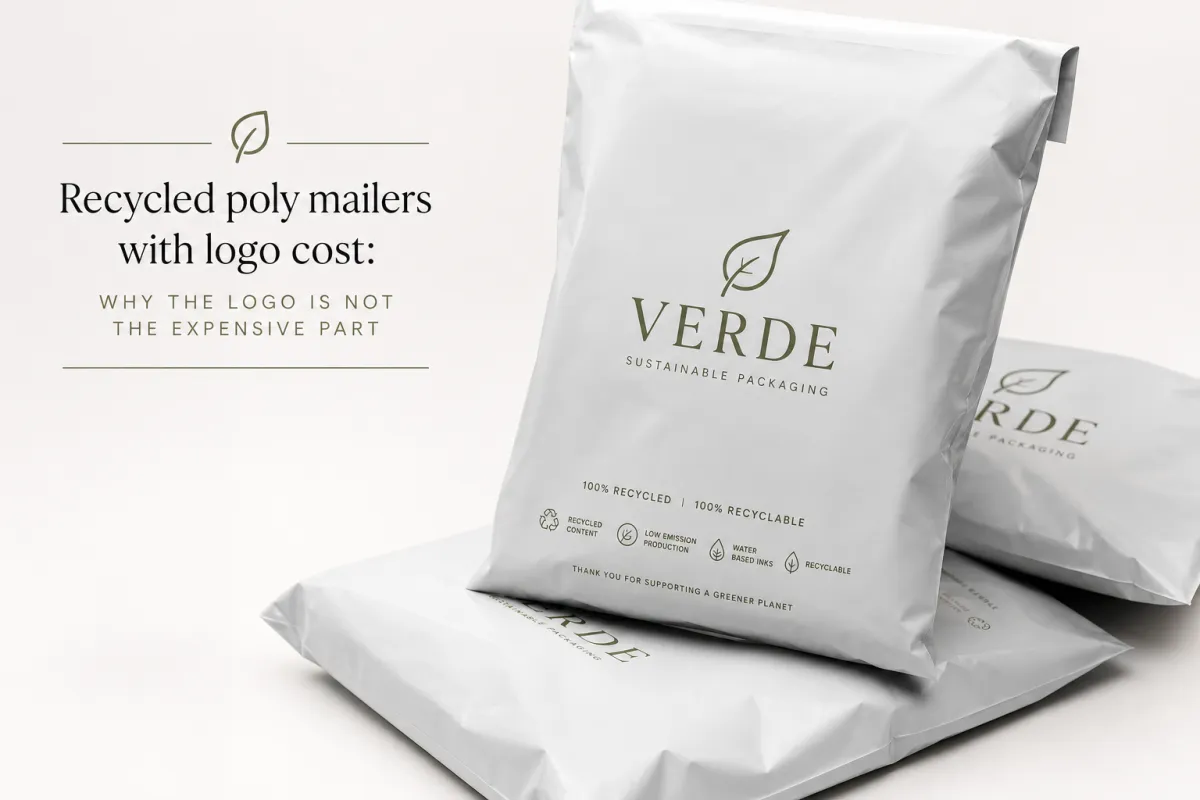
Many buyers assume the print is the biggest add-on, but on a normal production run the logo is often a smaller slice of the total than the film spec itself. A simple one-color logo on a recycled bag may add only a modest amount to cost per piece once the run gets large enough. Moving from a thin mailer to a thicker one usually shifts the quote more sharply.
That is why the useful question is not “How much does the logo cost?” It is “Does the whole mailer spec make sense for the product and the shipping lane?” A plain bag may look cheaper on paper, but if the branded recycled version reduces scuffing, strengthens brand recall, and gives the parcel a more finished look, the difference can be easy to justify.
From the buyer side, I have watched a lot of decisions get stuck on a few cents of print while the real opportunity sat in the bag itself. If the product is light apparel, the mailer probably does not need to be overbuilt. If the contents are dense, oddly shaped, or more likely to puncture the film, the bag should be chosen for strength first and branding second.
“A good mailer is not the loudest one on the dock; it is the one that fits the product, survives the trip, and still looks clean at the door.”
That makes recycled poly mailers with logo cost a planning number instead of a vague talking point. Once the quote drivers are clear, buyers can compare suppliers without getting fooled by different assumptions hidden in the spec.
What recycled poly mailers with logo are made of
A recycled poly mailer is a flexible polyethylene shipping bag made with recycled resin. It is widely used for apparel, soft goods, accessories, and other lightweight fulfillment items that do not need a rigid carton. The recycled content may come from post-industrial material, post-consumer material, or a blend of both, and that choice affects both pricing and production consistency. For anyone tracking recycled poly mailers with logo cost, this material mix is usually one of the first places the number moves.
Post-industrial recycled resin comes from manufacturing scrap that has not entered the consumer stream. Post-consumer recycled resin comes back through collection and reprocessing after use. Post-consumer material often takes more sorting and quality control, so it can cost a little more or behave a little differently from batch to batch. That does not make it a bad choice; it just means the buyer should ask where the resin comes from, what percentage is being used, and whether the supplier can keep color and performance steady across reorders.
The structure matters just as much as the recycled claim. A mailer needs a dependable seal flap, enough opacity to protect the contents, tear resistance matched to the product, and a print surface that holds artwork clearly instead of looking faded or blotchy. Some bags use a single-layer film, while others use a multilayer structure to balance strength, softness, and printability. Matte, gloss, and tinted finishes all affect how the logo reads, which is why a recycled mailer that seems simple can still take careful material selection.
There is a common misconception that recycled packaging automatically means weaker packaging. That is not always true. A properly made recycled bag can ship apparel very well when film thickness and seal strength are matched to the use case. Sharp items, heavy goods, and moisture-sensitive products may need a different package format, and that is fine. A mailer should be judged by the product it is meant to carry, not by a blanket assumption.
If you are comparing recycled options alongside broader packaging choices, it helps to review the full mix of formats available through Custom Packaging Products and, for mailer-specific use cases, the current lineup of Custom Poly Mailers.
For teams that care about material claims and transit performance, two useful references are the EPA recycling guidance and ISTA test standards. Those resources will not price your bag, but they reinforce a simple point: recycled content and shipping durability belong in the same buying conversation.
Specifications that affect performance, branding, and cost
Once the material type is set, the next pricing layer is specification. This is where recycled poly mailers with logo cost starts shifting in ways that can surprise people who are mostly looking at the artwork. Size, film thickness, seal type, adhesive strength, recycled content percentage, and print coverage all matter. A larger bag uses more resin. A thicker bag uses more resin. A full-bleed print uses more ink and more press time. Two quotes can look similar and still land far apart.
Size is usually the first decision. Too small and the packout feels cramped, which can stress seams and slow down fulfillment. Too large and you pay for extra material, extra cube, and more waste. For apparel, the best fit is usually a bag that lets the garment slide in without stretching the seal flap or leaving a lot of empty space inside. The right size can lower unit cost in more than one way because it reduces material use and often speeds up packing on the line.
Film thickness is the second major lever. Thicker films improve puncture resistance and can feel more premium in the hand, but they also raise the quote. A 2.25 mil bag may be enough for light apparel, while 2.5 to 3 mil is common for heavier soft goods or for brands that want a sturdier feel. If a supplier steers you toward a heavier gauge than you need, ask why. If the answer ties back to abuse in transit, seal strength, or presentation, that is useful. If not, you may be paying for a spec that does not earn its keep.
Logo placement is another place where buyers can overspend without noticing. A single-color front print is usually the simplest and cleanest option. Back printing, repeating logos, and two-sided print all add complexity. More colors can mean more setup charges, more registration risk, and more proofing work. A well-placed one-color logo often gives the strongest return because it reads clearly, looks intentional, and keeps production predictable. That matters when the target is a controlled cost per piece rather than a decorative package that pushes the budget too far.
- One-color front print: usually the easiest way to keep recycled poly mailers with logo cost under control.
- Two-sided print: useful for stronger branding, but it often adds setup and alignment complexity.
- Repeat pattern: visually strong, though it can increase print coverage and ink use.
- Thicker film: better durability, higher material cost, and often a more premium hand feel.
- Oversized bag: may simplify packing, but it can raise both material use and shipping waste.
One more practical step gets skipped more often than it should: test the fit and seal with the actual product line before the spec is locked. A bag that looks right on paper can behave differently once it is packed with folded garments, polybagged items, or mixed accessories. A short mock-up run can prevent a lot of trouble later, especially if your team wants the logo centered and crisp after the pouch is filled.
Recycled poly mailers with logo cost, MOQ, and quote drivers
The biggest drivers behind recycled poly mailers with logo cost are usually not hidden fees. They are the standard commercial variables behind any custom packaging run. Bag size, recycled resin blend, thickness, ink coverage, number of colors, and order volume all move the number. Once those levers are clear, comparing quotes gets much easier because you can tell which supplier is quoting a like-for-like spec and which one is quietly changing the equation.
MOQ, or minimum order quantity, matters because setup costs have to be absorbed across the run. A low MOQ can help when testing a new design or launching a new collection, but it often carries a higher unit cost. That is not a penalty so much as the math of production. Printing plates, cylinders, file preparation, press setup, and color matching all take time. Ordering more pieces spreads those fixed costs more thinly, and bulk pricing usually improves. Ordering fewer makes the setup charges show up more clearly in unit cost.
In many custom mailer quotes, the most visible extras are tooling fees and setup charges. Tooling fees usually refer to print plates or cylinders on a flexographic run, while setup charges can include artwork adjustment, proofing, and press preparation. Some digital print workflows reduce or remove tooling fees, which can help on smaller runs, though the tradeoff may show up in the per-piece price. A quote with a low headline number can still end up more expensive once every line item is counted.
Here is a practical comparison that shows how spec choices can change the number. These are general market-style ranges, not a promise of a specific quote, because freight, artwork, and supplier location all matter.
| Option | Typical use | Approximate unit cost | What affects the price |
|---|---|---|---|
| Stock recycled mailer, no logo | Basic e-commerce shipping for light apparel | $0.10-$0.18 | Size, thickness, recycled blend, freight |
| Custom recycled mailer, one-color logo | Most apparel brands and subscription shipments | $0.16-$0.28 | MOQ, print coverage, setup charges, film gauge |
| Custom recycled mailer, two-color or two-sided print | Higher-visibility branding and retail-forward presentation | $0.22-$0.38 | More print complexity, artwork alignment, tooling fees |
| Thicker custom recycled mailer, full coverage print | Heavier soft goods or premium unboxing programs | $0.28-$0.45 | More resin, more ink, more press time, larger MOQ |
The table helps because it shows the real buying question: are you paying more for branding, for strength, or for convenience? A good supplier should help answer that before production starts. If your monthly volume is steady, a slightly higher MOQ may unlock better bulk pricing and lower cost per piece. If the launch is still experimental, a smaller order can be the smarter move even when the price looks a bit higher.
Freight can distort comparisons if it is not quoted the same way. One supplier may offer a low ex-works unit price while another includes delivery to your warehouse or 3PL. If the shipping terms differ, the quote is not really apples-to-apples. Ask for the same size, same thickness, same logo coverage, same delivery assumption, and the same MOQ. Only then does recycled poly mailers with logo cost become a fair number to judge.
From a budget standpoint, the simplest way to keep the price in check is to limit unnecessary complexity. A clean one-color logo, a realistic bag size, and a recycled film thickness that fits the product usually give the best balance of value and presentation. The money saved by skipping extras can go toward insert cards, better cartons for heavier items, or simply more margin in the order.
Process, timeline, and lead time for branded recycled mailers
Lead time for branded packaging is rarely one single number. There is proof time, production time, and freight time, and each one can move the delivery date. For recycled poly mailers with logo cost planning, the timeline matters because a rush order can push you into more expensive shipping or a tighter production slot. The easiest way to avoid surprises is to treat the process as a sequence of steps rather than one event.
The process usually begins with the inquiry and quote. A buyer sends the bag size, estimated monthly or annual volume, logo artwork, recycled content preference, and any must-have features such as a tear strip or adhesive flap. The supplier reviews the spec, confirms whether the artwork is print-ready, and returns a proposal with MOQ, bulk pricing, freight assumptions, and any tooling fees or setup charges that apply. That first stage can move quickly when the spec is simple and the information is complete.
Proofing comes next. This is where the file is checked for placement, resolution, logo size, color expectations, and whether the print area makes sense on the actual bag dimensions. If your brand color needs to stay consistent, ask how the supplier handles color matching. On flexible film, exact color reproduction can vary more than it would on a rigid carton, so the proof stage is the right place to catch issues. A small correction here is far easier than finding out after production that the logo sits too close to the seal or disappears once the bag is filled.
Production usually starts after proof approval. For a straightforward recycled mailer, many programs sit in the 12 to 18 business day range from approved artwork to factory finish, though custom sizes or more involved prints can extend that. Freight is separate. Domestic transit may take only a few business days, while cross-border moves can add more. If the bags are needed for a campaign launch, do not plan around the production finish date alone; plan from the moment proof approval is signed off.
A few practical details are worth building into the calendar:
- Send artwork in a usable file format so the proof does not stall.
- Confirm whether the logo is one color, spot color, or a more complex setup.
- Approve the sample or digital proof quickly if the deadline is tight.
- Ask for the estimated freight window before the run starts.
- Set the reorder point early so stock does not run out during peak shipping periods.
Brands that understand the process usually keep better control over recycled poly mailers with logo cost because they avoid rush freight, avoid reproofing, and avoid the extra expense of fixing artwork after the run is already scheduled. That work is not glamorous, but it is where packaging budgets stay healthy.
If the packaging needs to hold up in transit, it is smart to think about validation too. ISTA-style testing, including drop and vibration checks, is a useful benchmark for shipping performance. It does not need to be complicated; the point is simply to make sure the mailer survives the journey your order will actually take.
Why choose us for recycled poly mailers with logo
For a packaging buyer, the best supplier is usually the one that makes the quote easy to trust. That means direct answers on specification, realistic guidance on MOQ, and clear communication on artwork and lead times. The value is not just a printed bag; it is a packaging partner that understands how recycled poly mailers with logo cost fits into a broader fulfillment operation. If the mailer saves time on the line, protects the contents, and keeps the brand presentation consistent, the purchase is doing its job.
At Custom Logo Things, the practical goal is to help you balance cost, durability, and presentation without dressing up the numbers. Some teams need a repeatable mailer for apparel shipments. Others need a stronger bag for heavier soft goods or a cleaner branded look for a launch season. The right recommendation depends on the product, volume, and budget, not on a one-size-fits-all sales line.
That approach matters most when buyers are planning a repeat order. A one-time quote can be misleading if it does not reflect the full run you will actually place later. The more useful conversation is about what should stay stable across reorders: size, print coverage, recycled content target, and acceptable lead time. That kind of planning turns a packaging item into a dependable program instead of an occasional purchase.
It also helps that the packaging conversation stays practical. If you need to compare categories, review broader materials, or shift between mailers and other formats, the range under Custom Packaging Products makes it easier to keep one source of truth for your packaging program. And if your main focus is mailers, the Custom Poly Mailers page is the natural place to narrow the options.
The honest answer is that recycled poly mailers with logo cost should never feel like a mystery line item. It should be a controlled decision, with the bag spec matched to the product and the print setup matched to the budget. That is what makes a quote feel reasonable instead of speculative.
Next steps for getting an accurate quote
If you want a quote that actually holds up, start with four pieces of information: bag size, monthly volume, recycled content preference, and logo file format. Those details usually narrow the range enough for a meaningful estimate. From there, ask the supplier to confirm whether the quote includes spec matching, print coverage, MOQ, freight assumptions, and any tooling fees or setup charges. Those line items separate a useful quote from a number that looks good until the order is ready to ship.
It also helps to define how the mailer will be used. Is the order mostly folded apparel? Will the contents include polybagged garments, boxed accessories, or mixed soft goods? Is the outer appearance important enough to justify a cleaner front print or a thicker film? These are practical questions, not design exercises. They shape the bag, the cost per piece, and the eventual repeat order.
For brands that care about consistency, I would also recommend asking for a pre-production proof or sample when color and placement matter. A small proof is often worth more than a long email thread, especially if the logo has fine lines or the brand uses a tight color standard. If the first production run goes well, set a reorder calendar immediately. The best packaging programs are usually the ones planned before stock runs short.
Here is a simple action list to move from interest to quote:
- Confirm the finished bag dimensions and the product size it must hold.
- Estimate the monthly or quarterly quantity, not just the first run.
- Choose the recycled content target that fits your brand and budget.
- Prepare logo artwork in a clean vector format if possible.
- Ask for a quote that compares the same spec across suppliers.
- Request a sample or proof if the logo or color needs close review.
Done this way, recycled poly mailers with logo cost turns into a manageable planning metric instead of a guess. You will know what is driving the number, where the savings sit, and which spec gives the best result for the product you ship.
The most useful takeaway is simple: lock the bag size to the actual product, keep the print uncomplicated unless the branding truly needs more, and compare quotes only after freight, MOQ, and setup charges are lined up the same way. That is the fastest route to a mailer program that fits the product, fits the budget, and keeps recycled poly mailers with logo cost in a range you can defend internally.
Frequently Asked Questions
What affects recycled poly mailers with logo cost the most?
Size and film thickness usually move the price more than the logo itself. Print coverage, number of colors, recycled resin blend, freight, and MOQ also have a strong effect on recycled poly mailers with logo cost, especially when you compare suppliers that are not quoting the same spec.
What is a typical MOQ for recycled poly mailers with logo?
MOQ depends on the bag size, print method, and whether the order is a stock-style item or a fully custom run. Smaller runs are possible, but they usually carry a higher unit cost. Larger production runs generally improve bulk pricing and consistency, which is why recycled poly mailers with logo cost often looks better once the quantity moves up.
How long does it take to produce recycled poly mailers with logo?
Lead time starts after artwork approval, so proofing speed matters. Simple specs can move faster than custom sizes or multi-color prints. A practical planning window is often 12-18 business days for production after approval, plus freight time based on destination and shipping method. That timing can shift if artwork changes late in the process, so keep the approvals tight if recycled poly mailers with logo cost is tied to a launch date.
Can I print on both sides without increasing cost too much?
Yes, but both-side printing usually adds setup and print complexity. The cost impact depends on coverage, colors, and how much alignment is required. If budget is tight, a strong single front print often gives the best value, and it keeps recycled poly mailers with logo cost easier to control.
Are recycled poly mailers strong enough for apparel orders?
Yes, they are commonly used for apparel, accessories, and other soft goods. The right thickness and seal strength matter more than recycled content alone. For heavy or sharp products, a different package format may be better. In other words, the right spec protects the shipment and keeps recycled poly mailers with logo cost aligned with the actual use case.


