Buyer Fit Snapshot
| Best fit | Recycled Stickers with Logo projects where brand print, material claims, artwork control, MOQ, and repeat-order consistency need to be specified before quoting. |
|---|---|
| Quote inputs | Share finished size, material target, print colors, finish, packing count, annual reorder estimate, ship-to region, and any compliance wording. |
| Proofing check | Approve dieline scale, logo placement, barcode or warning zones, color tolerance, closure strength, and carton packing before bulk production. |
| Main risk | Vague material claims, crowded artwork, missing packing details, or unclear freight terms can make a low unit price expensive after revisions. |
Fast answer: Recycled Stickers with Logo: Material, Adhesive, Artwork, and MOQ should be specified like a repeatable production item. The safest quote records material, print method, finish, artwork proof, packing count, and reorder notes in one written spec.
Production checks before approval
Compare the actual filled-product size with the drawing, then confirm tolerance on folds, seals, hang holes, label areas, and retail display edges. Reserve space for logos, QR codes, warning copy, and material claims before decorative graphics fill the panel.
Quote comparison points
Review material grade, print process, finish, sampling route, tooling charges, carton quantity, and freight assumptions side by side. A quote is only useful when the supplier can repeat the same color, closure quality, and packing count on the next order.
Recycled Stickers With Logo: A Practical Buying Guide
recycled stickers with logo sound simple until you actually spec them. A sticker can look premium, talk a nice sustainability story, and still fail the second it peels off a mailer, smears in transit, or gets sorted into the wrong waste stream. I have seen buyers learn that part the hard way. Usually twice.
For Custom Logo Things, the job is not finding the greenest-sounding label. It is choosing recycled stickers with logo that match the surface, hold up under real handling, and keep the packaging budget from wandering off a cliff. That means looking at the face stock, adhesive, liner, print method, and disposal story before you compare prices. Fancy claims are cheap. Performance is not.
There is also a trust issue that nobody likes to talk about. A supplier can say “recycled” and still leave out the part that matters most: recycled what, exactly? Paper? Film? Backing liner? Post-consumer content or pre-consumer scrap? Those details change the label’s feel, cost, and end-of-life path. Ignore them and you are basically buying vibes.
What Recycled Stickers With Logo Actually Mean
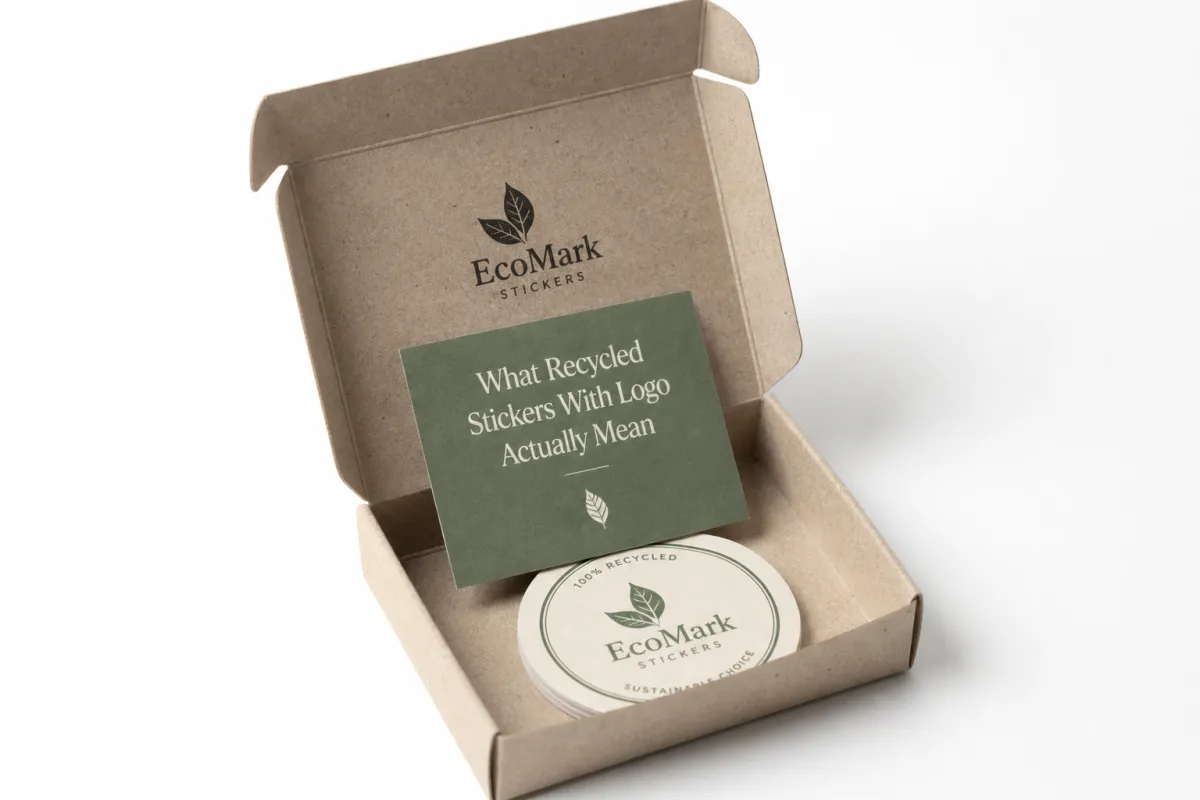
recycled stickers with logo are not one single product. The phrase usually points to a sticker built with recycled content in the face stock, sometimes in the liner, and occasionally in the adhesive system or backing paper. That sounds neat. It usually is not. The label, liner, and adhesive all affect how the sticker performs and what happens after the package is opened.
Buyers mix up recycled-content, recyclable, and compostable all the time. Those are different claims, and they are not interchangeable. A sticker can use recycled paper and still be rejected by local recycling programs. A film sticker can include recycled content and still have a very different end-of-life story. Compostable labels come with their own rules, and those rules are stricter than most marketing copy likes to admit.
If you are ordering recycled stickers with logo for shipping boxes, product seals, poly mailers, or paperboard cartons, the usual sweet spot is low to medium moisture exposure and moderate handling. That covers direct-to-consumer shipping, retail pack-outs, and branded sealing on cartons that do not sit in a damp warehouse forever. If the sticker needs to survive rain, ice packs, cold-chain movement, or oily surfaces, the spec gets technical fast. That is the point where “close enough” stops being useful.
From a buyer's point of view, the better question is not “Is this eco-friendly?” The useful question is, “What is recycled, what is not, and what does this sticker need to survive?” That one shift saves money and keeps you from ordering recycled stickers with logo that look good in a mockup and fall apart in production.
Practical rule: a recycled claim is not a performance claim. If the sticker has to seal a box, survive shipping, and still look clean on arrival, test it on the actual packaging surface before you commit to a full run.
For brands trying to clean up packaging without turning it into a science project, recycled stickers with logo usually make sense on shipping cartons, mailers, tissue wraps, and product seals. They are less comfortable on super-curved containers, wet environments, or highly textured substrates unless the adhesive and face stock are chosen with some actual thought. Packaging is not magic. It is friction management.
I once watched a team approve a beautiful recycled paper seal for a corrugated mailer, then discover the box coating was too slick for their chosen adhesive. The stickers looked perfect on the sample board and mediocre on the real box. That’s the kind of problem that makes smart people feel foolish. The fix was boring: a different adhesive and a better test. Boring is underrated.
How Recycled Stickers With Logo Are Made
Every version of recycled stickers with logo starts with the same basic stack: face stock, adhesive, liner, and printed artwork. The face stock is the visible top layer. The adhesive is what grabs the surface. The liner is the release backing you peel away. The print sits on top of the face stock, usually through digital or flexographic printing depending on quantity, color count, and finish.
Recycled paper face stocks are the most common option because they feel familiar, print well, and work nicely on cartons and paper mailers. They usually come in matte, uncoated, or lightly coated finishes. Recycled-content films exist too, and they matter if the sticker needs more moisture resistance or a cleaner wipeable surface. Those are useful, but they are not the same as a paper sticker with a recycled story. A supplier should be able to explain the difference without turning it into performance art.
Printing method changes the final result more than many buyers expect. Digital printing works well for shorter runs and variable artwork because setup is lighter. Flexographic printing can be more efficient on larger quantities, especially if the design is simple and the run is long enough to justify tooling. Heavy color coverage, metallic effects, and custom die-cut shapes can push cost up. They also change how recycled stickers with logo feel in hand, which matters more than people admit when they are comparing samples under terrible office lighting.
The die-cut matters too. A clean rectangle is cheaper. A custom shape around a logo outline costs more because the cutting profile adds setup and can increase waste. If the brand mark is detailed, the cut line needs enough clearance so the edge does not crush small text or thin strokes. That matters even more with recycled stickers with logo on natural paper stocks, where tiny details can disappear faster than anyone wants. You do not need a laser-level obsession, but you do need a sane eye.
The simplest way to think about the build is this: the sticker is only as good as the weakest layer. A face stock with recycled content does not rescue weak adhesion, sloppy liner release, or print that scuffs during packing. That is why recycled stickers with logo need to be evaluated as a system, not as a single green claim on a quote sheet. Procurement loves neat categories. Packaging does not care.
| Sticker Option | Best Use | Typical Price Range at 5,000 pcs | Durability | Buyer Note |
|---|---|---|---|---|
| Recycled paper matte | Cartons, mailers, seals | $0.06-$0.14 each | Good indoors, moderate handling | Strong value for most recycled stickers with logo orders |
| Recycled-content film | Moisture-prone packs, wipeable surfaces | $0.09-$0.20 each | Better water resistance | Useful, but the end-of-life story needs review |
| Uncoated recycled paper | Luxury seals, write-on surfaces | $0.07-$0.16 each | Moderate, surface-dependent | Great feel, softer print edge, can scuff if abused |
| Specialty compostable label | Niche composting programs | $0.12-$0.26 each | Variable | Only buy if the disposal path is actually available |
If you need a deeper packaging benchmark, the ISTA test standards help explain how labels and packs behave under shipping stress, and the FSC site explains chain-of-custody certification for paper-based materials. Different goals, same lesson: ask what the material actually does, not just what it claims.
Key Factors That Affect Cost, Durability, and Appearance
The cost of recycled stickers with logo changes for the same reasons any packaging component changes: material choice, size, quantity, color count, finish, and cut complexity. A tiny one-color circle sticker costs less than a large custom die-cut with full bleed artwork and a specialty matte coating. That is not a secret. It is just production math.
Quantity has a bigger impact than many buyers expect. Small runs carry more setup burden per piece, especially if the supplier needs to create a custom die, adjust press settings, or validate color on a recycled paper stock that absorbs ink differently from coated stock. A 1,000-piece order can easily cost 2 to 3 times more per unit than a 10,000-piece order, even with the same artwork. That is normal. Annoying, but normal.
Durability depends on the environment. Moisture, oil, abrasion, temperature swings, and dwell time all matter. A sticker on a shipping box may only need to survive a few handoffs and a delivery truck. A sticker on a refrigerated product seal may need to resist condensation and cold-room handling. A sticker on a textured kraft mailer needs aggressive tack because the surface steals adhesion right away. Recycled stickers with logo can handle a lot, but only if the adhesive matches the job.
Finish changes both appearance and legibility. Matte often feels more premium and hides fingerprints. Gloss boosts color saturation and makes artwork pop, but it can create glare. Uncoated looks natural and works well for earthy branding, though tiny type can appear softer. If the brand voice is quiet and tactile, matte or uncoated usually wins. If the design depends on bright color blocking, gloss may be worth the tradeoff.
There is also a practical buying lesson here: the cheapest quote is rarely the cheapest order. A low-cost sticker that curls in humidity, tears during application, or peels off a carton means rework, complaints, and a second purchase. Suddenly the “cheap” option is a very expensive lesson. Recycled stickers with logo should be judged by total outcome, not just the line item.
For buyers comparing options, I like to look at three buckets side by side:
- Substrate: recycled paper, recycled-content film, or specialty compostable material.
- Finish: matte, gloss, or uncoated, based on the brand feel and handling conditions.
- Total landed cost: unit price, setup, shipping, and the cost of any failures or reorders.
If you need to sanity-check how a package will hold up after transport, it is worth reviewing the basics from the EPA recycling guidance as well. It will not choose the sticker for you, obviously, but it will help separate end-of-life assumptions from actual collection rules.
One more thing: recycled stickers with logo on natural paper often show color differently than the proof on a bright white screen. That does not mean the printer missed the mark. It means the substrate is doing real physical work. If you want crisp brand colors, ask for a printed proof or at least a realistic sample on the intended stock. Guessing is not a procurement strategy.
And yes, this is the part where people get picky about white space, ink density, and edge sharpness. They should. Those details are exactly what separate packaging that feels considered from packaging that feels kinda thrown together.
Step-by-Step: Ordering Recycled Stickers With Logo
Ordering recycled stickers with logo goes smoother when you start with use case mapping instead of artwork. Decide where the sticker will go, what it touches, how long it needs to stay in place, and whether people will handle it with wet hands, gloves, or bare fingers. A box seal has different needs from a retail product label. A mailer seal has different needs from a warehouse barcode sticker. Same product family, very different outcomes.
Then gather artwork. You will want a vector logo file if possible, plus color references, size, shape, and any brand rules about contrast or minimum line weight. If the logo has fine text or delicate edges, tell the supplier early. Recycled paper can soften detail more than coated paper, especially on small stickers. A good proof stage prevents a lot of back-and-forth later, and it keeps recycled stickers with logo from turning into a guess-and-pray exercise.
Next, ask for quote comparisons that actually mean something. A real comparison should include material, adhesive type, finish, print method, quantity, turnaround time, and whether setup fees are included. If one quote is 20% lower but excludes die-cutting or uses a lighter stock, that lower number is not a bargain. It is an incomplete number wearing a fake moustache.
Samples matter more than most procurement teams want to admit. Ask for swatches or prior-production samples, then test them on your actual carton, mailer, bottle, or wrap. Do not test on a clean office desk and call it good. That is how people end up shocked when recycled stickers with logo behave differently on corrugated board, coated paper, or textured kraft.
If the packaging has to travel, ask whether the supplier can advise on shipping performance or test to a standard. For certain applications, package testing aligned with ISTA protocols gives you a better signal than guessing from a mockup. It is not overkill if the stickers are part of a sales-critical pack-out.
- Map the use case: surface, handling, dwell time, moisture, and temperature.
- Prepare artwork: vector file, size, bleed, color targets, and cut line.
- Request quotes: compare like for like, not apples to budget-filler oranges.
- Review proofs: check edges, text size, color, and finish.
- Order samples: test on real packaging before a larger run.
- Launch a pilot: place a small production run, then scale once it behaves properly.
For brands that need broader label support, it can help to compare options against Custom Labels & Tags so the sticker spec lines up with the rest of the packaging system. Recycled stickers with logo often sit inside a bigger mix of labels, seals, and insert cards, and the system works better when those pieces are planned together.
Pricing and Timeline for Recycled Stickers With Logo
Pricing for recycled stickers with logo usually starts with the simplest question: how many pieces do you need? The next questions are size, shape, material, and color coverage. A standard circle or rectangle in recycled paper is almost always cheaper than a custom contour-cut shape with full flood color. Add complex artwork, and the quote climbs again. None of that is mysterious; it is just production math.
For small orders, unit price can feel stubborn. That happens because setup does not disappear just because the quantity is low. A 500-piece run may carry a higher per-unit cost than a 5,000-piece order by a wide margin, sometimes 2x or more. On the other hand, a huge run may not make sense if the packaging design is still changing. Buying too much before the design settles is just paying to store future regret.
Here is a practical range many buyers can use as a starting point for recycled stickers with logo:
- Small runs: often higher per unit, especially below 1,000 pieces, because setup is spread across fewer stickers.
- Mid-volume orders: usually the best balance between price and flexibility, especially around 3,000 to 10,000 pieces.
- Large runs: lower unit cost, but only worth it if the artwork is stable and storage is not a problem.
Timeline is usually straightforward, but the slow part is often the one buyers ignore. A typical order may move through quote, proof approval, production, finishing, and shipping. If artwork is ready and the spec is clear, a smaller run may take about 7 to 12 business days after approval. Larger or more customized jobs can land in the 12 to 20 business day range, especially if you need custom cutting or a special recycled material that is not sitting on the shelf.
Delays usually happen in three places: artwork revisions, color approval, and material availability. Recycled materials can be a little less forgiving in supply than standard white stocks, especially if you want a niche finish or a special liner. If a launch date matters, build a buffer. No one ever regretted having packaging earlier than necessary.
Budgeting should also include the hidden parts of the order. Think shipping, setup fees, proofing charges if applicable, and the cost of any internal testing. If you are comparing recycled stickers with logo from several vendors, ask for the total landed cost per thousand, not just the sticker price. That is the number that tells the truth.
| Order Size | Typical Cost Behavior | Likely Timeline | Best For |
|---|---|---|---|
| 500-1,000 pieces | Highest per-unit cost | 7-14 business days after approval | Pilot testing, seasonal drops, internal samples |
| 3,000-10,000 pieces | Better balance of setup and unit price | 8-15 business days after approval | Most branded shipping and retail packaging |
| 10,000+ pieces | Lower unit cost, more planning needed | 12-20 business days after approval | Stable artwork, recurring pack-out programs |
One thing I tell packaging buyers all the time: do not compare sticker quotes without comparing the spec line. A recycled-content film with a stronger adhesive is not the same as a recycled paper label with a lighter tack. If the supplier cannot tell you the difference clearly, keep shopping. Recycled stickers with logo deserve an informed quote, not a vague one. Vague is how budgets get chewed up.
Common Mistakes Buyers Make With Recycled Stickers With Logo
The first mistake is buying on recycled claims alone. That is how brands end up with recycled stickers with logo that sound responsible but fail on the actual packaging. If the adhesive is wrong, the sticker curls. If the liner is awkward, the pack-out team loses time. If the face stock does not match the surface, the label lifts at the corners. Sustainability does not excuse bad adhesion.
The second mistake is sizing the logo too small. A sticker can be beautifully printed and still look weak because the artwork was squeezed to fit a design system instead of the real box size. On a shipping box, a tiny logo reads like a typo. On a product seal, too much empty space can make the brand feel undercooked. With recycled stickers with logo, the canvas matters as much as the design.
The third mistake is skipping samples. I know, everyone says they will test later. Later is usually after the stickers arrive, the team has already packed 2,000 units, and the whole batch starts peeling in the warehouse. That is an expensive time to discover a problem. A 5-minute sample test on the real surface saves hours of damage control. Sometimes it saves a whole reprint.
The fourth mistake is ignoring the application environment. Cold storage can reduce adhesion. Texture can reduce contact area. Dust can ruin bond strength. Curved surfaces can lift edges. If the sticker is going onto recycled kraft, coated paperboard, or a cold-pack carton, the conditions should shape the spec. Recycled stickers with logo are flexible, but they are not universal.
There is also a brand mistake that shows up more often than people admit: using the word “eco” as the whole brief. That is not a brief. That is wishful thinking. A better brief says how the package is used, how long the sticker must last, what surface it touches, what finish the brand wants, and what disposal story matters. That is how you get recycled stickers with logo that perform instead of merely posing.
And if a vendor tells you every option is perfect for every use case, that is your cue to be skeptical. Real materials have tradeoffs. Honest suppliers admit them.
Expert Tips and Next Steps for Better Orders
If you want a cleaner buying decision, compare substrate, finish, and total landed cost side by side. Do not let one attractive sample blind you to the other two. A matte recycled paper sticker may look nicer than a glossy recycled film, but if the job sits in a damp fulfillment lane, the film may be the smarter pick. Good packaging work is not about theoretical purity. It is about the right tradeoff.
My favorite sample checklist is short and annoyingly practical:
- Adhesion: does it hold after 24 hours, after shipping, and after light rubbing?
- Scuff resistance: does the print stay readable when rubbed against other cartons?
- Readability: can a customer see the logo at the intended distance?
- Surface fit: does it behave on kraft, coated board, or the actual container you use?
- Release behavior: does the sticker peel cleanly from the liner during pack-out?
A simple ordering workflow usually works best: audit the packaging surfaces, shortlist suppliers, request proofs, test samples, then place a pilot run. That sequence sounds almost too obvious, which is probably why so many teams skip it. For recycled stickers with logo, the pilot run is where the truth shows up. If the sticker passes on real packaging, you can scale with confidence instead of optimism.
Brands that buy a lot of packaging should also think in systems. If your cartons, mailers, tags, and seals all tell the same story, the result feels deliberate. That is where Custom Labels & Tags can fit into the mix alongside recycled stickers with logo, especially if you want a consistent look across shipping and retail formats.
If you are still unsure, test two versions at once: one paper-based and one recycled-content film, both with the same logo and the same adhesive intent. Then put them on the real box and move them through your normal handling process. The stronger performer usually reveals itself within a week. That is a better decision method than arguing over adjectives in a quote email.
Here is the clean takeaway: use the real packaging surface, the real handling conditions, and a short pilot run before you scale recycled stickers with logo. That is how you protect budget, avoid reorders, and end up with a sticker that actually earns its keep.
FAQ
Are recycled stickers with logo actually recyclable?
Not always. recycled stickers with logo and recyclable stickers are different claims, so the face stock, adhesive, and liner all need checking. Paper stickers are often easier to recycle than film-based options, but the final answer still depends on local recycling rules and how the packaging is processed.
Do recycled stickers with logo cost more than standard stickers?
Usually yes, especially for smaller runs or custom shapes, because recycled materials and setup can raise unit cost. The gap often shrinks on larger orders, which is why volume matters more than most buyers expect. If you want clean economics, compare total landed cost, not just the quote line.
Can recycled stickers with logo work on shipping boxes?
Yes. Shipping boxes are one of the best uses because the surface is usually flat and the sticker only needs to survive normal handling. If the box is recycled, textured, dusty, or cold, test adhesion first instead of guessing. recycled stickers with logo do well here when the adhesive is matched to corrugated board.
How do I choose the right adhesive for recycled stickers with logo?
Match the adhesive to the surface, not the marketing claim. Paperboard, coated boxes, glass, and plastic all behave differently. Ask for sample tests on the actual packaging if the label needs to survive shipping, moisture, or warehouse storage. That is the quickest way to avoid ugly surprises.
What file do I need to order recycled stickers with logo?
A vector logo file is the safest starting point because it holds edges cleanly at sticker size. You should also provide size, shape, bleed, finish preference, and any color targets so the proof stage does not turn into a circus. The more precise the brief, the fewer revisions on recycled stickers with logo.

