The soap Recycled Poly Mailers Material Sample guide comes down to one buyer question: will the mailer protect the product, carry the print, and survive handling once it is filled with the real soap? A sample can look clean on a desk and still fail in packing, shipping, or store fulfillment. That is why the sample exists. It is there to prove performance before the order is committed.
Soap creates a specific packaging problem. It is often heavy for its size, sometimes wrapped in a rigid carton or sleeve, and usually tied to a brand that cares about appearance. Recycled Poly Mailers sit in the middle of those needs. They have to seal well, resist puncture, and still look acceptable when recycled resin adds a little haze, flecking, or color variation. That variation is normal. Weak seals are not.
For buyers, the order of decisions matters. Verify fit first, then strength, then print, then price. If the sequence flips, the quote may look low but the real cost shows up later in damage, rework, or returns.
What the Sample Should Prove
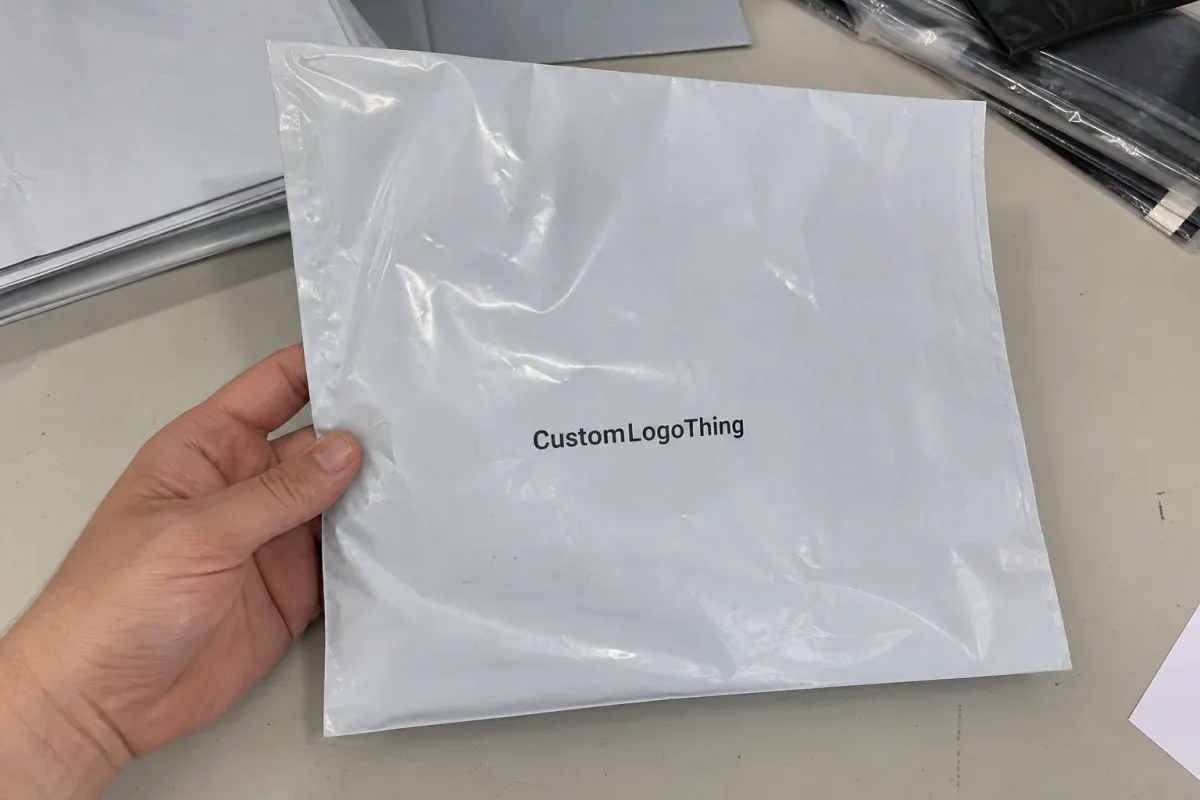
A useful sample must answer more than “Does it look right?” It should show how the film feels, how the closure behaves, how opaque the bag is, and whether the recycled content changes the finish in a way the brand can accept. A virgin-resin mailer and a recycled-content mailer rarely look identical. Buyers should expect some difference in gloss, color, and clarity.
For soap, the main concern is load behavior. A single wrapped bar is easy; a heavier bath bar, a multipack, or a gift set with a rigid insert puts much more stress on the bag. The sample should be packed with the actual product, sealed, handled, dropped, and stacked. If it only survives empty, it has not passed.
Request samples before a first production order, before changing size, after a packaging redesign, or when the recycled-content claim changes. They are also useful when moving from a simple bar pack to a bundle or subscription format, because the load and shape change the failure points.
“A sample that only looks good is not a sample. It is a guess with a pretty face.”
That is the whole point of a soap recycled Poly Mailers Material sample guide: remove the guesswork before thousands of units are printed.
How Recycled Poly Mailers Are Made
Resin mix and film structure
Recycled Poly Mailers usually use post-consumer recycled resin, post-industrial recycled resin, or a blend of both. PCR brings more visual variation because it comes from used plastic products. PIR is usually cleaner and more consistent because it comes from manufacturing scrap. Buyers often ask for “recycled content” without asking which type they are getting, but the mix affects color, stiffness, odor, and surface appearance.
Construction matters too. A single-layer film can be lower cost, but co-extruded structures often give better seal control and a more consistent outer finish. Recycled film may feel slightly softer or look less glossy than a virgin equivalent. That is not automatically a defect. The real question is whether it still seals cleanly and resists puncture at the closure and corners.
Typical mailer thickness is discussed in mils, not in loose terms like “strong” or “heavy-duty.” For soap shipments, many buyers start around 2.5 to 4 mil depending on product weight, carton shape, and shipping distance. Thin film lowers cost, but it also reduces puncture resistance. Packaging is simple that way.
What to ask for in writing
Ask for film thickness tolerance, recycled-content percentage, closure type, seal width, and acceptable visual variation. “Around 3 mil” is not a real spec. A useful spec gives a target, a tolerance, and a clear definition of cosmetic acceptance.
Recycled-content claims should be documented. If the order also includes paperboard sleeves, kraft inserts, or FSC-certified outer packaging, those materials should be tracked separately. FSC applies to forest-based fiber products, not to the plastic mailer itself. Keeping those claims separate avoids correction work later if a retailer or compliance team asks for proof.
Sample Testing That Actually Matters
The best sample tests are ordinary ones done carefully. Start with seal strength. Weak seals usually fail at the corner or along the closure line, not in the middle of a flat panel. Then check puncture resistance, tear propagation, and the closure after repeated handling. If the soap has a carton sleeve or rigid insert, those edges become stress points.
ASTM references help keep the conversation specific. ASTM D882 is often used for film tensile properties. ASTM F88 is a useful reference for seal strength. For shipping abuse, ISTA methods are worth reviewing, especially when the product is high value or will move through multiple handling steps. The goal is not to turn the project into a lab exercise. It is to anchor the decision in something more useful than opinion.
Real handling matters more than a desktop impression. Load the actual soap, close the mailer, then move it the way a picker or packer would. Drag it across a table. Stack it under weight. Drop it from a reasonable packing height. If the closure opens, the print scuffs badly, or the corner punctures, the sample is telling you what production will likely do.
Odor is worth checking too. Soap often carries fragrance oils or essential oils, and the mailer should not absorb those scents easily or add a strong plastic smell of its own. That issue shows up more often in lower-quality recycled film than buyers expect.
Price, MOQ, and Quote Drivers
Sample cost and production cost are different. A stock blank sample may be free or nearly free if the supplier already has one. A custom size, printed sample, or special recycled blend costs more because the supplier has to set it up. A sample is a test piece. Production is the bill.
For the finished order, the biggest quote drivers are film thickness, bag size, print coverage, recycled-content level, closure style, and order volume. A plain recycled mailer in a mid-sized run can land around $0.12-$0.20 per unit. Heavier film, more print, or a larger format can push that into the $0.18-$0.28 range or higher. Lower MOQ usually means a higher unit cost because setup and tooling get spread across fewer pieces.
| Option | Typical Sample Cost | Typical Lead Time | Best For | Buyer Note |
|---|---|---|---|---|
| Stock blank sample | $0-$15 plus freight | 2-5 business days | Fit and size checks | Good for quick screening, not final approval |
| Custom unprinted sample | $35-$90 | 5-10 business days | Material and seal review | Best balance of speed and realism |
| Printed pre-production sample | $75-$180 | 7-14 business days | Final sign-off | Closest to the production look |
Watch the extras. Freight, rush fees, artwork revisions, and re-sampling can quietly raise the total. If the supplier says sample fees will be credited against production, get that in writing before comparing bids. Otherwise the quote may look better than it is.
If the brand is buying cartons, inserts, or outer shippers at the same time, compare the mailer quote against the full packaging stack. A low-cost mailer paired with a weak insert is not a bargain. It is a future return.
Timeline From Request to Approval
The fastest sample projects start with clean input. Send the finished dimensions, soap weight, closure style, print file, recycled-content target, and ship-to address in one round. If the line includes multiple formats, list each one separately. A single bar, a gift set, and a subscription bundle behave differently, so they should not be treated as one spec.
- Spec review: confirm size, film gauge, closure style, print coverage, and recycled-content claim.
- Sample build: the supplier makes a blank or printed version based on the approved spec.
- Transit: domestic samples move faster; overseas samples need more time.
- Internal testing: load the real soap, check the seal, and run a basic drop and stack test.
- Feedback: send only the changes that actually matter.
- Revision: adjust once, then freeze the spec before production.
Three things usually slow the process down. Buyers debate thickness after the sample arrives. Marketing changes artwork after approval. Procurement waits too long to answer a question about closure style or pack count. Then the schedule slips. Packaging does not care why it slipped; it still needs time for setup, inspection, and transit.
A basic custom sample may take five to ten business days to build, plus shipping time. Printed pre-production samples can take longer. If the project needs new artwork plates, a revised proof, or a different film blend, expect more time. Planning for that delay is better than pretending it will not happen.
Material Factors That Affect Soap Performance
Soap is not the toughest packaging load, but it creates enough stress to justify attention. Moisture, fragrance, storage conditions, and carton shape all affect how the mailer performs. If the film is weak, the package can pick up warehouse odors or hold fragrance longer than expected. That matters more for bath bars and heavily scented products than for plain bars.
Opacity is one of the first things buyers notice. More opaque film hides scuffs and minor print inconsistency better. More transparent recycled film can look clean too, but it also shows the product shape, folds, and any rough edges underneath. Depending on the brand, that can be either a deliberate look or a problem.
Finish matters as well. Matte film often reads as more premium and hides handling marks better. Gloss can look brighter and cleaner, but it shows scratches faster. Neither is universally better. The right choice depends on the soap brand, the artwork, and how the mailer will be stored before shipping.
- Thickness: thinner film lowers cost, while heavier film improves puncture resistance and stiffness.
- Seal quality: a strong, even seal is essential if the pack is hand-filled or partially automated.
- Opacity: controls how much of the product and inner folds show through the film.
- Odor resistance: matters for fragrance-rich soaps and products stored near strong-smelling materials.
- Finish: matte and gloss change how scratches, dust, and handling marks show up.
There is also a branding tradeoff. Recycled-film flecking can support a sustainability message if the rest of the package uses recycled paperboard, kraft inserts, or other responsible materials. But the claim should match the material. Recycled plastic is not biodegradable, and vague “eco-friendly” language without support creates problems later.
From a buyer’s perspective, the sample should feel like part of the product experience. Thin film and sloppy seals make the whole order feel weaker, even if the soap itself is excellent. Packaging gets judged quickly.
Mistakes Buyers Make With Samples
The biggest mistake is approving by hand feel alone. An empty mailer can seem sturdy and still fail once the real soap load is inside. The right test is simple: pack the actual product, close the mailer, move it around, and inspect the seams. Then drop it. Then stack it. Weak points usually show up quickly.
Another common miss is ignoring fulfillment behavior. Conveyor handling, sorters, friction in master cartons, and repeated touch points during packing can expose flaws that a desk test will never show. A sample that opens cleanly in an office and tears after a few handling cycles is not production-ready.
Color variation deserves attention too. Recycled resin can vary from lot to lot, so a sample may not match the finished run exactly. Some variation is normal. Too much variation means the brand needs a tighter spec or a different resin blend. If color accuracy matters, ask for a proof on the exact film structure instead of a generic visual match.
Documentation is easy to ignore until someone asks for it. Keep records for recycled-content claims, any recyclability claim, the final print proof, and the approved gauge. If FSC-certified paperboard or kraft inserts are part of the pack, keep those certificates too. That paperwork is useful when procurement, compliance, or a retailer asks later.
“If the sample only passes on a desk, it has not passed.”
That is the practical test in this soap Recycled Poly Mailers material sample guide. Treat the sample like a shipment, not a display item.
What to Lock After Approval
Once the sample is approved, put the final spec in writing. Lock the dimensions, film gauge, recycled-content claim, print proof, closure style, pack count, and shipping instructions. Save a photo of the approved sample with that record. “Same as last time” is not a spec; it is a memory test.
Compare at least two suppliers on the same exact spec. Otherwise the quotes are not comparable. One supplier may include heavier film, another may exclude freight, and a third may quote a lower MOQ with a higher unit cost. Cheap-looking numbers are common. Comparable numbers are rarer.
For larger launches, ask for a pilot run or pre-production proof. That step is especially useful when the soap kit is heavy, the artwork has tight registration, or the launch date is fixed. Paying for a pilot can feel annoying. Reprinting a large order because the closure line is off by a few millimeters is worse.
Keep the approval record attached to the purchase file and reuse it for reorder checks. That one habit cuts confusion and helps keep the quality bar from drifting after the first production run.
Frequently Asked Questions
What should I check in a soap recycled poly mailer sample?
Load it with the actual soap product, then check how the bag handles weight, corners, and closure stress. Look at the seal line, the print, the finish, and any odor transfer. If the sample is meant to represent recycled content, confirm the visual variation is acceptable before approving the run.
Do recycled poly mailer samples usually cost extra?
Stock blanks are often low cost or free, but custom size, custom print, and special film blends usually add cost. Freight and revision rounds can also change the total. Ask whether the sample fee is credited back on production before comparing suppliers.
How long does the sample process usually take?
A simple stock sample can move in a few days. Custom samples usually take longer because the supplier has to build, inspect, and ship them. Add more time if the project needs new artwork, a different film blend, or a printed pre-production proof.
What thickness works best for soap mailers?
There is no single answer. Many soap projects land in the 2.5 to 4 mil range, but the right choice depends on product weight, carton shape, and shipping abuse. Heavier bars, sharper inserts, or longer transit routes usually justify thicker film and a stronger seal.
What documents should I keep after approval?
Keep the approved sample photo, the final spec sheet, the print proof, and any recycled-content or recyclability documentation. If the pack uses FSC-certified paperboard or kraft inserts, keep those records too. The file saves time when reorders, audits, or claim checks come back around.
Can recycled poly mailers be used for fragrance-heavy soaps?
Yes, but the film choice matters. Ask about odor resistance and inspect the sample after short storage if the soap carries a strong scent. Some lower-grade films hold odors or pick them up from the warehouse more easily than buyers expect.

