Buyer Fit Snapshot
| Best fit | Recycled Tissue Paper Wholesale for Retail Packaging projects where brand print, material claims, artwork control, MOQ, and repeat-order consistency need to be specified before quoting. |
|---|---|
| Quote inputs | Share finished size, material target, print colors, finish, packing count, annual reorder estimate, ship-to region, and any compliance wording. |
| Proofing check | Approve dieline scale, logo placement, barcode or warning zones, color tolerance, closure strength, and carton packing before bulk production. |
| Main risk | Vague material claims, crowded artwork, missing packing details, or unclear freight terms can make a low unit price expensive after revisions. |
Fast answer: Recycled Tissue Paper Wholesale for Retail Packaging should be specified like a repeatable production item. The safest quote records material, print method, finish, artwork proof, packing count, and reorder notes in one written spec.
Production checks before approval
Compare the actual filled-product size with the drawing, then confirm tolerance on folds, seals, hang holes, label areas, and retail display edges. Reserve space for logos, QR codes, warning copy, and material claims before decorative graphics fill the panel.
Quote comparison points
Review material grade, print process, finish, sampling route, tooling charges, carton quantity, and freight assumptions side by side. A quote is only useful when the supplier can repeat the same color, closure quality, and packing count on the next order.
A folded sheet of tissue can change how a shopper reads the whole purchase before the product even comes into view. That is why recycled Tissue Paper Wholesale for retail deserves more attention than it usually gets: it affects presentation, unit cost, and reorder reliability at the same time.
Inside a store bag, a gift box, or an ecommerce mailer, tissue is often the first material a customer sees and the first one they touch. When the spec is right, recycled tissue paper Wholesale for Retail adds polish without pushing the carton, insert, or packaging budget into awkward territory. When the spec is wrong, the problems show up fast: weak sheets, muddy print, poor fold memory, and color drift between replenishment orders. Nobody wants to explain why last month's tissue looked crisp and this month's looks tired.
Retail teams tend to compare three things at once: look, feel, and unit economics. That mix matters because recycled tissue paper Wholesale for Retail is usually a small line item with an oversized effect on giftability, unboxing, and brand consistency across stores, pop-ups, and fulfillment operations. If you want a broader view of packout and supply options, our Wholesale Programs page is a useful place to start.
I have watched buyers obsess over fancy cartons and then treat tissue like filler. That tends to backfire. The customer notices the tissue before they notice the strap, the zipper, or the insert card. A small detail. A big signal.
Recycled Tissue Paper Wholesale for Retail: Shelf Impact
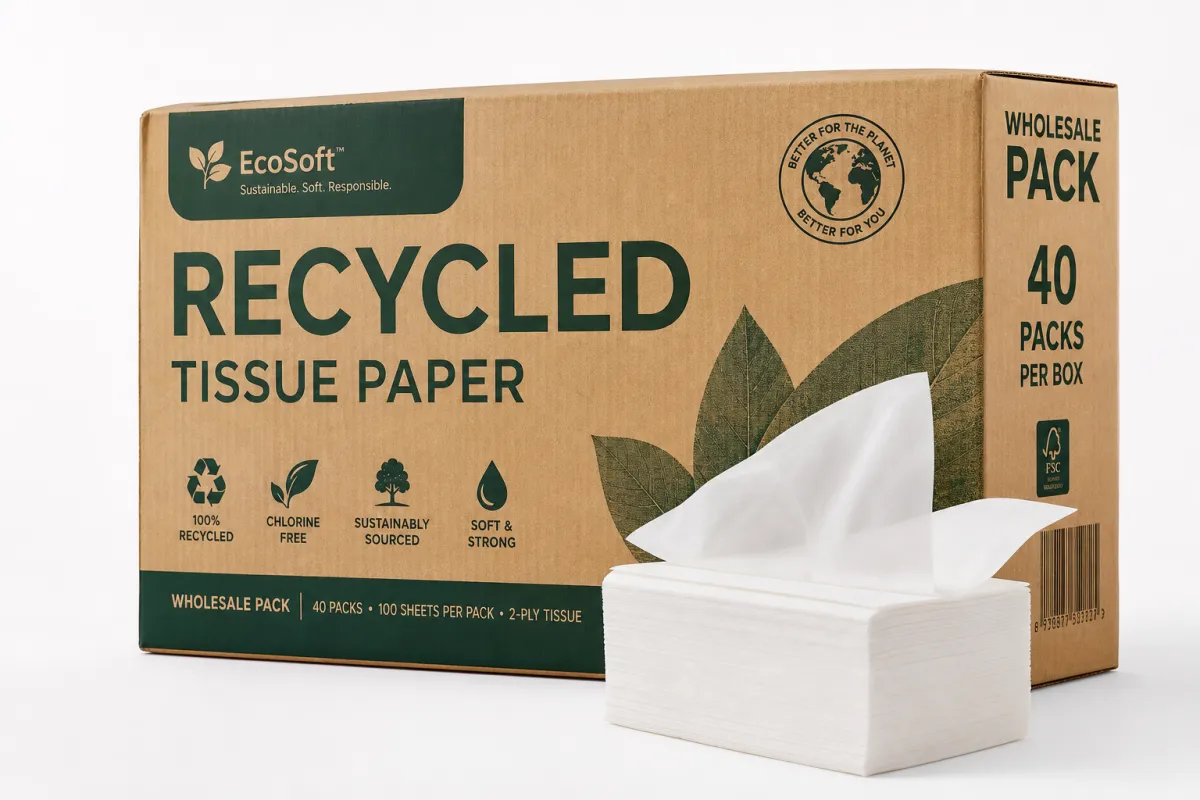
Retail packaging works like a chain of signals. The bag opens. The tissue appears. The customer decides whether the brand feels careful or sloppy. That moment is why recycled Tissue Paper Wholesale for retail can shape perception long before anyone studies the product itself. A soft white sheet, a natural unbleached tint, or a branded repeat pattern each tells a different story about price point and positioning.
For a packaging buyer, this is not decorative filler. It is an operating choice. Recycled tissue paper Wholesale for Retail has to support store labor, fit standard carton counts, hold up during handling, and look consistent from the first shipment to the last replenishment order. If one store gets a flatter, weaker sheet while another gets a heavier one, customers notice the difference even when the SKU is the same. Stores may not say it out loud, but they absolutely feel it.
There is also a margin story here. Tissue paper is small enough to seem forgettable, yet it affects how many units a team can prep per hour and how much extra wrap or void-fill gets used around it. A paper that folds cleanly, opens without crumbling, and prints with a sharp logo can reduce waste in production and in daily packing. That is the reason buyers sourcing recycled tissue paper wholesale for retail usually measure more than sustainability claims. They are balancing brand finish, labor speed, and unit cost.
I usually push buyers to answer a plain question before anything else: what does the tissue need to do in the customer journey? Line a bag? Wrap a shirt? Cushion a lightweight accessory? Create a reveal in a gift set? Each answer points to a different paper weight, sheet size, and print strategy. Recycled tissue paper wholesale for retail works best when the spec matches the real use, not a generic ideal.
- Apparel: A clean fold and light print density usually matter more than heavy opacity.
- Footwear: Slightly stronger paper helps reduce tearing around box corners and sharp fold lines.
- Beauty: A softer hand feel and steadier color consistency can support a higher perceived value.
- Gift sets: Recycled tissue paper wholesale for retail often needs better sheet uniformity and tighter registration.
- Seasonal programs: Fast replenishment and repeatable color usually matter more than extra decoration.
There is no single best tissue format. A chain store may need flat sheets by the carton, while a brand with in-house fulfillment may want pre-folded packs that speed up packing lines. Recycled tissue paper wholesale for retail works best when it fits the operating model, not just the marketing brief. That sounds obvious, but it gets ignored all the time.
Recycled Tissue Paper Wholesale for Retail Product Details
Recycled tissue paper wholesale for retail usually comes in a few working formats: flat sheets, folded packs, custom printed sheets, and bulk cartons for backroom use or fulfillment centers. Each format solves a different problem. Flat sheets are simple and economical. Folded packs are better for presentation and controlled count. Custom printed runs give retail teams a consistent brand surface. Bulk cartons are handy when staff need speed and low handling friction.
Use case matters more than style. Apparel brands often want tissue that drapes cleanly over folded garments and does not crack along a sharp fold. Footwear buyers usually want a sheet that can wrap interior stuffing or line the inside of a box without shredding at corners. Accessories, jewelry, and small leather goods need tissue that feels delicate but still survives repeated handling. Beauty and home goods often need recycled tissue paper wholesale for retail because the tissue acts as a visual cue for care, not just a spacer.
Most buyers also need to choose between decorative tissue and protective tissue. Decorative tissue cares about print clarity, surface finish, and brand color. Protective tissue cares about abrasion resistance, wrap performance, and enough fiber strength to keep the product clean inside the box or bag. Pay for decorative features the application does not need and you spend more than necessary. Buy a paper that is too light and it tears, curls, or looks flimsy on the shelf. It is not subtle, and it is not hard to spot.
Recycled content is another point that deserves a direct answer. Some mills use a mix of post-consumer and pre-consumer fiber. Others run high recycled percentages with tighter brightness control. The sheet may look bright white, soft white, or naturally tinted depending on bleaching, fiber mix, and whether the paper is dyed after formation. Buyers sourcing recycled tissue paper wholesale for retail should ask for the actual recycled content percentage, not a vague eco claim that will fall apart later.
Acid-free construction can matter if the tissue sits against textiles, paper goods, or archival-style gift items. Colorfastness matters if the tissue rubs against light fabrics or pale packaging. For direct retail use, it also helps to check whether the paper is suitable for wrapping, lining, or simple reveal packaging. The right answer is often application-specific, not universal.
I say this plainly because it saves everyone time: recycled tissue paper wholesale for retail is not the same thing as shipping tissue in a warehouse. Retail tissue is judged by appearance as much as function. The paper must fold well, print well, and stay visually stable across a run. If a supplier cannot describe the sheet's finish, opacity, and fold memory in real terms, the order is probably underspecified.
For sourcing language and sustainability claims, the FSC site is a useful reference point for chain-of-custody and claim structure. That matters when the broader retail program needs documentation for procurement, merchandising, or compliance review.
Material Specifications and Print Options That Matter
Any serious quote for recycled tissue paper wholesale for retail should begin with a spec sheet. Ask for sheet size, basis weight or gsm, opacity, finish, fold style, pack count, and the print method. Skip those details and the quote becomes nearly useless, because one supplier may be pricing a 17 gsm sheet while another is quoting 22 gsm with a different carton count and heavier print coverage.
Weight changes more than most people expect. A lighter sheet usually folds more easily, costs less, and works for volume programs where the tissue is mostly decorative. A heavier sheet resists tearing better, feels more substantial in hand, and can improve the perceived value of premium retail packaging. For recycled tissue paper wholesale for retail, many buyers land somewhere in the 17 gsm to 22 gsm range, depending on the product and the level of handling it will face.
Print options also change both cost and appearance in meaningful ways. A single-color logo repeat is usually the most economical custom path. A full-sheet repeat with tighter coverage creates a stronger brand impact but raises ink usage, setup complexity, and rejection risk. Edge-to-edge printing can look excellent on a high-visibility program, but it requires better artwork control and tighter proofing. If the brand uses PMS colors, ask in advance whether the printer can match to a target tolerance rather than just calling it close enough.
There is a practical reason to ask about tolerances. Tissue is a thin substrate. Ink density, moisture, and folding can all change how color reads. If the supplier does not define acceptable variation for sheet size, print registration, and shade consistency, procurement teams can end up arguing over cartons that technically passed production but do not match the original sample. Recycled tissue paper wholesale for retail works better when expectations are written down before production starts. Saves everyone a headache, which is rare enough in packaging to appreciate.
Ask for these items early:
- Sheet size: Common retail sizes include 20 x 30 in. and 15 x 20 in., but custom cuts are possible.
- GSM or basis weight: Heavier sheets generally improve hand feel and tear resistance.
- Opacity: Higher opacity is useful when the tissue sits near bright products or printed cartons.
- Fold style: Flat, interfolded, or custom-packed formats affect packing speed and carton efficiency.
- Print method: One-color, multi-color, or full coverage each changes cost and lead time.
- Recycled content proof: Useful for procurement records and brand sustainability claims.
Buyers who need testing for shipping performance should also think beyond shelf appearance. If the tissue is part of a mail order program, the outer pack may get rough treatment in transit before the customer sees it. The ISTA test standards are a useful benchmark for understanding shipment stress and pack integrity. That does not mean every tissue order needs lab testing. It does mean the packaging team should understand how the material behaves when cartons are stacked, moved, and opened repeatedly.
From a procurement standpoint, the cheapest tissue is the wrong choice if it tears, shades, or folds inconsistently. The real cost shows up in rework, waste, and the lost polish of a retail display.
For recycled tissue paper wholesale for retail, pre-production proofing is usually worth the extra step whenever the order involves a logo, a branded repeat, or a tighter launch window. A paper proof can reveal whether line thickness is too fine, whether the logo sits too close to the edge, and whether the ink looks too heavy on a porous sheet. Those are not minor details. They decide whether the run feels intentional or accidental.
One more practical note: if the artwork was built for coated paper or a box insert, do not assume it will behave the same on tissue. It usually won’t. Thin paper drinks ink differently, and what looks crisp on a monitor can turn muddy in production if the file is not prepared with that in mind.
Pricing, MOQ, and Ordering Economics
Price quotes for recycled tissue paper wholesale for retail are shaped by a few core variables: paper grade, sheet size, print complexity, quantity, packaging format, and freight. That is why two quotes that look close on the surface can be far apart in practice. A lower unit price may hide a larger setup charge. A higher sheet price may include cleaner packing, better print registration, or better freight geometry. For retail buyers, the only number that really matters is landed cost.
MOQ usually drops when the buyer accepts a standard sheet size or a standard recycled stock. Once you ask for custom dimensions, specialty colors, or multi-color print coverage, the minimum usually rises because the line needs more setup and more yield to cover labor. For recycled tissue paper wholesale for retail, standard unprinted or lightly printed orders often start in smaller production runs than fully custom programs. The exact MOQ still depends on the supplier's equipment, carton format, and artwork complexity.
Here is a practical comparison buyers can use during quote review:
| Option | Typical Spec | Common MOQ Range | Approx. Wholesale Price | Best Fit |
|---|---|---|---|---|
| Standard unprinted recycled tissue | 17 gsm, common retail sheet size, bulk carton | 5,000-10,000 sheets | $0.04-$0.08 per sheet | Store wrapping, internal packing, value-driven programs |
| Single-color logo print | 17-20 gsm, one PMS or close match, repeat pattern | 10,000-20,000 sheets | $0.07-$0.14 per sheet | Apparel, accessories, and branded gift packaging |
| Full-coverage custom print | 20-22 gsm, dense repeat, tighter registration control | 20,000-25,000+ sheets | $0.10-$0.18 per sheet | Premium retail launch, seasonal visual merchandising |
| Folded retail packs | Pre-counted pack, finished presentation, shelf-ready carton | Varies by pack size | Usually higher than bulk cartons | Small stores, gift counters, speed-sensitive teams |
These figures are directional, not fixed. Freight, carton count, and destination matter. A domestically delivered order can land very differently from a shipment routed through a distribution center with multiple store drops. Recycled tissue paper wholesale for retail also changes cost structure if you ask for premium cartons, special inserts, or split shipments. Hidden costs usually show up in rush production, extra proof rounds, and plate or setup charges on custom print work.
Retail teams should compare quotes by the same unit of measure. Cost per sheet is useful. Cost per folded pack is useful. Cost per thousand sheets is often better for planning. Cost per landed carton is even better if the tissue will be stored or shipped from a single location. The wrong comparison is the headline price with no context. That number may hide a low sheet count or exclude freight. Procurement teams do this dance every season, and it still wastes time.
When does higher pricing make sense? Usually when the better tissue cuts waste, reduces defects, or supports a more expensive product category. A retailer selling jewelry, premium apparel, or curated gift sets can often justify a heavier paper and better print because the tissue is part of the perceived value. In that case, recycled tissue paper wholesale for retail is not just an input. It is part of the selling environment.
If you need a purchasing starting point, our Wholesale Programs page can help you compare standard and custom packaging paths before you ask for a formal quote. That comparison helps because it keeps the spec realistic from the start.
Production Process and Timeline From Sample to Delivery
The production path for recycled tissue paper wholesale for retail is simple enough, but only if the inputs are clear. It usually begins with a quote, moves to specification review, then proofing, sample approval, production, quality check, and shipment. If any of those steps are vague, the timeline stretches fast. Missing artwork files are a common delay. So are late size changes, unconfirmed colors, and print files built for a different substrate.
Typical timing depends on quantity and print method. A clean stock-sheet order may move faster than a fully custom run. A realistic custom timeline often looks like this: quote and spec confirmation in 1-2 business days, artwork proofing in 1-3 business days, sample review in 3-7 business days if samples are needed, production in roughly 12-18 business days after approval, and freight after that depending on destination. If the order is tied to a launch or a seasonal reset, add buffer time. Retail deadlines rarely forgive paperwork delays.
Samples matter most in three situations. First, before final artwork approval, because the printed repeat can look different on tissue than it does on screen. Second, before a large MOQ, because the hand feel and fold behavior are hard to judge from a PDF. Third, when comparing paper weights, because a 17 gsm sheet and a 22 gsm sheet can look similar in a photo but behave very differently in a store bag or gift box.
What slows the schedule the most? Usually not the press itself. It is the back-and-forth before the press. Art files that are not vector-based need cleanup. Color targets described verbally instead of by reference create avoidable revision. Custom sizing can require new packing logic. Late changes after proof approval are especially expensive because they interrupt production already in motion. Recycled tissue paper wholesale for retail is best handled like any other production purchase: lock the specs early and keep the approvals clean.
Retail replenishment also deserves a separate plan. A store rollout rarely happens in one wave. One batch may support the launch. Another may replenish after the first sell-through. If the tissue is tied to a campaign or a gift-with-purchase event, the calendar should include reprint timing, transit time, and the days needed to check the first cartons on arrival. In practice, the strongest programs treat recycled tissue paper wholesale for retail as a repeatable supply item rather than a one-off novelty.
For teams planning transit-sensitive shipments, it can help to align the packaging spec with a recognized test protocol. That is where standards bodies such as ISTA help frame expectations for pack performance in the distribution chain. Not every tissue order needs formal testing, but the same logic still applies: know how the pack behaves before a customer opens it.
Why Choose Us for Recycled Tissue Paper Wholesale for Retail
For a retail buyer, the best supplier is the one that makes the order predictable. That means the same shade, the same fold, the same sheet count, and the same print alignment every time the program is reordered. Recycled tissue paper wholesale for retail should not need a long explanation each season. It should fit into the merchandising calendar, the fulfillment plan, and the store team's workflow without creating surprises.
That is the value Custom Logo Things is built to support. We focus on the practical side of the order: choosing a paper weight that matches the product, confirming the print setup before production starts, and helping you compare standard versus custom options without pushing you toward the most expensive route by default. Recycled tissue paper wholesale for retail is a small item, but if the spec is wrong, it creates avoidable labor and quality noise across the whole retail chain.
Quality control matters because tissue is visually unforgiving. If the print drifts, the sheet count is short, or the fold edge is uneven, the issue shows up immediately in a store display or fulfillment line. Buyers do not want an explanation about why the carton was close enough. They want a carton that matches the proof. That is why we treat recycled tissue paper wholesale for retail like a controlled production item, not a generic paper commodity.
There is also a cost-control advantage in working with a supplier that understands retail operations. A knowledgeable team can suggest a more efficient sheet size, recommend a lower-risk print coverage, or point out when a standard stock will perform just as well as a custom one. Those choices may save money without sacrificing presentation. In some cases, they also reduce lead time because fewer production variables mean fewer chances for delay.
- Consistent reorders: Useful for stores that cannot afford visible variation between shipments.
- Clear proofing: Helpful when a logo, pattern, or color target must match the brand system.
- Retail-aware specs: Important when the tissue needs to fit bags, boxes, or folding workflows.
- Practical cost tradeoffs: Better for buyers comparing unit cost against waste, labor, and presentation.
That is the real difference between a vendor and a supply partner. A vendor sells paper. A supply partner helps the packaging work inside a retail operation. Recycled tissue paper wholesale for retail should feel like part of the brand system, not a loose add-on that someone orders at the last minute.
If you are still comparing options, our Wholesale Programs page can help frame the decision before sampling. It is usually easier to lock a strong spec once the basic wholesale formats are clear.
Next Steps: Request Samples, Lock Specs, and Order
The fastest way to move forward on recycled tissue paper wholesale for retail is to prepare a clean request. Send the sheet size, paper color, print artwork, quantity, target ship date, and destination. If you already know whether the tissue will be used for apparel, accessories, gift sets, or ecommerce, include that too. Those details help narrow the paper weight and the packing format before pricing starts.
For launches, seasonal programs, or high-visibility displays, ask for a physical sample or pre-production proof. That extra step is worth it because tissue is one of those materials that looks simple but behaves differently across print density, fold lines, and fiber mix. Recycled tissue paper wholesale for retail can look excellent in a mockup and still need adjustment once it is printed on the final stock. A sample shows the real thing.
Then compare at least two or three quotes against the same spec sheet. Do not compare one vendor's 17 gsm flat sheet with another vendor's 20 gsm folded pack and call that fair. Recycled tissue paper wholesale for retail only becomes comparable when the sheet size, print method, pack count, freight terms, and setup costs are lined up side by side. Landed cost per sheet or per pack is the number that should guide the purchase.
Here is the cleanest order path:
- Define the retail use case and target presentation level.
- Choose the paper weight, finish, and sheet size.
- Confirm whether the order needs logo print, repeat pattern, or plain stock.
- Request samples or proof files.
- Approve the final spec and lock the ship date.
- Place the order with enough buffer for transit and replenishment.
That process keeps the order controlled and the output consistent. It also protects the brand from avoidable variation in color, sheet count, or packing format. In a retail environment, those details are not cosmetic. They are operational.
If your team is ready to move, send the first email with the exact sheet size, paper color, recycled content requirement, artwork file, quantity, target delivery date, and warehouse or store destination. For recycled tissue paper wholesale for retail, the more precise the request, the more useful the quote will be.
Recycled tissue paper wholesale for retail is a disciplined packaging purchase, not a decorative afterthought. Lock the spec, approve the proof, and place the order with enough lead time to avoid expensive rush work. If you do that part right, the tissue does its job quietly, which is exactly what good packaging should do.
Frequently Asked Questions
What is the usual MOQ for recycled tissue paper wholesale for retail?
MOQ usually depends on sheet size, print count, and whether the stock is standard or custom. Standard unprinted or lightly printed runs often start lower than fully custom retail programs. Ask for an MOQ based on the exact size and quantity you plan to reorder, not a generic estimate, because recycled tissue paper wholesale for retail changes quickly once the sheet size or print coverage changes.
Can recycled tissue paper wholesale for retail be custom printed with our logo?
Yes. Most wholesale programs support logo printing, repeat patterns, and PMS color targets. Single-color prints are usually the most cost-efficient, while full-sheet coverage increases setup and unit cost. Send vector artwork early so the printer can confirm line thickness, placement, and color limits before production begins.
How do I compare quotes for recycled tissue paper wholesale for retail?
Compare the same sheet size, paper weight, print method, pack count, and shipping terms across every quote. Look at landed cost per sheet or per pack, not only the unit price on the front page. Check whether setup fees, plates, samples, and freight are included before deciding, because those items can move the real cost more than the headline number.
Is recycled tissue paper strong enough for retail apparel and gift packaging?
For apparel, accessories, and gift sets, the right recycled tissue paper is usually strong enough for wrapping and display. Heavier paper grades resist tearing better and create a more premium feel for higher-value retail items. If the product is sharp, heavy, or moisture-sensitive, ask for a sample before placing a large order so the paper can be tested against the actual use case.
How long does production take after artwork approval?
Timing depends on the print method, quantity, and whether the order needs custom sizing or special finishing. After approval, standard wholesale jobs move through printing, quality checks, and packing before shipping. If you have a store launch or seasonal deadline, build in buffer time for proofs and transit so the order arrives with room to spare.