A takeaway bag usually gets noticed for the wrong reason. A handle tears near the curb. Steam softens the bottom panel. Grease shadows show through the sidewall before the guest gets home. A delivery driver lifts three packed meals in one hand and finds the exact weak point nobody tested during sourcing.
For a restaurant group, that is not a small packaging nuisance. One approved bag may move through twenty, fifty, or several hundred locations, and it has to carry repeat menu builds, regional order habits, counter pickup, third-party delivery, catering add-ons, and whatever storage limits each back-of-house space already has. A useful Takeaway Paper Bags supplier quote Checklist for Restaurant groups keeps that reality in front of the pricing conversation, so the buyer is not comparing vague promises or mismatched bag constructions.
The lowest unit price can still be expensive if the quote leaves out paper weight, reinforcement, carton count, freight terms, setup charges, or the load the bag is expected to carry. Good RFQ discipline makes suppliers price the same item, under the same conditions, with the same assumptions visible.
When One Weak Bag Becomes a Multi-Location Problem
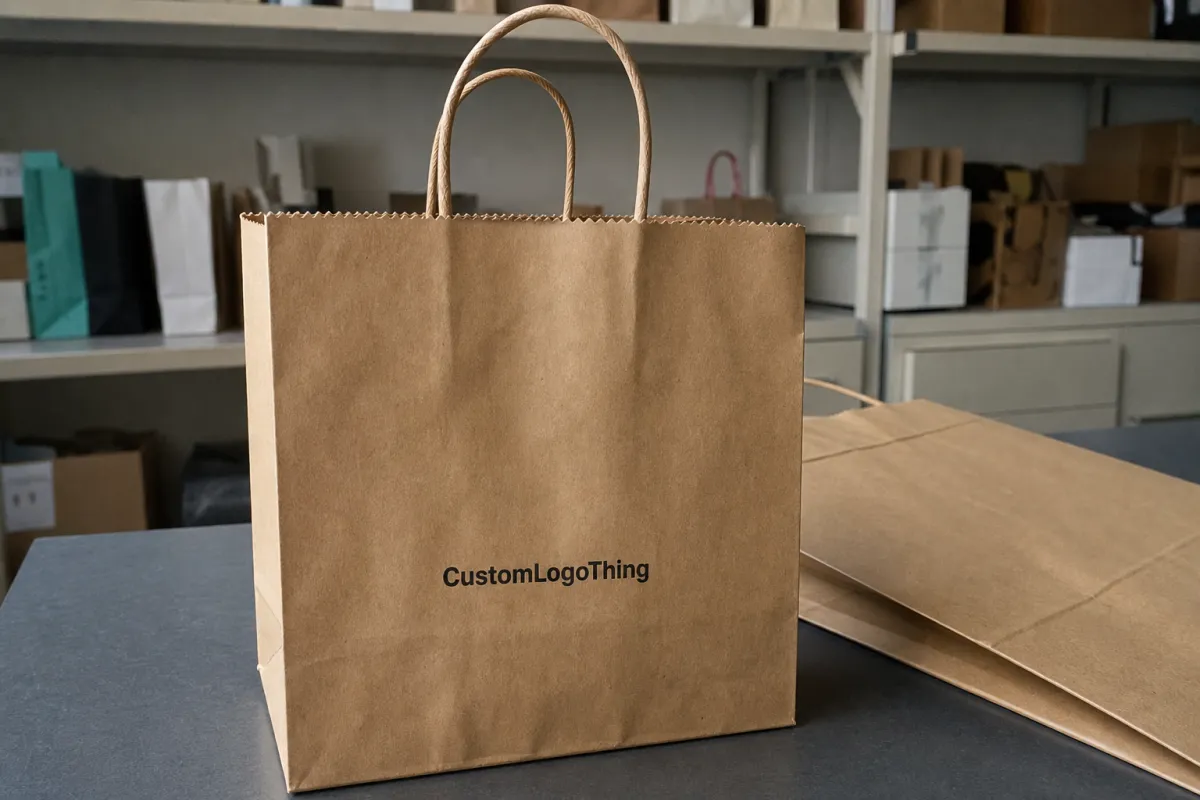
Most people judge a paper takeaway bag after food is already packed inside it. From a purchasing and operations view, that is late in the process. The better conversation starts with service conditions: hot rice bowls, chilled drinks, stacked clamshells, sauced containers, napkins, utensils, receipt stickers, and the handoff from kitchen shelf to driver to guest.
A restaurant group also has to protect consistency. If one location receives a natural kraft bag with a soft, muted logo and another receives a bright white bag with sharper print, guests may not identify the technical difference, but they can feel the brand becoming uneven. Handle style, paper shade, print method, and reinforcement all influence cost and appearance, and those details belong in the quote request before suppliers start pricing.
Practical callout: A low price is not a clean comparison unless the quote includes bag size, paper GSM, handle construction, print coverage, carton packing, freight terms, and any setup or sample charges.
Vague quotes also make internal approvals harder. Finance may see only a unit cost. Operations may care about shelf space and breakage. Marketing may care about color and logo position. A structured checklist gives each team the same specification to review, instead of forcing them to interpret a short email that says “custom kraft bag with logo.”
Match Bag Construction to Real Takeaway Loads
Two paper bags can share the same width, gusset, and height, then behave very differently under load. Paper GSM, bottom fold, handle patch, adhesive quality, top-turn reinforcement, and ink coverage all change how the bag performs. That is why the specification should begin with what the bag must carry, not only how large it looks on a shelf.
Kraft paper bags remain common for casual dining, coffee, bakery, bowl concepts, and high-volume takeaway because the natural brown surface feels familiar and hides light scuffing. White paper bags give brighter logo contrast and a cleaner presentation for bakery, dessert, salad, specialty beverage, or more premium meal programs. Recycled-content paper can be a strong option, although shade variation and print sharpness depend on the specific stock, so buyers should ask about availability and appearance before locking in artwork.
Twisted-handle bags feel more substantial in the hand and often suit a branded pickup experience. Flat-handle bags pack efficiently in cartons and can work well at fast counters where staff need quick dispensing. SOS block-bottom bags stand open for packing, which helps with bakery items, sandwiches, pastries, and lighter grab-and-go orders. For family meals, stacked bowls, large clamshells, or orders handled by drivers, reinforced handles and a stronger bottom fold are usually worth pricing as their own option rather than treating them as a small upgrade.
| Bag Format | Common Use | Practical Strength Point | Quote Detail to Confirm |
|---|---|---|---|
| Twisted-handle kraft bag | Restaurant meals, retail-style takeaway, branded pickup | Comfortable carry feel and stronger perceived value | Handle patch, top fold, paper GSM, and print coverage |
| Flat-handle paper bag | Fast counter service and high-volume daily use | Efficient carton packing and quick dispensing | Handle attachment method and cartons per pallet |
| SOS block-bottom bag | Bakery, sandwiches, pastries, dry goods | Stands open and upright for easier packing | Bottom gusset depth and grease-resistance needs |
| Reinforced carryout bag | Family meals, stacked clamshells, delivery orders | Better load control at handles and base | Reinforcement location and tested load target |
Menu type should guide the build. Burger boxes need width and bottom stability. Noodle bowls need height, steam tolerance, and a bottom panel that does not sag after five minutes on a pickup rack. Bakery products need a clean presentation surface and often benefit from white or lighter kraft. Catering orders may need a larger gusset, heavier paper, or a separate catering bag instead of stretching the standard dinner bag beyond its practical capacity.
Do not forget the container lid. A 9 x 9 inch clamshell or bowl tray may have a rim that adds just enough width to make a tight bag frustrating for staff. Measure the widest point of the packed container, then test the loading angle, because a bag that fits only when handled slowly will create trouble during rush periods.
Takeaway Paper Bags Supplier Quote Checklist for Restaurant Groups
A professional RFQ should read like a production brief. The supplier should not have to guess the bag size, print area, paper grade, or delivery point. Tighter inputs create cleaner pricing and fewer revisions after approval.
Use dimensions in the standard order: width x gusset x height. A small difference can matter. A 10-inch wide bag may sound close to a 10.5-inch wide bag, but square bowls, clamshells, and stacked containers can bind against the side panels when the fit is too close. If several menu builds use the same bag, measure the largest common order, not the lightest one.
- Bag size: Width x gusset x height, plus tolerance if a container fit is tight.
- Paper grade: Natural kraft, white kraft, recycled-content paper, or a target GSM such as 100gsm, 120gsm, or 150gsm.
- Handle style: Twisted paper, flat paper, die-cut, reinforced, or no handle.
- Print specification: One-color logo, two-sided print, full-panel branding, Pantone color, safe margin, and ink coverage.
- Use condition: Expected load weight, hot food, chilled drinks, delivery handoff, and storage environment.
- Packing and delivery: Bags per carton, cartons per pallet, destination ZIP or warehouse, and required arrival date.
Artwork deserves more attention than it often gets. A supplier needs vector logo files, usually AI, EPS, or editable PDF, for clean plate making and sharp edges. A low-resolution PNG may be enough for a rough mockup, but it often slows production once the job moves into print preparation. If brand color matters, specify Pantone matching or an approved CMYK value, and remember that kraft paper will mute ink compared with white paper.
Sustainability requirements should be stated before quoting, not added after price approval. If procurement requires FSC options, recycled paper content, food-contact suitability, plastic-free handles, or local labeling language, put those requirements in the RFQ. FSC program information is available from the Forest Stewardship Council, and buyers can review broader recycling and waste guidance from the U.S. Environmental Protection Agency. Certification and labeling details may affect material choice, documentation, and lead time.
For heavy meals, multiple drinks, or delivery orders that pass through several hands, ask for samples before committing to bulk production. Fill the sample with actual containers. Wait several minutes with hot food or warm test loads. Carry it by one handle, then by both handles, then support it from the bottom. Check bottom sag, handle stress, grease marks, sidewall bowing, and whether the logo still presents cleanly after normal handling.
Pricing, MOQ, and Unit Cost Details to Compare
Paper bag pricing is built from several moving parts: material grade, bag size, handle construction, ink coverage, print setup, order quantity, packing method, freight, and any warehousing or split-shipment support. A good quote separates those items so purchasing teams can see what is driving the price.
MOQ, or minimum order quantity, usually comes from production realities rather than an arbitrary sales rule. Paper sourcing may require a certain roll or sheet quantity. Printing setup has fixed labor, plate, and make-ready costs. Converting equipment runs most efficiently at volume. Carton packing also creates natural increments, often based on bag size and handle style.
Custom printed Takeaway Paper Bags can vary widely. A smaller one-color kraft bag in a higher quantity may sit near a lower unit range, while a large reinforced two-sided bag with heavier paper, more ink, and lower volume will cost more. In many restaurant group quote conversations, broad planning ranges may fall around $0.18-$0.28 per unit for 5,000 pieces on simpler builds, and $0.32-$0.65 per unit or more for larger reinforced custom bags, depending on size, paper, print, packing, and freight. Those are planning ranges, not universal prices.
| Cost Item | What to Ask | Why It Matters |
|---|---|---|
| Unit price | Price by quantity tier, size, and print version | Shows whether volume breaks justify larger orders |
| Setup or plate charges | One-time or repeat charge, by color or artwork | Prevents surprise costs during reorder planning |
| Carton packing | Bags per carton, carton dimensions, total cartons | Affects storage space and freight efficiency |
| Freight terms | Delivered, prepaid, collect, or quoted separately | Turns factory price into landed cost |
| Quote validity | Valid for 15, 30, or 60 days | Paper and freight markets can move before approval |
Compare landed cost, not factory unit price alone. A slightly cheaper bag may cost more if cartons are oversized, pallet count is inefficient, freight is excluded, or reorders require rush production. Restaurant groups should also ask whether mixed sizes or shared artwork can be combined for better volume tiers. Not every run allows it, but asking early gives the supplier room to structure the quote intelligently.
Annual usage planning helps as well. A 20,000-piece first order with planned quarterly reorders is not the same production conversation as a one-off 20,000-piece order with no forecast. If a group can share monthly usage, location count, rollout schedule, and seasonal peaks, the supplier can quote with better assumptions about material, production slots, and reorder timing.
Process and Timeline From Artwork to Delivery
The usual path is simple on paper: confirm specification, review artwork, prepare quotation, approve proof or sample, schedule production, print, convert, inspect, carton pack, and ship. Delays usually come from missing details. A missing Pantone number, unclear delivery address, late proof approval, or changed quantity can push a job behind other scheduled work.
Lead time depends on paper availability, print complexity, custom size, handle type, order volume, proof approval speed, and seasonal demand. Buyers should plan for the quote and proof stage first, then production after approval. A simple repeat order may move faster. A new custom size with physical sample approval can require additional time, especially if the first sample reveals that the bag needs a wider gusset, heavier paper, or adjusted handle placement.
Proof type matters. A digital proof confirms layout, print position, and general color intent on screen. A production sample lets the buyer inspect size, paper feel, handle construction, and logo placement before bulk production. A bulk production sample comes from the actual run and is useful when a restaurant group needs tighter brand consistency across a chain rollout.
Build buffers around menu launches, new store openings, catering season, and packaging transitions. Bags are often needed before public promotion starts because staff training, shelf setup, photography, and soft-launch service all require the correct packaging in hand. Ask for milestone dates in writing: artwork cutoff, sample approval deadline, production start, inspection window, ship date, and estimated arrival date.
Delivery should be treated as part of the product. If everything ships to one distribution center, the freight plan is usually simpler. If cartons ship to many stores, the quote should spell out split-shipment costs, carton labels, destination list format, and special receiving instructions. A well-made bag sitting at the wrong dock still creates an opening-week problem.
Common Quote Mistakes That Raise Risk or Cost
The most common mistake is quoting by size only. Size matters, but it does not describe the full bag. A 10 x 6 x 12 inch bag made with lighter paper and no reinforcement is not equivalent to the same size bag built with heavier kraft, a stronger bottom fold, and a reinforced handle area.
Another mistake is comparing a plain kraft stock bag with a custom printed reinforced bag as if they are interchangeable. Print setup, ink coverage, paper grade, handle construction, and carton packing all change the cost. A stock bag can be a sensible choice for small tests or short-term coverage, but it should not become the benchmark for a chain-wide branded bag unless the comparison accounts for the missing features.
Artwork can create avoidable delays. Logos pulled from a website, screenshots, or compressed files may not hold clean edges on press. Regional brand versions need discipline too. If one region needs a bilingual panel, another needs a different logo lockup, and a third needs seasonal artwork, each version should be identified before quoting so setup, proofing, and inventory are not underestimated.
Operational details are just as important as print. Carton dimensions affect back-of-house storage. Reorder timing affects safety stock. Store-level handling affects breakage and waste. If employees regularly put five heavy containers into a bag designed for two light meals, the bag will be blamed, but the specification was never matched to the behavior.
- Load test hot containers after several minutes, not only the moment they leave the prep line.
- Check grease show-through on sauced, oily, or fried items.
- Carry samples by one handle, two handles, and from the bottom.
- Measure shelf space for full cartons before approving carton quantity.
- Confirm reorder lead time before stock drops below a safe level.
There are also honest limits to paper. Paper bags can be made stronger, but they are still affected by moisture, trapped steam, sharp container corners, excessive swinging, and overloading. If a menu regularly includes heavy drinks or wet items, the answer may be a reinforced bag, drink carrier, insert, separate packing method, or a different bag size rather than simply asking for a cheaper version of the same design.
How Custom Logo Things Supports Multi-Location Buying
Custom Logo Things helps restaurant groups turn real service conditions into clear custom packaging specifications before quoting. The useful work happens before a purchase order: paper weight, handle selection, bag sizing, print method, MOQ planning, carton Packing, and Reorder scheduling all need to be visible enough for a buyer to compare options.
The goal is practical fit. If a lighter kraft bag is enough for bakery orders, overbuilding it adds cost without much benefit. If a dinner delivery order regularly includes three clamshells, two drinks, and a sauced side container, underbuilding the bag risks spills, refunds, and a poor guest handoff. The better answer depends on the load, the brand standard, the storage space, and the budget.
Visual goals also need to be aligned with production reality. Natural kraft gives an earthy look but softens ink contrast. White paper produces cleaner color and sharper logo presentation. A one-color logo can control cost, while two-sided full-panel branding may suit a flagship launch or premium concept. Ink coverage, safe margins, and handle position all affect how the finished bag looks in a guest's hand.
Future rollouts should be discussed early. Additional sizes, seasonal artwork, catering bags, store opening kits, and chain-wide reorder timing can all influence the best quote structure. If the group may add a larger family meal bag later, say so before the first quote. It helps the supplier think in systems rather than isolated SKUs.
Restaurant buyers can send current bag photos, container dimensions, quantity targets, and brand files through Contact Us. Clear starting information helps Custom Logo Things recommend a bag that is strong enough where it counts and cost-controlled where extra material is not adding value.
What to Gather Before You Request a Supplier Quote
Before requesting pricing, gather the information that controls the quote. You do not need a perfect technical drawing, but you do need enough detail for suppliers to price the same bag. That is the purpose of a takeaway paper Bags Supplier Quote checklist for restaurant groups: fewer assumptions, cleaner comparisons, and fewer surprises after approval.
- Choose target bag sizes or measure current bags using width x gusset x height.
- List real menu load examples, such as two burger boxes plus fries, four noodle bowls, or a family meal pack.
- Decide handle style preference: twisted paper, flat paper, reinforced, die-cut, or no handle.
- Prepare logo files in vector format and identify print colors, including Pantone numbers if brand color is controlled.
- Estimate first order quantity, monthly use, and annual usage if available.
- Identify delivery locations, warehouse requirements, carton labeling needs, and launch deadline.
Photos help more than many teams expect. Take pictures of current containers, stacked meal combinations, existing bags, and shelf storage areas. Add a ruler or tape measure in the photo when possible. Those details help the supplier confirm fit and suggest stronger or more cost-efficient alternatives.
Decide which points are fixed and which are flexible. Brand color may be fixed, while paper shade may be flexible. Delivery date may be fixed, while carton packing may be adjustable. A specific size may be fixed because of a container footprint, while handle style may be open to comparison. Telling the supplier what can move often produces better options.
Ask for samples, quote tiers, and a written production timeline rather than choosing from unit price alone. If the specification is clear, suppliers can show where cost is coming from and where a change may improve strength, appearance, storage efficiency, or reorder planning.
Use the checklist before sending RFQs so every supplier prices the same bag, the same service conditions, and the same delivery expectation. That is how purchasing teams get cleaner comparisons, better performance, and fewer packaging surprises across multiple locations.
FAQ
What should a restaurant group include in a takeaway paper bag supplier quote request?
Include bag size, paper GSM, handle type, print colors, artwork files, expected load weight, monthly or annual volume, carton packing needs, delivery addresses, and required delivery date. Add photos or dimensions of food containers so the supplier can check fit, bottom support, and handle strength before quoting.
How does MOQ affect custom takeaway paper bags for restaurant groups?
MOQ is influenced by paper sourcing, printing setup, bag size, handle style, and production efficiency. Restaurant groups may improve pricing by sharing volume forecasts, planning reorders early, or using shared artwork across multiple locations when the production setup allows it.
What paper weight is best for printed takeaway bags?
The right paper weight depends on bag size, load weight, handle type, and whether the bag carries hot meals, drinks, or stacked containers. A supplier should recommend GSM after reviewing actual menu packaging rather than quoting by dimensions alone.
How long does the custom paper bag quote and production process take?
The quote stage can move quickly when specifications and artwork are complete, while production timing depends on sample approval, print complexity, order volume, and material availability. Ask for milestone dates covering proof approval, production start, inspection, ship date, and estimated arrival.
How can buyers compare takeaway paper bag pricing accurately?
Compare landed cost, not just unit price. Include setup charges, sample fees, carton quantity, freight terms, pallet count, and payment terms, and make sure every supplier quotes the same paper grade, size, handle type, print coverage, and delivery requirement.


